
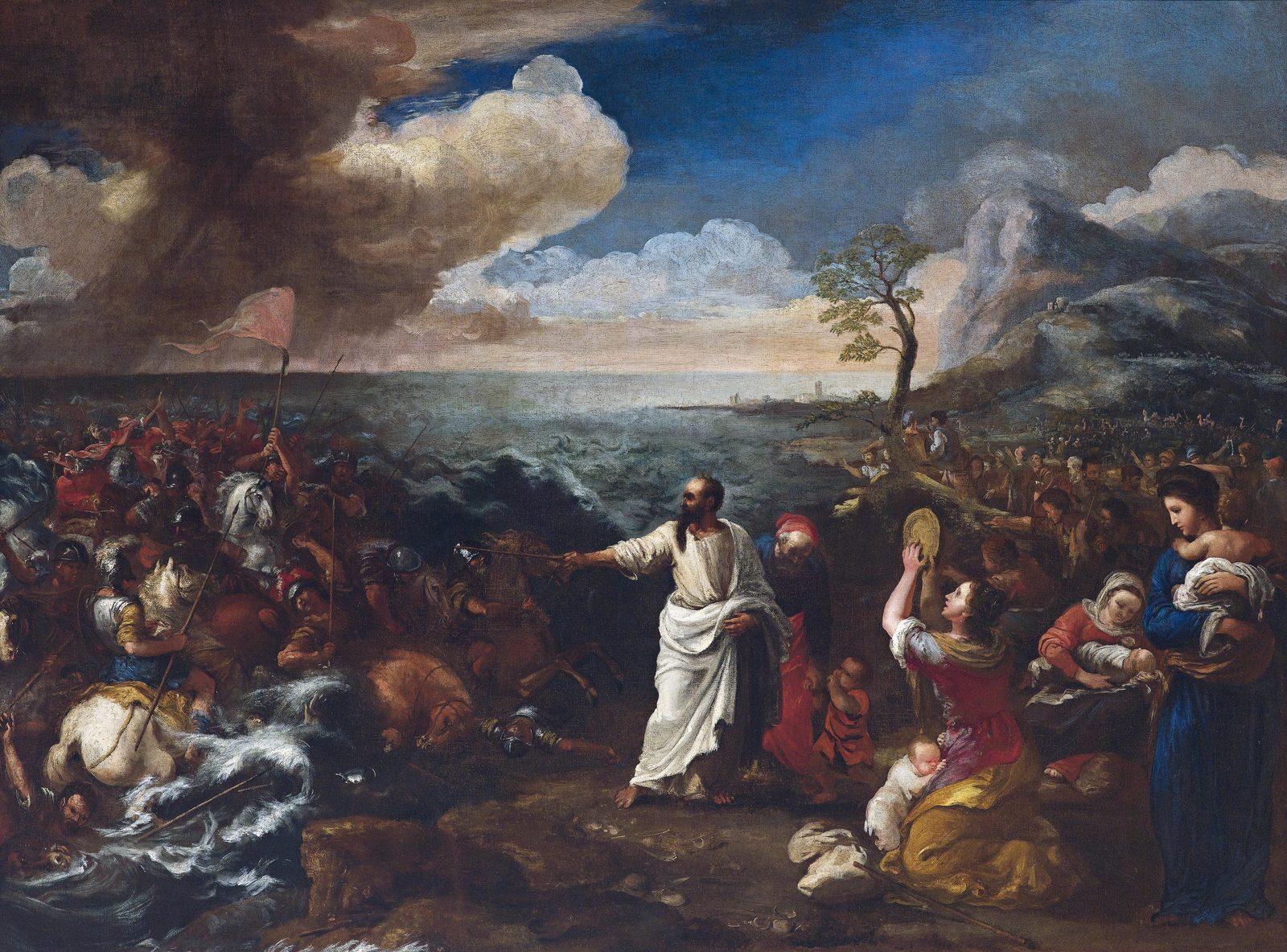
Jacques Courtois, The Crossing of the Red Sea, by 1676. Public domain.
Exodus 6:6 · Symbol · Featured Study
The Arm of the LORD
The words outstretched arm stand in sixteen verses of the Berean text, from Exodus to Ezekiel.
Therefore tell the Israelites: ‘I am the LORD, and I will bring you out from under the yoke of the Egyptians and deliver you from their bondage. I will redeem you with an outstretched arm and with mighty acts of judgment.
- The word
- זְרוֹעַ (zeroa), H2220
- First appears
- Genesis 49:24 “…his bow, and his strong arms were tempered…”
Exodus 6:6 is the first verse in which God promises His outstretched arm.
Summary
In Deuteronomy 33:27 Moses tells Israel that “underneath are the everlasting arms”.
- In Exodus 15:16 Moses and Israel sing that His arm will make the nations still as a stone.
- In 1 Kings 8:42 Solomon prays for the man from far away who hears of His outstretched arm.
- In Acts 13:17 Paul speaks in the synagogue at Pisidian Antioch. He says that God led Israel out with an uplifted arm.
The Promise in Egypt
Exodus 5 tells how Pharaoh took the straw from the brick makers.
In Exodus 5:2 Pharaoh had answered Moses that he did not know the LORD. God's answer to Moses follows in Exodus 6:6, and Exodus 6:9 records that the Israelites did not listen because of their broken spirit. The question here is what the arm of the LORD does in Scripture. The answer is given by the passages where it acts and the words that carry it. What the text leaves unsaid and the readings of Christian teachers complete it.
The Arm Through Scripture
Eight passages in canon order carry the arm from Job 40 to Jeremiah 32.
From Job to Jeremiah's prayer, each passage names the arm of God.
- Job 40:9Do you have an arm like God's?
- Psalm 44:3It was by Your right hand, Your arm, and the light of Your face
- Psalm 89:13Mighty is Your arm; strong is Your hand
- Psalm 98:1His right hand and holy arm have gained Him the victory
- Isaiah 51:9Awake, awake, put on strength, O arm of the LORD
- Isaiah 59:16So His own arm brought salvation
- Jeremiah 27:5By My great power and outstretched arm, I made the earth
- Jeremiah 32:17You have made the heavens and the earth by Your great power and outstretched arm
Each card gives the Berean words of its passage and opens it in the reader.
A Mighty Hand and an Outstretched Arm
Moses gave Israel a set pair of words for the exodus, and later writers kept them.
Deuteronomy uses the words outstretched arm more than any other book.
| Book | Verses | Where the words stand | Who speaks |
|---|---|---|---|
| Exodus | 1 | the promise before the plagues | God to Moses |
| Deuteronomy | 6 | Moses' sermons in the land of Moab | Moses, and the worshipper with the firstfruits |
| 1 Kings | 1 | the dedication of the temple | Solomon in prayer |
| 2 Kings | 1 | the covenant charge, recalled after the fall of Samaria | the narrator recalls the LORD's command |
| 2 Chronicles | 1 | the dedication of the temple, as Chronicles records it | Solomon in prayer |
| Psalms | 1 | Psalm 136 | the psalmist |
| Jeremiah | 3 | the making of the earth, and the exodus remembered in prayer | God, and Jeremiah in prayer |
| Ezekiel | 2 | Israel gathered from the nations for judgment | God speaks to the house of Israel |
Jeremiah, Ezekiel
In Deuteronomy the pair becomes Israel's confession. In Deuteronomy 5:15 it is the reason given for keeping the Sabbath. In Deuteronomy 7:19 it is Moses' answer to a people afraid of the nations ahead of them.
The pair turned against Judah, and Israel gathered for judgmentJeremiah 21:5 and Ezekiel 20:33 to 34
Zedekiah had sent to ask whether the LORD would perform for them something like all His past wonders, in Jeremiah 21:2.
And I Myself will fight against you with an outstretched hand and a mighty arm, with anger, fury, and great wrath.It stands here because the adjectives of the exodus pair trade places in it, an outstretched hand and a mighty arm. In Jeremiah 21:5 that arm fights against Jerusalem.
Ezekiel 20:30 to 34 is said to the house of Israel.
As surely as I live, declares the Lord GOD, with a strong hand, an outstretched arm, and outpoured wrath I will rule over you. With a strong hand, an outstretched arm, and outpoured wrath I will bring you out from the peoples and gather you from the lands to which you have been scattered.It stands here because Ezekiel turns the exodus pair toward judgment on Israel itself.
To Whom Has the Arm Been Revealed?
Isaiah 52 and 53 move from the bared arm to the servant whom few believed.
Isaiah 52:10 says the LORD has bared His holy arm in the sight of all the nations. Three verses later the Servant passage of Isaiah 52:13 to 53:12 opens. The next chapter opens with Isaiah's question about believing.
Who has believed our message? And to whom has the arm of the LORD been revealed?Isaiah asks the question before he describes the servant who grew up like a tender shoot.
Although Jesus had performed so many signs in their presence, they still did not believe in Him.John 12:38 calls this unbelief the fulfilment of Isaiah 53:1.
The Words for Arm and Stretching Out
Three words carry the picture in Hebrew and Greek, as Strong's concordance defines them.
zeroa
91 uses in the canon
The word means the arm as stretched out, or the foreleg of an animal, and figuratively force.
natah
214 uses in the canon
The verb means to stretch or spread out, and it stands behind the word outstretched.
brachion
3 uses in the canon
The word means the arm, and figuratively strength. It stands in Mary's song, in John's quotation of Isaiah and in the sermon of Acts 13.
What the Text Leaves Unsaid
At the sea Moses stretches out his hand over the water, as Exodus 14:16, Exodus 14:21 and Exodus 14:27 record.
Exodus names the arm in the promise and in the song, and nowhere between them.
| What the text states | What it leaves unsaid |
|---|---|
| Exodus 6:6 promises redemption with an outstretched arm. | Exodus 7 to 14 never names the arm in the plagues or at the sea. |
The Arm That Gathers the Lambs
The herald's news in Isaiah 40:9 is followed by the arm at work.
Behold, the Lord GOD comes with might, and His arm establishes His rule. His reward is with Him, and His recompense accompanies Him.It stands here because it gives the arm its first work, to rule.
He tends His flock like a shepherd; He gathers the lambs in His arms and carries them close to His heart. He gently leads the nursing ewes.It stands here because it gives the same arm its second work, to carry.
Readings of the Arm
Christian teachers read the arm as the Messiah himself or as God's power at work.
The arm is the Messiah in personJohn Gill
John Gill, the Baptist commentator, writes on Psalm 77:15 in his Exposition of the Old Testament, published from 1748 to 1763. Where the Berean text of Psalm 77:15 reads With power, the Hebrew has zeroa. On that verse Gill reads the redemption from Egypt as a type of the redemption by Christ, the arm and power of God.
The arm is a figure of God's strengthAlbert Barnes; John Wesley
Albert Barnes, in his Notes, Explanatory and Practical, published from 1832 to 1869, writes on Luke 1:51 that the arm is the symbol of strength. John Wesley published his Explanatory Notes upon the New Testament in 1755. In them he reads the arm in John 12:38 as God's power shown by Christ in His preaching, miracles and redemption.
The objection is that Isaiah 53:1 asks to whom the arm has been revealed and then describes a man who was despised and rejected.
Matthew Henry gives both readingsMatthew Henry
Matthew Henry, the Presbyterian commentator, writes on Isaiah 51:9 in his Commentary on the Whole Bible. There he says that the arm of the Lord is Christ, or it is put for God himself.
Books to Read Next
Each book gives in full one of the readings of the arm.
Exposition of the Old Testament
John Gill · 1748 to 1763
Read its note on Psalm 77:15 for Gill's reading of the arm as Christ in his own words.
Explanatory Notes upon the New Testament
John Wesley · 1755
Read its note on John 12:38 for Wesley's reading of the arm as God's power in Christ in his own words.
Notes, Explanatory and Practical
Albert Barnes · 1832 to 1869
Read its note on Luke 1:51 for Barnes's reading of the arm as strength in his own words.
Mighty Deeds With His Arm
The New Testament first names God's arm in the song Mary sang before the birth of her Son.
He has performed mighty deeds with His arm; He has scattered those who are proud in the thoughts of their hearts.It stands here because, as in Psalm 89:10, God's arm scatters, and here it scatters the proud.
Sources
Scripture is the Berean Standard Bible.
- James Strong, Exhaustive Concordance of the Bible, 1890, entries H2220, H5186 and G1023.
- John Gill, Exposition of the Old Testament, 1748 to 1763, on Psalm 77:15.
- Albert Barnes, Notes, Explanatory and Practical, on the Old and New Testaments, 1832 to 1869, on Luke 1:51.
- John Wesley, Explanatory Notes upon the New Testament, 1755, on John 12:38.
- Matthew Henry, Commentary on the Whole Bible, 1706 to 1721, Volume IV (Isaiah to Malachi), on Isaiah 51:9.
Keep Studying
People and groups5
Places1
Symbols7
Doctrines5