
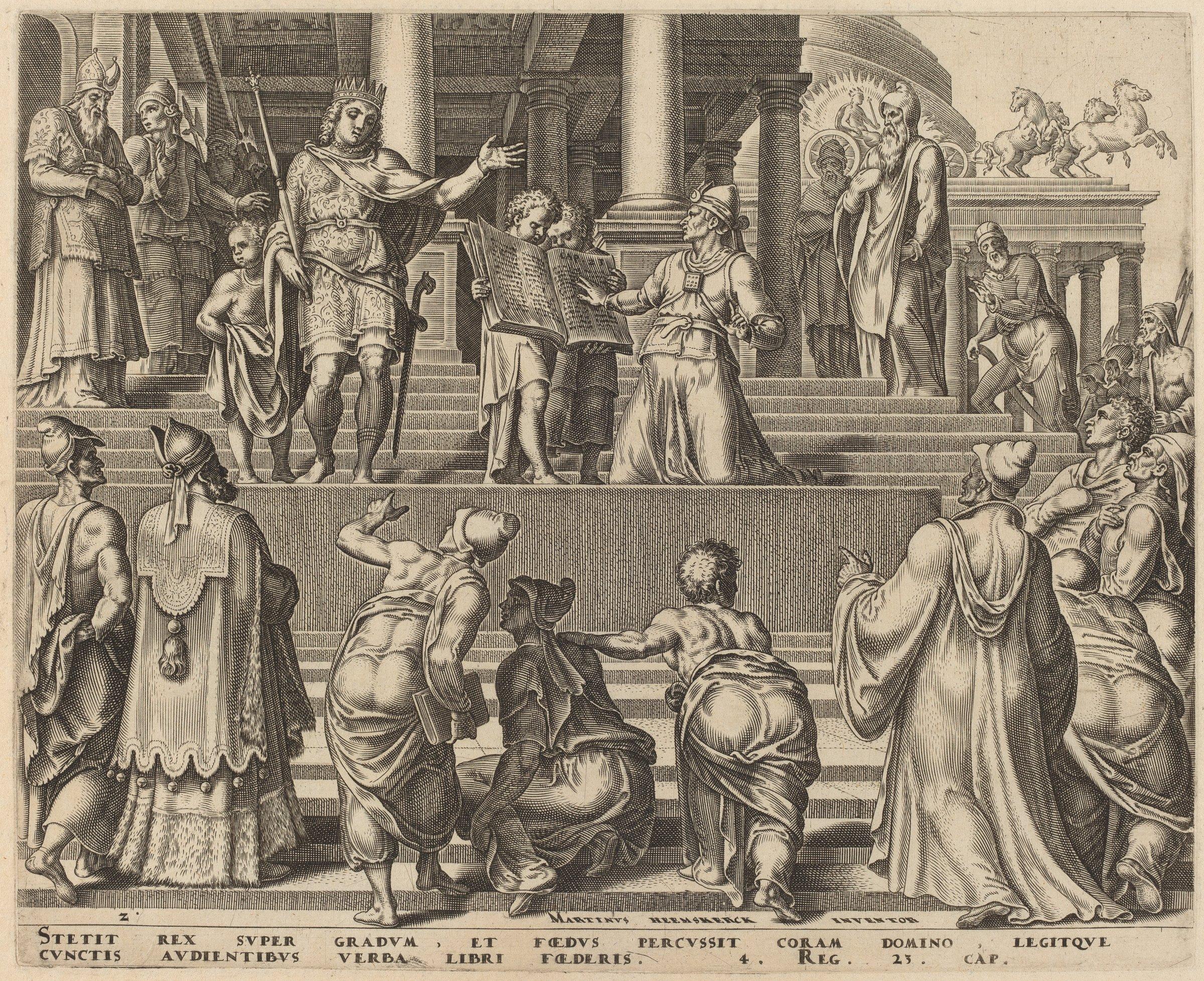
Philip Galle after Maerten van Heemskerck, about 1569. Public domain.
Nehemiah 8 · Subject · Featured Study
The Public Reading of the Law
Scripture records the Law read aloud to the gathered people from Moses at Sinai to Ezra at the Water Gate.
Ezra opened the book in full view of all the people, since he was standing above them all, and as he opened it, all the people stood up.
- Books
- Nehemiah, Deuteronomy, Joshua, 2 Kings, Acts, 1 Timothy
- Hold in memory
- Nehemiah 8:6, Deuteronomy 31:12, 1 Timothy 4:13
Paul charged a church before the Lord to have his letter read to every one of its members.
Summary
Moses told the priests to read the Law to all Israel every seven years. Joshua, Josiah and Ezra each read it to the people. By the first century it was read in the synagogues every Sabbath.
- A stone from Jerusalem names a synagogue built for the reading.
- Three Hebrew words carry the teaching of the reading.
- Readers differ on what the Levites did as Ezra read.
The Reading at the Water Gate
Nehemiah 8 tells how the Law was read and explained on the first day of the seventh month.
After Ezra's blessing the people answered Amen with uplifted hands and bowed with their faces to the ground.
So Ezra read it aloud from daybreak until noon as he faced the square before the Water Gate, in front of the men and women and those who could understand. And all the people listened attentively to the Book of the Law.The whole assembly listened through the morning.
The Law Read Aloud in Scripture
Eleven readings run from Sinai to the churches of Paul.
From Moses to the apostles, the written word was read aloud to gathered hearers.
| Reader | What was read | Who heard |
|---|---|---|
| Moses | The Book of the Covenant | The people at Sinai |
| The priests, by Moses' command | This law, every seven years at Tabernacles | All Israel |
| Joshua | All the words of the law, the blessings and the curses | The whole assembly, women, little ones and foreigners |
| Josiah | The Book of the Covenant found in the temple | All the people, small and great |
| Baruch | The words of Jeremiah from the scroll | All the people at the house of the LORD |
| Ezra | The Book of the Law of Moses | Men, women and all who could understand |
| Not named | The Book of Moses | The people |
| Jesus | The scroll of Isaiah | The synagogue at Nazareth |
| The synagogue readers | The Law and the Prophets | The synagogue at Pisidian Antioch |
| The church at Colossae | Paul's letter, then the letter from Laodicea | The Colossian and Laodicean churches |
| Not named, by Paul's charge | Paul's letter | All the brothers |
Not named, Jesus, The synagogue readers, The church at Colossae, Not named, by Paul's charge
Read in the Synagogues
Acts names the Law and the Prophets read every Sabbath.
For Moses has been proclaimed in every city from ancient times and is read in the synagogues on every Sabbath.”James gave it as the reason for his counsel to the Gentile believers.
After the reading from the Law and the Prophets, the synagogue leaders sent word to them: “Brothers, if you have a word of encouragement for the people, please speak.”The sermon at Pisidian Antioch followed the reading.
But their minds were closed. For to this day the same veil remains at the reading of the old covenant. It has not been lifted, because only in Christ can it be removed. And even to this day when Moses is read, a veil covers their hearts.Paul names the reading of Moses as the practice of his own day.
A Synagogue Built for the Reading
A Greek inscription from Jerusalem names the purpose of a synagogue.
Raymond Weill's report of his digging in Jerusalem in 1913 and 1914 publishes a stone that names a synagogue built by Theodotus.
Weill, whose report appeared in 1920, translated its purpose as the reading of the Law and the teaching of the commandments, and he dated it to the first century AD. The same inscription names rooms and water for guests from abroad.
Three Words of the Reading
Parash, sekel and bin stand side by side in the account of the reading.
parash (Hebrew, H6567)
To separate or to specify. The STEP Bible lexicon of Tyndale House counts it five times, and its form in this verse, meforash, is glossed making clear.
sekel (Hebrew, H7922)
Intelligence, rendered sense and understanding in the King James. It stands sixteen times, and here it is the sense the Levites gave.
bin (Hebrew, H995)
To discern or understand. The account uses it of the Levites causing the people to understand, and of the people who understood.
What the Text Leaves Unsaid
Nehemiah 8 leaves three things about the reading unsaid.
Nehemiah 8 calls the book the Book of the Law of Moses and names no part of it, apart from the feast of booths found on the second day.
It names no language for the reading or for the Levites' teaching.
It gives no year for the reading, so it leaves open whether this was the seventh year that Deuteronomy 31:10 names.
Blessed Is the One Who Reads
The last book of Scripture opens with a blessing on reading aloud.
Blessed is the one who reads aloud the words of this prophecy, and blessed are those who hear and obey what is written in it, because the time is near.The blessing assumes churches that heard Scripture read aloud.
Voices on the Reading
Matthew Henry's Commentary on the Whole Bible appeared in 1710.
Matthew Henry (1662 to 1714)
Commentary on the Whole Bible
The people's weeping in Nehemiah 8:9 drew this comment.
“The masters of the assembly endeavoured to pacify them and encourage them. Now Nehemiah is brought in, and not before, in this chapter; he took notice of the people's weeping. Ezra was pleased to see them so affected with the word, but Nehemiah observed to him, and Ezra concurred in the thought, that it was now unseasonable.”
on Nehemiah 8:9Puritan
About this saying
What Did the Levites Do as Ezra Read?
Readers differ on whether the Levites translated what Ezra read or repeated it aloud.
They translated it into AramaicThe Babylonian Talmud, Nedarim 37b
The Babylonian Talmud takes the clauses of the verse in turn. It reads the first as the Aramaic translation, the second as the division into verses, and the third as the cantillation notes.
Against this reading, L. W. Batten notes that it assumes most hearers no longer understood Hebrew, a loss he places later than Ezra's day.
They repeated it aloud for the crowdL. W. Batten
L. W. Batten holds that Ezra alone was the reader. As one sense of the verse, he offers that the Levites repeated each sentence with a loud voice so that the whole assembly could hear.
Against this reading, the Talmud takes the same word as the Aramaic translation.
The readings of C. F. Keil and John Wesley are set out in the study of the return.
Books to Read Next
Both works are in the public domain, and each has a free copy to read.
A Critical and Exegetical Commentary on the Books of Ezra and Nehemiah
L. W. Batten · 1913
Batten sets out the possible senses of the Levites' work on pages 356 and 357.
Read at the Internet ArchiveLa Cité de David
Raymond Weill · 1920
Weill publishes the Theodotus inscription with its Greek text and a French translation on page 186.
Read at the Internet ArchiveDevote Yourself to the Reading
Until I come, devote yourself to the public reading of Scripture, to exhortation, and to teaching.In the synagogue of Acts 13:15 the word of encouragement also followed the reading.
Sources
Scripture is the Berean Standard Bible.
- The site's lexicon, STEP Bible TBESH glosses (Tyndale House, CC BY 4.0), entries H6567, H7922 and H995.
- The site's word-by-word Hebrew of Nehemiah 8:7 to 8, with Strong's numbers and glosses.
- Babylonian Talmud, Nedarim 37b and Megillah 3a, William Davidson Edition (English), Koren, CC-BY-NC.
- L. W. Batten, A Critical and Exegetical Commentary on the Books of Ezra and Nehemiah, International Critical Commentary, 1913, pp. 356 to 357.
- Raymond Weill, La Cité de David, Paul Geuthner, 1920, p. 186.
- Matthew Henry, Commentary on the Whole Bible, on Nehemiah 8:9.
Keep Studying
Read it4
Studies5
People and groups6
Places1
Church history2
Go further1