
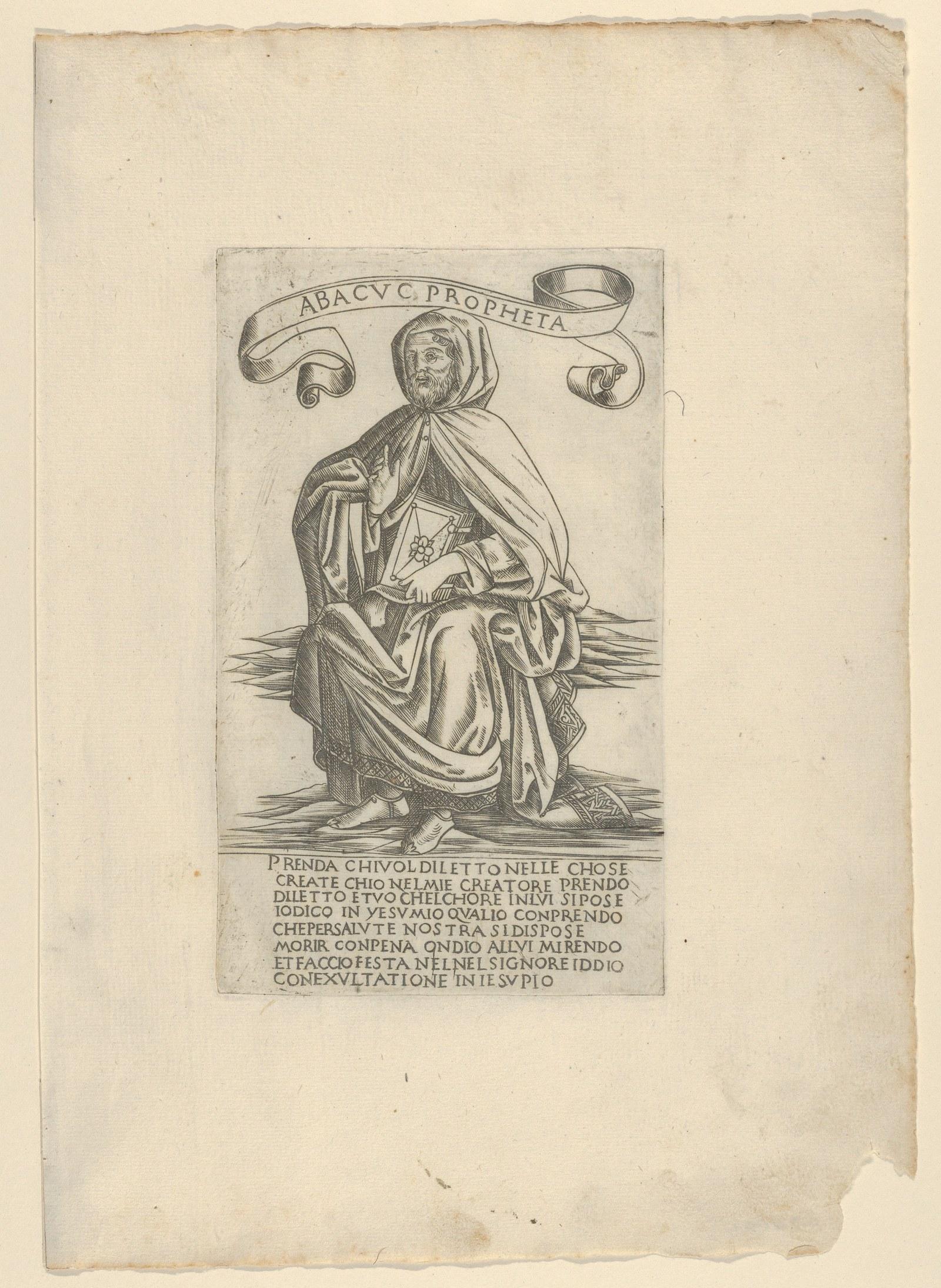
Francesco Rosselli or Baccio Baldini, The Prophet Habakkuk, 1480 to 1490. CC0.
Habakkuk 3:16 to 19 · Subject · Featured Study
Joy Without Harvest
The book of Habakkuk closes with a song for a year when the fields and the folds stand empty.
Five of the six losses Habakkuk names already stood among the curses of Deuteronomy 28.
yet I will exult in the LORD; I will rejoice in the God of my salvation!
yet I will exult in the LORD; I will rejoice in the God of my salvation!
- Book
- Habakkuk
- Hold in memory
- Habakkuk 3:18
Summary
Habakkuk shakes at what is coming in Habakkuk 3:16. He then pictures a farm with no crop and no herd, and still says he will be glad in the LORD.
- Joel 1 mourns the loss of grain, wine, oil and fig, and says the joy of mankind has dried up.
- Hannah also rejoiced in the LORD's salvation when she prayed in First Samuel 2:1.
- Psalm 73 says the flesh and the heart may fail while God stays the strength of the heart.
The Close of the Prayer
Habakkuk 3:16 to 19 stand here in the Berean text.
I heard and trembled within; my lips quivered at the sound. Decay entered my bones; I trembled where I stood. Yet I must wait patiently for the day of distress to come upon the people who invade us.The prophet's fear stands first, so the joy two verses on is spoken by a man who is still afraid.
Though the fig tree does not bud and no fruit is on the vines, though the olive crop fails and the fields produce no food, though the sheep are cut off from the fold and no cattle are in the stalls,This verse stands between the fear and the joy, so the joy is spoken only after the losses are counted.
GOD the Lord is my strength; He makes my feet like those of a deer; He makes me walk upon the heights! For the choirmaster. With stringed instruments.The fear of Habakkuk 3:16 needed an answer, and this verse gives it in a strength that does not hang on the harvest.
How the Prayer Moves
The prayer of Habakkuk 3 has eight parts, from its title to its last line.
The prayer turns at Habakkuk 3:16 from the vision of God to the prophet's own answer.
Only the heading and the last line stand outside the prophet's own words.
Six Losses on One Farm
Habakkuk 3:17 names six things a farm of Judah lived on.
Every source of food and drink on the farm fails in one verse.
| The loss in Habakkuk 3:17 | What it gave, in the words of another verse | Where those words stand |
|---|---|---|
| The fig tree | my sweetness and my good fruit | Judges 9:11, the fig tree's words in the fable Jotham told the leaders of Shechem |
| The vines | my wine that cheers both God and man | Judges 9:13, the grapevine's words in the same fable |
| The olive crop | my oil that honors both God and man | Judges 9:9, the olive tree's words in the same fable |
| The fields | bread that sustains his heart | Psalm 104:15, among the gifts the psalm says God brings from the earth |
| The sheep in the fold | the lambs of your flocks | Deuteronomy 28:4, among the blessings Moses set before Israel |
| The cattle in the stalls | the calves of your herds | Deuteronomy 28:4, in the same blessing as the flocks |
The losses the Law had namedDeuteronomy 28:18 and Deuteronomy 28:38 to 40
The fruit of your womb will be cursed, as well as the produce of your land, the calves of your herds, and the lambs of your flocks.Moses names the herds and the flocks among the curses on a people who turn from the LORD.
You will sow much seed in the field but harvest little, because the locusts will consume it. You will plant and cultivate vineyards, but will neither drink the wine nor gather the grapes, because worms will eat them. You will have olive trees throughout your territory but will never anoint yourself with oil, because the olives will drop off.The same chapter adds the field, the vineyard and the olive trees, the other three losses of Habakkuk 3:17 that the Law had named.
Marks of a Song in a Prophet's Book
Habakkuk 3 carries a title, a mark of pause and a note to the choirmaster, as a psalm does.
The title names the kind of song with the word Shigionoth. Strong's lexicon, the numbered dictionary of the Bible's Hebrew and Greek words, glosses it as a rambling poem.
Selah, which Strong's glosses as a pause in the music, stands in Habakkuk 3:3, Habakkuk 3:9 and Habakkuk 3:13. Outside the book of Psalms, these three verses are the only places the word stands.
The last line of the prayer gives the song to the choirmaster, the one who led the music of the temple, and asks for stringed instruments.
The Hebrew of Habakkuk 3:18 to 19
Two of the four words name joy, one names salvation and one names the deer.
עָלַז alaz
16 uses in the canon
to exult, the verb of I will exult; Strong's glosses it as to jump for joy
גִּיל gil
45 uses in the canon
to rejoice, the verb of I will rejoice; Strong's says it means properly to spin round under a strong feeling
יֶשַׁע yesha
36 uses in the canon
salvation or deliverance, in the God of my salvation
אַיָּלָה ayyalah
10 uses in the canon
a doe or female deer, whose sure feet God gives the prophet
Joy in the God of Salvation
In Habakkuk 3:18 the prophet places his gladness in the LORD Himself.
Matthew Henry, in his Commentary of 1710, explains why the loss of every crop cannot take this joy away.
“This is the principal ground of our joy in God, that he is the God of our salvation, our eternal salvation, the salvation of the soul; and, if he be so, we may rejoice in him as such in our greatest distresses, since by them our salvation cannot be hindered, but may be furthered.”
Matthew Henry · Commentary on the Whole Bible · on Habakkuk 3:18Puritan
The prophet's line on the deer's feet is also David's, in the song that stands both in Psalm 18:33 and in Second Samuel 22:34.
He makes my feet like those of a deer and stations me upon the heights.David sang this line after the LORD delivered him from his enemies, and Habakkuk sings it before his deliverance has come.
Joy as it runs through the whole of Scripture is taught on the joy page, and joy in trial on a page of its own.
Voices on the Closing Song
Jerome and Bede, teachers of the early and medieval church, both read Habakkuk's last verse.
Jerome (died 420)
Jerome, in his Commentary on Habakkuk, renders Habakkuk's last verse with God leading the prophet up to the high places, singing in psalms.
Bede (died 735)
Bede, in his Commentary on the Song of Habakkuk, reads the deer's feet as feet made sure, so that the prophet may triumph in God's glory.
Strength for the Heights
The prayer that began with a plea for mercy in Habakkuk 3:2 ends with the prophet on the heights.
Habakkuk 2 gave the command to wait for the vision, and this song ends the book in joy.
Sources
Scripture is the Berean Standard Bible.
- Matthew Henry, Commentary on the Whole Bible (1710), on Habakkuk 3:18.
- Jerome, Commentary on Habakkuk, on Habakkuk 3:18 to 19.
- Bede, Commentary on the Song of Habakkuk, on Habakkuk 3:19.
Keep Studying
Studies3