

Prophet
Elijah
Tishbite Prophet · Divided Monarchy (North) · c. 900-840 BC
Elijah Taken Up in a Chariot of Fire, Giuseppe Angeli
Summary
Elijah the Tishbite was the prophetic voice against the Baal worship that Ahab and Jezebel established in the northern kingdom (c. 874-853 BC). His contest with the prophets of Baal on Mount Carmel, the fire he called down, his departure in a chariot of fire, and his appearance with Moses at the Transfiguration make him the prophetic pattern beside Moses.
- Elijah walked into the story with no family line and no call scene, and his first recorded sentence told King Ahab that the rain had stopped.
- On Mount Carmel he put one question to the nation, soaked the altar three times over, prayed two sentences, and the fire of the LORD fell.
- The day after the fire he ran from a threat, sat under a broom tree and asked God to take his life, and God sent sleep and bread before any word.
- He said twice that he was the only faithful man left, and both times the text had already told the reader otherwise.
- He did not die. A whirlwind took him, which is why Malachi can promise he will be sent again and why Moses and Elijah stand with Jesus on the mountain.
On this page
Start here
Now Elijah the Tishbite, who was among the settlers of Gilead, said to Ahab, “As surely as the LORD lives—the God of Israel before whom I stand—there will be neither dew nor rain in these years except at my word!”
1 Kings 17:1→- 6 key events in order
- 111 verses name Elijah, across 12 books
In Scripture
- Verses
- 111
- Books
- 12
Elijah
- Role
- Tishbite Prophet
- Era
- Divided Monarchy (North)
- Dates
- c. 900-840 BC
- Tribe
- Gilead (Tishbite)
The life in order
in the order the canon tells it
- He appears in front of Ahab and announces the drought1 Kings 17:1Now Elijah the Tishbite, who was among the settlers of Gilead, said to Ahab, “As surely as the LORD lives—the God of Israel before whom I stand—there will be neither dew nor rain in these years except at my word!”
- Ravens feed him at the Brook of Cherith, morning and evening1 Kings 17:6The ravens would bring him bread and meat in the morning and evening, and he would drink from the brook.
- The widow's jar of flour and jug of oil do not run out at Zarephath1 Kings 17:16The jar of flour was not exhausted and the jug of oil did not run dry, according to the word that the LORD had spoken through Elijah.
- He raises the widow's son, the first raising from the dead in Scripture1 Kings 17:22And the LORD listened to the voice of Elijah, and the child’s life returned to him, and he lived.
- The fire of the LORD falls on Mount Carmel1 Kings 18:38Then the fire of the LORD fell and consumed the sacrifice, the wood, the stones, and the dust, and it licked up the water in the trench.
- After seven trips to the ridge, the rain comes1 Kings 18:45Meanwhile, the sky grew dark with clouds and wind, and a heavy rain began to fall. So Ahab rode away and went to Jezreel.
- Jezebel sends one threat and he runs for his life1 Kings 19:3And Elijah was afraid and ran for his life. When he came to Beersheba in Judah, he left his servant there,
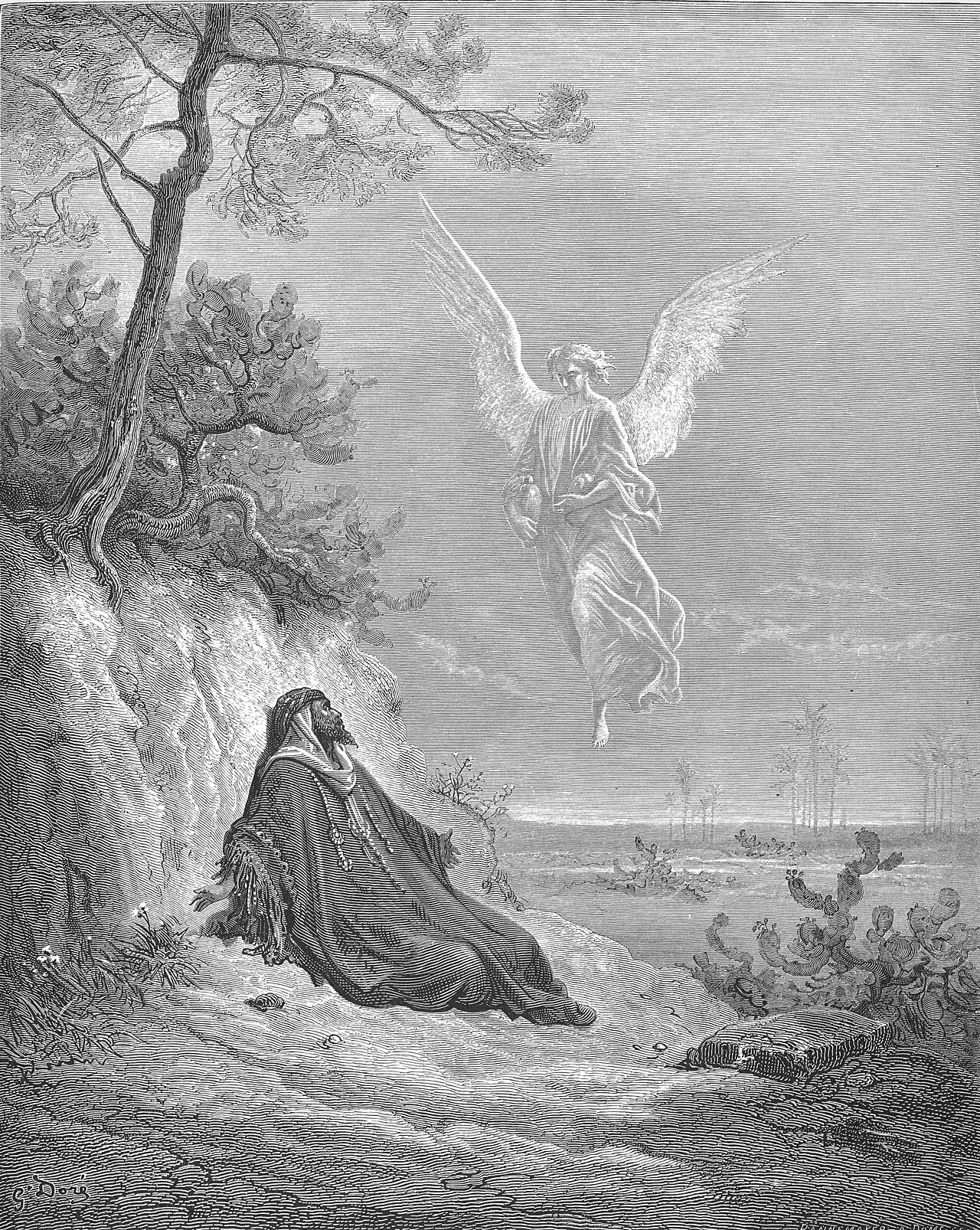
- Under a broom tree in the desert he asks God to take his life1 Kings 19:4while he himself traveled on a day’s journey into the wilderness. He sat down under a broom tree and prayed that he might die. “I have had enough, LORD,” he said. “Take my life, for I am no better than my fathers.”
- Fed twice by an angel, he walks forty days to Horeb1 Kings 19:8So he got up and ate and drank. And strengthened by that food, he walked forty days and forty nights until he reached Horeb, the mountain of God.
- After the wind, the earthquake and the fire comes a still, small voice1 Kings 19:12After the earthquake there was a fire, but the LORD was not in the fire. And after the fire came a still, small voice.
- God corrects him with a number: seven thousand who never bowed to Baal1 Kings 19:18Nevertheless, I have reserved seven thousand in Israel—all whose knees have not bowed to Baal and whose mouths have not kissed him.”
- He throws his cloak around Elisha at the plough1 Kings 19:19So Elijah departed and found Elisha son of Shaphat. He was plowing with twelve teams of oxen, and he was with the twelfth team. Elijah passed by him and threw his cloak around him.
- He meets Ahab in Naboth's stolen vineyard and gives him the sentence1 Kings 21:19Tell him that this is what the LORD says: ‘Have you not murdered a man and seized his land?’ Then tell him that this is also what the LORD says: ‘In the place where the dogs licked up the blood of Naboth, there also the dogs will lick up your blood—yes, yours!’”
- Fire falls on a captain and his fifty, sent to arrest him2 Kings 1:10Elijah answered the captain, “If I am a man of God, may fire come down from heaven and consume you and your fifty men.” And fire came down from heaven and consumed the captain and his fifty men.
- A letter reaches Jehoram of Judah, the one time he wrote instead of came2 Chronicles 21:12Then a letter came to Jehoram from Elijah the prophet, which stated: “This is what the LORD, the God of your father David, says: ‘You have not walked in the ways of your father Jehoshaphat or of Asa king of Judah,
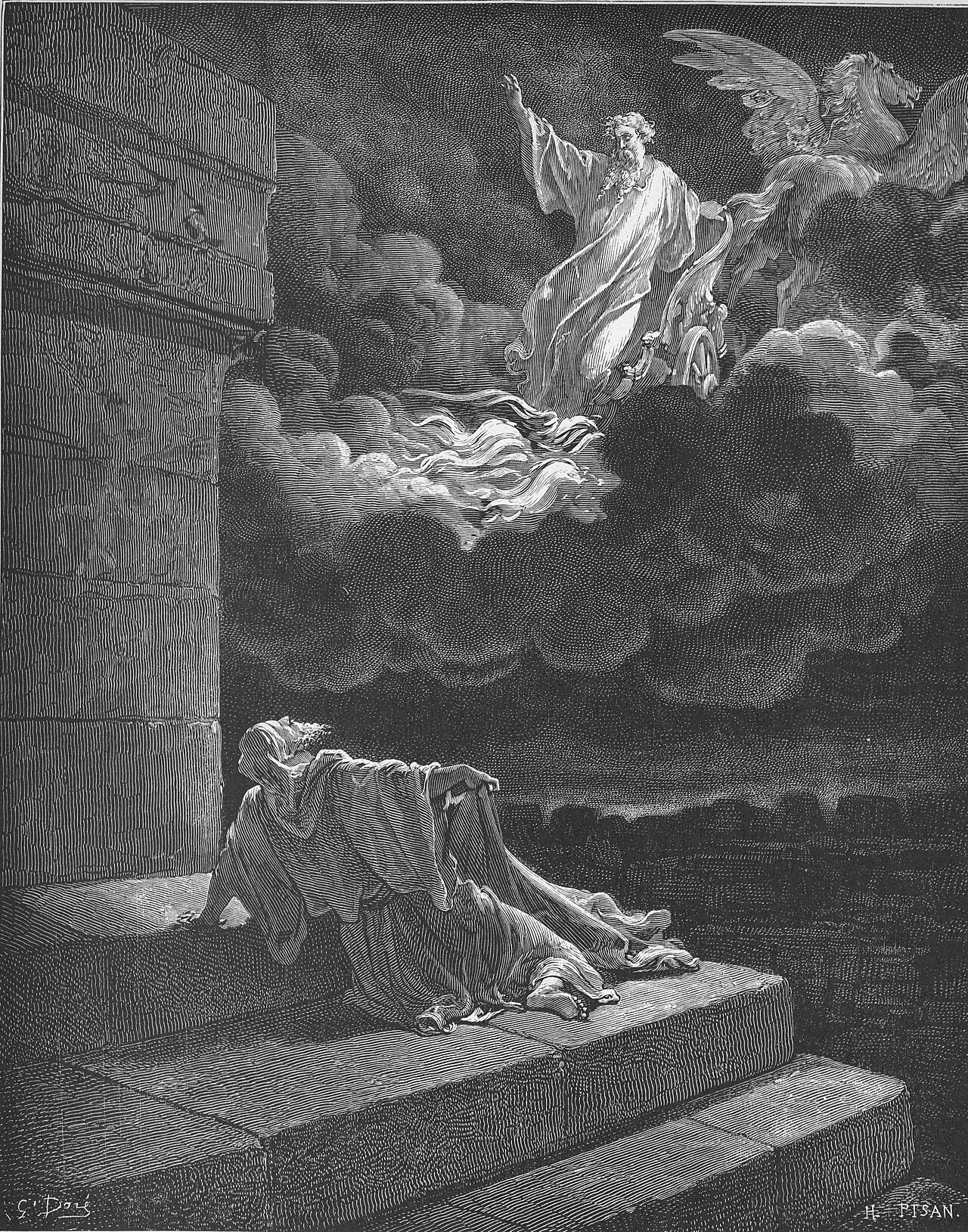
- A chariot of fire separates him from Elisha and a whirlwind takes him up2 Kings 2:11As they were walking along and talking together, suddenly a chariot of fire with horses of fire appeared and separated the two of them, and Elijah went up into heaven in a whirlwind.
- The Old Testament closes with a promise that Elijah will be sent againMalachi 4:5Behold, I will send you Elijah the prophet before the coming of the great and awesome Day of the LORD.
- Jesus says of John the Baptist that he is the Elijah who was to comeMatthew 11:14And if you are willing to accept it, he is the Elijah who was to come.
- Moses and Elijah stand with Jesus on the mountain, talking with HimMatthew 17:3Suddenly Moses and Elijah appeared before them, talking with Jesus.
- James names him as a man just like us, to teach ordinary people to prayJames 5:17Elijah was a man just like us. He prayed earnestly that it would not rain, and it did not rain on the land for three and a half years.
Why Elijah matters
Elijah was a prophet in the northern kingdom of Israel in the second half of the ninth century before Christ. He arrives with no family line, no call scene and no introduction. His first recorded sentence tells the king of Israel that the rain has stopped. The king was Ahab. He had married Jezebel of Sidon, and he had built a temple to Baal in his own capital. Baal was the storm god of that region. Announcing a drought to Ahab was a challenge aimed straight at the god he had just housed. For six chapters Elijah is the one man standing between the house of Ahab and a nation that has changed gods. Ravens bring him bread and meat at a brook that is drying up. A starving widow in Jezebel's own home country feeds him from a jar of flour that never empties, and when her son dies Elijah raises him, which is the first raising from the dead recorded in Scripture. On Mount Carmel he asks the nation one question, soaks an altar until the trench around it fills, prays two sentences, and the fire falls. The day after Carmel he ran for his life. One woman sent one threat, and the man who had faced four hundred and fifty prophets sat down in the desert and asked God to kill him. The text puts the triumph and the collapse back to back and offers no transition between them. What heaven sends is sleep, then food, then food again, then a question, and only then a job. He was wrong about one thing and he said it twice. He told God he was the only one left. The reader already knows better, because the narrator had said six verses earlier that a palace steward named Obadiah hid a hundred prophets in caves and fed them. God does not argue. He gives a number: seven thousand knees that never bowed. He did not die. A chariot of fire separated him from Elisha, a whirlwind took him up, and the cloak he dropped fell on the man who took his place. Fifty men searched for three days and found nothing, and no burial is recorded anywhere in Scripture. Because he was taken rather than buried, Malachi can close the Old Testament by promising that Elijah will be sent again, and the New Testament names him more often than any prophet except Moses.
Biography
Elijah appeared abruptly in 1 Kings 17 announcing a three-year drought. Fed by ravens at the brook Cherith, then sustained by a widow's barrel of meal that did not run out, Elijah emerged from obscurity to challenge Baal-worship at its peak. The confrontation on Mount Carmel (1 Kings 18) is the canonical set-piece: Elijah alone against 450 prophets of Baal, the fire of YHWH falling, the people declaring "the LORD, he is God!" Immediately after, Jezebel threatened his life; Elijah fled to Horeb, despondent, wishing to die. There God met him not in wind, earthquake, or fire, but in a "still small voice" (1 Kgs 19:12) — one of the most tender theophanies in Scripture. He was sent back with fresh commissions. Elijah's final departure was unique in the Hebrew Bible: he did not die but was taken up into heaven in a whirlwind, with a chariot of fire (2 Kgs 2). His mantle fell on Elisha. Malachi 4:5-6 foretells Elijah's return before the great day of the LORD; John the Baptist is identified as fulfilling this role (Matt 11:14; 17:12). Elijah's appearance with Moses at Jesus's transfiguration (Matt 17:3) represents the witness of the Prophets alongside the Law to Christ's glory.
Now Elijah the Tishbite, who was among the settlers of Gilead, said to Ahab, “As surely as the LORD lives—the God of Israel before whom I stand—there will be neither dew nor rain in these years except at my word!”
Carmel, and the God who answers by fire
1 Kings 18, in the order the chapter tells it
- One question, and nobody answers it1 Kings 18:21Then Elijah approached all the people and said, “How long will you waver between two opinions? If the LORD is God, follow Him. But if Baal is God, follow him.” But the people did not answer a word.
- The terms: the God who answers by fire1 Kings 18:24Then you may call on the name of your god, and I will call on the name of the LORD. The God who answers by fire, He is God.” And all the people answered, “What you say is good.”
- He repairs an altar that was already there1 Kings 18:30Then Elijah said to all the people, “Come near to me.” So all the people approached him, and he repaired the altar of the LORD that had been torn down.
- Twelve stones for twelve tribes1 Kings 18:31And Elijah took twelve stones, one for each tribe of the sons of Jacob, to whom the word of the LORD had come and said, “Israel shall be your name.”
- Two sentences at the evening sacrifice1 Kings 18:36-37At the time of the evening sacrifice, Elijah the prophet approached the altar and said, “O LORD, God of Abraham, Isaac, and Israel, let it be known this day that You are God in Israel and that I am Your servant and have done all these things at Your command. Answer me, O LORD! Answer me, so that this people will know that You, the LORD, are God, and that You have turned their hearts back again.”
- The fire falls, and it licks up the water1 Kings 18:38Then the fire of the LORD fell and consumed the sacrifice, the wood, the stones, and the dust, and it licked up the water in the trench.
- The people fall on their faces1 Kings 18:39When all the people saw this, they fell facedown and said, “The LORD, He is God! The LORD, He is God!”
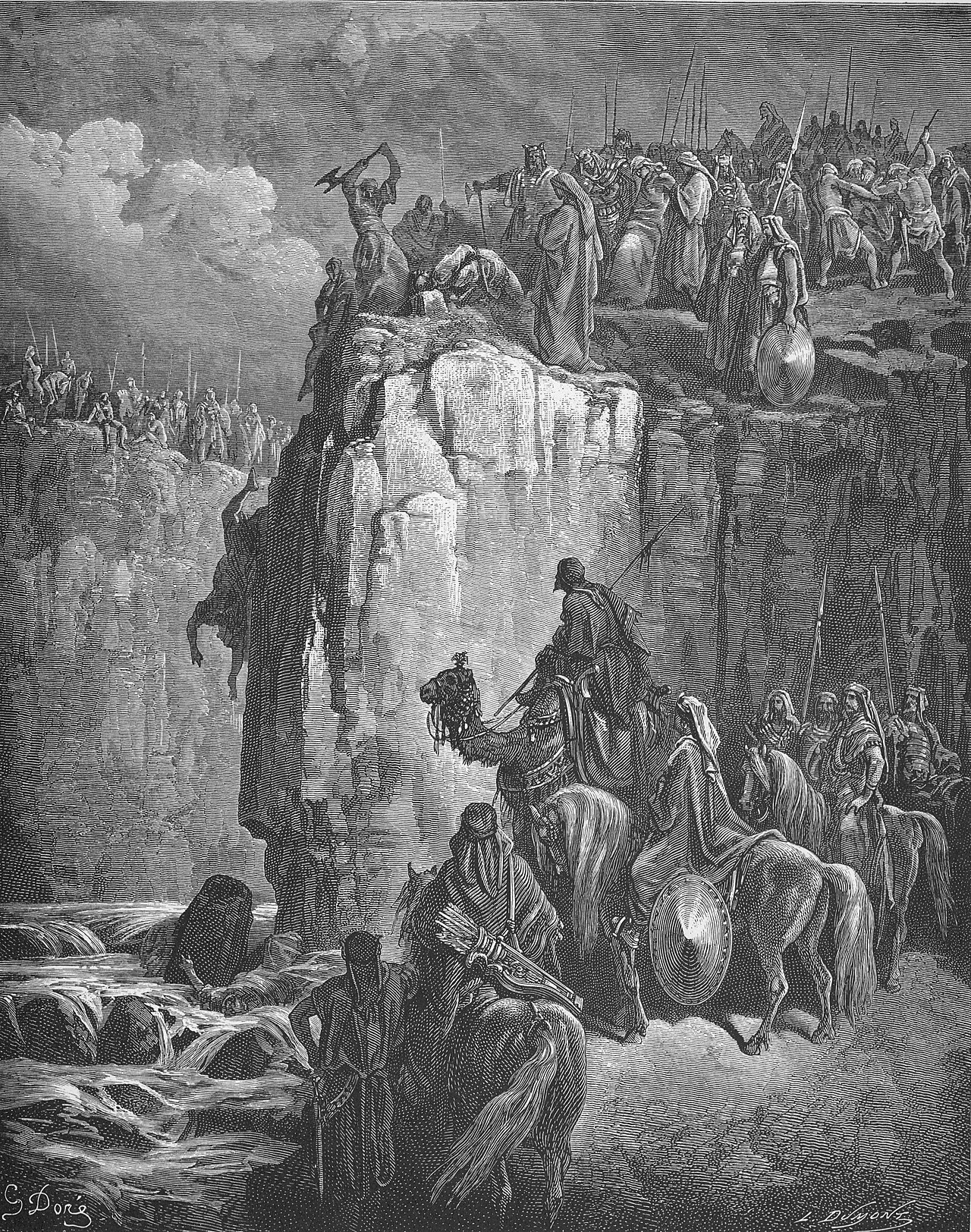
- The prophets of Baal are taken down to the Kishon1 Kings 18:40Then Elijah ordered them, “Seize the prophets of Baal! Do not let a single one escape.” So they seized them, and Elijah brought them down to the Kishon Valley and slaughtered them there.
- He climbs the summit and puts his face between his knees1 Kings 18:42So Ahab went up to eat and drink. But Elijah climbed to the summit of Carmel, bent down on the ground, and put his face between his knees.
- A cloud the size of a man's hand1 Kings 18:44On the seventh time the servant reported, “There is a cloud as small as a man’s hand rising from the sea.” And Elijah replied, “Go and tell Ahab, ‘Prepare your chariot and go down before the rain stops you.’”
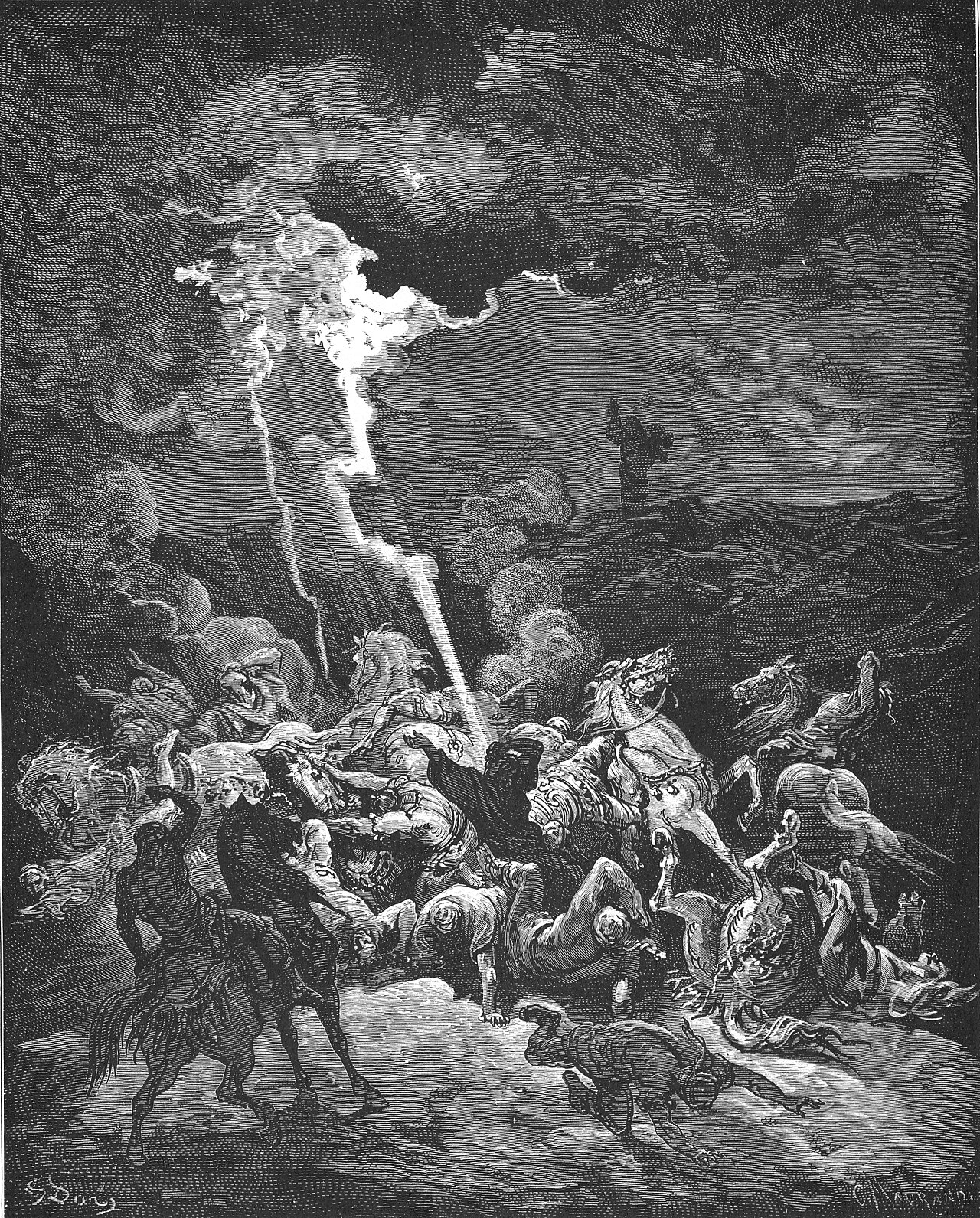
The chapter does not end at the fire. Six verses run past it, and the rain is the answer to the drought Elijah announced in chapter 17. Two details the retelling usually drops. At noon he taunted the prophets of Baal and told them to shout louder in case their god was asleep. And the altar he used was not new: he repaired one that had been torn down, and he built it with twelve stones for twelve tribes at a time when the kingdom had been split in two for two generations. Ahab summoned four hundred and fifty prophets of Baal and four hundred prophets of Asherah, but only the prophets of Baal took the challenge and only they were seized. The mountain has its own page, which carries the ridge, the contest and the rain in full. No engraving of the fire falling on Carmel exists anywhere in this site's holdings. Doré engraved the aftermath at the Kishon instead, so the one image a reader most expects is not on the wall below.
Elijah at Carmel: the full studyKey events
- 1Announces three-year drought
c. 870 BCE
- 2Fed by ravens; sustains widow of Zarephath
c. 867
- 3Mount Carmel contest with prophets of Baal
c. 866
- 4Still small voice at Horeb
c. 865
- 5Anoints Elisha
c. 850
- 6Taken up in whirlwind
c. 848
More key verses
Text: Berean Standard Bible.
“Then Elijah approached all the people and said, “How long will you waver between two opinions? If the LORD is God, follow Him. But if Baal is God, follow him.” But the people did not answer a word.”
“After the earthquake there was a fire, but the LORD was not in the fire. And after the fire came a still, small voice.”
“As they were walking along and talking together, suddenly a chariot of fire with horses of fire appeared and separated the two of them, and Elijah went up into heaven in a whirlwind.”
“Elijah was a man just like us. He prayed earnestly that it would not rain, and it did not rain on the land for three and a half years.”
What they got right, and what they got wrong
Strengths
Boldness against royal evil; trust in YHWH's provision; capacity for silence and solitude alongside dramatic public action.
Weaknesses
Despair at Horeb; overestimated his own isolation ("I, even I only, am left") — YHWH corrected him by revealing the 7,000 who had not bowed to Baal.
Lessons
One person with God is a majority. Prophetic exhaustion is real and is met with gentleness (the still small voice). Faithfulness finds its successor (Elisha). The greatest prophet is not the loudest.
Spiritual significance
Elijah is the prophet of national covenant confrontation — the one who stands against royal apostasy alone. His still-small-voice experience dignifies prophetic exhaustion. His non-death ascension makes him the eschatological forerunner of Christ (via John the Baptist).
How Elijah points to Jesus
The New Testament's own use of Elijah is as a forerunner, and that reading is not imposed on the text from outside. Malachi closes the Old Testament by promising that God will send Elijah before the great and awesome Day of the LORD. Gabriel tells Zechariah that his son will go before the Lord "in the spirit and power of Elijah" and quotes Malachi's own words back to him (Luke 1:17). Jesus says of John, "he is the Elijah who was to come" (Matthew 11:14), and later, "Elijah has already come, and they did not recognize him" (Matthew 17:12), and Matthew records that the disciples understood He was speaking about John. Scripture puts a second half beside that one, and both halves stand. Asked directly whether he was Elijah, John answered "I am not" (John 1:21). From its earliest centuries the church read the identification as one of office and spirit rather than of person, and said so against the idea that a soul had come back into another body. Gregory the Great settled it in one sentence in the sixth century: John was Elijah in spirit and he was not Elijah in person, so what the Lord declares about the spirit, John denies about the person. Origen had already drawn the distinction Luke 1:17 itself draws, that the angel said spirit and power and did not say mind. The resemblance a reader can check for himself is in the clothing. 2 Kings 1:8 describes a hairy man with a leather belt around his waist, and Matthew 3:4 describes John in camel's hair with a leather belt around his waist. Bede listed the parallels in the eighth century and added the one that lands hardest: both men were hunted by a king and his queen. On the mountain of the transfiguration, Moses and Elijah stand with Jesus, and Luke alone reports what they were talking about, "His departure, which He was about to accomplish at Jerusalem" (Luke 9:31). Malachi's last chapter had named the same two men in the same order, the law of Moses at 4:4 and Elijah at 4:5. John Chrysostom's fourth-century answer to why these two and no others is concrete: both had stood up to a king on behalf of an ungrateful people, both were plain men, and neither owned anything, Moses possessing nothing and Elijah nothing but his sheepskin. Augustine of Hippo read the voice from the cloud as the point of the whole scene, noticing that it did not say these are my beloved sons, because only one is the Son and the others are adopted. The passage gives its own last word at Matthew 17:8, "And when they looked up, they saw no one except Jesus." Which mountain it was is not stated in Scripture. Tabor carries a fourth-century tradition and Hermon is argued from its nearness to Caesarea Philippi, and this page names both and settles neither. Elijah went up and did not die, and the church has long read that as a figure of the ascension of Christ. John Wesley wrote that by translating him God gave, in a dark and degenerate age, a very sensible proof of another life, together with a type of the ascension of Christ and the opening of the kingdom of heaven to all believers. Albert Barnes is blunt about the ground the figure stands on: "No honest exegesis can explain this passage in any other sense than as teaching the translation of Elijah, who was taken from the earth, like Enoch Gen 5:24, without dying." The difference matters and this page states it plainly. Elijah was taken. Christ ascended in His own right, having died and risen first. Two of Elijah's miracles are picked up in the Gospels. Jesus took the widow of Zarephath into the synagogue at Nazareth and said that Elijah was sent past every widow in Israel to a Sidonian one, and the congregation tried to throw Him off a cliff for saying it (Luke 4:25-29). His point was that God's mercy in Elijah's day reached past Israel's borders. It was never that Israel had been set aside, and the next place the New Testament quotes Elijah says so in Paul's own words. At the gate of Nain, Luke has Jesus meet the funeral of a widow's only son and closes the account with the same clause 1 Kings 17:23 closes on, that He gave him back to his mother. The echo is deliberate and so is the difference. Elijah stretched himself over the child three times and pleaded; Jesus touched the coffin and spoke. Paul takes Elijah's worst moment and makes it the proof that God has not rejected His people. Romans 11 quotes the complaint at Horeb, then quotes God's answer, the seven thousand, and calls it the pattern for a remnant chosen by grace in Paul's own day. Theodoret of Cyrus drew the edge of it in the fifth century, that Elijah did not know about those seven thousand until God told him, so a reader today should not assume he knows the count either. James takes the other end of the life. He names Elijah as a man just like us, points at the drought and the rain, and attaches the example to an instruction in the present tense: confess your sins to each other, pray for each other, and the prayer of a righteous man has great power to prevail. The argument runs from Elijah's ordinariness to the reader's own praying, and this site teaches it at that strength. Bede reached the same conclusion in the eighth century and pressed it further, that if one man praying obtained so much, the frequent prayer of many righteous people is worth more.
John the Baptist is the "Elijah to come" (Matt 11:14); his wilderness preaching and mantle of garments echo Elijah's. Elijah at the transfiguration with Moses witnesses to Jesus.
The voices
each quoted from the work named
The name Elijah means “Yahweh is my God.” It is expressive of the truth which his whole life preached. The two words rendered “Tishbite” and “inhabitant” are in the original (setting aside the vowel points) “exactly alike.” The meaning consequently must either be “Elijah the stranger, of the strangers of Gilead,” or (more probably) “Elijah the Tishbite, of Tishbi of Gilead.” Of Tishbi in Gilead there is no further trace in Scripture; it is to be distinguished from another Tishbi in Galilee.
The answer is that he had done all these things according to God's word. It was no whim of his to chastise the nation with a drought. It was no scheme of his, concocted in his own brain, that he should put the Godhead of Jehovah or of Baal to the test by a sacrifice to be consumed by miraculous fire. Oh, no! If you read the life of Elijah through, you will see that whenever he takes a step, it is preceded by, "The word of the Lord came unto Elijah the Tishbite." He never acts of himself—God is at his back.
He that stood undaunted in the midst of the terrors both of heaven and earth trembles at the impotent menaces of a proud passionate woman. Great faith is not always alike strong.
4 more teachers on these versesJerome · Gregory the Great · John Wesley · Augustine of Hippo
Elijah, whom John the Baptist followed in spirit and virtue and who caused fire to fall from heaven and the waters of the Jordan to part by his prayers, was afraid of Jezebel and fled, and exhausted, he sat down in the wilderness under a tree, and, wearied from walking, he prayed for death, saying, "It is enough for me, Lord, take away my soul, for I am no better than my ancestors." Who can deny that he was a just man?
For the angel says to Zechariah concerning John: "He will go before him in the spirit and power of Elijah." He is said to be coming in the spirit and power of Elijah because just as Elijah will precede the second coming of the Lord, so John preceded the first. Just as the former will be the precursor of the Judge, so the latter was made the precursor of the Redeemer. John therefore was Elijah in spirit; he was not Elijah in person. What the Lord therefore declares concerning the spirit, John denies concerning the person.
Elijah was a man of like passions - Naturally as weak and sinful as we are.
Moses was there, and Elijah. The voice did not say: These are my beloved sons. For One only is the Son; others are adopted. It is he that is commended to them: He from whom the law and prophets derive their glory.
Elijah in Scripture
Open a book to read its mentions here. Text: Berean Standard Bible. Names repeat in Scripture, so some of these verses may speak of another person called Elijah. The two marks are drawn from the chapters this page's own references stand in.
Old TestamentNew Testamentsegment width = share of mentions
Old Testament6 books · 82 mentions
1 Kings48 mentions
- 1 Kings 17:1Now Elijah the Tishbite, who was among the settlers of Gilead, said to Ahab, “As surely as the LORD lives—the God of Israel before whom I stand—there will be neither dew nor rain in these years except at my word!”
- 1 Kings 17:2Then a revelation from the LORD came to Elijah:
- 1 Kings 17:5So Elijah did what the LORD had told him, and he went and lived by the Brook of Cherith, east of the Jordan.
- 1 Kings 17:8Then the word of the LORD came to Elijah:
- 1 Kings 17:10So Elijah got up and went to Zarephath. When he arrived at the city gate, there was a widow gathering sticks. Elijah called to her and said, “Please bring me a little water in a cup, so that I may drink.”
43 further mentions in 1 Kings, read them in the book.
2 Kings29 mentions
- 2 Kings 1:3But the angel of the LORD said to Elijah the Tishbite, “Go up to meet the messengers of the king of Samaria and ask them, ‘Is it because there is no God in Israel that you are on your way to inquire of Baal-zebub, the god of Ekron?’
- 2 Kings 1:4Therefore this is what the LORD says: ‘You will not get up from the bed on which you are lying. You will surely die.’” So Elijah departed.
- 2 Kings 1:8“He was a hairy man,” they answered, “with a leather belt around his waist.” “It was Elijah the Tishbite,” said the king.
- 2 Kings 1:9Then King Ahaziah sent to Elijah a captain with his company of fifty men. So the captain went up to Elijah, who was sitting on top of a hill, and said to him, “Man of God, the king declares, ‘Come down!’”
- 2 Kings 1:10Elijah answered the captain, “If I am a man of God, may fire come down from heaven and consume you and your fifty men.” And fire came down from heaven and consumed the captain and his fifty men.
24 further mentions in 2 Kings, read them in the book.
1 Chronicles1 mention
2 Chronicles1 mention
Ezra2 mentions
New Testament6 books · 29 mentions
Matthew9 mentions
- Matthew 11:14And if you are willing to accept it, he is the Elijah who was to come.
- Matthew 16:14They replied, “Some say John the Baptist; others say Elijah; and still others, Jeremiah or one of the prophets.”
- Matthew 17:3Suddenly Moses and Elijah appeared before them, talking with Jesus.
- Matthew 17:4Peter said to Jesus, “Lord, it is good for us to be here. If You wish, I will put up three shelters—one for You, one for Moses, and one for Elijah.”
- Matthew 17:10The disciples asked Him, “Why then do the scribes say that Elijah must come first?”
4 further mentions in Matthew, read them in the book.
Mark9 mentions
- Mark 6:15Others were saying, “He is Elijah,” and still others, “He is a prophet, like one of the prophets of old.”
- Mark 8:28They replied, “Some say John the Baptist; others say Elijah; and still others, one of the prophets.”
- Mark 9:4And Elijah and Moses appeared before them, talking with Jesus.
- Mark 9:5Peter said to Jesus, “Rabbi, it is good for us to be here. Let us put up three shelters—one for You, one for Moses, and one for Elijah.”
- Mark 9:11And they asked Jesus, “Why do the scribes say that Elijah must come first?”
4 further mentions in Mark, read them in the book.
Luke7 mentions
- Luke 1:17And he will go on before the Lord in the spirit and power of Elijah, to turn the hearts of the fathers to their children and the disobedient to the wisdom of the righteous—to make ready a people prepared for the Lord.”
- Luke 4:25But I tell you truthfully that there were many widows in Israel in the time of Elijah, when the sky was shut for three and a half years and great famine swept over all the land.
- Luke 4:26Yet Elijah was not sent to any of them, but to the widow of Zarephath in Sidon.
- Luke 9:8others that Elijah had appeared, and still others that a prophet of old had arisen.
- Luke 9:19They replied, “Some say John the Baptist; others say Elijah; and still others, that a prophet of old has arisen.”
2 further mentions in Luke, read them in the book.
John2 mentions
Romans1 mention
Common questions
Was Elijah a real person, or a legend?
The text presents him as a man inside a datable reign. Ahab son of Omri ruled in Samaria, and he appears by name outside the Bible in Shalmaneser III's account of the battle of Qarqar in 853 BC. The inscription credits him with two thousand chariots and ten thousand soldiers, a figure many who study it read as inflated, since it would rival Assyria's own contribution and sits oddly with a hill country ill-suited to chariots. Jehu, the man Elijah was told to anoint, pays tribute to the same Assyrian king in 841 BC and is named on his monuments, and the Moabite Stone names Omri, Ahab's father.
No inscription mentions Elijah, and this page says so rather than reaching. What the record supplies is the world he stands in, not a witness to the man himself. The reign dates usually given, around 874 to 853 BC for Ahab, follow the chronology of Edwin R. Thiele in The Mysterious Numbers of the Hebrew Kings, anchored to the Assyrian eponym canon, and they are stated here as that framework rather than as a bare fact.
Why did God feed him with ravens, of all birds?
The raven is on the unclean list in Leviticus 11:15 and Deuteronomy 14:14. The text does not explain the choice. It says only, "I have commanded the ravens to feed you there."
Ravens are scavengers, so the birds least likely to give food away are the ones that bring it twice a day. Then the brook dries up in the drought Elijah himself announced, and God sends him to be fed by a starving foreign widow. The pattern the chapter builds is that the provision keeps arriving from the last place a man would look.
Was the drought three years or three and a half?
Readers differ; the positions are named
Both numbers are in Scripture. 1 Kings 18:1 says the word came to Elijah in the third year of the drought. Luke 4:25 and James 5:17 both say three years and six months.
The reading the commentators give is the same in John Wesley and in Matthew Henry. The third year of 1 Kings 18:1 counts from the time Elijah went to live with the widow at Zarephath, not from the first day without rain. Add the months at the Brook of Cherith before that and the total reaches three and a half years.
Three and a half years is also a length Scripture uses elsewhere for a bounded season of testing, including the 1,260 days of Revelation 11:3. That connection is worth naming and it is not worth pressing.
Was it right for Elijah to call fire down on the soldiers?
Readers differ; the positions are named
This is the hardest thing on the page and it deserves an answer rather than a deflection. The facts first. Two companies of fifty are consumed (2 Kings 1:10, 1:12). A third captain kneels, asks for his life and the lives of his men, and lives. An angel then tells Elijah to go down with him and not be afraid, and Elijah goes.
Four readings, with the men who hold them. Adam Clarke argues the agency was God's and not Elijah's, since Elijah could no more bring fire from heaven than his critics could, and God "would not have destroyed these men had there not been a sufficient cause to justify the act." John Wesley reads it as a proof of commission and not revenge, done "not to secure himself... nor to revenge himself, for it was not his own cause that he acted in: but to prove his mission." Albert Barnes works the question at length and lands on both halves, that Elijah "is, consequently, no pattern for Christian men" and yet that "what he did, when he did it, was not sinful." And Caesarius of Arles was answering this same question from a pulpit in the sixth century, so it is not a modern squeamishness.
What Scripture itself does with the episode is the fact this page leads with. James and John propose exactly this precedent against a Samaritan village, and Jesus turns and rebukes them (Luke 9:54-55). Titus of Bostra saw the reasoning they were using, that they thought it more just for the Samaritans to perish than the soldiers who came for Elijah. Ambrose of Milan gives the sharpest answer in the fourth century: "But let him be avenged who fears. He who fears not, seeks not vengeance." The page gives the text, the readings and their holders, and Jesus's own refusal of the precedent, and stops there.
Did Elijah really not die?
2 Kings 2:11 says he went up into heaven in a whirlwind. Fifty men searched for three days and found nothing, and no burial is recorded anywhere in Scripture. Albert Barnes puts it as flatly as it can be put: "No honest exegesis can explain this passage in any other sense than as teaching the translation of Elijah, who was taken from the earth, like Enoch Gen 5:24, without dying."
The memory was fixed before Christ. 1 Maccabees, written in the second century before Christ and read here as a labelled study resource rather than as Scripture, has a dying father list Elijah among the faithful with the line, "Elias for being zealous and fervent for the law was taken up into heaven."
Two things follow. This is why Malachi can promise that Elijah will be sent again, and why the scribes expected him before the Messiah. And it is the ground of the oldest reading of the two witnesses of Revelation, that they are the two men Scripture never records dying. Tertullian gave the reasoning around the year 200, that their death was postponed rather than cancelled.
How did Elijah write a letter to a king who reigned after he was taken up?
Readers differ; the positions are named
2 Chronicles 21:12 has a letter reaching Jehoram of Judah from Elijah, and 2 Kings 2 appears to place Elijah's departure earlier. Adam Clarke states the difficulty in two sentences: "From 2Ki 2:11, it is evident that Elijah had been translated in the reign of Jehoshaphat, the father of Jehoram. How then could he send a letter to the son?"
Three readings, with their holders, and no verdict. Albert Barnes argues that the Chronicles notice "proves that he was alive after the death of Jehoshaphat," which bears on where 2 Kings 2 sits in the book, since the events of Kings are not always arranged in the order they happened. John Wesley notes that Jehoram's accession is recorded at 1 Kings 22:50, before Elijah's departure is narrated, and that Elijah wrote rather than went because his own departure was near. A third reading is that the letter was written earlier and delivered later, which the text neither states nor excludes.
What all three share is that the difficulty is one of arrangement rather than of fact, and the page says that much and stops.
Was John the Baptist Elijah come back?
No, and Scripture says so twice in two different ways. Jesus says of John, "he is the Elijah who was to come" (Matthew 11:14) and "Elijah has already come" (Matthew 17:12), and Matthew adds that the disciples understood He meant John. But John himself, asked point blank whether he was Elijah, answered "I am not" (John 1:21).
The resolution the church has given from its earliest centuries is that the identification is of office and spirit and not of person, and Gabriel had already said as much before John was born, that he would go before the Lord "in the spirit and power of Elijah" (Luke 1:17). Origen made the distinction exactly: "He says not, in the mind of Elijah, but in the spirit and power." John Chrysostom said it in one sentence: "Christ called John Elijah, not because he was Elijah, but because he was fulfilling the ministry of that prophet."
The idea that a soul had come back was raised and rejected early. Tertullian worked through every verse a reader would use and showed that Elijah's case cannot be transmigration at all, because he never died. Origen wrote against the same reading at length, and Jerome named it as the error of foolish philosophers. This is not a modern question.
Is Elijah one of the two witnesses in Revelation?
Readers differ; the positions are named
The two witnesses of Revelation 11 are given two powers: to shut the sky so that no rain falls, and to turn water to blood. The first is Elijah's in 1 Kings 17:1 and the second is Moses's in Exodus 7, and Adam Clarke reads the verse that way line by line. Fire from their mouths against their enemies reads against 2 Kings 1, and their title, the two olive trees and the two lampstands, comes from Zechariah 4.
The positions, with their holders. Elijah and Enoch, the two men Scripture never records dying, held by Hippolytus of Rome in the third century and by Tertullian, who gives the reasoning that their death was postponed and they are reserved for it. Elijah and Moses, on the two powers and on the pair at the transfiguration. Elijah and Jeremiah, which Alcuin of York reports around 804 as the reading of Victorinus, on the ground that Jeremiah's death is nowhere recorded. And a corporate or symbolic reading, which the site's own page also carries.
The expectation of a returning Elijah is older than the New Testament. Sirach, written about 180 years before Christ and labelled here as a study resource rather than as Scripture, already expands Malachi's promise: Elijah was "ordained for reproofs in their times, to pacify the wrath of the Lord’s judgment, before it brake forth into fury, and to turn the heart of the father unto the son, and to restore the tribes of Jacob." That is the background to the disciples' question about why the scribes say Elijah must come first.
This site reads Revelation as describing a future period rather than as a figure for the church age, so a literal return of Elijah before the Day of the LORD is a live expectation here, and Jesus's own future-tense "Elijah does indeed come, and he will restore all things" is read as leaving Malachi 4:5 not yet exhausted. Which two men the witnesses are is not settled on this page.
Can an ordinary person pray the way Elijah prayed?
James answers this directly, and it is the reason he brings Elijah up at all. "Elijah was a man just like us. He prayed earnestly that it would not rain, and it did not rain on the land for three and a half years. Again he prayed, and the heavens gave rain." The Greek behind "just like us" is homoiopathes, which means similarly affected.
The argument runs from his ordinariness to the reader's own prayer, and the instruction it is attached to is in the present tense: confess to each other, pray for each other, and the prayer of a righteous man has great power to prevail. John Wesley's note is eleven words. Bede drew the conclusion in the eighth century, that if one Elijah praying obtained such things, the frequent prayer of many righteous people is worth more.
What that prayer actually looked like is in 1 Kings 18:42-44, and it is not impressive to watch. A man bent double with his face between his knees, sending a servant to look at the sea, told six times that there was nothing there, and sending him a seventh. Matthew Henry's line is the one to end on: "It is not enough to say a prayer, but we must pray in prayer."
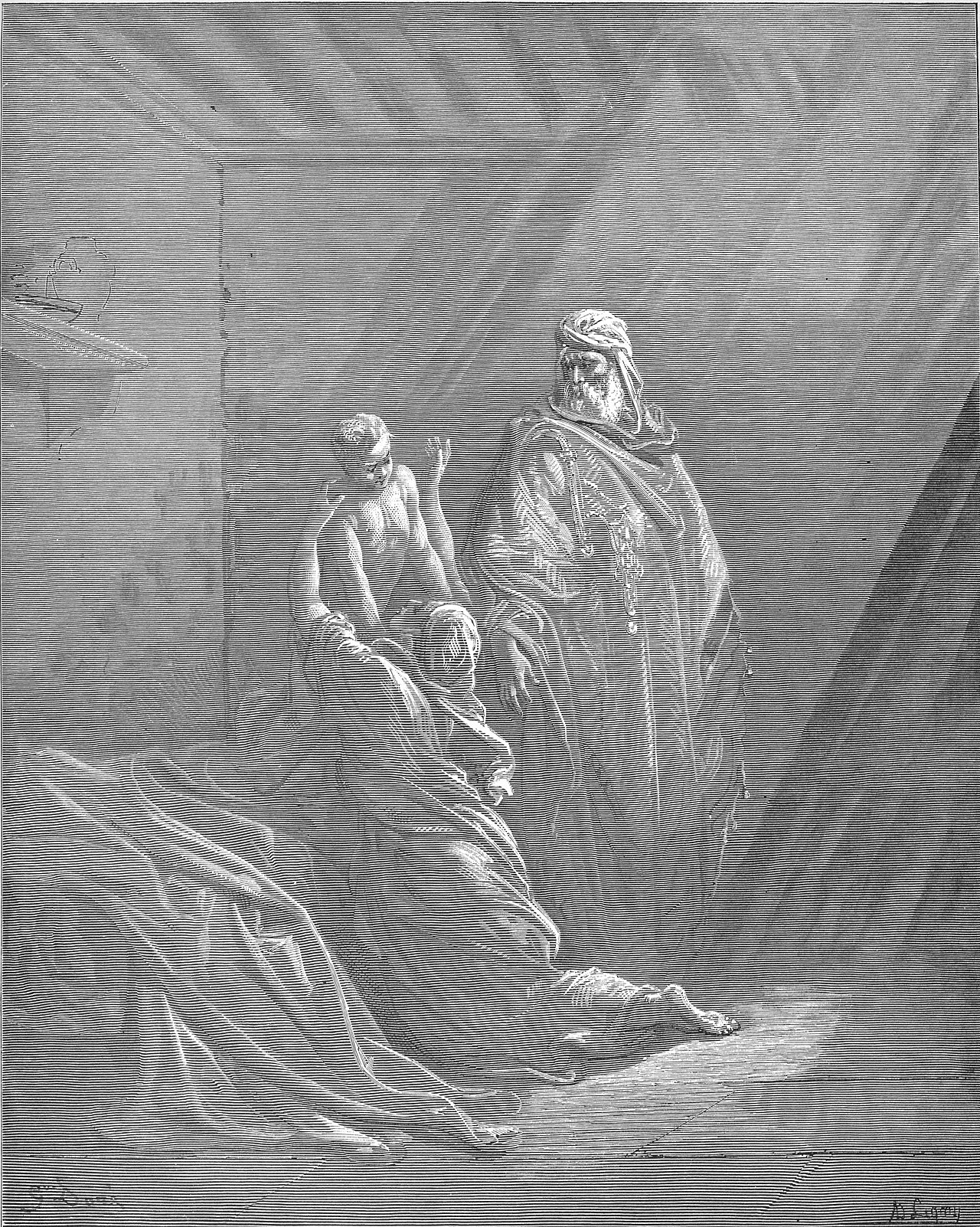
Notable art
6 verified pieces depicting Elijah
Sources cited
- Berean Standard BibleEvery verse quoted on this page, taken byte for byte from the site's verses table. Public domain since 2023.
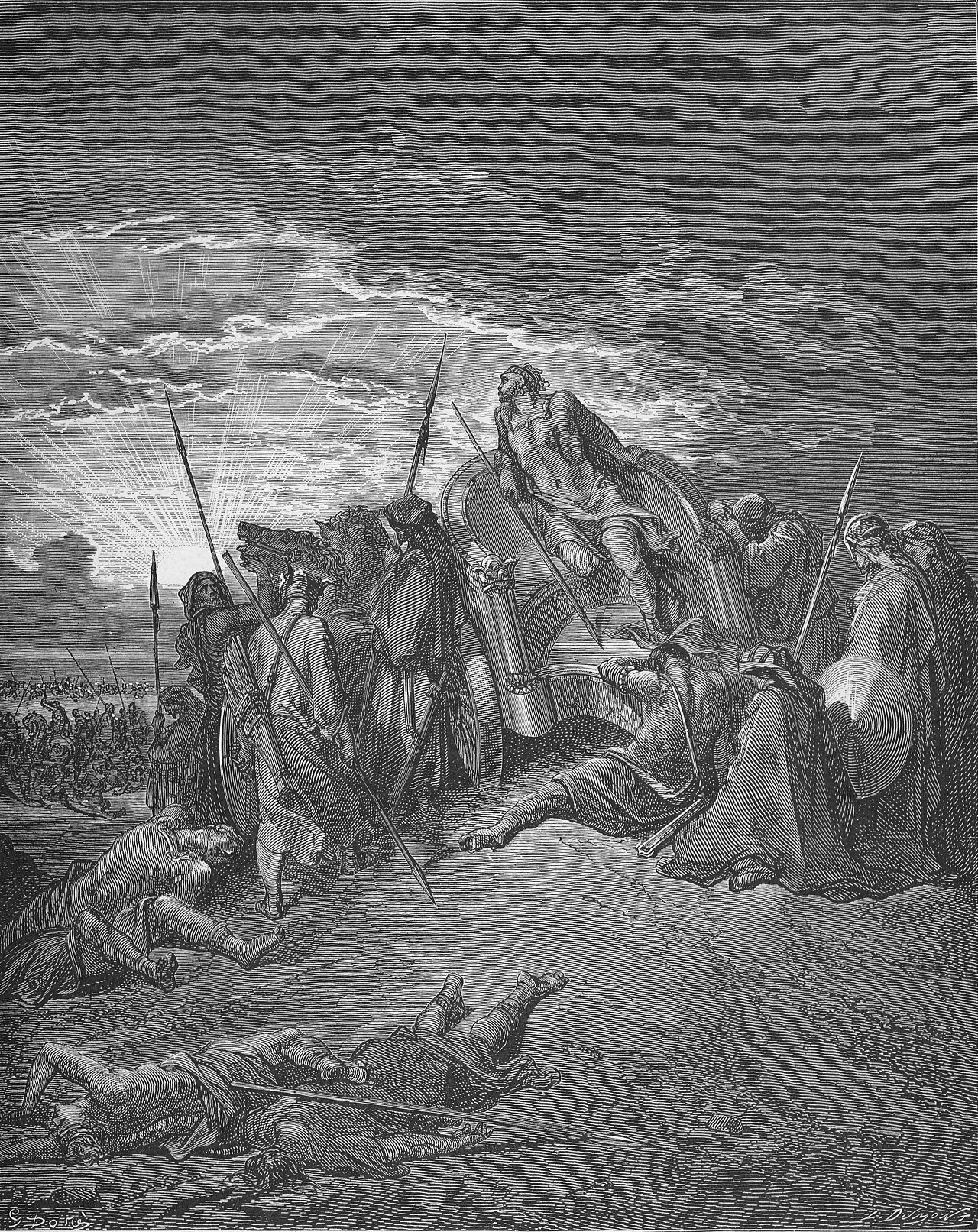
- Gustave Doré, La Sainte Bible (1866)The six engravings on this page. Public domain.
- Giuseppe Angeli, Elijah Taken Up in a Chariot of Fire (c. 1740-1755)The painting at the head of this page, National Gallery of Art. Public domain.
- Albert Barnes, Notes, Explanatory and Practical, on the Old and New Testaments (1832-1869)Quoted on 1 Kings 17:1 and reported on 1 Kings 19:10, 2 Kings 1:10, 2 Kings 2:11 and 2 Chronicles 21:12. Public domain.
- Matthew Henry, Commentary on the Whole Bible (1710)Quoted on 1 Kings 19:3 and reported on 1 Kings 18:40, Luke 4:25-26 and James 5:17-18. Public domain.
- John Wesley, Explanatory Notes upon the Old Testament (1765) and upon the New Testament (1755)Quoted on James 5:17 and reported on 2 Kings 1:10, 2 Kings 2:1, 2 Chronicles 21:12 and Luke 4:25. Public domain.
- Adam Clarke, Commentary on the Bible (1832)Reported on 1 Kings 19:18, 2 Kings 1:10, 2 Chronicles 21:12, Malachi 4:5 and Revelation 11:6. Public domain.
- Jamieson, Fausset & Brown, Commentary Critical and Explanatory on the Whole Bible (1871)Reported on Malachi 4:4 and Luke 9:54. Public domain.
- Charles H. Spurgeon, The Metropolitan Tabernacle PulpitSermon No. 1832 on 1 Kings 18, quoted here. Public domain, CCEL edition.
- The early Christian writers cited on this pageTertullian, Hippolytus of Rome, Origen of Alexandria, Jerome, John Chrysostom, Ambrose of Milan, Augustine of Hippo, Titus of Bostra, Theodoret of Cyrus, Caesarius of Arles, Gregory the Great and Bede, each named on this page by century rather than by a stored death year. Public domain translations.
- The Apocrypha, King James Version with Apocrypha (1769 standardized text)Sirach 48:10 and 1 Maccabees 2:58, quoted from the site's apocrypha_verses table and labelled study resources rather than Scripture. Public domain.
- Edwin R. Thiele, The Mysterious Numbers of the Hebrew KingsThe chronology this site follows for the divided monarchy, anchored to the Assyrian eponym canon. In copyright; named as a framework rather than quoted.
- The British Museum, Assyrian royal inscriptions of Shalmaneser IIIThe Kurkh Monolith (BM 118884), which names Ahab the Israelite at the battle of Qarqar in 853 BC, and the Black Obelisk, which records tribute from Jehu in 841 BC. Neither mentions Elijah.
- Mount Carmel on this siteThe ridge, the contest and the rain in full, with its own quote pool and the Roman-era witnesses to an altar on the mountain. This page tells the man and doors to the mountain.
- Associates for Biblical Research, on the Kurkh Monolith's figure of two thousand chariots for AhabConfirmed by search 2026-09-02. The chariot count is the inscription's own claim; the note that it is widely read as inflated follows the standard scholarly caution.
Keep studying
On this page
Studies7
Trails1
Every page that names them1
Books11
Doorway1
Keep this page