
Exodus 14:21
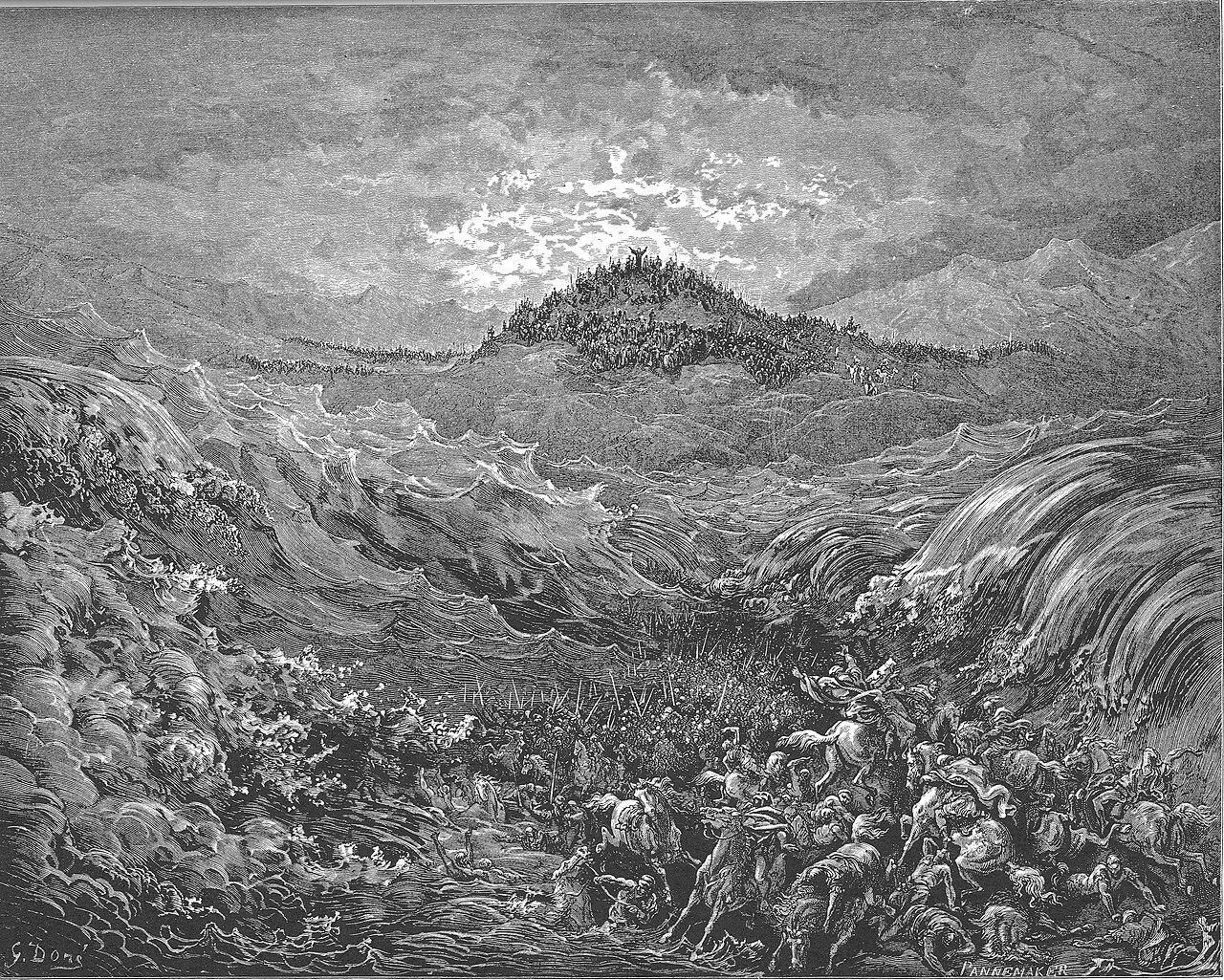
in Exodus 14Then Moses stretched out his hand over the sea, and all that night the LORD drove back the sea with a strong east wind that turned it into dry land. So the waters were divided,
BSB
The same verse in ASV and KJV ▾
ASV
And Moses stretched out his hand over the sea; and Jehovah caused the sea to go back by a strong east wind all the night, and made the sea dry land, and the waters were divided.
KJV
And Moses stretched out his hand over the sea; and the Lord caused the sea to go back by a strong east wind all that night, and made the sea dry land, and the waters were divided.
⋯
This verse in Exodus 14
Commentary
11 notes on this verseA commentator
Albert Barnes1798–1870
Notes, Explanatory and Practical, on the Old and New Testaments (1832-1869)
A strong east wind - The agency by which the object effected was natural (compare Exo 15:8 note): and the conditions of the narrative are satisfied by the hypothesis, that the passage took place near Suez. The waters were divided - i. e. there was a complete separation between the water of the gulf and the water to the north of Kolsum.
This site's exposition
And Moses stretched out his hand over the sea
on Exodus 14:21-22
The sea goes back before a strong east wind blowing all that night, so a means and a miracle stand in the same sentence. Israel walks on dry ground with the waters a wall on the right hand and on the left, and both details are repeated word for word at verse 29 once the army is gone. Paul calls the crossing a baptism at 1 Corinthians 10:1 and 10:2, saying the fathers were all under the cloud and all passed through the sea and were all baptized unto Moses in the cloud and in the sea.
The record, by era
The Church Fathers3 voices
We find that arms have always needed faith, but faith has never needed arms. The rod of faith parted the sea which submerged the army bereft of faith together with its wicked leader.
The Jews under the guidance of Moses passed over the Red Sea, but that case is widely different from this. He did all with prayer and as a servant, but Christ with absolute power. There when the south wind blew, the water yielded so as to make them pass over on dry land, but here the miracle was greater. For the sea retaining its proper nature so bare its Lord upon its surface, thus testifying to the Scripture which saith, "Who walketh upon the sea as upon a pavement."
Note how the teachers of the Old and New Testaments differ in their deeds but are paired in glory, for the one Wisdom issued twin laws in the two Testaments, so equal distinction gives the same weight to differing powers. Peter did not divide the …
The Puritans and the Awakening2 voices
This march through the sea was in the night, and not a moon-shine night, for it was seven days after the full moon, so that they had no light but what they had from the pillar of fire.
The instituted sign made use of was Moses's stretching out his hand over it, to signify that it was done in answer to his prayer, for the confirmation of his mission, and in favour to the people whom he led. The natural sign was a strong east wind, signifying that it was done by the power of God, whom the winds and the seas obey.
4 more voices on this verse
The Puritans and the Awakening2 voices
And Moses stretched out his hand over the sea,.... With his rod in it, as he was directed to, Exo 14:
Note, It is very common, but very absurd and criminal, for people to repent of their good deeds; their justice and charity, and even their repentance, are repented of.
The Nineteenth Century2 voices
A commentator
Jamieson, Fausset & Brown1802–1910
Commentary Critical and Explanatory on the Whole Bible (1871)
The idea of divine interposition, therefore, is imperative; and, assuming the passage to have been made at Mount Attakah, or at the mouth of Wady Tawarik, an east wind would cut the sea in that line.
The Lord caused the sea to go back - That part of the sea over which the Israelites passed was, according to Mr. Bruce and other travelers, about four leagues across, and therefore might easily be crossed in one night. In the dividing of the sea two agents appear to be employed, though the effect produced can be attributed to neither. By stretching out the rod the waters were divided; by the blowing of the vehement, ardent, east wind, the bed of the sea was dried. It has been observed, that in the place where the Israelites are supposed to have passed, the water is about fourteen fathoms or twenty-eight yards deep: had the wind mentioned here been strong enough, naturally speaking, to have divided the waters, it must have blown in one narrow track, and continued blowing in the direction in which the Israelites passed; and a wind sufficient to have raised a mass of water twenty-eight yards deep and twelve miles in length, out of its bed, would necessarily have blown the whole six hundred thousand men away, and utterly destroyed them and their cattle. I therefore conclude that the east wind, which was ever remarked as a parching, burning wind, was used after the division of the waters, merely to dry the bottom, and render it passable. For an account of the hot drying winds in the east, See Clarke’s note on Gen 8:1. God ever puts the highest honor on his instrument, Nature; and where it can act, he ever employs it. No natural agent could divide these waters, and cause them to stand as a wall upon the right hand and upon the left; therefore God did it by his own sovereign power. When the waters were thus divided, there was no need of a miracle to dry the bed of the sea and make it passable; therefore the strong desiccating east wind was brought, which soon accomplished this object. In this light I suppose the text should be understood.
The words behind it
21 Hebrew wordsEvery Hebrew word of this verse in the order it stands, with what it means and the door to its own study. The last column counts the times a word stands in the whole Bible: the rarer the word, the more the places it appears belong together.
| Hebrew | Sound | Meaning | Word study | In the Bible |
|---|---|---|---|---|
| וַיֵּ֨ט | vaiyet | and he stretched out | H5186 → | 214 times |
| מֹשֶׁ֣ה | mosheh | Moses | H4872 → | 765 times |
| אֶת־ | ʾet- | <obj.> | H853 → | 10935 times |
| יָדוֹ֮ | yado | hand his | H3027 → | 1618 times |
| עַל־ | ʾal- | over | H5921 → | 5755 times |
| הַיָּם֒ | haiyam | the sea | H3220 → | 396 times |
| וַיּ֣וֹלֶךְ | vaiyolekh | and he drove | H1980 → | 1546 times |
| יְהוָ֣ה׀ | yahweh | Yahweh | H3068 → | 6520 times |
| אֶת־ | ʾet- | <obj.> | H853 → | 10935 times |
| הַ֠יָּם | haiyom | the sea | H3220 → | 396 times |
| בְּר֨וּחַ | beruach | by a wind | H7307 → | 378 times |
| קָדִ֤ים | kadim | an east wind | H6921 → | 69 times |
| עַזָּה֙ | ʾazah | strong | H5794 → | |
| כָּל־ | kol- | all | H3605 → | 5413 times |
| הַלַּ֔יְלָה | halaylah | the night | H3915 → | 233 times |
| וַיָּ֥שֶׂם | vaiyasem | and he made | H7760 → | 584 times |
| אֶת־ | ʾet- | <obj.> | H853 → | 10935 times |
| הַיָּ֖ם | haiyam | the sea | H3220 → | 396 times |
| לֶחָרָבָ֑ה | lecharavah | into <the> dry ground | H2724 → | |
| וַיִּבָּקְע֖וּ | vaiyibakeu | and they were divided | H1234 → | |
| הַמָּֽיִם׃ | hamayim | the waters | H4325 → | 581 times |
וַיֵּ֨טand he stretched out
vaiyetH5186 →214 times
מֹשֶׁ֣הMoses
moshehH4872 →765 times
אֶת־<obj.>
ʾet-H853 →10935 times
יָדוֹ֮hand his
yadoH3027 →1618 times
עַל־over
ʾal-H5921 →5755 times
הַיָּם֒the sea
haiyamH3220 →396 times
וַיּ֣וֹלֶךְand he drove
vaiyolekhH1980 →1546 times
יְהוָ֣ה׀Yahweh
yahwehH3068 →6520 times
אֶת־<obj.>
ʾet-H853 →10935 times
הַ֠יָּםthe sea
haiyomH3220 →396 times
בְּר֨וּחַby a wind
beruachH7307 →378 times
קָדִ֤יםan east wind
kadimH6921 →69 times
עַזָּה֙strong
ʾazahH5794 →
כָּל־all
kol-H3605 →5413 times
הַלַּ֔יְלָהthe night
halaylahH3915 →233 times
וַיָּ֥שֶׂםand he made
vaiyasemH7760 →584 times
אֶת־<obj.>
ʾet-H853 →10935 times
הַיָּ֖םthe sea
haiyamH3220 →396 times
לֶחָרָבָ֑הinto <the> dry ground
lecharavahH2724 →
וַיִּבָּקְע֖וּand they were divided
vaiyibakeuH1234 →
הַמָּֽיִם׃the waters
hamayimH4325 →581 times
A shaded row is a word that stands 400 times or fewer in the Bible.
The walk
8 stopsEach card is a verse this one points to, and under it the verses that one points to in turn. Where several paths arrive at the same place, that place is listed first: the text keeps returning to it.
Through
Nehemiah 9:11You divided the sea before them, and they crossed through it on dry ground. You hurled their pursuers into the depths like a stone into raging waters.
it leads to
- Psalms 78:13
He split the sea and brought them through; He set the waters upright like a wall.
Reached by 5 separate paths from here.
- Exodus 14:21–22
Then Moses stretched out his hand over the sea, and all that night the LORD drove back the sea with a strong east wind that turned it into dry land. So the waters were…
Reached by 4 separate paths from here.
- Exodus 14:27–28
So Moses stretched out his hand over the sea, and at daybreak the sea returned to its normal state. As the Egyptians were retreating, the LORD swept them into the sea.
- Psalms 78:13
Through
Psalms 66:6He turned the sea into dry land; they passed through the waters on foot; there we rejoiced in Him.
it leads to
- Joshua 3:16
the flowing water stood still. It backed up as far upstream as Adam, a city in the area of Zarethan, while the water flowing toward the Sea of the Arabah (the Salt Sea) was…
Reached by 2 separate paths from here.
- Joshua 3:14
So when the people broke camp to cross the Jordan, the priests carried the ark of the covenant ahead of them.
- Joshua 3:16
Through
Exodus 15:8At the blast of Your nostrils the waters piled up; like a wall the currents stood firm; the depths congealed in the heart of the sea.
it leads to
- Job 4:9
By the breath of God they perish, and by the blast of His anger they are consumed.
- Job 4:9
Through
Isaiah 63:12who sent His glorious arm to lead them by the right hand of Moses, who divided the waters before them to gain for Himself everlasting renown,
it leads to
- Exodus 15:16
and terror and dread will fall on them. By the power of Your arm they will be as still as a stone until Your people pass by, O LORD, until the people You have…
- Exodus 15:16
Through
Joshua 4:23For the LORD your God dried up the waters of the Jordan before you until you had crossed over, just as He did to the Red Sea, which He dried up before us until…
it leads to
- Isaiah 63:12–14
who sent His glorious arm to lead them by the right hand of Moses, who divided the waters before them to gain for Himself everlasting renown,
- Isaiah 63:12–14
Where this verse is studied
On this page
Studies4
About Exodus
Who and where
1 name in this verse with a page on the site.
This page draws on 10 works. Open the list of works
This page draws on Adam Clarke, Commentary on the Bible; Albert Barnes, Notes, Explanatory and Practical, on the Old and New Testaments (1832-1869); Jamieson, Fausset & Brown, Commentary Critical and Explanatory on the Whole Bible; John Chrysostom, HOMILIES ON THE GOSPEL OF JOHN 43; John Gill, Exposition of the Old Testament (1748-1763); John Wesley, Explanatory Notes upon the Old Testament; Keil and Delitzsch, Biblical Commentary on the Old Testament: The Pentateuch; Matthew Henry, Commentary on the Whole Bible; Paulinus of Nola, POEM 26.150 and Paulinus of Nola, POEM 26.366.