
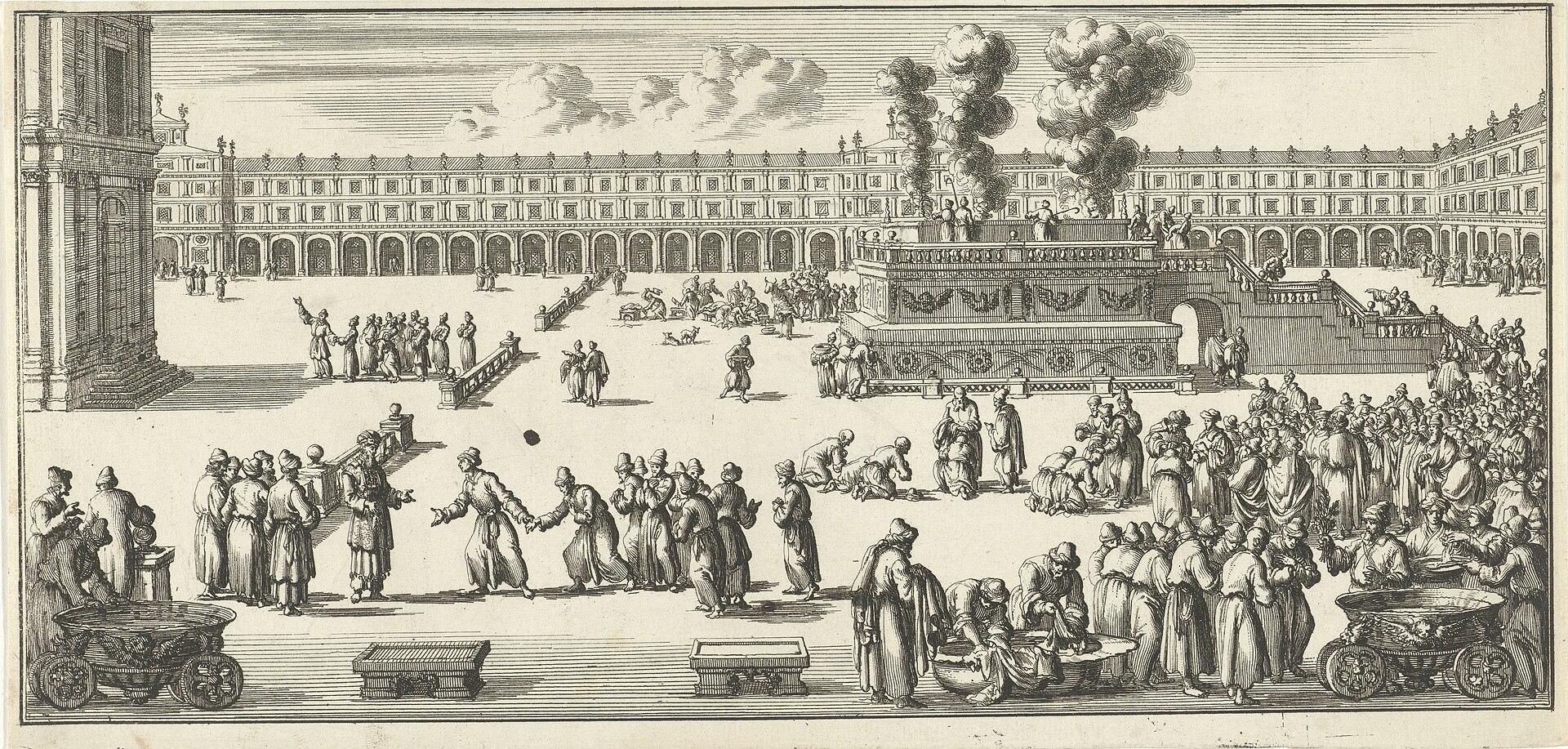
Jan Luyken, The Levites Appointed to Serve the Priests, 1683. Public domain.
Malachi 2:5 · Doctrine · Featured Study
The Covenant with Levi
Malachi 2 holds up Levi as the pattern of a faithful teacher of God's law.
“My covenant with him was one of life and peace, which I gave to him; it called for reverence, and he revered Me and stood in awe of My name.
- First taught
- Exodus 32:29 “Afterward, Moses said, “Today you have been ordained…”
- Fullest statement
- Malachi 2:5 “My covenant with him…”
The priests of Malachi's day were measured against the faithful priests who came before them.
Summary
The LORD made a covenant with Levi's line to serve Him as priests. Malachi 2:5 names its gifts and what it asked in return.
- Malachi 2:9 says the LORD made the faithless priests despised before the people.
- Malachi 3:3 promises that the coming Lord will purify the sons of Levi.
- Augustine read the verses of the covenant as words about Christ.
The Covenant in Malachi 2
The LORD's decree against the priests names the covenant it is meant to keep.
Malachi 2:1 to 3 warns the priests that the LORD will curse their blessings if they do not honor His name.
Then you will know that I have sent you this commandment so that My covenant with Levi may continue,” says the LORD of Hosts.The decree of Malachi 2:1 to 3 has a purpose that looks back to the first priests.
True instruction was in his mouth, and nothing false was found on his lips. He walked with Me in peace and uprightness, and he turned many from iniquity.The verse describes the first priests by what they taught and how they lived.
But you have departed from the way, and your instruction has caused many to stumble. You have violated the covenant of Levi,” says the LORD of Hosts.This verse names the fault of the later priests, the instruction that led others astray.
The Covenant Through Scripture
The covenant with the priests runs from Sinai to Malachi's promise of refining.
Each step names what the covenant gave or what the priests did with it.
- The covenant at this step
- The Levites are ordained after they stand with Moses.
- The covenant at this step
- The holy offerings are given to Aaron's line by a covenant of salt.
- The covenant at this step
- Phinehas receives a covenant of permanent priesthood.
- The covenant at this step
- Levi will teach Israel the law and offer at the altar.
- The covenant at this step
- Nehemiah prays against priests who defiled the covenant.
- The covenant at this step
- The covenant with the Levites stands as firm as day and night.
- The covenant at this step
- The refiner's work begins with the priests.
The seven steps follow the order of the books.
The Priest as the LORD's Messenger
Malachi 2:7 explains why the people looked to a priest's mouth.
For the lips of a priest should preserve knowledge, and people should seek instruction from his mouth, because he is the messenger of the LORD of Hosts.The verse joins the priest's teaching to his office as messenger.
so that you may teach the Israelites all the statutes that the LORD has given them through Moses.”The law gave Aaron's sons the work of teaching from the start.
My people are destroyed for lack of knowledge. Because you have rejected knowledge, I will also reject you as My priests. Since you have forgotten the law of your God, I will also forget your children.Hosea brought the same charge against the priests of Israel.
Three Words of the Covenant
Three Hebrew words of Malachi 2:4 to 6 name the covenant, its gift and its demand.
berith
284 uses in the canon
Berith is a covenant, the bond the LORD made with Phinehas and with Levi.
shalom
236 uses in the canon
Shalom is peace and well-being, the way Levi walked with the LORD.
mora
12 uses in the canon
Mora is fear or reverence, what the covenant asked of the priest.
The first two words stand side by side in the LORD's promise to Phinehas.
Voices on the Covenant with Levi
Two teachers, Gregory the Great and Matthew Henry, explain what the faithful priest did.
Gregory the Dialogist (died 604)
Gregory the Great, also called Gregory the Dialogist, wrote of the priest's office in his Book of Pastoral Rule. A priest who will not rebuke sin, he held, fails the office Malachi 2:7 describes.
“For in sacred language teachers are sometimes called prophets, in that, by pointing out how fleeting are present things, they make manifest the things that are to come. And such the divine discourse convinces of seeing false things, because, while fearing to reprove faults, they vainly flatter evil doers by promising security: neither do they at all discover the iniquity of sinners, since they refrain their voice from chiding. For the language of reproof is the key of discovery, because by chiding it discloses the fault of which even he who has committed it is often himself unaware. Hence Paul says, ‘That he may be able by sound doctrine even to convince the gainsayers.’ Hence through Malachi it is said, ‘The priest's lips keep knowledge, and they shall seek the law at his mouth.’ Hence through Isaiah the Lord admonishes, saying, ‘Cry aloud, spare not, lift up thy voice like a trumpet.’ For it is true that whosoever enters on the priesthood undertakes the office of a herald, so as to walk, himself crying aloud, before the coming of the judge who follows terribly.”
Gregory the Dialogist · The Book of Pastoral Rule, Part 2, Chapter 4 · on Malachi 2:7Patristic
Matthew Henry (1662 to 1714)
Matthew Henry drew the verse into the work of a minister in his own day.
“It is God only that by his grace can turn men from iniquity, and yet it is here said of a pious laborious minister that he turned men from iniquity as a worker together with God, and an instrument in his hand; and those that turn many to righteousness shall shine as the stars, Dan. xii.”
Matthew Henry · Commentary on the Whole Bible · on Malachi 2:6Puritan
Who the Covenant Names
Barnes, Maurer and Augustine each name a different man in Malachi 2:5.
Aaron and his lineAlbert Barnes
Albert Barnes held that the covenant was made with Aaron as Levi's representative in the desert. Through Aaron it passed to each of his line who served after him.
The tribe that kept faith at SinaiMaurer, as Jamieson, Fausset and Brown report him
Jamieson, Fausset and Brown give Maurer's reading of the verse as a promise and a condition. The LORD gave life and peace, and Levi kept the condition of reverence, as Deuteronomy 33:8 to 9 records.
He said of his father and mother, ‘I do not consider them.’ He disregarded his brothers and did not know his own sons, for he kept Your word and maintained Your covenant.Moses' blessing says Levi kept the LORD's word and covenant above his own family.
ChristAugustine of Hippo
Augustine read Malachi 2:5 to 7 as words about Christ, whom the prophet calls the angel of the Lord of hosts.
“A little further on Malachi speaks of Christ, again in the person of God: ‘My covenant was with him of life and peace, and I gave him fear; and he feared me, and he was afraid before my name. The law of truth was in his mouth, and iniquity was not found on his lips. He walked with me in peace and equity and turned many away from iniquity. For the lips of the priest shall keep knowledge, and they shall seek the laws at his mouth because he is the angel of the Lord of hosts.’ No one should be astonished to hear Christ spoken of as ‘the angel of the Lord of hosts.’ He was called his servant because he came to humanity in the form of a servant; similarly he was called an angel because of the evangel, which he brought to humankind.”
Augustine of Hippo · City of God 18.35 · on Malachi 2:5Patristic
A Royal Priesthood
The New Testament gives the priests' work of praise to the whole church.
But you are a chosen people, a royal priesthood, a holy nation, a people for God’s own possession, to proclaim the virtues of Him who called you out of darkness into His marvelous light.Peter's letter gives the title of priesthood to the whole people of God.
who has made us to be a kingdom, priests to His God and Father—to Him be the glory and power forever and ever! Amen.John praises Christ, who has made His people priests to God.
Malachi 2:6 holds up the first priests' pattern of true teaching, an upright walk and many turned from sin.
Sources
Scripture is the Berean Standard Bible.
- The Hebrew text of Malachi 2:4 to 6 and Numbers 25:12, word by word, with Strong's numbers.
- Strong's Hebrew lexicon, the counts of uses.
- The notes of the commentators and the fathers on Malachi 1 to 4.
- Matthew Henry, Commentary on the Whole Bible (1710), on Malachi 2:6.
- Gregory the Great, The Book of Pastoral Rule, part 2, chapter 4.
- Albert Barnes, Notes, Explanatory and Practical (1832 to 1869), on Malachi 2:5.
- Jamieson, Fausset and Brown, Commentary Critical and Explanatory on the Whole Bible (1871), on Malachi 2:5 to 9.
- Augustine of Hippo, City of God 18.35 (430)
Keep Studying
People and groups7
Show the next 1 title
Places1
Subjects1
Symbols2