
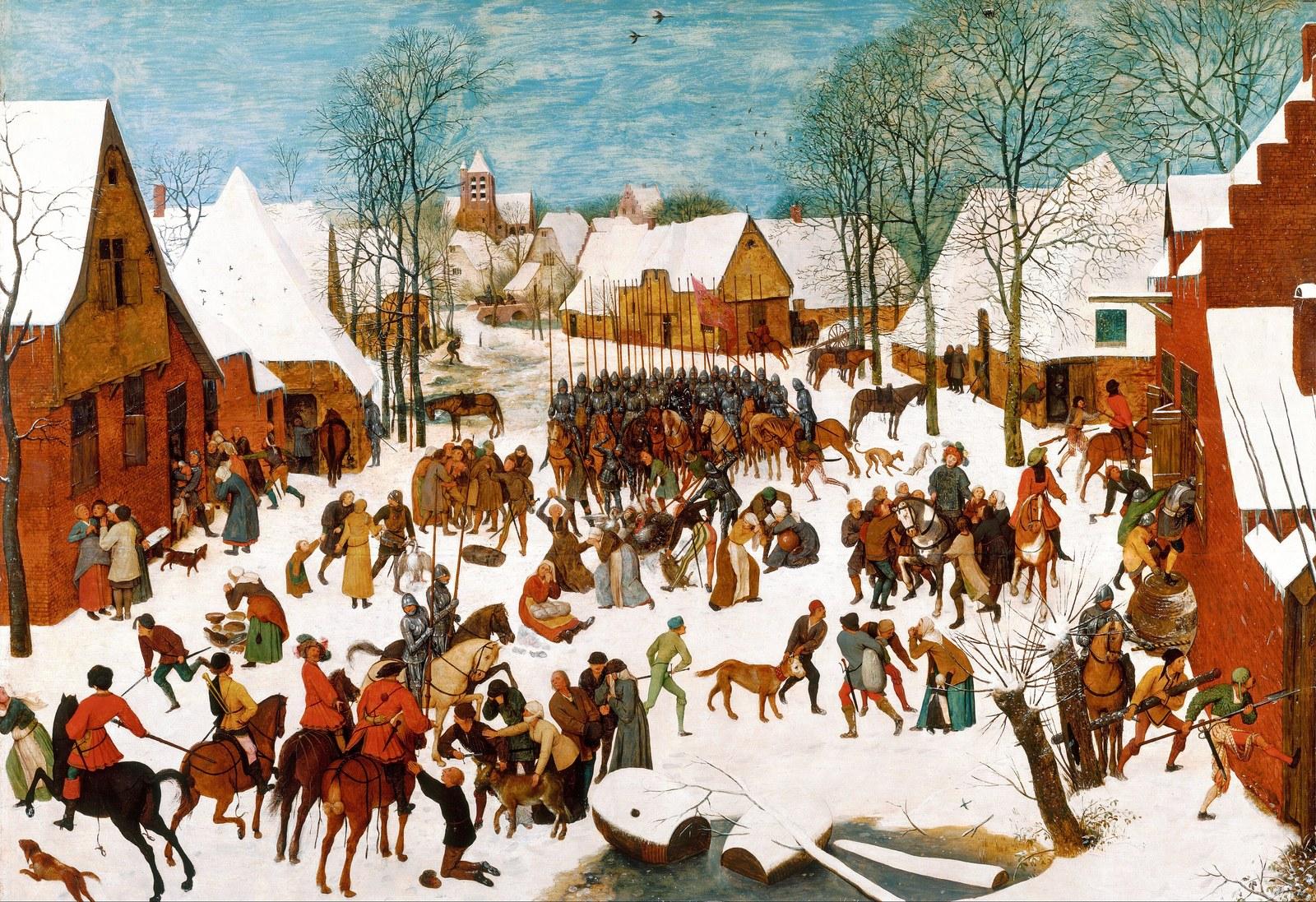
Pieter Bruegel the Elder, Massacre of the Innocents, 1565 to 1567. Public domain.
Matthew 2:16 to 18 · Story · Featured Study
The Massacre of the Innocents
Herod ordered the killing of the boys of Bethlehem, two years old and under, after the Magi left by another road.
“A voice is heard in Ramah, weeping and great mourning, Rachel weeping for her children, and refusing to be comforted, because they are no more.”
- Where
- Bethlehem
- Who
- Herod the Great, Joseph of Nazareth, Jesus of Nazareth
- When
- Before the death of Herod the Great (Matthew 2:19)
An angel sent Joseph to Egypt with the Child by night, before the soldiers came to Bethlehem.
Summary
Herod the Great was king of Judea when Jesus was born. Only Matthew among the Gospels tells this story.
- Herod learned the time of the star from the Magi in secret (Matthew 2:7).
- Two later writers disagree on whether it happened just as Matthew tells it.
- Herod died soon after, and the family settled in Nazareth (Matthew 2:19 to 23).
The Order from Herod
Two teachers of the church asked why Herod gave the order and why God allowed it.
Pseudo-Chrysostom, in the Catena Aurea, traced the order to a king's fear for his crown. He likened Herod to a wounded beast that tears at whatever it meets.
John Chrysostom, in his ninth homily on Matthew, took up the question why God allowed it. He answered that a wrong suffered either takes away the sufferer's sins or is repaid with a reward.
The Magi, their star and their gifts have their own study.
The Story in Seven Steps
Matthew tells the story from the Magi's question in Jerusalem to the family's home in Nazareth.
Herod's order falls between the Magi's departure and Herod's own death.
- The Magi in Jerusalem"Where is the One who has been born King of the Jews?"Matthew 2:2
- Herod asks the time"learned from them the exact time the star had appeared"Matthew 2:7
- The Magi go home"they withdrew to their country by another route"Matthew 2:12
- The flight by night"took the Child and His mother by night, and withdrew to Egypt"Matthew 2:14
- The order"he was filled with rage"Matthew 2:16
- Herod's death"After Herod died, an angel of the Lord appeared in a dream to Joseph"Matthew 2:19
- The home in Nazareth"he went and lived in a town called Nazareth"Matthew 2:23
Each step stands with the Berean words of its verse.
Herod in Josephus
Josephus records Herod's last years in his Antiquities, Books 16 and 17.
Herod had his sons Alexander and Aristobulus strangled at Sebaste, and his son Antipater killed five days before his own death. Josephus wrote that he died after reigning thirty-four years from the death of Antigonus.
As he lay dying at Jericho, Herod shut the leading men of the nation in the hippodrome. He ordered them killed at his death, so that the nation would mourn at his funeral. His sister Salome and Alexas released them before his death was made known.
Rachel Weeping for Her Children
Jeremiah wrote of Rachel weeping for the exiles of Israel.
This is what the LORD says: “Keep your voice from weeping and your eyes from tears, for the reward for your work will come, declares the LORD. Then your children will return from the land of the enemy.Matthew quotes the verse before this one, and Jeremiah's own answer to the weeping stands here.
Jamieson, Fausset and Brown read Matthew's use of Jeremiah as a second lament from the same mother.
“Rachel, the mother of Joseph and Benjamin, was buried in the neighborhood of Bethlehem (Ge 35:19), where her sepulchre is still shown. She is figuratively represented as rising from the tomb and uttering a double lament for the loss of her children--first, by a bitter captivity, and now by a bloody death.”
Jamieson, Fausset & Brown · Commentary Critical and Explanatory on the Whole Bible · on Matthew 2:18Reformed
Jerome noted that Matthew quotes Jeremiah in his own words, following neither the Hebrew nor the Greek translation word for word.
Voices on the Innocents
A teacher of the fourth century and one of the eighteenth read the children and their mothers.
Hilary of Poitiers (died 367)
Hilary of Poitiers read Rachel as a picture of the church weeping for her children.
“It could not be that they were not who seemed now dead, but by glorious martyrdom they were advanced to eternal life; and consolation is for those who have suffered loss, not for those who have reaped a gain. Rachel affords a type of the Church long barren now at length fruitful. She is heard weeping for her children, not because she mourned them dead, but because they were slaughtered by those whom she would have retained as her first-born sons.”
Hilary of Poitiers · Catena Aurea by Aquinas · on Matthew 2:17 to 18Patristic
Matthew Henry (1662 to 1714)
Matthew Henry counted the children among the martyrs.
“The diseases and deaths of little children are proofs of original sin. But we must look upon this murder of the infants under another character: it was their martyrdom. How early did persecution commence against Christ and his kingdom!”
Matthew Henry · Commentary on the Whole Bible · on Matthew 2:16Puritan
Did It Happen as Matthew Tells It?
Adam Clarke and David Friedrich Strauss weighed the report of Macrobius in opposite ways.
An event Macrobius reportsAdam Clarke, Commentary on the Bible, on Matthew 2:16
Adam Clarke wrote that this cruelty of Herod seems alluded to in very decisive terms by Macrobius, a Latin writer of the late fourth century.
Macrobius tells in his Saturnalia, Book 2, that the emperor Augustus heard of a son of Herod who died among the boys under two whom Herod ordered killed in Syria. Augustus said it was better to be Herod's pig than his son.
A story told after Pharaoh and MosesDavid Friedrich Strauss, The Life of Jesus Critically Examined (1835)
David Friedrich Strauss argued that Josephus, who wrote at length on Herod, gives no hint of this decree. He held that Macrobius loses credit as a witness, because he mixes the killing of the infants with the execution of Antipater, a grown son.
Strauss read the story as shaped on Pharaoh's order against the Hebrew sons and the later Jewish legends of Moses' birth.
Then Pharaoh commanded all his people: “Every son born to the Hebrews you must throw into the Nile, but every daughter you may allow to live.”Strauss set Pharaoh's order against a whole class of children beside Herod's order.
Strauss also matched the angel's word to Joseph in Matthew 2:20 with the LORD's word to Moses in Exodus 4:19.
Those Seeking the Child's Life
The danger to the Child ends with the death of those who sought Him.
“Get up!” he said. “Take the Child and His mother and go to the land of Israel, for those seeking the Child’s life are now dead.”The verse gives the reason Joseph could bring the Child home.
Sources
Scripture is the Berean Standard Bible.
- Flavius Josephus, Antiquities of the Jews 16.11.7, 17.6.5 and 17.8.1, translated by William Whiston (1737)
- Macrobius, Saturnalia 2.4.11, Latin text.
- David Friedrich Strauss, The Life of Jesus Critically Examined (1835), translated by George Eliot (1846), part 1, chapter 4.
- Adam Clarke, Commentary on the Bible (1832), on Matthew 2:16.
- Jamieson, Fausset and Brown, Commentary Critical and Explanatory on the Whole Bible (1871), on Matthew 2:18.
- Jerome, on Jeremiah 31:15, in the Catena Aurea on Matthew 2:17 to 18.
- Pseudo-Chrysostom, in the Catena Aurea, on Matthew 2:16.
- Matthew Henry, Commentary on the Whole Bible (1710), on Matthew 2:16.
- Hilary of Poitiers, in the Catena Aurea, on Matthew 2:17 to 18.
- John Chrysostom, Homily 9 on the Gospel of Matthew, on Matthew 2:16.