
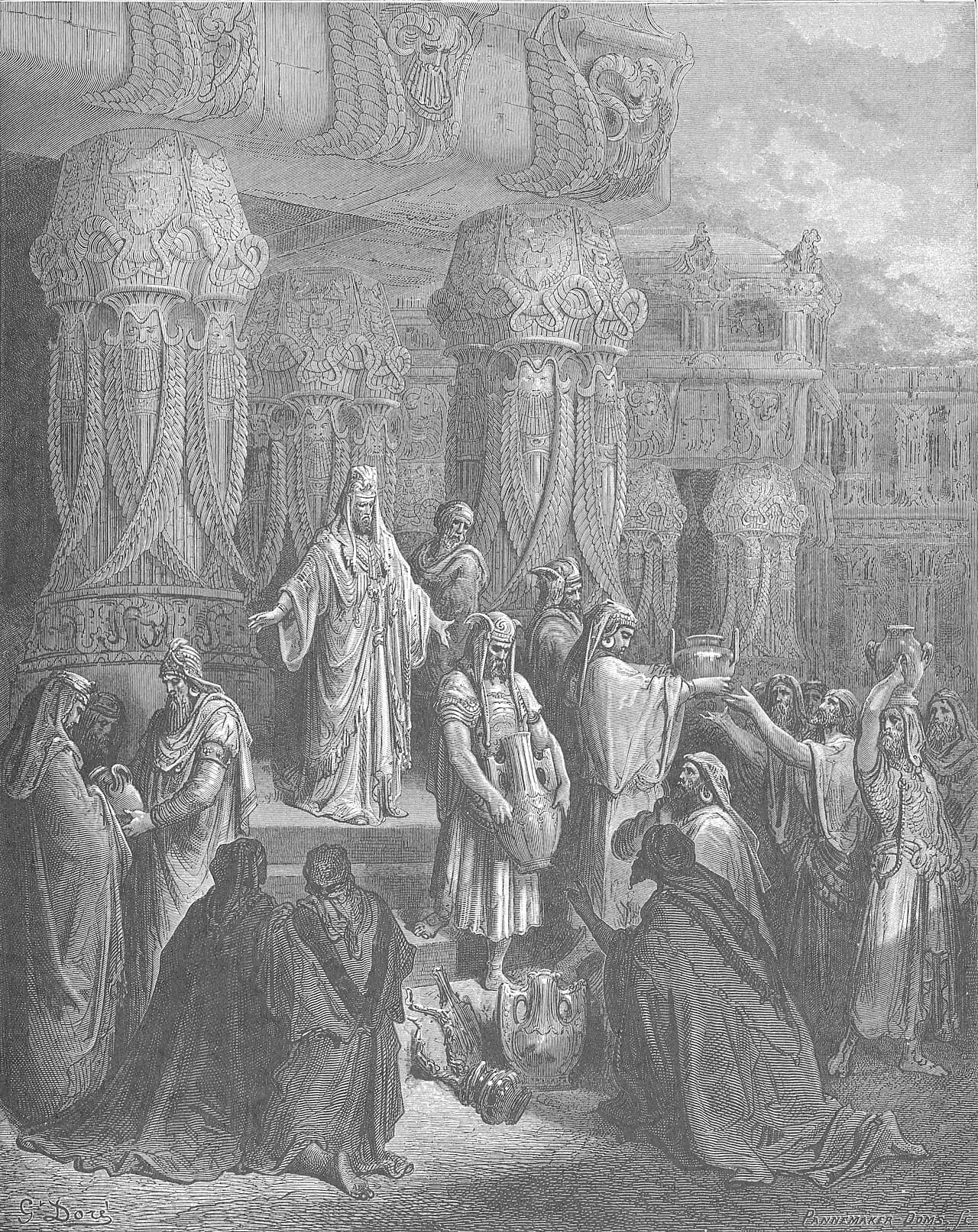
Cyrus Restores the Vessels of the Temple, Gustave Doré, 1866. Public domain.
Old Testament · Book 15 of 66
Ezra
Ezra records the return of the Jewish exiles from Babylon and the rebuilding of the temple in Jerusalem. Ezra the scribe then arrives to teach the law of God and to call the people back to it.
Ezra records the return of the Jewish exiles from Babylon and the rebuilding of the temple in Jerusalem. Ezra the scribe then arrives to teach the law of God and to call the people back to it.
What is Ezra about?
Ezra tells how the exiles came home from Babylon and rebuilt the house of God. In the first year of Cyrus the LORD stirs the king to let them go, and the book lists those who went up. They build the altar and lay the foundation, letters to the Persian kings stop the work, and the house is finished under Darius. Many years later Ezra the scribe comes up, because he had “set his heart to study the Law of the LORD, to practice it, and to teach” (7:10). He finds the people married to the peoples of the land, and the book ends with their confession and the list of names.
All 10 chapters
Every chapter of the book, in one grid. Each cell opens that chapter.
- The returnEzra 1 to 2
- The house rebuiltEzra 3 to 6
- Ezra's returnEzra 7 to 8
- The marriagesEzra 9 to 10
The colour is the movement of the book the chapter stands in, and every cell opens that chapter's Study level.
Who wrote it, where, when, for whom, and why?
The book names no writer for itself. From 7:27 to 9:15 Ezra speaks in the first person, and the rest of the book speaks of him. It calls him a priest of the line of Aaron and a scribe skilled in the Law of Moses (7:1 to 6). It copies the Persian letters in the language they were written in (4:7). Nehemiah shows Ezra reading the Law to the people (Nehemiah 8:1 to 9).
this Ezra came up from Babylon. He was a scribe skilled in the Law of Moses, which the LORD, the God of Israel, had given. The king had granted Ezra all his requests, for the hand of the LORD his God was upon him.
Ezra 7:6, Berean Standard Bible.
The book begins in Babylon and ends in Jerusalem. Its letters pass between Jerusalem, the officials west of the Euphrates and the Persian court (4:10, 5:6), and the scroll of Cyrus is found at Ecbatana in Media (6:2). Ezra's company gathers at the Ahava Canal before it goes up (8:15).
The text dates its events by the years of Persian kings: the first year of Cyrus (1:1), the second year of Darius (4:24), the sixth year of Darius (6:15) and the seventh year of Artaxerxes (7:7). Between the house finished and Ezra's journey it says only many years later (7:1). The last date is the first day of the first month (10:17).
The book is about and for those who came up from the captivity (2:1), called the exiles (6:16), and those who trembled at the words of the God of Israel (9:4).
The book gives its reasons in its own words: the return fulfils the word of the LORD spoken through Jeremiah (1:1), the house is finished by the command of God and the decrees of three kings (6:14), and the remnant is kept by grace in its bondage (9:8 and 9).
Though we are slaves, our God has not forsaken us in our bondage, but He has extended to us grace in the sight of the kings of Persia, giving us new life to rebuild the house of our God and repair its ruins, and giving us a wall of protection in Judah and Jerusalem.
Ezra 9:9, Berean Standard Bible.
Judah is a province of the Persian empire. Its governors answer to the king, and its neighbours in Samaria can write to him (4:10). The opening decree is the one with which 2 Chronicles ends (2 Chronicles 36:22 and 23), and Haggai and Zechariah date their prophecies to the same second year of Darius (Haggai 1:1, Zechariah 1:1).
Sources. Ezra 1:1, 2:1, 4:7, 4:10, 4:24, 5:6, 6:2, 6:14, 6:15, 6:16, 7:1 to 6, 7:7, 7:27 to 9:15, 8:15, 9:4, 9:8 and 9, 10:17; 2 Chronicles 36:22 and 23; Nehemiah 8:1 to 9; Haggai 1:1; Zechariah 1:1. Every verse is read in the Berean Standard Bible.
How is Ezra arranged, and what is it for?
The four movements the book falls into, then what it teaches and what it was written to do.
- The returnEzra 1 to 2, 81 verses, the turn at 1:1
Cyrus sends the exiles home with the temple's vessels, and the book lists those who went up.
- The house rebuiltEzra 3 to 6, 76 verses, the turn at 6:15
The altar, the foundation, the letters that stop the work, and the house finished under Darius.
- Ezra's returnEzra 7 to 8, 64 verses, the turn at 7:10
Ezra goes up with the king's letter, fasts at the Ahava Canal and brings the gifts to the house.
- The marriagesEzra 9 to 10, 59 verses, the turn at 9:4
The report of the marriages, Ezra's prayer, the assembly in the rain and the list of names.
The theme
The God of Israel keeps his word through the kings of Persia. He stirs Cyrus to send his people home, turns the heart of the king to help them build (6:22) and puts it into the heart of Artaxerxes to honour his house (7:27). The book says again and again that the hand of God was on Ezra (7:6, 7:9, 8:18, 8:31). The people rebuild the altar and the house and keep the Passover, and the book closes on the question of whether a small remnant will stay separate to the LORD.
The purpose
Ezra records how the exiles came back, who they were and how the house of God was rebuilt, keeping the lists and the kings' letters word for word. It shows the Law of Moses taught again by a scribe who practised it, and a people who confessed their unfaithfulness when it was named. It leaves them in Jerusalem with the house standing, which is where Nehemiah takes up the rebuilding of the wall.
Two returns on one line, from the first year of Cyrus to the seventh of Artaxerxes
The first return, under Zerubbabel (7 stations)
- The decree of CyrusDecreeEzra 1:1 to 4the first year of Cyrus king of Persia538 BC, reckoned
- The altar set upEzra 3:1 to 6the first day of the seventh monthno year given
- The foundation laidEzra 3:8 to 11the second month of the second year after they arrived536 BC, reckoned
- The work stoppedEzra 4:24until the second year of the reign of Dariusno year given
- Haggai and ZechariahEzra 5:1 to 2the second year of Darius520 BC, reckoned
- The decree of DariusDecreeEzra 6:1 to 12the reign of Darius, the year not givenno year given
- The house finishedEzra 6:15the third day of Adar, the sixth year of Darius515 BC, reckoned
The second return, under Ezra (3 stations)
- The letter of ArtaxerxesDecreeEzra 7:11 to 26the seventh year of King Artaxerxes (7:7)458 BC, reckoned
- Ezra arrivesEzra 7:8 to 9the first day of the fifth month, the seventh yearthe same year, reckoned
- The list completedEzra 10:17the first day of the first monthno year given
a decree an eventThe colour is the movement the station stands in.Reckoned: a calendar year from a later count; if the king is Artaxerxes II, the year is 398 BC (see Where do readers disagree).
The return, Ezra 1 to 2
What the text says in Ezra 1 to 2, and the pages it opens on.
In the first year of Cyrus king of Persia the LORD stirs the king's spirit, and Cyrus proclaims that the God of heaven has appointed him to build a house at Jerusalem, and that any of God's people may go up. Their neighbours give them silver, gold and goods. Cyrus brings out the articles Nebuchadnezzar had taken from the temple, 5,400 of gold and silver, and they are counted out to Sheshbazzar, the prince of Judah. Chapter 2 lists those who came up with Zerubbabel and Jeshua, family by family, then the priests, the Levites, the singers, the gatekeepers and the temple servants, and those who could not prove their descent. The chapter closes with the count of the whole assembly, and each returns to his own town.
In the first year of Cyrus king of Persia, to fulfill the word of the LORD spoken through Jeremiah, the LORD stirred the spirit of Cyrus king of Persia to send a proclamation throughout his kingdom and to put it in writing as follows:
- Study
Ezra 1the decree of Cyrus and the 5,400 vessels given backShow the summary and 4 pagesShow summary, 4 pagesHide the summary
In the first year of Cyrus the LORD stirs the king to proclaim that the exiles may go up and build the house of the LORD in Jerusalem. Their neighbours give them silver, gold, goods and livestock.
- Cyrus brings out the articles Nebuchadnezzar took from the temple and has them counted out to Sheshbazzar, the prince of Judah (1:7 to 8).
- Sheshbazzar brings all the gold and silver articles up from Babylon to Jerusalem (1:11).
On this chapter (4)
- The exile and the return
Seventy years in Babylon and the way home.
- Persia
The empire whose kings sent the exiles home.
- Who is Sheshbazzar, and is he Zerubbabel?
Answered under Where do readers disagree, lower on this page, with each reading and who holds it.
- Ezra 1:1
The verse on its own page, with the commentators on it by era.
- Study
Ezra 2the list of those who came up, family by familyShow the summary and 3 pagesShow summary, 3 pagesHide the summary
The chapter lists the people of the province who came up from the captivity, family by family and town by town. The priests, the Levites, the singers, the gatekeepers and the temple servants follow.
- Some families and priests cannot prove their descent, and those priests are kept from the priesthood (2:59 to 63).
- The chapter ends with the whole assembly, its servants and singers, and its animals, and with the freewill offerings for the house (2:64 to 69).
On this chapter (3)
- The remnant
The survivors God keeps, from the prophets to Paul.
- Why do the lists of Ezra 2 and Nehemiah 7 differ?
Answered under Where do readers disagree, lower on this page, with each reading and who holds it.
- Ezra 2:64
The verse on its own page, with the commentators on it by era.
Those who went up, by group, against the whole assembly
- The whole assembly (2:64)42,360
- The men of Israel, by family and town (2:3 to 35, summed)24,144
- The priests (2:36 to 39, summed)4,289
- The Levites (2:40)74
- The singers (2:41)128
- The gatekeepers (2:42)139
- The temple servants and the descendants of Solomon's servants (2:43 to 58)392
- Those who could not prove their families (2:59 to 60)652
- The groups added together29,818
- Besides them
- 7,337 servants and 200 singers (2:65)
- Not accounted for in the lines
- 12,542
Characters (4)
Who the text names. A name with a page carries its door.
- Cyrus
King of Persia, whose spirit the LORD stirs to send the exiles home (1:1).
- Sheshbazzar
The prince of Judah, who receives the 5,400 vessels and brings them up (1:8, 1:11).
- Zerubbabel
Son of Shealtiel, first named of those who come up (2:2); Matthew 1:12 and Luke 3:27 name him in the line of Jesus.
- Jeshua
The priest who comes up with Zerubbabel (2:2) and later builds the altar (3:2).
Places (2)
Where the chapters stand.
Themes (3)
What these chapters raise, each on its own page where one stands.
- The exile and the return
Seventy years in Babylon and the way home.
- Persia
The empire whose kings send the exiles home.
- The remnant
The survivors God keeps, from the prophets to Paul.
Where the New Testament uses these chapters (0 uses, 1 later reading)No New Testament passage quotes or names these chapters.
No New Testament passage quotes or names Ezra 1 to 2. The row below is a later Christian reading, marked as one, with its holder and work.
- Later Christian readingCyrus, Ezra 1:1 to 4 at a later reading. Cyrus, who sets the captives free, is read as a type of Christ, who frees those bound by sin. Held by Matthew Henry, his commentary (1706), on Ezra 1.
The house rebuilt, Ezra 3 to 6
What the text says in Ezra 3 to 6, and the pages it opens on.
In the seventh month the people gather at Jerusalem, and Jeshua and Zerubbabel build the altar and offer the burnt offerings before any foundation is laid. In the second year the foundation is laid, and the people shout for joy while the older priests, Levites and family heads who had seen the first house weep. Their enemies offer to help build and are refused, and the people of the land oppose the work through the reign of Cyrus. Letters to the Persian kings follow, and the work stops until the second year of Darius. Haggai and Zechariah prophesy, the building starts again, and Tattenai writes to Darius. The scroll of Cyrus is found at Ecbatana, Darius orders the work to go on at the royal cost, and the house is finished and dedicated, and the Passover kept.
And this temple was completed on the third day of the month of Adar, in the sixth year of the reign of King Darius.
- Study
Ezra 3the altar set up, the foundation laid, the shout and the weepingShow the summary and 2 pagesShow summary, 2 pagesHide the summary
In the seventh month the people gather in Jerusalem, and Jeshua and Zerubbabel build the altar and offer burnt offerings on it. They keep the Feast of Tabernacles before the foundation of the temple is laid.
- In the second year the foundation is laid, and the priests and Levites praise the LORD with trumpets and cymbals (3:8 to 11).
- The older men who had seen the first house weep while many others shout for joy (3:12 to 13).
On this chapter (2)
- The exile and the return
Seventy years in Babylon and the way home.
- Ezra 3:11
The verse on its own page, with the commentators on it by era.
- Study
Ezra 4the people of the land oppose the work, and the letters stop itShow the summary and 4 pagesShow summary, 4 pagesHide the summary
The enemies of Judah and Benjamin offer to help build the house and are refused. The people of the land then discourage the builders and hire counsellors against them.
- Letters to Xerxes and Artaxerxes accuse the Jews of rebuilding a rebellious city (4:6 to 16).
- Artaxerxes orders the work stopped, and it stands still until the second year of Darius (4:21 to 24).
On this chapter (4)
- Persia
The empire whose kings sent the exiles home.
- The wall
The walls of Jerusalem rebuilt under Nehemiah.
- Why is part of Ezra in Aramaic?
Answered under Where do readers disagree, lower on this page, with each reading and who holds it.
- Ezra 4:24
The verse on its own page, with the commentators on it by era.
- Study
Ezra 5Haggai and Zechariah prophesy, and Tattenai writes to DariusShow the summary and 2 pagesShow summary, 2 pagesHide the summary
Haggai and Zechariah prophesy, and Zerubbabel and Jeshua begin to rebuild the house. Tattenai the governor asks who authorised the work.
- The eye of their God is on the elders, and they are not stopped while the report goes to Darius (5:5).
- Tattenai's letter gives the elders' answer and asks for a search of the royal archives (5:6 to 17).
On this chapter (2)
- Study
Ezra 6the scroll found at Ecbatana, the house finished, the PassoverShow the summary and 2 pagesShow summary, 2 pagesHide the summary
Darius has the archives searched, and a scroll with the decree of Cyrus is found at Ecbatana. He orders the governors to leave the work alone and to pay its cost from the royal treasury.
- The house is finished in the sixth year of Darius and dedicated with joy (6:15 to 16).
- The exiles keep the Passover and the Feast of Unleavened Bread (6:19 to 22).
On this chapter (2)
Four letters to the king, and the two replies
- 1Ezra 4:6The people of the landXerxesAn accusation against the people of Judah and Jerusalem.No reply is recorded.
- 2Ezra 4:7Bishlam, Mithredath and TabeelArtaxerxesA letter written in Aramaic and then translated.No reply is recorded.
- 3Ezra 4:8 to 16Rehum the commander and Shimshai the scribeArtaxerxesThe Jews are rebuilding that rebellious and wicked city and restoring its walls.Artaxerxesthe reply, Ezra 4:17 to 22Issue an order for these men to stop until I so order.The work is stopped by force (4:23).
- 4Ezra 5:6 to 17Tattenai the governor and Shethar-bozenaiDariusLet the royal archives in Babylon be searched to see whether Cyrus issued the decree.Dariusthe reply, Ezra 6:1 to 12The scroll of Cyrus is found at Ecbatana; leave the work alone, and pay the cost from the royal treasury.Tattenai carries out the order (6:13), and the house is finished (6:15).
Characters (6)
Who the text names. A name with a page carries its door.
- Jeshua and Zerubbabel
They build the altar and lay the foundation (3:2, 3:8).
- Haggai
The prophet whose words set the building going again (5:1, 6:14).
- Zechariah
Son of Iddo, who prophesies beside Haggai (5:1, 6:14).
- Tattenai
Governor west of the Euphrates, who asks who authorised the work and writes to Darius (5:3, 5:6).
Show the next 2
- Darius
The king who has the archives searched and confirms Cyrus's decree (6:1, 6:12).
- Rehum and Shimshai
The officials whose letter to Artaxerxes stops the work (4:8, 4:23).
Places (2)
Where the chapters stand.
- The house of God
The temple in Jerusalem, finished on the third day of Adar (6:15).
- Ecbatana
The fortress in Media where the scroll of Cyrus is found (6:2).
Themes (2)
What these chapters raise, each on its own page where one stands.
- The altar before the house
Burnt offerings begin on the altar before the foundation is laid (3:3, 3:6).
- Repentance
Turning back to God, the call of the prophets.
Where the New Testament uses these chapters (0 uses, 1 later reading)No New Testament passage quotes or names these chapters.
No New Testament passage quotes or names Ezra 3 to 6. The row below is a later Christian reading, marked as one, with its holder and work.
- Later Christian readingThe second house, Ezra 4:1 to 5 at a later reading. The house built under opposition is read as a figure of the church, built by Christ against its enemies. Held by Matthew Henry, his commentary (1706), on Ezra 4.
Ezra's return, Ezra 7 to 8
What the text says in Ezra 7 to 8, and the pages it opens on.
Many years later, in the reign of Artaxerxes, Ezra comes up from Babylon. He is a priest descended from Aaron and a scribe skilled in the Law of Moses, and the king grants all he asks. Artaxerxes' letter sends him with silver and gold for the house and with authority to appoint judges and teach the law. Ezra gathers the company at the Ahava Canal, finds no Levites and sends for them, and proclaims a fast, because he was ashamed to ask the king for soldiers. He weighs out the silver, the gold and the articles to twelve leading priests to carry, and in Jerusalem they are weighed out again in the house of God.
For Ezra had set his heart to study the Law of the LORD, to practice it, and to teach its statutes and ordinances in Israel.
- Study
Ezra 7Ezra goes up with Artaxerxes' letterShow the summary and 4 pagesShow summary, 4 pagesHide the summary
In the reign of Artaxerxes Ezra comes up from Babylon, a priest of Aaron's line and a scribe skilled in the Law of Moses. He had set his heart to study the Law, to practise it and to teach it.
- The king's letter gives him silver and gold for the house and authority to appoint judges (7:11 to 26).
- Ezra blesses the LORD for putting it into the king's heart to honour the house (7:27 to 28).
On this chapter (4)
- The seventy weeks
Daniel's weeks and the decrees they are counted from.
- Which Artaxerxes sent Ezra, and when?
Answered under Where do readers disagree, lower on this page, with each reading and who holds it.
- Did Ezra write Chronicles, and did he shape the canon?
Answered under Where do readers disagree, lower on this page, with each reading and who holds it.
- Ezra 7:10
The verse on its own page, with the commentators on it by era.
- Study
Ezra 8the fast at the Ahava Canal and the gifts weighed outShow the summary and 2 pagesShow summary, 2 pagesHide the summary
Ezra lists the family heads who went up with him and gathers them to camp at the canal. Finding no Levites, he sends for ministers for the house of God.
- He proclaims a fast and asks God for a safe journey, because he was ashamed to ask the king for soldiers (8:21 to 23).
- The silver, the gold and the articles are weighed out to the priests, carried to Jerusalem and weighed again in the house (8:24 to 34).
On this chapter (2)
- The fear of the LORD
The reverence that trembles at God's word.
- Ezra 8:21
The verse on its own page, with the commentators on it by era.
Four months from Babylon to Jerusalem
The seventh year of Artaxerxes (7:7), by month
- 1Day 1, month 1. The journey begins from Babylon (7:9).
- 2Day 12, month 1. The company sets out from the canal, after three days' camp and a fast (8:15, 8:21, 8:31).
- 3Day 1, month 5. Ezra arrives in Jerusalem (7:9).
Characters (3)
Who the text names. A name with a page carries its door.
- Ezra
Priest and scribe skilled in the Law of Moses, of the line of Aaron (7:1 to 6).
- Artaxerxes
King of Persia, whose letter sends Ezra with silver, gold and authority (7:11 to 26).
- Meremoth son of Uriah
The priest into whose hand the gifts are weighed out (8:33).
Places (2)
Where the chapters stand.
- The Ahava Canal
Where the company camps three days and fasts before the journey (8:15, 8:21).
- Casiphia
Where Ezra sends to Iddo and the temple servants for ministers for the house (8:17).
Themes (2)
What these chapters raise, each on its own page where one stands.
- The law
Ezra came to study, practise and teach it (7:10).
- The fear of the LORD
The reverence that trembles at God's word.
Where the New Testament uses these chapters (0 uses, 1 later reading)No New Testament passage quotes or names these chapters.
No New Testament passage quotes or names Ezra 7 to 8. The row below is a later Christian reading, marked as one, with its holder and work.
- Later Christian readingEzra the scribe, Ezra 7:6 at a later reading. Ezra is read as the one who gathered and restored the books of Scripture after the exile. Held by Irenaeus, Against Heresies 3.21.2; John Wesley, Explanatory Notes upon the Old Testament (1765), on Ezra 7:6, reporting the Jewish tradition.
The marriages, Ezra 9 to 10
What the text says in Ezra 9 to 10, and the pages it opens on.
The leaders report to Ezra that the people, the priests and the Levites among them, have married women of the peoples of the land. Ezra tears his garments and sits appalled until the evening offering, and then he prays, confessing the people's guilt as his own. A great assembly gathers weeping, and Shecaniah proposes a covenant to send away the foreign wives and their children. The men of Judah and Benjamin are summoned within three days and sit in the square in the heavy rain. Four men oppose the plan. Family heads examine every case over three months, and the book ends with the list of the men who had married foreign women.
Then everyone who trembled at the words of the God of Israel gathered around me because of the unfaithfulness of the exiles, while I sat there in horror until the evening offering.
- Study
Ezra 9the report of the marriages and Ezra's confessionShow the summary and 3 pagesShow summary, 3 pagesHide the summary
The leaders report that the people, the priests and the Levites have not kept themselves separate from the peoples of the land. Ezra tears his garments and sits appalled until the evening offering.
- Everyone who trembled at the words of God gathers around him (9:4).
- At the evening offering he kneels and confesses the people's guilt as his own, and thanks God for a remnant kept by grace (9:5 to 15).
On this chapter (3)
- The remnant
The survivors God keeps, from the prophets to Paul.
- Repentance
Turning back to God, the call of the prophets.
- Ezra 9:8
The verse on its own page, with the commentators on it by era.
- Study
Ezra 10the covenant, the assembly in the rain and the list of namesShow the summary and 3 pagesShow summary, 3 pagesHide the summary
While Ezra prays, a great assembly gathers weeping, and Shecaniah proposes a covenant to send away the foreign wives and their children. The men of Judah and Benjamin assemble within three days and sit in the square in the rain.
- Four men oppose the plan, and family heads examine every case (10:15 to 17).
- The chapter ends with the list of the men who had married foreign women (10:18 to 44).
On this chapter (3)
- Marriage, singleness and divorce
What Scripture says of marriage and its breaking.
- Was the putting away of the wives right?
Answered under Where do readers disagree, lower on this page, with each reading and who holds it.
- Ezra 10:11
The verse on its own page, with the commentators on it by era.
Three months of the assembly, and the men it named
From the ninth month to the first, by month
The men named, by group (111)
- Priests (10:18 to 22)17
- Levites (10:23)6
- Singers (10:24)1
- Gatekeepers (10:24)3
- Other Israelites (10:25 to 43)84
Characters (3)
Who the text names. A name with a page carries its door.
- Ezra
Tears his garments, prays and confesses the people's sin as his own (9:3, 9:6).
- Shecaniah son of Jehiel
Confesses the unfaithfulness and proposes the covenant (10:2 to 4).
- Jonathan and Jahzeiah
The two who oppose the plan, with Meshullam and Shabbethai (10:15).
Places (2)
Where the chapters stand.
- The square at the house of God
Where all the people sit trembling in the rain (10:9).
- Jerusalem
Where all the men of Judah and Benjamin assemble within three days (10:9).
Themes (3)
What these chapters raise, each on its own page where one stands.
- Holy seed
The phrase the report uses of the people mixed with the peoples of the land (9:2).
- Marriage, singleness and divorce
What Scripture says of marriage and its breaking.
- The remnant
The survivors Ezra's prayer names (9:8).
Where the New Testament uses these chapters (0 uses, 1 later reading)No New Testament passage quotes or names these chapters.
No New Testament passage quotes or names Ezra 9 to 10. The row below is a later Christian reading, marked as one, with its holder and work.
- Later Christian readingThe evening offering, Ezra 9:4 to 5 at a later reading. The evening offering at which Ezra rises to pray is read as a type of the Lamb of God, offered in the evening of the world. Held by Matthew Henry, his commentary (1706), on Ezra 9.
- Author
- Ezra (traditional); the book uses first-person narrative in chs. 7–10
- Date
- Events 538–458 BC; compilation c. mid-5th century BC
- Audience
- The post-exilic community rebuilding the covenant polity
Where do readers disagree?
One list: the readings with their holders, and what the evidence does not settle.
Who is Sheshbazzar, and is he Zerubbabel?
The Exile and the Return→- Zerubbabel under a Babylonian name. Held by Matthew Henry, Commentary on the Whole Bible (1706), on 1:8, and by John Wesley, Explanatory Notes upon the Old Testament (1765), on 1:8.
- Two men, uncle and nephew. Held by W. F. Albright, "The Date and Personality of the Chronicler", Journal of Biblical Literature 40 (1921).
What the evidence does not settle: The text calls Sheshbazzar the prince of Judah and governor (1:8, 5:14) and gives Zerubbabel the building (3:8), and it never says whether they are one man.
The argument in full
Zerubbabel under a Babylonian name. Both men lead the first return and both lay the foundation (3:8, 5:16), so the two names are read as one man's court name and his own.
Two men, uncle and nephew. Sheshbazzar is read as Shenazzar, a son of Jeconiah (1 Chronicles 3:18), made governor by Cyrus (5:14), and Zerubbabel as the grandson of Jeconiah who followed him.
Which Artaxerxes sent Ezra, and when?
Persia→- Artaxerxes I, 458 BC. Held by Derek Kidner, Ezra and Nehemiah, Tyndale Old Testament Commentaries (1979).
- Artaxerxes II, 398 BC. Held by Albin van Hoonacker, "Néhémie et Esdras, nouvelle hypothèse sur la chronologie de l'époque de la restauration", Le Muséon 9 (1890).
- Artaxerxes I, about 428 BC. Held by John Bright, A History of Israel (1959).
What the evidence does not settle: The book names the king and the seventh year (7:7) and never says which Artaxerxes; the calendar year follows from the choice.
The argument in full
Artaxerxes I, 458 BC. The seventh year of Artaxerxes I puts Ezra thirteen years before Nehemiah, who comes in the twentieth year of the same king (Nehemiah 2:1), and the two stand together at the reading of the Law (Nehemiah 8:9).
Artaxerxes II, 398 BC. Ezra's prayer thanks God for a wall of protection in Judah and Jerusalem (9:9), read as Nehemiah's wall already standing, so Ezra is read as coming after Nehemiah, under the second king of the name.
Artaxerxes I, about 428 BC. The seventh year of 7:7 is read as a copyist's slip for the thirty-seventh, which keeps Artaxerxes I and puts Ezra after Nehemiah's first years in Jerusalem.
Why is part of Ezra in Aramaic?
- The letters kept in the language of the empire. Held by Robert Jamieson, A. R. Fausset and David Brown, Commentary Critical and Explanatory on the Whole Bible (1871), on 4:7, and by Roland de Vaux, "The Decrees of Cyrus and Darius on the Rebuilding of the Temple", in The Bible and the Ancient Near East (1971).
- A compiler's sources left in their own language. Held by H. G. M. Williamson, Ezra, Nehemiah, Word Biblical Commentary (1985).
What the evidence does not settle: The story between the letters also stays in Aramaic (4:8 to 6:18, 7:12 to 26), and the letters alone do not explain why.
The argument in full
The letters kept in the language of the empire. Aramaic was the language the Persian court wrote its decrees in, and the book copies the letters as they were filed (4:7).
A compiler's sources left in their own language. The Aramaic runs past the letters into the story (5:1 to 5, 6:13 to 18), so it is read as the seam of a writer who kept his Aramaic source whole.
Why do the lists of Ezra 2 and Nehemiah 7 differ?
- Numbers miscopied, the total kept. Held by Derek Kidner, Ezra and Nehemiah, Tyndale Old Testament Commentaries.
- The total counts people the list does not name. Held by Robert Jamieson, A. R. Fausset and David Brown, Commentary Critical and Explanatory on the Whole Bible (1871), on Ezra 2.
What the evidence does not settle: The lines of Ezra 2 add up to 29,818 in the Berean text, and the text states 42,360; it does not say who makes up the rest.
The argument in full
Numbers miscopied, the total kept. The two lists give the same total (2:64, Nehemiah 7:66) and differ in figures inside the list, the part of a copied list most easily changed.
The total counts people the list does not name. The lines of the list add up to less than the total, and the rest are read as returnees from tribes other than Judah and Benjamin.
Was the putting away of the wives right?
Marriage, Singleness and Divorce→- A covenant measure the moment required. Held by Derek Kidner, Ezra and Nehemiah, Tyndale Old Testament Commentaries.
- Reported without the narrator approving every part. Held by H. G. M. Williamson, Ezra, Nehemiah, Word Biblical Commentary, and Joseph Blenkinsopp, Ezra-Nehemiah, Old Testament Library (1988).
What the evidence does not settle: The book records the measure and the dissent and passes no verdict of its own, and it does not say whether the children were sent away (10:44).
The argument in full
A covenant measure the moment required. The report names the abominations of the peoples of the land (9:1), the Law forbade such marriages because they turn hearts to other gods (Deuteronomy 7:3 and 4), and a small remnant around one altar could have been lost in a generation.
Reported without the narrator approving every part. The proposal comes from Shecaniah and the assembly (10:2 to 4) and not from a word of God, four men oppose it (10:15), and Malachi in the same period says the LORD hates divorce (Malachi 2:16).
The same book seats at the Passover all who had separated themselves from the uncleanness of the peoples of the land to seek the LORD (6:21), so the line the book draws is worship and not birth.
Did Ezra write Chronicles, and did he shape the canon?
- Ezra wrote his book and the genealogies of Chronicles. Held by W. F. Albright, "The Date and Personality of the Chronicler", Journal of Biblical Literature, who takes Ezra to be the Chronicler, and before him by the Babylonian Talmud, tractate Bava Batra 15a.
- Ezra gathered and restored the Scriptures. Held by John Wesley, Explanatory Notes upon the Old Testament (1765), on 7:6, who reports it as the Jewish tradition, and by Irenaeus, Against Heresies 3.21.2.
- Chronicles and Ezra are by different writers. Held by Sara Japhet, "The Supposed Common Authorship of Chronicles and Ezra-Nehemiah Investigated Anew", Vetus Testamentum 18 (1968), and H. G. M. Williamson, Israel in the Books of Chronicles (1977).
What the evidence does not settle: The book names no writer for itself; chapters 7 to 9 speak in Ezra's first person (7:27 to 9:15), and the rest speaks of him.
The argument in full
Ezra wrote his book and the genealogies of Chronicles. Chronicles ends with the words Ezra begins with (2 Chronicles 36:22 and 23, Ezra 1:1 to 3), and Ezra is the scribe of the Law (7:6).
Ezra gathered and restored the Scriptures. Ezra is the scribe skilled in the Law of Moses (7:6) who reads it to the people (Nehemiah 8:1 to 9), and the books are read as gathered by his hand.
Chronicles and Ezra are by different writers. The two works differ in their language and in what they stress, and the shared verses are read as a link made between two books.
The Text and the Spade
- The Cyrus Cylinder (Babylon, British Museum)c. 538 BC
Cyrus' own account of his entry into Babylon and of returning displaced peoples and their gods to their cities with sanctuaries rebuilt. It establishes the policy Ezra 1 depends on, in Cyrus' own words, while naming Mesopotamian sites rather than Jerusalem.
- The Elephantine papyri (Aswan, Egypt)fifth century BC; the temple petition dated 407 BC
Aramaic documents from a Jewish military colony in Upper Egypt. The 407 BC petition asking permission to rebuild their temple names Bagavahya the governor of Judah, Johanan the high priest in Jerusalem, and Delaiah and Shelemiah the sons of Sanballat governor of Samaria. The Sanballat who opposed Nehemiah is attested here as a real man with a real office, and the whole archive shows Persian-period Jewish Aramaic of the kind Ezra 4-7 carries.
- The Murashu archive (Nippur, Babylonia)c. 455-403 BC
Hundreds of business tablets from a Babylonian firm, carrying dozens of recognizably Judean personal names among its clients and neighbors. The archive documents the large community that stayed behind, which is the background to Ezra 8's difficulty in recruiting Levites for the second caravan.
- Yehud stamp impressions and coinslate sixth to fourth century BC
Jar handles and small silver coins stamped YHD, the Aramaic name of the Persian province of Judah. They confirm Yehud as an administrative unit with its own fiscal apparatus, and their small quantity fits a province of modest size rather than a restored kingdom.
The pages Ezra opens on
Studies29
Show the next 6 titles
Books beside it6
Sources for this page
The painting in the band is Cyrus Restores the Vessels of the Temple, Gustave Doré, 1866. Public domain. The movements, the chapter entries, the figures and the Context are read off the text of Ezra, and every count on the page is read from the store by scripts/count-ezra-lists.mjs. The works behind the readings under Where do readers disagree and the later readings are the Babylonian Talmud, tractate Bava Batra; Irenaeus, Against Heresies; Matthew Henry, Commentary on the Whole Bible (1706); John Wesley, Explanatory Notes upon the Old Testament (1765); Robert Jamieson, A. R. Fausset and David Brown, Commentary Critical and Explanatory on the Whole Bible (1871); Albin van Hoonacker, “Néhémie et Esdras”, Le Muséon 9 (1890); W. F. Albright, “The Date and Personality of the Chronicler”, Journal of Biblical Literature 40 (1921); John Bright, A History of Israel (1959); Sara Japhet, “The Supposed Common Authorship of Chronicles and Ezra-Nehemiah Investigated Anew”, Vetus Testamentum 18 (1968); Roland de Vaux, “The Decrees of Cyrus and Darius on the Rebuilding of the Temple”, in The Bible and the Ancient Near East (1971); H. G. M. Williamson, Israel in the Books of Chronicles (1977) and Ezra, Nehemiah, Word Biblical Commentary (1985); Derek Kidner, Ezra and Nehemiah, Tyndale Old Testament Commentaries (1979); and Joseph Blenkinsopp, Ezra-Nehemiah, Old Testament Library (1988). Every verse quoted on this page is the Berean Standard Bible, read from the store.