The Most High rules in the kingdom of men
The book states its thesis four times, in almost the same words, and every time it is a pagan king who has to learn it. The heavenly sentence on Nebuchadnezzar is passed 'so that the living will know that the Most High rules over the kingdom of mankind and gives it to whom He wishes' (4:17). It is repeated to his face (4:25), repeated again when it falls (4:32), and rehearsed to his successor as history (5:21). The king who says 'Is this not Babylon the Great, which I myself have built' (4:30) ends his own chapter with the correction in his mouth: 'He is able to humble those who walk in pride' (4:37). The title carrying that claim, Most High, stands in thirteen verses of the book, more often on Gentile lips than on Jewish ones. The claim covers everything: 'He does as He pleases with the army of heaven and the peoples of the earth. There is no one who can restrain His hand or say to Him, What have You done?' (4:35).
Daniel 4:17 · Daniel 4:35 · Daniel 5:21
One kingdom outlasts all the others
Two visions say the same thing twice in two languages. In chapter 2 a statue of four metals is broken by something nobody made: 'a stone was cut out without hands, which smote the image upon its feet' (2:34), and then 'the stone that smote the image became a great mountain, and filled the whole earth' (2:35). The interpretation is given plainly: 'And in the days of those kings shall the God of heaven set up a kingdom which shall never be destroyed' (2:44). In chapter 7 the same sequence returns as four beasts, and the kingdom is handed to a person: 'his dominion is an everlasting dominion, which shall not pass away, and his kingdom that which shall not be destroyed' (7:14), and then to a people, 'his kingdom is an everlasting kingdom, and all dominions shall serve and obey him' (7:27). The word kingdom carries the whole argument, appearing in forty-one verses of the book. Even the kings inside the story end up saying it. Darius signs a decree that Daniel's God 'is the living God, and stedfast for ever' (6:26).
Daniel 2:44 · Daniel 7:14 · Daniel 7:27
How to live in an empire without belonging to it
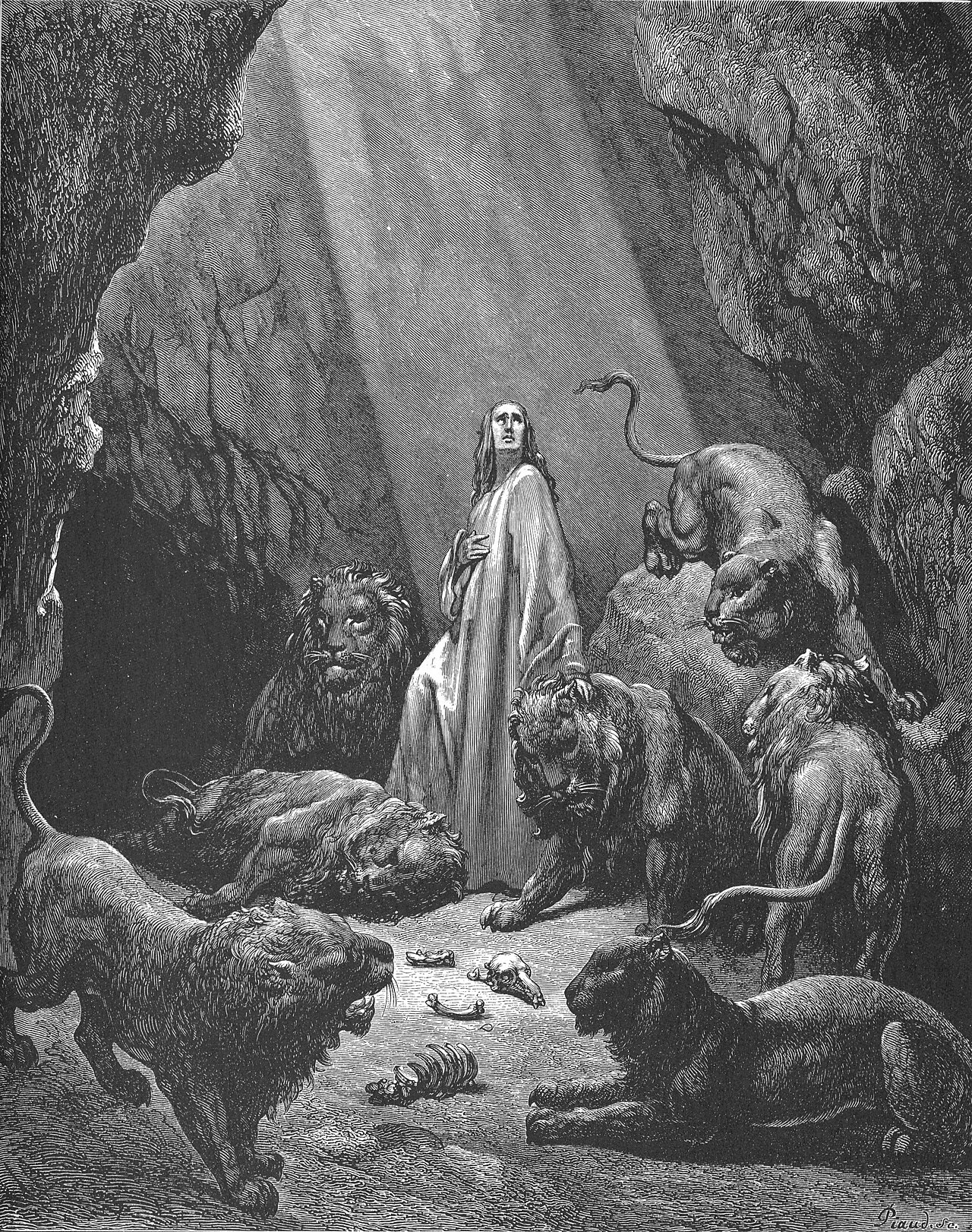
The first six chapters are a working manual for faith under a government that does not share it, and they draw the line in a specific place. Daniel takes the Babylonian schooling, the Babylonian name, and the Babylonian office. He does not take the food: 'But Daniel made up his mind that he would not defile himself' (1:8). His three friends serve the state until the state asks for worship, and then they answer with no argument at all, 'we have no need to answer you in this matter' (3:16), and with a confidence that does not depend on the outcome: 'If the God whom we serve exists, then He is able to deliver us from the blazing fiery furnace and from your hand, O king' (3:17), followed at once by 'But even if He does not, let it be known to you, O king, that we will not serve your gods' (3:18). Those two words carry the weight. Daniel does the same with prayer when prayer is made a crime, and the detail the text keeps is that nothing changed: 'three times a day he got down on his knees, prayed, and gave thanks to his God, just as he had done before' (6:10).
Daniel 1:8 · Daniel 3:18 · Daniel 6:10
Prayer that is heard on the first day, and the war behind the map
Daniel prays four times in the book, and twice the text lets the reader watch what the prayer sets moving. In chapter 9 he confesses on behalf of a whole nation, 'we have sinned and done wrong. We have acted wickedly and rebelled' (9:5), and pleads on no merit at all, 'we are not presenting our petitions before You because of our righteous acts, but because of Your great compassion' (9:18). The covenant name, printed the LORD, occurs six times in Daniel, and all six stand in this one chapter, in this one prayer. In chapter 10 the answer to a three-week fast comes with an explanation attached. The messenger tells him 'from the first day that you purposed to understand and to humble yourself before your God, your words were heard' (10:12), and then says what delayed the delivery: 'However, the prince of the kingdom of Persia opposed me for twenty-one days. Then Michael, one of the chief princes, came to help me' (10:13). The same conflict continues after the vision, 'I must return at once to fight against the prince of Persia, and when I have gone forth, behold, the prince of Greece will come' (10:20), and the book names Israel's own guardian in it, 'Michael your prince' (10:21), who stands up again at 12:1. Heaven has its own courts and its own reporting: a decision reaches Nebuchadnezzar as 'the decree of the watchers, the verdict declared by the holy ones' (4:17). Daniel is the book where Scripture first gives an angel a name, and it gives two, Gabriel at 8:16 and 9:21 and Michael at 10:13, 10:21, and 12:1.
Daniel 9:18 · Daniel 10:12 · Daniel 10:13
The dead will rise, and it will not go the same way for everyone
The Old Testament hopes for resurrection in several places and states it flatly here: 'And many who sleep in the dust of the earth will awake, some to everlasting life, but others to shame and everlasting contempt' (12:2). Two outcomes are named in one sentence, and the vocabulary of everlasting is attached to both. The next verse gives the shape of the first outcome: 'Then the wise will shine like the brightness of the heavens, and those who lead many to righteousness will shine like the stars forever and ever' (12:3). Jesus takes the same two outcomes and the same order in John 5:29, 'those who have done good to the resurrection of life, and those who have done evil to the resurrection of judgment.' The book then applies the promise to one old man by name and makes it personal: 'You will rest, and will arise to your inheritance at the end of the days' (12:13). Rest first, then standing, then a portion held for him.
Daniel 12:2 · Daniel 12:3 · Daniel 12:13
God tells secrets, and then seals the rest
Babylon employed an entire professional class to read dreams and omens, and chapter 2 puts that class in an impossible position and lets it say so: 'there is no other that can show it before the king, except the gods, whose dwelling is not with flesh' (2:11). The answer comes back to Daniel in a night vision, and his response is a doxology rather than a claim: God 'revealeth the deep and secret things; he knoweth what is in the darkness, and the light dwelleth with him' (2:22), and 'there is a God in heaven that revealeth secrets' (2:28). Daniel keeps nothing for himself, telling the king plainly that 'this secret is not revealed to me for any wisdom that I have more than any living' (2:30). Some of it stays closed. The last chapter shuts the file: 'shut up the words, and seal the book, even to the time of the end' (12:4), repeated at 12:9, 'the words are shut up and sealed till the time of the end.' Daniel himself is left without the interpretation of his own vision more than once, 'I wondered at the vision, but none understood it' (8:27), and the book says who will eventually read it: 'none of the wicked shall understand; but they that are wise shall understand' (12:10).
Daniel 2:22 · Daniel 12:4 · Daniel 12:10