
Place
Babel
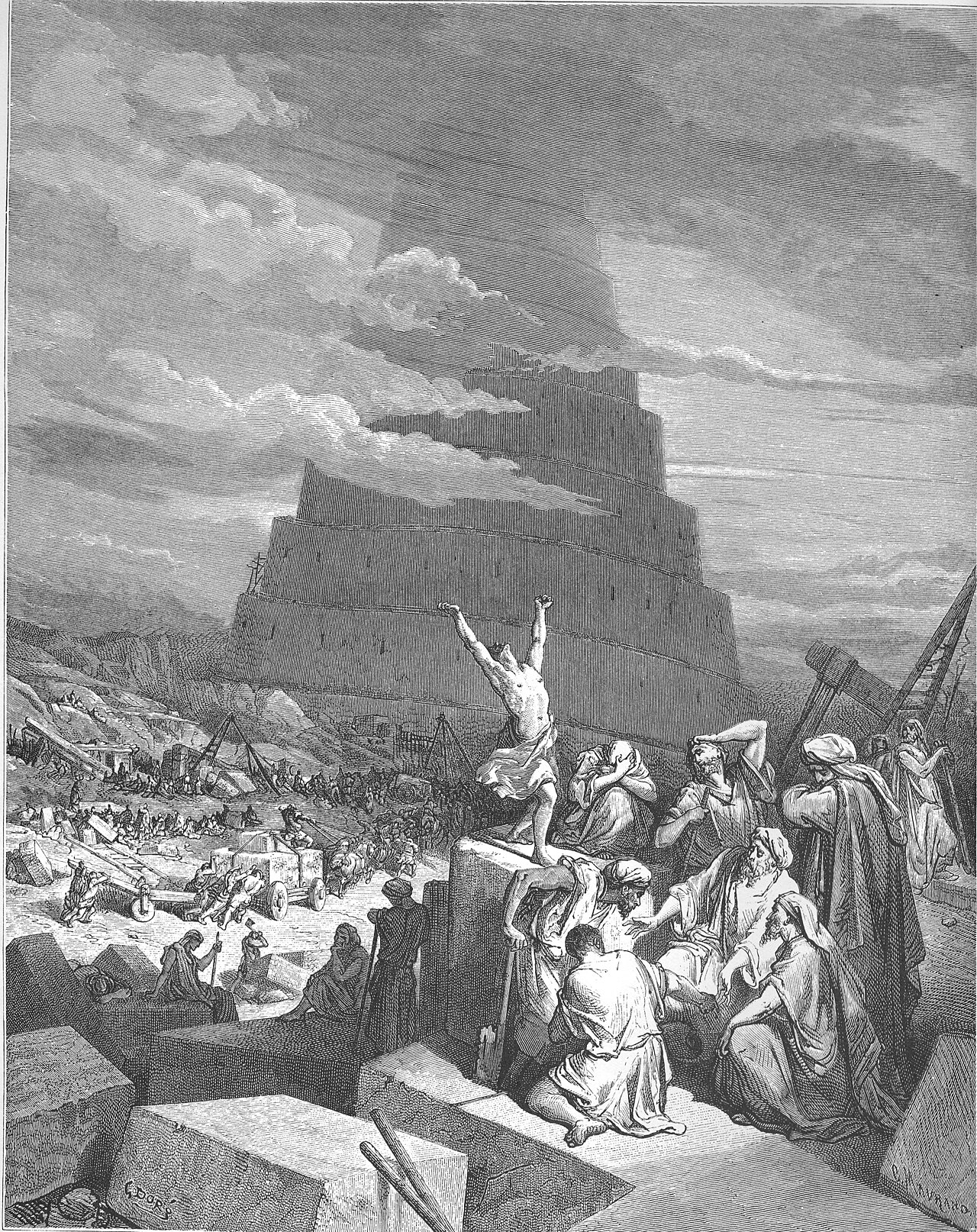
Gustave Doré, La Sainte Bible (Tours: Alfred Mame et fils, 1866). Public domain.
Summary
The city and tower on the plain of Shinar where men set out to make a name for themselves, and where God confused their speech and scattered them, a confusion Pentecost reverses.
- One people, one language, built a city and a tower on the plain of Shinar to make a name for themselves.
- God confused their speech so they could no longer understand one another, and scattered them over the earth.
- The place is called Babel for that reason, and it sits in the same land where Nimrod's kingdom began and where Babylon later stood.
- Zechariah later sees Wickedness itself carried back to Shinar to be given a house there.
- At Pentecost the confusion is answered: people of many nations each hear the apostles in their own tongue.
On this page
In Scripture
- Verses
- 1
- Books
- 1
Near Babel
Straight-line distances, computed from the gazetteer coordinates.
Where it is
the country around it
- Coordinates
- 32.5365° N, 44.4209° Eopen the Atlas →
- Region
- Shinar (Mesopotamia)
1 place the record names with Babel, the farthest 0.6 km away
- Located: the gazetteer fixes one site
- A dashed line ends at a place the gazetteer does not fix
Not located: Shinar. The gazetteer records no location for it, so it is not marked.
Why Babel matters
Babel: the tower and the confusion
Genesis 10:8-10 and 11:1-9, in the order it happens
Read Genesis 10:8-10 and 11:1-9, in the order it happens
- Nimrod's kingdom begins in ShinarGenesis 10:10His kingdom began in Babylon, Erech, Accad, and Calneh, in the land of Shinar.
- One language, one people, moving eastGenesis 11:1Now the whole world had one language and a common form of speech.
- A plain found, a city plannedGenesis 11:4“Come,” they said, “let us build for ourselves a city with a tower that reaches to the heavens, that we may make a name for ourselves and not be scattered over the face of all the earth.”
- The LORD comes down to seeGenesis 11:6And the LORD said, “If they have begun to do this as one people speaking the same language, then nothing they devise will be beyond them.
- The languages confusedGenesis 11:7Come, let Us go down and confuse their language, so that they will not understand one another’s speech.”
- Scattered, and the name givenGenesis 11:9That is why it is called Babel, for there the LORD confused the language of the whole world, and from that place the LORD scattered them over the face of all the earth.
Genesis 11 never names who built the tower. Tradition, not the text, ties it to Nimrod, whose kingdom Genesis 10:8-10 already places in the same land.
The Tower of Babel: the full studyWhat happened here, in order
in the order the canon tells it
- Nimrod becomes a mighty one on the earthGenesis 10:8Cush was the father of Nimrod, who began to be a mighty one on the earth.
- His kingdom's first cities, in the land of ShinarGenesis 10:10His kingdom began in Babylon, Erech, Accad, and Calneh, in the land of Shinar.
- A plain found in ShinarGenesis 11:2And as people journeyed eastward, they found a plain in the land of Shinar and settled there.
- Brick instead of stone, tar instead of mortarGenesis 11:3And they said to one another, “Come, let us make bricks and bake them thoroughly.” So they used brick instead of stone, and tar instead of mortar.
- The LORD comes down to see the city and the towerGenesis 11:5Then the LORD came down to see the city and the tower that the sons of men were building.
- The building stops, the people scatteredGenesis 11:8So the LORD scattered them from there over the face of all the earth, and they stopped building the city.
- Wickedness given a house in the land of ShinarZechariah 5:11“To build a house for it in the land of Shinar,” he told me. “And when it is ready, the basket will be set there on its pedestal.”
- Filled with the Spirit, speaking in other tonguesActs 2:4And they were all filled with the Holy Spirit and began to speak in other tongues as the Spirit enabled them.
- Every nation hears its own native languageActs 2:8How is it then that each of us hears them in his own native language?
- The wonders of God, in every tongueActs 2:11both Jews and converts to Judaism; Cretans and Arabs—we hear them declaring the wonders of God in our own tongues!”
Babel in Scripture
1 verse names it, in 1 book
Open a book to read its mentions here. Text: Berean Standard Bible.
The account
Read the account as one telling
Common questions
Where was Babel, and is it the same place as Babylon?
Genesis places Babel on a plain in the land of Shinar, and Genesis 10:10 already names Babylon as one of the first cities of Nimrod's kingdom in that same land. Babylon's own site, on the Euphrates, was excavated by Robert Koldewey between 1899 and 1917, and its ziggurat, Etemenanki, has long been read as standing where Babel's tower stood. The full case for and against that identification is set out on the Babylon page, which this page does not repeat.
Why did God confuse the languages?
The text gives its own reason. Speaking one language, the builders had said plainly that their goal was to make a name for themselves and avoid being scattered, in direct contradiction of God's command to fill the earth. God said that as one people with one tongue, nothing they set their mind to would be beyond them, and He confused their speech so the work could not continue. The judgment answers the stated purpose of the building rather than the building itself.
Was Nimrod the builder of the tower?
Readers differ; the positions are named
Genesis 11 does not name a builder. Genesis 10:8-10 says Nimrod founded a kingdom whose first cities included Babylon, in the land of Shinar, which is the same land where the tower is built one chapter later. The link between Nimrod and the tower itself comes from later tradition, stated plainly by Josephus in the Antiquities of the Jews, rather than from the Genesis 11 text. This page names the tradition and does not treat it as Scripture's own claim.
What does it mean that Pentecost reverses Babel?
At Babel one language became many, and understanding broke down. At Pentecost the apostles, still speaking their own native Galilean speech, are heard by Jews from many nations each in that nation's own language, declaring the wonders of God. The confusion that stopped a proud, defiant work becomes the means of a gospel going out to the nations Babel had scattered.
What does Zechariah's vision of Wickedness in Shinar mean?
Readers differ; the positions are named
Zechariah sees Wickedness personified as a woman, shut under a lead cover, carried by two winged women to have a house built for her in Shinar, the same land as Babel. Readers hold more than one position on what this pictures: some read it as wickedness returning to its ancient home and being confined there rather than let loose in the land, others as a symbol of exported sin finding a settled, lasting place. This page names the vision and does not choose between the readings.
Sources cited
- OpenBible.info Bible Geocoding: Babelread 2026-08-20The coordinates on this page. Used under CC-BY with attribution to OpenBible.info.
- Gustave Doré, La Sainte Bible (Tours: Alfred Mame et fils, 1866)The engraving on this page. Public domain.
- Flavius Josephus, Antiquities of the Jews, Book 1, Chapter 4Cited for the traditional identification of Nimrod as the tower's builder, which the Genesis text itself does not state.
Keep studying
On this page
Books that name it1
Lives that run through it1
Doorway2
Keep this page