

Ivan Aivazovsky, Descent of Noah from Ararat, 1889. Public domain.
Genesis 8 · Place · Featured Study
Ararat
Genesis 8:4 sets the ark on the mountains of Ararat, the highland the Assyrians called Urartu, where tradition has named two different peaks.
Readers have searched the mountains of Ararat for one summit since antiquity.
And the waters continued to recede until the tenth month, and on the first day of the tenth month the tops of the mountains became visible.
- Today
- the Armenian highlands, where tradition names two peaks
- Region
- the ancient kingdom of Urartu
- First named
- Genesis 8:4 “…rest on the mountains of Ararat.”
- Last named
- Jeremiah 51:27 “…her. Summon the kingdoms against her—Ararat, Minni, and…”
Readers have searched the mountains of Ararat for one summit since antiquity.
Summary
Ararat is the land where the ark came to rest when the flood went down.
- Genesis sets the ark in Ararat, and three other verses use the name for a country.
- The Assyrians called the same land Urartu, a kingdom from the ninth century BC to the sixth.
- An older tradition put the landing on Mount Judi. From the eleventh century, Armenians named the great cone now called Mount Ararat as the place.
The Mountains of Ararat
What the Hebrew word Ararat names, and what the Latin made of it.
The Hebrew word for mountains is plural, and Ararat is the name of a land. The lexicon glosses it as Armenia, and the Latin Vulgate of Jerome renders the phrase as the mountains of Armenia.
And the waters continued to recede until the tenth month, and on the first day of the tenth month the tops of the mountains became visible.Ten weeks passed between the landing and the first sight of a summit.
The Hebrew word for mountains is plural, and Ararat is the name of a land. The lexicon glosses it as Armenia, and the Latin Vulgate of Jerome renders the phrase as the mountains of Armenia.
The Land of Ararat on the Map
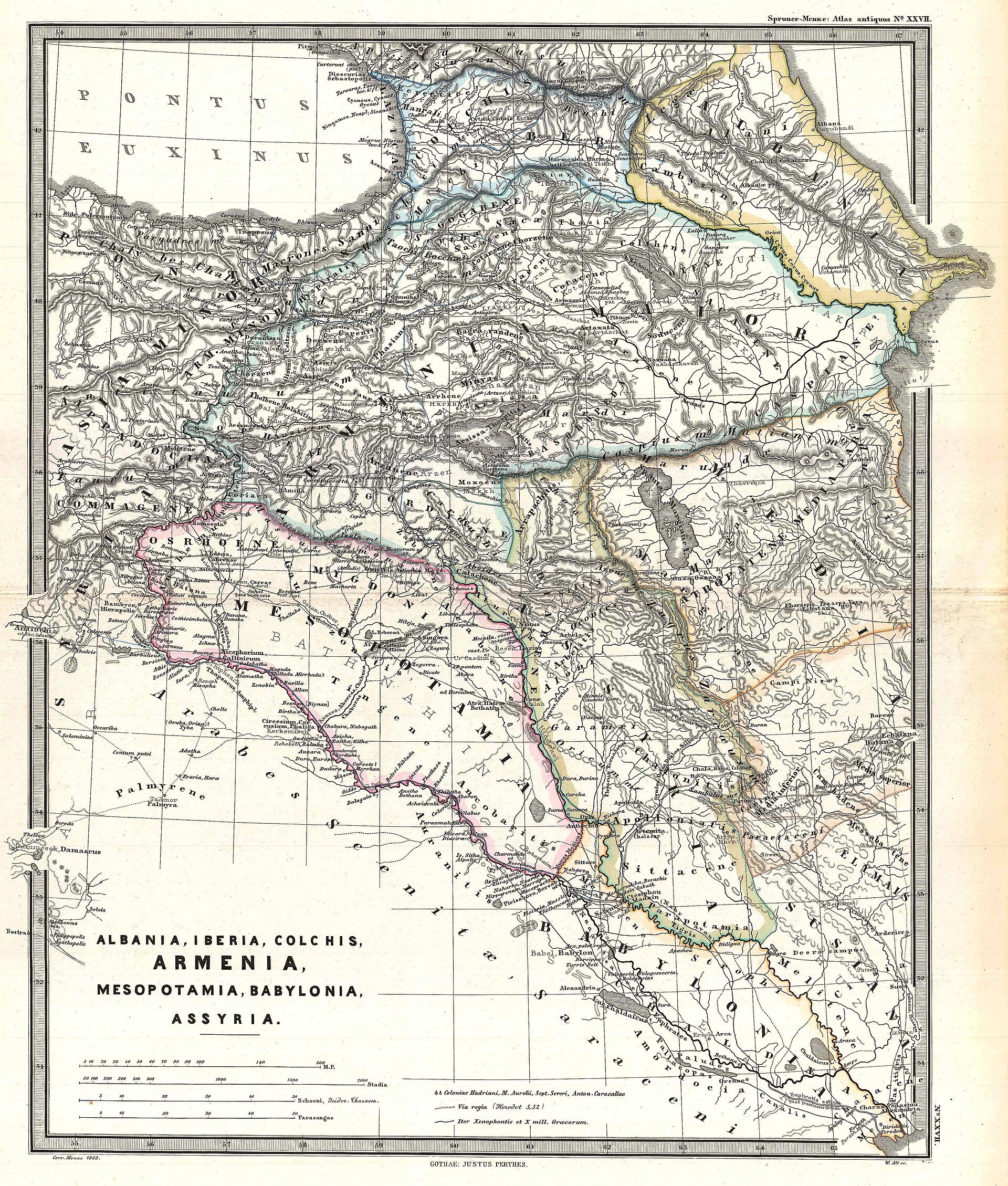
Spruner's plate of 1865 runs from the Armenian highlands down to Babylon.
Ararat lay north of Assyria, and tradition has named two of its mountains as the place the ark rested.
- Located: the site is known
- Proposed: a mountain tradition names as the landing place
- 1?Greater Ararat (Masis), The volcano called Mount Ararat in English Genesis 8:4
- 2?Mount Judi, The mountain of the Carduchi, the landing place of the older tradition Genesis 8:4
- 3Nineveh, Sennacherib's sons fled from here to the land of Ararat 2 Kings 19:37
- 4Babylon, The city against which Ararat was called to war Jeremiah 51:27
Base map: Albania, Iberia, Colchis, Armenia, Mesopotamia, Babylonia, Assyria, Karl von Spruner and Theodor Menke, Atlas Antiquus, plate XXVII (Gotha: Justus Perthes, 1865), public domain. Places with a place page stand at its coordinates and the others at the point cited for each, set on the plate by Haran and Masis, as the plate prints them.
Four places, each with the verse that ties it to Ararat. The plate prints Lake Van as Arsissa, the two peaks of Masis to the north of it and the Carduchi to the south.
Ararat Through Time
Four verses of Scripture and the record of the kingdom and the mountain, in order.
Scripture names Ararat in the days of Noah and again in the last century of the kingdom of Urartu.
- The days of NoahThe ark rests on the mountains of Ararat in the seventh month, on the seventeenth dayGenesis 8:4
- The mid ninth century BCThe kingdom of Urartu emerges in the Armenian highlands
- 680 BC, by Barnes's reckoningSennacherib's sons kill their father in Nineveh and escape to the land of Ararat2 Kings 19:37
- The same eventIsaiah tells the flight to Ararat in the same wordsIsaiah 37:38
- The early sixth century BCJeremiah summons the kingdoms of Ararat, Minni and Ashkenaz against BabylonJeremiah 51:27
- The sixth century BCUrartu falls, to the Medes or later to Cyrus
- About AD 93Josephus writes that the Armenians call the place of the landing the Place of Descent
- The eleventh centuryArmenians begin to name the great cone of Masis as the landing place
- 1829Friedrich Parrot and Khachatur Abovian make the first recorded ascent of the mountain
Nine events in order; the four rows of Scripture carry their verses.
About AD 93, The eleventh century, 1829
The Kingdom of Urartu
Assyria's records name the highland north of it Urartu, and the kingdom's own kings called it Biainili.
Urartu was an Iron Age kingdom in the highlands between Lake Van, Lake Urmia and Lake Sevan, and its capital Tushpa stood beside Lake Van. Its kings warred often with Assyria, and the name Urartu is the same name as the Hebrew Ararat.
One day, while he was worshiping in the temple of his god Nisroch, his sons Adrammelech and Sharezer put him to the sword and escaped to the land of Ararat. And his son Esar-haddon reigned in his place.The flight shows Ararat as a country outside the rule of Assyria.
“Raise a banner in the land! Blow the ram’s horn among the nations! Prepare the nations against her. Summon the kingdoms against her—Ararat, Minni, and Ashkenaz. Appoint a captain against her; bring up horses like swarming locusts.Here Ararat is a kingdom with its own army, called to war beside Minni and Ashkenaz.
The Mountain Called Ararat
Greater Ararat and Lesser Ararat are two cones of one dormant volcano.
Greater Ararat rises to 5,137 m (16,854 ft) and Lesser Ararat to 3,896 m (12,782 ft). An eruption and a landslide struck its north flank on 2 July 1840. Armenians call the mountain Masis.
What the travellers found on the mountainAdam Clarke on Genesis 8:4
Adam Clarke, in his Commentary of 1832, reports the monasteries on the mountain and the old reports that the remains of the ark could still be seen. He adds that the French naturalist Tournefort, who was on the spot, found nothing of the kind.
What Genesis Leaves Unsaid
Genesis records the landing and leaves several things about it untold.
Genesis gives no height for the place where the ark rested. It does not say what became of the ark after Noah left it, and it does not say which way the family went down from the mountains.
Where It Points
What happened when the family came down, and how the New Testament reads the rescue.
Then Noah built an altar to the LORD. And taking from every kind of clean animal and clean bird, he offered burnt offerings on the altar.The first thing built on the dry ground after the flood was an altar.
As long as the earth endures, seedtime and harvest, cold and heat, summer and winter, day and night shall never cease.”God answered the offering with a promise for the whole earth.
who disobeyed long ago when God waited patiently in the days of Noah while the ark was being built. In the ark a few people, only eight souls, were saved through water. And this water symbolizes the baptism that now saves you also—not the removal of dirt from the body, but the pledge of a clear conscience toward God—through the resurrection of Jesus Christ,Peter sets the household of the ark beside the church he writes to.
The Voices
Three teachers on the end of the flood, the refuge of Sennacherib's sons and the mountain, from Ephrem the Syrian to Jamieson, Fausset and Brown.
died 373 · Ephrem the Syrian
COMMENTARY ON GENESIS 6.13.3
The seasons given back after the flood year
The quotation1 quotation
“And because there was neither planting nor harvest during that year and the seasonal cycles had been disturbed, God restored to the earth that which had been taken away in his anger.”
Ephrem the Syrian · Commentary on Genesis 6.13.3 · on Genesis 8:22Patristic
1662 to 1714 · Matthew Henry
Commentary on the Whole Bible
The sons who escaped to Ararat
The quotation1 quotation
“Justly is his blood mingled with his sacrifices, since he will not be convinced by such a plain and dear-bought demonstration of his folly in worshipping idols. His sons that murdered him were suffered to escape, and no pursuit was made after them, his subjects perhaps being weary of the government of so proud a man and thinking themselves well rid of him.”
Matthew Henry · Commentary on the Whole Bible · on 2 Kings 19:37Puritan
1802 to 1910 · Jamieson, Fausset & Brown
Commentary Critical and Explanatory on the Whole Bible
The heights a reader was given in 1871
The quotation1 quotation, 1 paragraph
“The mountain which tradition points to as the one on which the ark rested is now called Ara Dagh, the ‘finger mountain.’ Its summit consists of two peaks, the higher of which is 17,750 feet and the other 13,420 above the level of the sea.”
Jamieson, Fausset & Brown · Commentary Critical and Explanatory on the Whole Bible · on Genesis 8:4Reformed
Modern surveys give lower heights for both peaks than the commentary of 1871.
Which Mountain?
Three readings of where in the land of Ararat the ark came to rest, each with its holders.
Mount Judi, in the land of the CarduchiBerossus, as Josephus quotes him; Hippolytus of Rome
Josephus, in his Antiquities of about AD 93, quotes the Babylonian priest Berossus: part of the ship was still in Armenia at the mountain of the Cordyaeans, and people carried off its bitumen as amulets. Hippolytus of Rome, in a fragment on Genesis, has the ark draw near Mount Kardu, and the Quran names al-Judi at Sura 11:44.
The objection: Corduene lay south of the highland, and Barnes places the Ararat of Jeremiah in the centre and east of Armenia.
Masis, the great coneWilliam of Rubruck; James Bryce, 1878
William of Rubruck is the earliest European writer usually cited for Masis as the landing place. The Wikipedia article on the mountain reports James Bryce, writing for the Royal Geographical Society in 1878. Bryce judged that the writer of Genesis had this mountain in mind because it is so much higher than any other summit in Armenia.
The objection: F. C. Conybeare held that the mountain was a centre of pagan myths and cults before Armenian theologians set the ark on its snows.
A land, with no peak namedAlbert Barnes on Genesis 8
Barnes reads Ararat as a land forming part of Armenia, and the verse in its plural leaves the place within that land open.
The objection: the ark came to rest at one place, and readers have always asked which one it was.
Books to Read Next
Two of these three works can be read free online.
Antiquities of the Jews, Book 1, chapter 3
Flavius Josephus, translated by William Whiston · about AD 93
Josephus quotes Berossus and Nicolaus of Damascus on the landing in Armenia.
Read at Project GutenbergTranscaucasia and Ararat
James Bryce · 1877
Bryce wrote these notes of his tour of the Caucasus and Ararat in the autumn of 1876.
Read at archive.orgThe Ancient Civilization of Urartu
Boris B. Piotrovsky · 1969
The excavator of Karmir Blur sets out the history and the finds of the kingdom of Urartu.
In print: find it wherever books are sold.
A World Begun Again
Ararat is where God set down the household He had carried through the judgment, and where the earth was given to them again.
The rescue Noah's household knew in the ark now comes through Christ, risen from the dead. The land of the landing asks the reader to come to Christ as Noah came into the ark, and to answer the rescue with worship.
Sources
Scripture is the Berean Standard Bible.
- Strong's Hebrew dictionary, h780.
- Flavius Josephus, Antiquities of the Jews 1.3.5 to 6, translated by William Whiston, public domain.
- OpenBible.info, Bible Geocoding Data, ancient.jsonl, CC BY.
- Matthew Henry, Commentary on the Whole Bible, 1710, on 2 Kings 19:37.
- Jamieson, Fausset and Brown, Commentary Critical and Explanatory on the Whole Bible, 1871, on Genesis 8:4.
- Ephrem the Syrian, Commentary on Genesis, on Genesis 8:22.
- Adam Clarke, Commentary on the Bible, 1832, on Genesis 8:4.
- Albert Barnes, Notes, Explanatory and Practical, on the Old and New Testaments, on Genesis 8, 2 Kings 19:37 and Jeremiah 51:27.
- Hippolytus of Rome, Exegetical Fragments, on Genesis 8.
- Bede, Commentary on Genesis, on Genesis 8:4, giving the Latin reading the mountains of Armenia.
- James Bryce, Transcaucasia and Ararat (London, 1877; the archive.org copy is the edition of 1878), public domain.
Keep Studying
Read it4