
Daniel 5:30
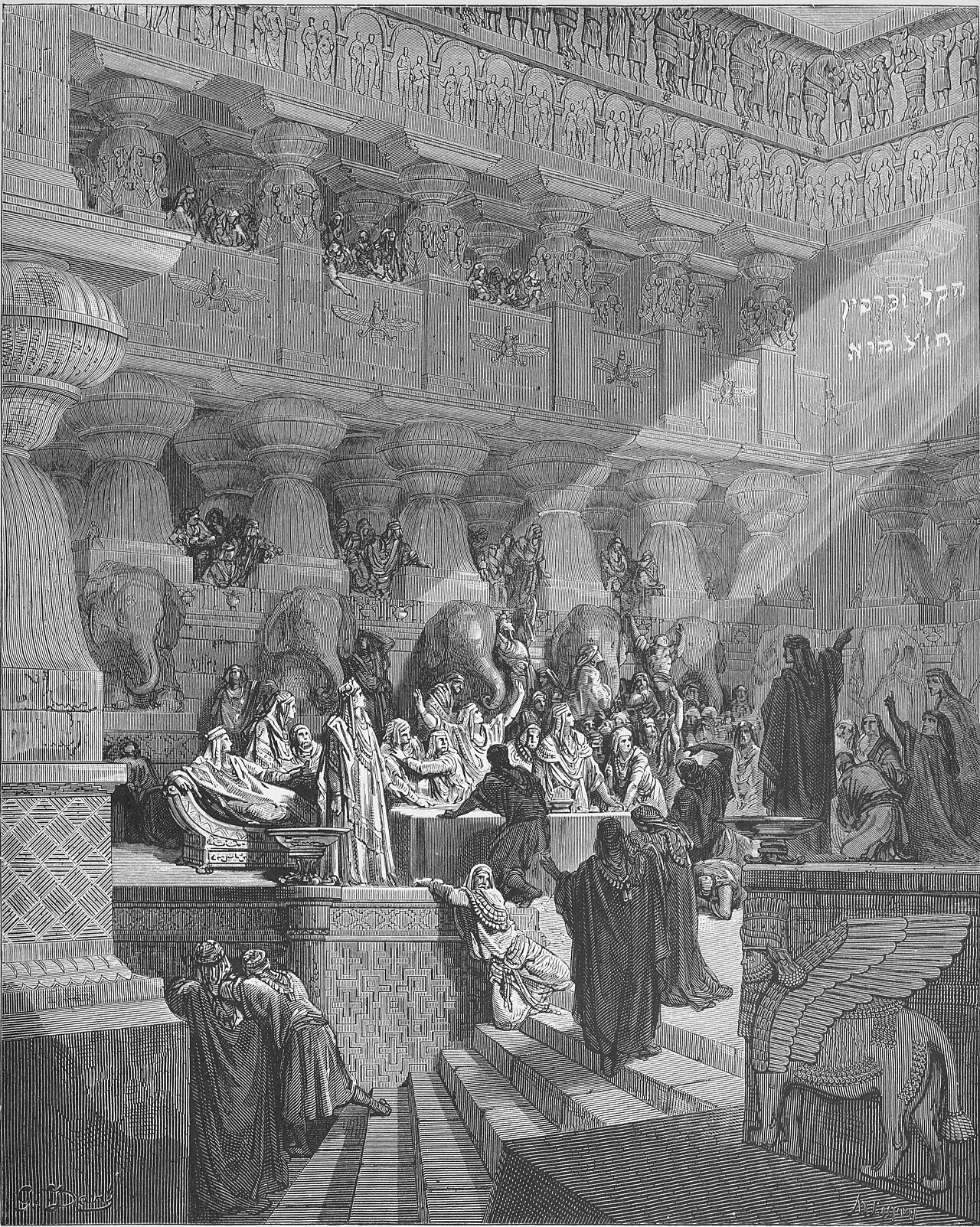
in Daniel 5That very night Belshazzar king of the Chaldeans was slain,
BSB
The same verse in ASV and KJV ▾
ASV
In that night Belshazzar the Chaldean king was slain.
KJV
In that night was Belshazzar the king of the Chaldeans slain.
⋯
This verse in Daniel 5
Commentary
9 notes on this verseVerses 30, 31. "On that same night Belshazzar, King of the Chaldeans, was slain, and Darius the Mede succeeded to his kingdom at the age of sixty-two." Josephus writes in his tenth book of the Jewish Antiquities that when Babylon had been laid under siege by the Medes and Persians, that is, by Darius and Cyrus, Belshazzar, King of Babylon, fell into such forgetfulness of his own situation as to put on his celebrated banquet and drink from the vessels of the Temple, and even while he was besieged he found leisure for banqueting.
This site's exposition
Belshazzar king of the Chaldeans
on Daniel 5:30-31
“That very night Belshazzar king of the Chaldeans was slain,” the sentence falling within hours of its writing and Babylon falling at the feast. “Darius the Mede received the kingdom at the age of sixty-two,” and the older commentators treat his identity as open. The book leaves it unresolved.
The record, by era
The Church Fathers2 voices
In the same night king Belshazzar the Chaldean was killed and Darius the Mede received the kingdom being sixty-two years old. [Daniel 5:29-31] After the interpretation had been solved by Daniel, just as Scripture encompasses all things, in the same night the phrase was fulfilled and the kingdom of the Babylonians passed to the Medes, just as was spoken by Daniel, "He appoints kings and removes them knowing what is in darkness and light is with him" [Daniel 2:21, 22]
Now, it is necessary to inquire why on earth the God of all corrected Nebuchadnezzar and in turn restored him to his kingdom but forthwith deprived this man of both kingdom and life. On consideration, then, we find, first, that Nebuchadnezzar had not observed another …
The Puritans and the Awakening3 voices
Now in this sumptuous feast, 1. He put an affront upon the providence of God and bade defiance to his judgments. His city was now besieged; a powerful enemy was at his gates; his life and kingdom lay at stake.
And it was foretold what a consternation it would be to the court, Jer. li. Note, Death comes as a snare upon those whose hearts are overcharged with surfeiting and drunkenness. The transferring of the kingdom into other hands.
In that night was Belshazzar, the king of the Chaldeans, slain.
2 more voices on this verse
The Nineteenth Century2 voices
In that night was Belshazzar - slain - Xenophon says, he was dispatched by two lords, Gadatas and Gobrias, who went over to Cyrus, to avenge themselves of certain wrongs which Belshazzar had done them. We have already seen that Cyrus entered the city by the bed of the Euphrates, which he had emptied, by cutting a channel for the waters, and directing them into the marshy country.
A commentator
Albert Barnes1798–1870
Notes, Explanatory and Practical, on the Old and New Testaments (1832-1869)
proposed
In that night was Belshazzar the king of the Chaldeans slain - On the taking of Babylon, and the consequences, see the notes at Isa 13:17-22; Isa 45:1-2. The account which Xenophon (“Cyrop.” vii. s.) gives of the taking of Babylon. and of the death of the king - though without mentioning his name, agrees so well with the statement here, that it may be regarded as a strong confirmation of its correctness. After describing the preparation made to take the city by draining off the waters of the Euphrates, so as to leave the channel dry beneath the walls for the amy of Cyrus, and after recording the charge which Cyrus gave to his generals Gadatas and Gobryas, he adds, “And indeed those who were with Gobryas said that it would not be wonderful if the gates of the palace should be found open, “as the whole city that night seemed to be given up to revelry” ὥς ἐν κώμῳ γὰρ δοκεῖ ἡ πόλις πᾶσα εἶναι τῇδε τῇ νυκτί hōs en kōmō gar dokei hē polis pasa einai tēde tē nukti. He then says that as they passed on, after entering the city, “of those whom they encountered, part being smitten died, part fled again back, and part raised a clamor. But those who were with Gobryas also raised a clamor as if they also joined in the revelry, and going as fast as they could, they came soon to the palace of the king. But those who were with Gobryas and Gadatas being arrayed, found the gates of the palace closed, but those who were appointed to go against the guard of the palace fell upon them when drinking before a great light, and were quickly engaged with them in hostile combat. Then a cry arose, and they who were within having asked the cause of the tumult, the king commanded them to see what the affair was, and some of them rushing out opened the gates. […]
The words behind it
6 Hebrew wordsEvery Hebrew word of this verse in the order it stands, with what it means and the door to its own study. The last column counts the times a word stands in the whole Bible: the rarer the word, the more the places it appears belong together.
| Hebrew | Sound | Meaning | Word study | In the Bible |
|---|---|---|---|---|
| בֵּ֚הּ | beh | on it | ||
| בְּלֵ֣ילְיָ֔א | beleileya' | on night the | H3916 → | 5 times |
| קְטִ֕יל | ketil | he was killed | H6992 → | 7 times |
| בֵּלְאשַׁצַּ֖ר | beleshatzar | Belshazzar | H1113 → | 7 times |
| מַלְכָּ֥א | malka' | king the | H4430 → | 180 times |
| כַשְׂדָּאָֽה׃ פ | khasdaya' | Chaldeans the | H3779 → | 8 times |
בֵּ֚הּon it
beh
בְּלֵ֣ילְיָ֔אon night the
beleileya'H3916 →5 times
קְטִ֕ילhe was killed
ketilH6992 →7 times
בֵּלְאשַׁצַּ֖רBelshazzar
beleshatzarH1113 →7 times
מַלְכָּ֥אking the
malka'H4430 →180 times
כַשְׂדָּאָֽה׃ פChaldeans the
khasdaya'H3779 →8 times
A shaded row is a word that stands 400 times or fewer in the Bible.
The walk
8 stopsEach card is a verse this one points to, and under it the verses that one points to in turn. Where several paths arrive at the same place, that place is listed first: the text keeps returning to it.
Through
Jeremiah 51:39While they are flushed with heat, I will serve them a feast, and I will make them drunk so that they may revel; then they will fall asleep forever and never wake up, declares…
it leads to
- Jeremiah 25:27
“Then you are to tell them that this is what the LORD of Hosts, the God of Israel, says: ‘Drink, get drunk, and vomit. Fall down and never get up again, because of the…
Reached by 2 separate paths from here.
- Jeremiah 51:57
I will make her princes and wise men drunk, along with her governors, officials, and warriors. Then they will fall asleep forever and not wake up,” declares the King, whose name is the LORD…
- Nahum 1:10
For they will be entangled as with thorns and consumed like the drink of a drunkard—like stubble that is fully dry.
- Isaiah 22:12–14
On that day the Lord GOD of Hosts called for weeping and wailing, for shaven heads and the wearing of sackcloth.
- Jeremiah 25:27
Through
Jeremiah 51:57I will make her princes and wise men drunk, along with her governors, officials, and warriors. Then they will fall asleep forever and not wake up,” declares the King, whose name is the LORD…
it leads to
- Jeremiah 46:18
As surely as I live, declares the King, whose name is the LORD of Hosts, there will come one who is like Tabor among the mountains and like Carmel by the sea.
- Jeremiah 48:15
Moab has been destroyed and its towns have been invaded; the best of its young men have gone down in the slaughter, declares the King, whose name is the LORD of Hosts.
- Jeremiah 46:18
Through
Jeremiah 51:31One courier races to meet another, and messenger follows messenger, to announce to the king of Babylon that his city has been captured from end to end.
it leads to
- 2 Samuel 18:19–31
Then Ahimaaz son of Zadok said, “Please let me run and tell the king the good news that the LORD has avenged him of his enemies.”
- 2 Chronicles 30:6
So the couriers went throughout Israel and Judah with letters from the king and his officials, which read: “Children of Israel, return to the LORD, the God of Abraham, Isaac, and Israel, so that…
- 2 Samuel 18:19–31
Where this verse is studied
On this page
About Daniel
This page draws on 9 works. Open the list of works
This page draws on Adam Clarke, Commentary on the Bible; Albert Barnes, Notes on the Book of Daniel; Albert Barnes, Notes, Explanatory and Practical, on the Old and New Testaments (1832-1869); Carl Friedrich Keil, Biblical Commentary on the Book of Daniel; Hippolytus of Rome, Commentary on Daniel 3.18.2-3; Jerome, St. Jerome, Commentary on Daniel, CHAPTER FIVE; John Gill, Exposition of the Old Testament (1748-1763); Matthew Henry, Commentary on the Whole Bible and Theodoret of Cyrus, COMMENTARY ON DANIEL 5:28.