
Daniel 5:29
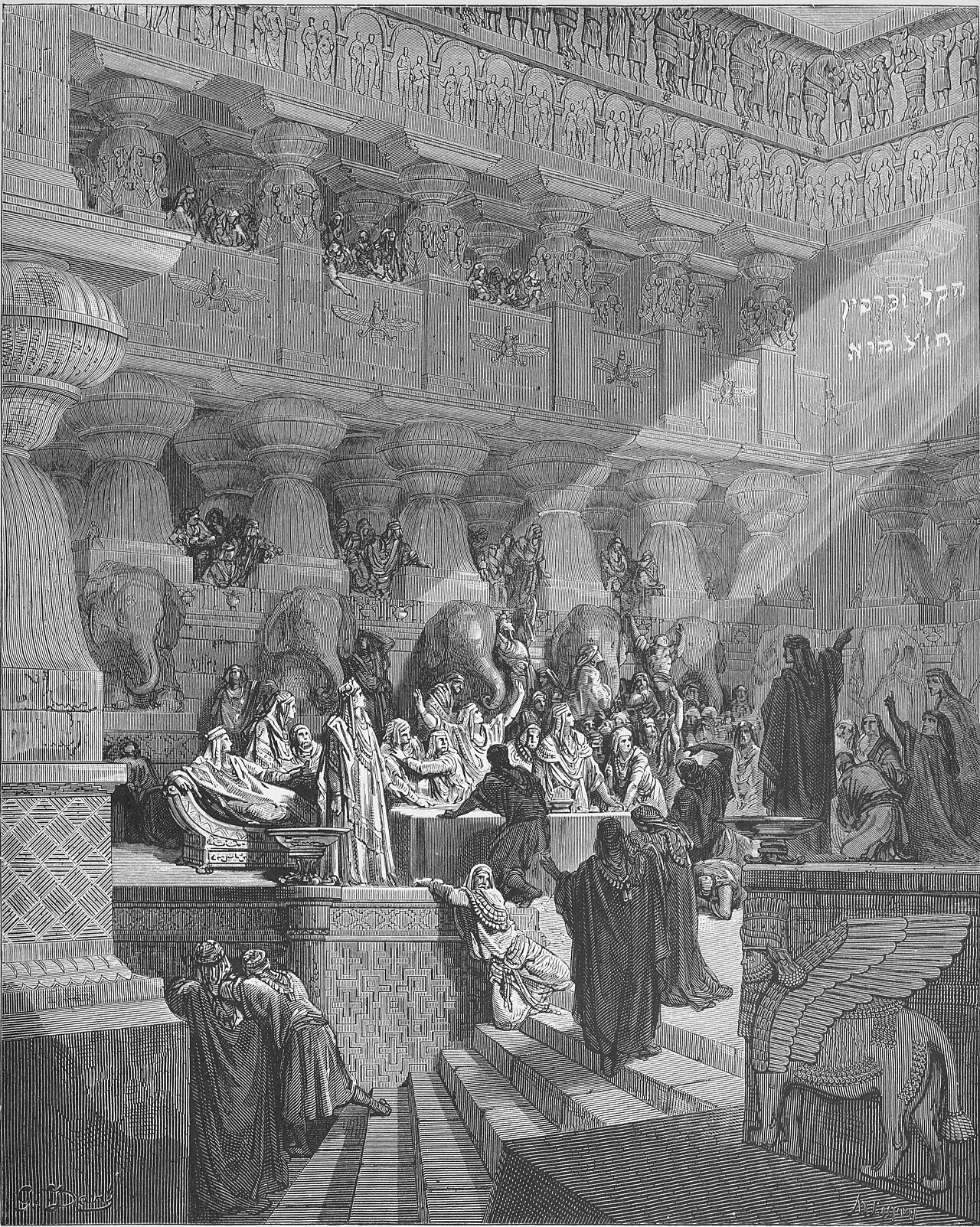
in Daniel 5Then Belshazzar gave the command, and they clothed Daniel in purple, placed a gold chain around his neck, and proclaimed him the third highest ruler in the kingdom.
BSB
The same verse in ASV and KJV ▾
ASV
Then commanded Belshazzar, and they clothed Daniel with purple, and put a chain of gold about his neck, and made proclamation concerning him, that he should be the third ruler in the kingdom.
KJV
Then commanded Belshazzar, and they clothed Daniel with scarlet, and put a chain of gold about his neck, and made a proclamation concerning him, that he should be the third ruler in the kingdom.
⋯
This verse in Daniel 5
Commentary
9 notes on this verseVerse 29. "Then at the kings order Daniel was clothed with purple and a golden chain was placed around his neck, and he was proclaimed to have authority as third ruler in the kingdom." Or else, it might be construed as having authority over a third part of the kingdom. At any rate he received the royal insignia of necklace and purple, with the result that he appeared more notable to Darius, who was to be the successor in the royal power, and all the more honorable because of his notability.
This site's exposition
third highest ruler in the kingdom
Belshazzar keeps his word under sentence, giving Daniel the purple, the gold chain and the rank of “the third highest ruler in the kingdom”. Nineteenth and twentieth century archaeology shows Belshazzar as co-regent under his father Nabonidus, who remained first ruler, so third was the most he could give.
The record, by era
The Church Fathers2 voices
The vain king did not do that in order to give honor to Daniel for those sad omens, which he had announced to him by interpreting the writing, but he tried to catch his benevolence, as if he had understood that Daniel was extremely pleasing …
For the king, after he heard the writing and its interpretation, was grieved at what was spoken, but he commanded Daniel to be clothed in purple and to be the third position in the kingdom.
The Puritans and the Awakening2 voices
30 In that night was Belshazzar the king of the Chaldeans slain. 31 And Darius the Median took the kingdom, being about threescore and two years old. Reason enough he had to tremble, for he was just falling into the hands of the king of terrors,
quarantine:scripture (2026-07-29) — verbatim-run:25w-of-44
Then commanded Belshazzar,....
The Nineteenth Century1 voice
A commentator
Jamieson, Fausset & Brown1802–1910
Commentary Critical and Explanatory on the Whole Bible (1871)
As the capture of the city by Cyrus was not till near daylight, there was no want of time in that eventful night for accomplishing all that is here recorded. The capture of the city so immediately after the prophecy of it (following Belshazzar's sacrilege), marked most emphatically to the whole world the connection between Babylon's sin and its punishment.
2 more voices on this verse
The Nineteenth Century2 voices
Clothed Daniel with scarlet - ארגונא argevana, more probably with purple. The gold chain about the neck was an emblem of magisterial authority. It is often thus mentioned in Scripture.
A commentator
Albert Barnes1798–1870
Notes, Explanatory and Practical, on the Old and New Testaments (1832-1869)
proposed
Then commanded Belshazzar - In compliance with his promise, Dan 5:16. Though the interpretation had been so fearful in its import, and though Daniel had been so plain and faithful with him, yet he did not hesitate to fulfill his promise. It is a remarkable instance of the result of fidelity, that a proud monarch should have received such a reproof, and such a prediction in this manner, and it is an encouragement to us to do our duty, and to state the truth plainly to wicked men.
The words behind it
18 Hebrew wordsEvery Hebrew word of this verse in the order it stands, with what it means and the door to its own study. The last column counts the times a word stands in the whole Bible: the rarer the word, the more the places it appears belong together.
| Hebrew | Sound | Meaning | Word study | In the Bible |
|---|---|---|---|---|
| בֵּאדַ֣יִן׀ | bedayin | <in> then | H116 → | 57 times |
| אֲמַ֣ר | ʾamar | he said | H560 → | 71 times |
| בֵּלְשַׁאצַּ֗ר | beleshatzar | Belshazzar | H1113 → | 7 times |
| וְהַלְבִּ֤ישׁוּ | vehalbishu | and they clothed | H3848 → | 3 times |
| לְדָֽנִיֵּאל֙ | ledaniyel | <obj.> Daniel | H1841 → | 57 times |
| אַרְגְּוָנָ֔א | ʾargevana' | <the> purple | H711 → | 3 times |
| וְהַֽמְנִיכָ֥א | vehamonkha' | and necklace the | H2002 → | 3 times |
| דִֽי־ | di- | of | H1768 → | 345 times |
| דַהֲבָ֖א | dahava' | <the> gold | H1722 → | 23 times |
| עַֽל־ | ʾal- | [was] on | H5922 → | 104 times |
| צַוְּארֵ֑הּ | tzavereh | neck his | H6676 → | 3 times |
| וְהַכְרִ֣זֽוּ | vehakhrizu | and they made proclamation | H3745 → | |
| עֲל֔וֹהִי | alohi | concerning him | H5922 → | 104 times |
| דִּֽי־ | di- | that | H1768 → | 345 times |
| לֶהֱוֵ֥א | leheve' | he will be | H1934 → | 71 times |
| שַׁלִּ֛יט | shalit | having mastery | H7990 → | 10 times |
| תַּלְתָּ֖א | talta' | third the | H8531 → | |
| בְּמַלְכוּתָֽא׃ | bemalkhuta' | in kingdom the | H4437 → | 57 times |
בֵּאדַ֣יִן׀<in> then
bedayinH116 →57 times
אֲמַ֣רhe said
ʾamarH560 →71 times
בֵּלְשַׁאצַּ֗רBelshazzar
beleshatzarH1113 →7 times
וְהַלְבִּ֤ישׁוּand they clothed
vehalbishuH3848 →3 times
לְדָֽנִיֵּאל֙<obj.> Daniel
ledaniyelH1841 →57 times
אַרְגְּוָנָ֔א<the> purple
ʾargevana'H711 →3 times
וְהַֽמְנִיכָ֥אand necklace the
vehamonkha'H2002 →3 times
דִֽי־of
di-H1768 →345 times
דַהֲבָ֖א<the> gold
dahava'H1722 →23 times
עַֽל־[was] on
ʾal-H5922 →104 times
צַוְּארֵ֑הּneck his
tzaverehH6676 →3 times
וְהַכְרִ֣זֽוּand they made proclamation
vehakhrizuH3745 →
עֲל֔וֹהִיconcerning him
alohiH5922 →104 times
דִּֽי־that
di-H1768 →345 times
לֶהֱוֵ֥אhe will be
leheve'H1934 →71 times
שַׁלִּ֛יטhaving mastery
shalitH7990 →10 times
תַּלְתָּ֖אthird the
talta'H8531 →
בְּמַלְכוּתָֽא׃in kingdom the
bemalkhuta'H4437 →57 times
A shaded row is a word that stands 400 times or fewer in the Bible.
The walk
8 stopsEach card is a verse this one points to, and under it the verses that one points to in turn. Where several paths arrive at the same place, that place is listed first: the text keeps returning to it.
Through
Daniel 5:7The king called out for the enchanters, astrologers, and diviners to be brought in, and he said to these wise men of Babylon, “Whoever reads this inscription and tells me its interpretation will be…
it leads to
- Daniel 5:16
But I have heard about you, that you are able to give interpretations and solve difficult problems. Therefore, if you can read this inscription and give me its interpretation, you will be clothed in…
- Daniel 2:48
Then the king promoted Daniel and gave him many generous gifts. He made him ruler over the entire province of Babylon and chief administrator over all the wise men of Babylon.
- Genesis 41:42–44
Then Pharaoh removed the signet ring from his finger, put it on Joseph’s finger, clothed him in garments of fine linen, and placed a gold chain around his neck.
- Daniel 2:6
But if you tell me the dream and its interpretation, you will receive from me gifts and rewards and great honor. So tell me the dream and its interpretation.”
- Daniel 6:2–3
and over them three administrators, including Daniel, to whom these satraps were accountable so that the king would not suffer loss.
- Daniel 5:16
Through
Daniel 5:16But I have heard about you, that you are able to give interpretations and solve difficult problems. Therefore, if you can read this inscription and give me its interpretation, you will be clothed in…
it leads to
- Daniel 5:7
The king called out for the enchanters, astrologers, and diviners to be brought in, and he said to these wise men of Babylon, “Whoever reads this inscription and tells me its interpretation will be…
- Genesis 40:8
“We both had dreams,” they replied, “but there is no one to interpret them.” Then Joseph said to them, “Don’t interpretations belong to God? Tell me your dreams.”
- Acts 8:18
When Simon saw that the Spirit was given through the laying on of the apostles’ hands, he offered them money.
- Daniel 5:7
Where this verse is studied
About Daniel
Who and where
1 name in this verse with a page on the site.
This page draws on 10 works. Open the list of works
This page draws on Adam Clarke, Commentary on the Bible; Albert Barnes, Notes on the Book of Daniel; Albert Barnes, Notes, Explanatory and Practical, on the Old and New Testaments (1832-1869); Carl Friedrich Keil, Biblical Commentary on the Book of Daniel; Ephrem the Syrian, COMMENTARY ON DANIEL 5:29; Hippolytus of Rome, Commentary on Daniel 3.18.1; Jamieson, Fausset & Brown, Commentary Critical and Explanatory on the Whole Bible; Jerome, St. Jerome, Commentary on Daniel, CHAPTER FIVE; John Gill, Exposition of the Old Testament (1748-1763) and Matthew Henry, Commentary on the Whole Bible.