
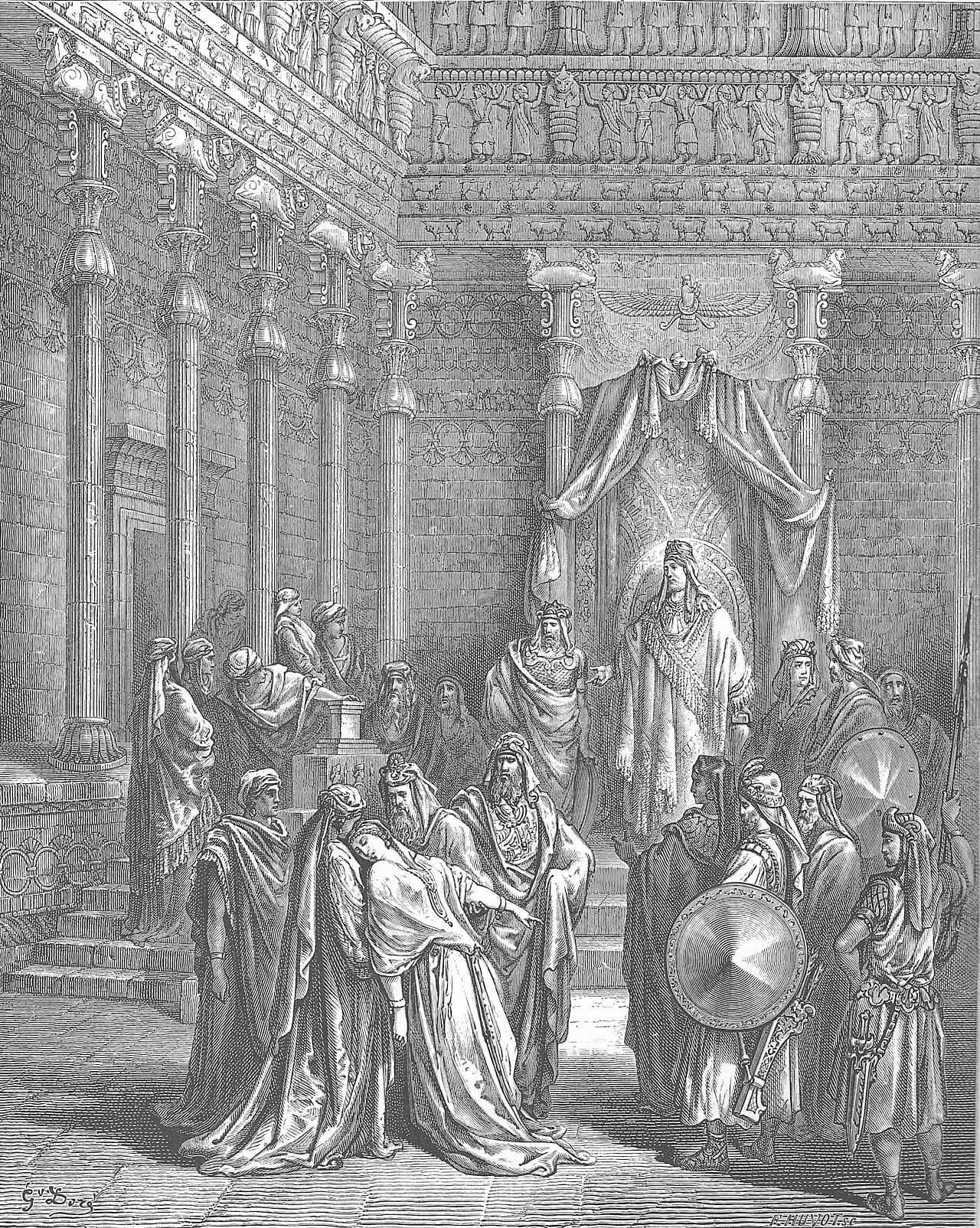
Esther Before the King, Gustave Doré, 1866. Public domain.
Old Testament · Book 17 of 66
Esther
Esther tells how a Jewish woman became queen of Persia and, with her cousin Mordecai, saved her people from Haman's plot to destroy them. The feast of Purim marks that deliverance.
Esther tells how a Jewish woman became queen of Persia and, with her cousin Mordecai, saved her people from Haman's plot to destroy them. The feast of Purim marks that deliverance.
What is Esther about?
Esther tells how the Jews scattered through the Persian empire were saved from a day set for their destruction. The king puts away his queen, Vashti, and makes Esther, a Jewish orphan raised by her cousin Mordecai, queen in her place. Haman, raised above all the princes, casts the lot and wins an edict to kill every Jew on one day. Mordecai urges Esther to go to the king unsummoned, for who knows whether she has come to the kingdom “for such a time as this” (4:14). She risks her life, Haman is hanged on the gallows he built, and the day of death becomes the feast of Purim.
All 10 chapters
Every chapter of the book, in one grid. Each cell opens that chapter.
- The feast and the queenEsther 1 to 2
- The decreeEsther 3 to 4
- The reversalEsther 5 to 7
- The deliveranceEsther 8 to 10
The colour is the movement of the story the chapter stands in, and every cell opens that chapter's Study level.
Who wrote it, where, when, for whom, and why?
The book names no writer. It says that Mordecai recorded these events and sent letters to all the Jews in the provinces (9:20), that Esther wrote with Mordecai with full authority to confirm the second letter about Purim (9:29), and that her decree was written into the record (9:32). For the whole account of Mordecai's greatness it sends the reader to the Book of the Chronicles of the Kings of Media and Persia (10:2). No other book of Scripture tells this story or names Esther.
Mordecai recorded these events and sent letters to all the Jews in all the provinces of King Xerxes, both near and far,
Esther 9:20, Berean Standard Bible.
The story stands in the citadel of Susa, where the king sits on his throne (1:2): the garden court of the palace (1:5), the harem (2:8), the king's gate where Mordecai sits (2:19), the inner court no one may enter unsummoned (4:11) and Haman's house (5:10). The edicts go out to the provinces from India to Cush (1:1, 8:9). Jerusalem is named once, as the city Mordecai's family was carried from (2:6).
The book dates itself by the years of the king's reign. The first feast is in the third year (1:3), Esther is taken to the king in the tenth month of the seventh year (2:16), and the lot is cast in the first month of the twelfth year (3:7). The day of the edicts falls in the twelfth month, Adar, of that year (3:13, 9:1). Mordecai's family had gone into exile with Jeconiah king of Judah under Nebuchadnezzar (2:5 and 6), so the story is set among the Jews who remained in the east.
Mordecai's letters go to all the Jews in all the provinces, near and far (9:20), and the days are to be kept by every generation, family, province and city, by the Jews, their descendants and all who join them (9:27 and 28).
The book gives its purpose in its last chapter: to confirm the days of Purim at their appointed time (9:31), the days on which the Jews gained rest from their enemies and their sorrow turned to joy (9:22), so that their memory would not fade from their descendants (9:28).
This is the Persian court. Letters go by couriers on royal horses to each province in its own script (1:22, 8:10), a decree sealed with the king's ring cannot be revoked (8:8), no one enters the king's presence unsummoned (4:11), and the king's deeds are written in the Book of the Chronicles (2:23, 6:1). Haman is an Agagite (3:1) and Mordecai a Benjamite descended from Kish (2:5); Scripture names Agag as the Amalekite king Saul son of Kish spared (1 Samuel 9:1 and 15:8).
Sources. Esther 1:1, 1:2, 1:3, 1:5, 1:22, 2:5 and 6, 2:8, 2:16, 2:19, 2:23, 3:1, 3:7, 3:13, 4:11, 5:10, 6:1, 8:8, 8:9, 8:10, 9:1, 9:20, 9:22, 9:27 and 28, 9:29, 9:31, 9:32 and 10:2; 1 Samuel 9:1 and 15:8. Every verse is read in the Berean Standard Bible.
How is Esther arranged, and what is it for?
The four movements the story falls into, then what it teaches and what it was written to do.
- The feast and the queenChapters 1 to 2, 45 verses
The king's feasts, Vashti put away, Esther made queen, and a plot against the king uncovered.
The turn, 2:17. The king sets the royal crown on Esther's head.
- The decreeChapters 3 to 4, 32 verses
Haman raised, the lot cast, an edict to kill every Jew, and Mordecai's word to Esther.
The turn, 4:14. Mordecai asks whether Esther has come to the kingdom for this time.
- The reversalChapters 5 to 7, 38 verses
Two banquets and the night between them: Mordecai honoured and Haman hanged.
The turn, 6:1. The king cannot sleep, and the chronicles are read to him.
- The deliveranceChapters 8 to 10, 52 verses
The ring given to Mordecai, a second edict, the day overturned, and Purim set for every year.
The turn, 9:1. On the day set for their destruction the Jews overpower those who hated them.
The theme
A people in exile, under a king who does not know them, is marked for death by an enemy's lot and an edict that cannot be revoked. The rescue comes through a queen who hid her people and then speaks for them, a deed recorded and forgotten that is read on a sleepless night, and a second edict under the same ring. Each thing Haman sets up falls back on his own head, and the book leaves the hand behind the turning unnamed, so the reader is made to look for it.
The purpose
Esther was written so that the Jews would keep Purim every year and remember the month their sorrow turned to joy. It gives the feast its reason, its dates and its customs of feasting and of gifts to one another and to the poor. It shows the Jews who stayed in the east after the exile that they were still kept as a people, and it stands beside Ezra and Nehemiah as the story of those who did not go home.
Everything turns on one night
Set up
Answered
The king feasts his officials and princes.
The Jews feast in every province and city.
Haman's edict, written on the thirteenth day of the first month.
Mordecai's edict, written on the twenty-third day of the third month.
Mordecai tears his clothes and puts on sackcloth and ashes.
Mordecai goes out in royal garments of blue and white.
Haman builds a gallows for Mordecai.
Haman is hanged on the gallows he prepared.
Haman thinks the king means to honour him.
Haman leads Mordecai through the square in the king's robe.
The feast and the queen, Esther 1 to 2
What the text says in these two chapters, and the pages they open on.
In the third year of his reign Xerxes shows the riches of his kingdom for half a year and then holds a seven-day feast in the citadel of Susa. On the seventh day he sends for Queen Vashti to display her beauty, and she refuses to come. On the counsel of his princes he decrees that she will never again enter his presence. Young women are gathered from every province, and Esther, the orphan her cousin Mordecai has raised as his daughter, is taken into the palace under the care of Hegai. On Mordecai's word she does not reveal her people. In the seventh year the king sets the royal crown on her head. Mordecai then learns of a plot by two of the king's eunuchs, Esther reports it in his name, and the deed is written in the chronicles and left unrewarded (2:23).
And the king loved Esther more than all the other women, and she found grace and favor in his sight more than all of the other virgins. So he placed the royal crown upon her head and made her queen in place of Vashti.
- Study
Esther 1the king's feasts, and Vashti refuses to comeShow the summary and 3 pagesShow summary, 3 pagesHide the summary
Ahasuerus reigns from India even to Ethiopia over a hundred and twenty and seven provinces, and throws a hundred and eighty days of display for his princes, then seven days of feasting in the palace garden court for everyone in Shushan, white cloth and blue hangings, pillars of marble, couches of gold and silver, and drinking by decree that 'no limit was placed on the drinking, and every official of his household was to serve each man whatever he desired.' Queen Vashti feasts the women separately. On the seventh day the king, merry with wine, sends seven chamberlains to bring her wearing the royal crown to show her beauty; she refuses. Fearing the example will reach every wife in the empire, the princes have Vashti deposed by unalterable law, 'that every man should be master of his own household.'
- The king shows the riches of his kingdom for half a year and then feasts the citadel for seven days (1:4 and 5).
- Vashti refuses to come at the king's command, brought by his eunuchs (1:12).
- A decree that cannot be repealed removes her, and letters go to every province in its own script (1:19 to 22).
On this chapter (3)
- Persia
The empire behind the book, its kings and its court.
- Is Ahasuerus Xerxes, and what does Herodotus record of his queen?
Answered under Where do readers disagree, lower on this page, with each reading and who holds it.
- Esther 1:12
The verse on its own page, with the commentators on it by era.
- Study
Esther 2Esther made queen, and a plot uncoveredShow the summary and 3 pagesShow summary, 3 pagesHide the summary
Virgins are gathered to Shushan under Hegai the keeper of the women. Mordecai the Benjamite, carried away in the captivity of Jeconiah, had brought up his uncle's daughter Hadassah, that is Esther, 'and the maiden was fair and beautiful.' Twelve months of purifying follow (six with oil of myrrh, six with spices) and Esther, requiring nothing beyond what Hegai appointed, 'obtained favor in the sight of all them that looked upon her.' The king loves her above all the women, sets the royal crown upon her head, and makes her queen instead of Vashti. She keeps her people secret at Mordecai's charge. At the king's gate Mordecai uncovers the plot of Bigthan and Teresh: written in the chronicles, and left unrewarded.
On this chapter (3)
- The exile and return
How the Jews came to live in Babylon and Persia.
- Were Esther's concealment and the second day of killing right?
Answered under Where do readers disagree, lower on this page, with each reading and who holds it.
- Esther 2:17
The verse on its own page, with the commentators on it by era.
- The exile and return
The 10 feasts of the book
- 11:3 and 4Of the court
The king's feast for his officials, after a display of wealth lasting half a year.
- 21:5Of the court
A seven-day feast for all the people of the citadel.
- 31:9Of the court
Vashti's banquet for the women of the palace.
- 42:18Of the court
Esther's banquet, given by the king when she is crowned.
- 53:15Of the court
The king and Haman sit down to drink as the edict goes out.
- 65:5Of the court
Esther's first banquet for the king and Haman.
- 77:1Of the court
Esther's second banquet, where she names Haman.
- 88:17Of the Jews
Feasting among the Jews when the second edict reaches them.
- 99:17 to 19Of the Jews
Rest and feasting on the fourteenth, and in Susa on the fifteenth.
- 109:22Of the Jews
Purim, days of feasting and gifts kept every year.
Characters (6)
Who the text names. A name with a page carries its door.
- Xerxes
The Persian king, Ahasuerus in the Hebrew, who rules from Susa over the provinces from India to Cush (1:1).
- Vashti
The queen who refuses the king's summons and is put away (1:12, 1:19).
- Esther
Hadassah, the orphan raised as Mordecai's daughter and made queen in place of Vashti (2:7, 2:17).
- Mordecai
A Benjamite of Susa, carried from Jerusalem with Jeconiah's exiles, who raised Esther (2:5 to 7).
Show the next 2
- Hegai
The king's eunuch in charge of the women, who shows Esther favour (2:9, 2:15).
- Memucan
The prince whose counsel removes Vashti (1:16 to 21).
Places (3)
Where the chapters stand.
- Susa
The Persian capital whose citadel holds the king's throne (1:2).
- The citadel
The fortified palace quarter of Susa where the feasts are held (1:5).
- The harem
Where the young women are kept for twelve months before they go to the king (2:12).
Themes (2)
What these chapters raise, each on its own page.
- Persia
The empire behind the book, its king and its court.
- The exile and return
Why a Benjamite from Jerusalem lives in Susa (2:6).
No New Testament passage quotes or names these chapters.
The decree, Esther 3 to 4
What the text says in these two chapters, and the pages they open on.
The king raises Haman the Agagite above all the princes, and every servant at the king's gate bows to him except Mordecai, who has told them he is a Jew. Haman resolves to destroy not Mordecai alone but all his people. In the first month the Pur, the lot, is cast before him and falls on the twelfth month. He tells the king of a scattered people whose laws differ, offers ten thousand talents of silver, and receives the king's signet ring. The edict goes out in every script and language to kill all the Jews on one day, and the king and Haman sit down to drink while the city is in confusion (3:15). Mordecai puts on sackcloth, and through Hathach he sends Esther a copy of the edict and urges her to go to the king. She answers that anyone who enters the inner court unsummoned dies unless the king holds out the gold scepter. Mordecai answers that if she keeps silent, relief will arise from another place, and Esther asks the Jews of Susa to fast for her three days.
For if you remain silent at this time, relief and deliverance for the Jews will arise from another place, but you and your father’s house will perish. And who knows if perhaps you have come to the kingdom for such a time as this?”
- Study
Esther 3Haman raised, the lot cast, the edict sentShow the summary and 2 pagesShow summary, 2 pagesHide the summary
Haman the Agagite is promoted above all the princes, and all the king's servants bow to him: 'but Mordecai bowed not down, nor did him reverence.' Told that Mordecai is a Jew, Haman is filled with wrath and scorns to lay hands on him alone: he seeks to destroy every Jew in the kingdom. Pur, that is the lot, is cast month by month and falls on Adar. His pitch to the king is a masterpiece of insinuation ('There is a certain people scattered abroad and dispersed among the peoples… and their laws are diverse from those of every people'), with ten thousand talents offered for the treasuries. The posts ride out, and 'the king and Haman sat down to drink; but the city of Shushan was perplexed.'
On this chapter (2)
- Purim
The feast of the fourteenth and fifteenth of Adar.
- Esther 3:7
The verse on its own page, with the commentators on it by era.
- Purim
- Study
Esther 4sackcloth, and Mordecai's word to EstherShow the summary and 4 pagesShow summary, 4 pagesHide the summary
Mordecai rends his clothes, puts on sackcloth with ashes, and goes out into the midst of the city crying with a loud and bitter cry; in every province there is great mourning among the Jews, with fasting and wailing. Esther sends Hathach; Mordecai returns a copy of the decree and charges her to go in to the king. She answers with the law of the inner court (death for anyone unsummoned, unless the golden sceptre is held out) and she has not been called these thirty days. Mordecai's reply is the hinge of the book: deliverance will arise to the Jews from another place, 'And who knows if perhaps you have come to the kingdom for such a time as this?' (4:14). She calls a three-day fast: 'And if I perish, I perish!'
On this chapter (4)
- Providence hidden
The God the book never names, and how readers have seen his hand.
- Fasting
The fast in Scripture, from Esther's three days to the church.
- Why is God not named in the book?
Answered under Where do readers disagree, lower on this page, with each reading and who holds it.
- Esther 4:14
The verse on its own page, with the commentators on it by era.
- Providence hidden
One year, from the lot to Purim
- 1Nisan
- 2month
- 3Sivan
- 4month
- 5month
- 6month
- 7month
- 8month
- 9month
- 10month
- 11month
- 12Adar
- Month 1, Nisan3:7, Haman
The lot is cast before Haman, and it falls on the twelfth month.
- Day 13, month 1, Nisan3:12, Haman
Haman's edict is written and sealed.
- Day 23, month 3, Sivan8:9, Mordecai
Mordecai's edict is written and sealed.
- Day 13, month 12, Adar9:1, the Jews
The day the edicts name, and the enemies' plan overturned.
- Day 14 and 15, month 12, Adar9:21, the Jews
Purim, kept on the two days that follow.
Characters (4)
Who the text names. A name with a page carries its door.
- Haman
The Agagite raised above all the princes, who seeks to destroy all the Jews (3:1, 3:6).
- Mordecai
Will not bow to Haman, puts on sackcloth and presses Esther to go to the king (3:2, 4:1, 4:8).
- Esther
Hears the law of the inner court, then calls a fast and resolves to go in (4:11, 4:16).
- Hathach
The eunuch who carries the words between Esther and Mordecai (4:5 to 10).
Places (3)
Where the chapters stand.
- The king's gate
Where Mordecai sits, refuses to bow and learns of the plot (2:21, 3:2).
- The provinces
The lands from India to Cush, each sent the edict in its own script (3:12).
- The inner court
Where no one may come before the king unsummoned (4:11).
Themes (3)
What these chapters raise, each on its own page.
- The lot
The Pur cast to choose the day, and the feast named for it.
- Fasting
The three days' fast Esther asks of the Jews of Susa.
- Providence hidden
The rescue from another place that the book does not name.
No New Testament passage quotes or names these chapters.
Later Christian reading Mordecai's word to Esther, Esther 4:14. Henry reads relief from another place as trust that God will save his people by some means, and Esther's place as a call to use it for them. Held by Henry in his commentary on 4:14, the work named under Where do readers disagree.
The reversal, Esther 5 to 7
What the text says in these three chapters, and the pages they open on.
On the third day Esther stands in the inner court, the king holds out the scepter, and she asks him and Haman to a banquet. There she asks them to come again the next day. Haman goes home glad until he sees Mordecai at the gate, and on the advice of his wife Zeresh he has a gallows built. That night the king cannot sleep and has the chronicles read to him, and he learns that Mordecai was never honoured for saving his life. Haman, arriving to ask for Mordecai's death, is asked what should be done for the man the king delights to honour, and he must lead Mordecai through the city square in the king's robe. At the second banquet Esther asks for her life and her people's and names Haman as the enemy. Harbonah tells the king of the gallows, and Haman is hanged on it.
That night sleep escaped the king; so he ordered the Book of Records, the Chronicles, to be brought in and read to him.
- Study
Esther 5the scepter, the first banquet, the gallows builtShow the summary and 1 pageShow summary, 1 pageHide the summary
On the third day Esther puts on her royal apparel and stands in the inner court; the king holds out the golden sceptre and offers her to the half of the kingdom. Her request is only that he and Haman come to a banquet she has prepared. And there, asked again, she asks them back a second time on the morrow. Haman goes out 'joyful and glad of heart' until he sees Mordecai in the king's gate, who neither stands up nor moves. At home he recounts his riches, his many sons, and his private invitations, then undoes it all: 'yet all this availeth me nothing, so long as I see Mordecai the Jew sitting at the king's gate.' Zeresh advises a gallows fifty cubits high, and he builds it.
On this chapter (1)
- Esther 5:2
The verse on its own page, with the commentators on it by era.
- Esther 5:2
- Study
Esther 6the sleepless night, and Mordecai honouredShow the summary and 2 pagesShow summary, 2 pagesHide the summary
'That night sleep escaped the king'. The book of records is read before him, and there stands the unrewarded service of Mordecai. At the very hour Haman arrives in the outer court to ask for his hanging. The king asks what should be done to the man whom the king delights to honor; Haman, certain it means himself, prescribes royal apparel, the horse the king rides, the crown royal, and a noble prince to proclaim before him. 'Hurry,' says the king, 'and do just as you proposed. Take the robe and the horse to Mordecai the Jew, who is sitting at the king’s gate.' Haman leads the horse, then hurries home mourning with his head covered, where his wise men tell him he shall surely fall before this man of the seed of the Jews.
On this chapter (2)
- Providence hidden
The God the book never names, and how readers have seen his hand.
- Esther 6:1
The verse on its own page, with the commentators on it by era.
- Providence hidden
- Study
Esther 7the second banquet, and Haman hangedShow the summary and 1 pageShow summary, 1 pageHide the summary
At the second banquet the king asks a third time, and Esther answers at last for herself and her nation: 'let my life be given me at my petition, and my people at my request: for we are sold, I and my people, to be destroyed, to be slain, and to perish.' Who is he that durst presume?: 'An adversary and an enemy, even this wicked Haman.' The king rises in wrath into the palace garden; Haman falls upon Esther's couch to beg his life, and the king returning takes it for assault. They cover his face. Harbonah points out the fifty-cubit gallows built for Mordecai, and Haman is hanged upon it, and the king's wrath was pacified.
On this chapter (1)
- Esther 7:10
The verse on its own page, with the commentators on it by era.
- Esther 7:10
Two banquets and the night between them
- 1 of 3, 5:4 to 8The first banquet
Esther asks the king and Haman to come again tomorrow. Haman goes home and builds a gallows for Mordecai.
- 2 of 3, 6:1 to 14That night
The king cannot sleep, hears the chronicles, and has Haman lead Mordecai through the square in honour.
- 3 of 3, 7:1 to 10The second banquet
Esther asks for her life and her people's and names Haman, who is hanged on his own gallows.
Characters (4)
Who the text names. A name with a page carries its door.
- Esther
Stands in the inner court, gives two banquets and names Haman as the enemy (5:1, 7:6).
- Haman
Builds the gallows, leads Mordecai in honour, and is hanged on his own gallows (5:14, 6:11, 7:10).
- Zeresh
Haman's wife, who counsels the gallows and then foresees his fall (5:14, 6:13).
- Harbonah
The eunuch who tells the king of the gallows at Haman's house (7:9).
Places (3)
Where the chapters stand.
- The inner court
Where Esther stands unsummoned and the scepter is held out (5:1 and 2).
- The city square
Where Haman leads Mordecai in the king's robe (6:11).
- Haman's house
Where the gallows is built (5:14, 7:9).
Themes (2)
What these chapters raise, each on its own page.
- Providence hidden
The night that turns the book, with no miracle named.
- Persia
The chronicles, the robe and the horse of the Persian court.
No New Testament passage quotes or names these chapters.
Later Christian reading The sleepless night, Esther 6:1. Henry reads the king's sleeplessness and the reading of the chronicles as providence ordering small things for the good of the church. Held by Henry in his commentary on 6:1, the work named under Where do readers disagree.
The deliverance, Esther 8 to 10
What the text says in these three chapters, and the pages they open on.
The same day the king gives Esther the estate of Haman and gives Mordecai the signet ring. Esther falls at the king's feet and asks that Haman's letters be revoked, but a decree sealed with the king's ring cannot be revoked, so Mordecai writes a second edict giving the Jews in every city the right to assemble and defend themselves on the same day. Mordecai goes out in royal garments, and there is joy and feasting among the Jews. When the day comes the plan of their enemies is overturned. In Susa the Jews kill five hundred men and the ten sons of Haman, and at Esther's request a second day is given there. Three times the text says they took no plunder. Mordecai and Esther write to set the fourteenth and fifteenth of Adar as Purim, named from the Pur, and the book closes with Mordecai second only to the king, seeking the good of his people (10:3).
On the thirteenth day of the twelfth month, the month of Adar, the king’s command and edict were to be executed. On this day the enemies of the Jews had hoped to overpower them, but their plan was overturned and the Jews overpowered those who hated them.
- Study
Esther 8the ring, the second edict, and joy in the provincesShow the summary and 2 pagesShow summary, 2 pagesHide the summary
Esther is given the house of Haman, and Mordecai the ring taken from him. Then she falls at the king's feet weeping for the reversal of Haman's device. But writing sealed with the king's ring may no man reverse, so a counter-decree is written instead: the Jews in every city may gather themselves together and stand for their life against any who assault them, on that same thirteenth of Adar. Posts ride out on swift steeds. Mordecai goes forth in royal apparel of blue and white, a great crown of gold, and a robe of fine linen and purple; 'the city of Shushan shouted and was glad.' The Jews had light and gladness and joy and honor, and many of the peoples became Jews.
On this chapter (2)
- Persia
The empire behind the book, its kings and its court.
- Esther 8:8
The verse on its own page, with the commentators on it by era.
- Persia
- Study
Esther 9the day overturned, and Purim established; Haman's ten sons named: Parshandatha, Dalphon, Aspatha, Poratha, Adalia, Aridatha, Parmashta, Arisai, Aridai, Vaizatha (9:7 to 9)Show the summary and 4 pagesShow summary, 4 pagesHide the summary
Esther 9 is the day Haman chose by lot, and it runs the opposite way from his plan. The Jews defend themselves, and the two days after it become the yearly feast of Purim.
- The narrator states the point of the book in one line: it was turned to the contrary.
- Haman's ten sons are killed and named one by one.
- Three times the chapter says they did not take the plunder.
- Purim is named after pur, the lot Haman cast to pick the day.
- Esther writes with full authority to confirm the feast, the orphan of chapter 2 now legislating for an empire.
On this chapter (4)
- Purim
The feast of the fourteenth and fifteenth of Adar.
- The Jewish writings
The Mishnah and the Talmud, where the reading of the scroll is ruled.
- Where does Purim come from?
Answered under Where do readers disagree, lower on this page, with each reading and who holds it.
- Esther 9:1
The verse on its own page, with the commentators on it by era.
- Study
Esther 10Mordecai second only to the kingShow the summary and 3 pagesShow summary, 3 pagesHide the summary
Ten verses close the book. Ahasuerus lays a tribute upon the land and upon the isles of the sea; his acts of power and might, 'the full account of the greatness to which the king had raised him,' are written in the chronicles of the kings of Media and Persia. Mordecai the Jew was next to king Ahasuerus, great among the Jews, accepted of the multitude of his brethren, 'seeking the good of his people and speaking peace to all his countrymen.' The book ends as it ran: the name of God never once spoken in it, and his hand on every page: the sleepless night, the fallen lot, the decree that could not be revoked and was outwritten instead.
On this chapter (3)
- The Additions to Esther
The six Greek additions that follow 10:3 in the Greek.
- What are the Greek additions, and why does the Hebrew lack them?
Answered under Where do readers disagree, lower on this page, with each reading and who holds it.
- Esther 10:3
The verse on its own page, with the commentators on it by era.
- The Additions to Esther
Characters (4)
Who the text names. A name with a page carries its door.
- Mordecai
Given the king's ring, writes the second edict and becomes second only to the king (8:2, 8:10, 10:3).
- Esther
Pleads at the king's feet for her people and confirms Purim by her decree (8:3, 9:32).
- The ten sons of Haman
Named one by one in the text (9:7 to 9) and hanged after their deaths (9:14).
- Xerxes
Lets the second edict go out under his ring and lays tribute on the land (8:8, 10:1).
Places (2)
Where the chapters stand.
- Susa
The Persian capital whose citadel holds the king's throne (1:2).
- The provinces from India to Cush
The empire the second edict reaches, where the Jews assemble in their cities (8:9, 9:2).
Themes (3)
What these chapters raise, each on its own page.
- Purim
The feast of the fourteenth and fifteenth of Adar.
- The remnant
A people kept alive in exile.
- The Jewish writings
How the scroll of Esther is read at Purim in the synagogue.
No New Testament passage quotes or names these chapters.
- Author
- Anonymous; some rabbinic tradition attributes to Mordecai
- Date
- Events c. 483–473 BC, during Xerxes I's reign (Heb. Ahasuerus); compilation 4th–5th century BC
- Audience
- The diaspora community: and later readers of every generation in which God's people live under Gentile powers
Where do readers disagree?
One list: the readings with their holders, and what the evidence does not settle.
Why is God not named in the book?
Providence hidden, argued in full→- Providence at work behind the page. Held by Matthew Henry, Commentary on the Whole Bible (1706), who writes in his introduction to Esther that the name of God is not in the book but the finger of God is.
- A lesson for a scattered people. Held by Jon D. Levenson, Esther: A Commentary (1997), and Karen H. Jobes, Esther, NIV Application Commentary (1999).
- A court story told in the court's own language. Held by Carey A. Moore, Esther, Anchor Bible (1971), and Adele Berlin, Esther, JPS Bible Commentary (2001).
What the evidence does not settle: Whether the fast of 4:16 carries prayer with it, since the text records the fast and names no prayer; the Greek additions supply the prayers the Hebrew does not have.
The argument in full
Providence at work behind the page. Mordecai trusts that relief will arise from another place (4:14), and the story turns on a sleepless night and a record read at the right hour (6:1 and 2), so the silence teaches the reader to see a hand the book does not name.
A lesson for a scattered people. The book shows Jews far from the land how God keeps his people through ordinary events, with no prophet, no temple and no miracle to point to.
A court story told in the court's own language. The book tells a people's rescue and a festival's beginning in the manner of a Persian court tale, and its silence belongs to that manner.
Is Ahasuerus Xerxes, and what does Herodotus record of his queen?
Persia, the empire behind the book→- Ahasuerus is Xerxes I. Held by Edwin M. Yamauchi, Persia and the Bible (1990).
- Ahasuerus is Artaxerxes. Held by Flavius Josephus in his Antiquities of the Jews, book 11, who follows the Greek Old Testament in naming the king Artaxerxes.
- Herodotus counts against the book. Held by Lewis Bayles Paton, A Critical and Exegetical Commentary on the Book of Esther (1908).
What the evidence does not settle: Whether Vashti or Esther can be matched to any queen a Greek writer names, since no Persian record found so far names either woman.
The argument in full
Ahasuerus is Xerxes I. The Hebrew Ahasuerus answers to the Old Persian Khshayarsha, which Greek writes as Xerxes, and the Berean Standard Bible prints Xerxes. An empire from India to Cush (1:1) and a court at Susa fit his reign, and a king with many wives could keep a queen no Greek writer names.
Ahasuerus is Artaxerxes. The Greek translators and Josephus set the story under a later king of the same house.
Herodotus counts against the book. Herodotus names the queen of Xerxes as Amestris in his Histories (7.114 and 9.108 to 113) and knows no Vashti and no Esther, and he says the king chose his wives from seven noble Persian families (3.84).
What are the Greek additions, and why does the Hebrew lack them?
The Additions to Esther: the God who gets named→- Later additions to the Hebrew book. Held by Jerome, who set them apart at the end of his Latin Esther in the Vulgate (c. 405), and by Carey A. Moore, Daniel, Esther and Jeremiah: The Additions, Anchor Bible (1977).
- Part of the book as the church received it. Held by Robert Bellarmine, Disputations on the Controversies of the Christian Faith (1586), after the Council of Trent's Decree on the Canonical Scriptures (1546).
- Useful to read, and set apart. Held by Martin Luther, who printed them among the Apocrypha of his German Bible (1534), and by the Thirty-Nine Articles of the Church of England (1571), article 6.
What the evidence does not settle: Whether the additions were written to supply what the Hebrew withholds, and whether the shorter Greek Alpha Text witnesses to an older Hebrew form of the book.
The argument in full
Later additions to the Hebrew book. Six additions, lettered A to F, give Mordecai's dream and its meaning, the text of both edicts, the prayers of Mordecai and Esther, and a longer account of her audience, and they name God often. Their Greek and their points of difference from the Hebrew mark them as later.
Part of the book as the church received it. The Greek Esther was read in the churches with its additions, and the council received the book with all its parts.
Useful to read, and set apart. Luther set them apart as books good and useful to read and not held equal to Scripture, and the Articles list the rest of the Book of Esther among the books the church reads for example of life and does not use to establish any doctrine.
Why was no copy found at Qumran, and was the book's place in the canon disputed?
Who decided the canon→- Questioned by the rabbis, and kept. Held by the Babylonian Talmud, tractate Megillah 7a, and by Moses Maimonides in his Mishneh Torah, Laws of the Megillah 2:18.
- Left off early Christian lists. Held by Melito of Sardis, whose list Eusebius keeps in his Ecclesiastical History, and by Athanasius in his Thirty-Ninth Festal Letter.
- Kept at a distance. Held by Martin Luther, Table Talk (1566).
- Qumran knew its sources and not the book. Held by J. T. Milik, Les modèles araméens du livre d'Esther dans la grotte 4 de Qumrân (1992).
What the evidence does not settle: Why no fragment of Esther survived among the scrolls, since the community's calendar, its view of the book and the chances of survival each account for the lack and none is proved; Esther is the one book of the Hebrew Bible with no copy there.
The argument in full
Questioned by the rabbis, and kept. The Talmud records a debate over whether the scroll was spoken by the Holy Spirit and settles that it was; Maimonides writes that the scroll and the days of Purim will never be annulled.
Left off early Christian lists. Melito's list of the books of the Old Testament has no Esther, and Athanasius counts it among the books to be read and not among the canon.
Kept at a distance. Luther said he was so hostile to Esther and to 2 Maccabees that he wished they did not exist at all.
Qumran knew its sources and not the book. The Aramaic fragments of 4Q550 tell tales of the Persian court with names like those of Esther, and Milik read them as models the book drew on; later readers have judged them a separate work.
Were Esther's concealment and the second day of killing right?
- Faithful acts inside a pagan court. Held by Karen H. Jobes, Esther, NIV Application Commentary (1999).
- The book records what it does not praise. Held by Lewis Bayles Paton, A Critical and Exegetical Commentary on the Book of Esther (1908), who judged that the book has no noble character.
What the evidence does not settle: Why Esther asked for the second day, since the text gives her request (9:13) and not her reason, and whether enemies were still gathering in Susa on the fourteenth.
The argument in full
Faithful acts inside a pagan court. Esther hides her people on Mordecai's word (2:10) and names them when silence would cost their lives (7:3 and 4). The second day in Susa answers an edict that still stood, the grant was against those who attacked them (8:11), and three times the text says no plunder was taken (9:10, 9:15, 9:16).
The book records what it does not praise. Esther asks for a second day of killing and for the bodies of Haman's sons to be hanged (9:13), and the concealment and her place among the king's women are compromises the narrator never judges.
Where does Purim come from?
Purim→- From the events the book records. Held by Matthew Henry, Commentary on the Whole Bible (1706), on 9:20 to 32, and assumed by the Mishnah, tractate Megillah, which fixes the days the scroll is read in the towns and the walled cities.
- A Babylonian feast retold. Held by Heinrich Zimmern, Zur Frage nach dem Ursprunge des Purimfestes (1891).
- A Persian feast taken over. Held by Paul de Lagarde, Purim: ein Beitrag zur Geschichte der Religion (1887).
What the evidence does not settle: Whether any older feast stood behind Purim before the events the book records; names like Mordecai and Esther were common among Jews of the period, and Esther's Hebrew name, Hadassah, stands at 2:7.
The argument in full
From the events the book records. The feast is named for the Pur that Haman cast (9:24 and 26), and the letters of Mordecai and Esther set it on the fourteenth and fifteenth of Adar (9:21, 9:29).
A Babylonian feast retold. Mordecai and Esther are read as the gods Marduk and Ishtar, and the feast as a Babylonian new year festival given Jewish characters.
A Persian feast taken over. The feast is traced to a Persian festival of the dead, taken over by the Jews of the east and later explained by the story.
The book glosses Pur for its reader as the lot (3:7, 9:24). A clay die inscribed with the Akkadian word puru, the lot of an official named Iahali, was published by William W. Hallo in The First Purim (1983), which shows the word in use for casting lots in the east.
The pages Esther opens on
Studies29
Show the next 6 titles
Words7
Sources for this page
The painting in the band is Esther Before the King, Gustave Doré, 1866. Public domain. The movements, the chapter entries, the graphics and the Context are read off the text of Esther. The works behind the readings under Where do readers disagree and the graphics are the Mishnah, tractate Megillah; the Babylonian Talmud, tractate Megillah; Herodotus, Histories; Flavius Josephus, Antiquities of the Jews (c. 93); Eusebius, Ecclesiastical History (c. 325); Athanasius, Thirty-Ninth Festal Letter (367); Jerome, the Vulgate (c. 405); Moses Maimonides, Mishneh Torah (c. 1180); the Council of Trent, Decree on the Canonical Scriptures (1546); Martin Luther, the German Bible (1534) and Table Talk (1566); the Thirty-Nine Articles (1571); Robert Bellarmine, Disputations on the Controversies of the Christian Faith (1586); Matthew Henry, Commentary on the Whole Bible (1706); Paul de Lagarde, Purim (1887); Heinrich Zimmern, Zur Frage nach dem Ursprunge des Purimfestes (1891); Lewis Bayles Paton, A Critical and Exegetical Commentary on the Book of Esther (1908); Carey A. Moore, Esther (1971) and Daniel, Esther and Jeremiah: The Additions (1977); Sandra Beth Berg, The Book of Esther: Motifs, Themes and Structure (1979); Yehuda T. Radday, Chiasm in Joshua, Judges and Others (1981); William W. Hallo, The First Purim (1983); Edwin M. Yamauchi, Persia and the Bible (1990); J. T. Milik, Les modèles araméens du livre d'Esther (1992); Jon D. Levenson, Esther: A Commentary (1997); Karen H. Jobes, Esther (1999); and Adele Berlin, Esther (2001). Every verse quoted on this page is the Berean Standard Bible, read from the store.