
Exodus 17:13
in Exodus 17So Joshua overwhelmed Amalek and his army with the sword.
BSB
The same verse in ASV and KJV ▾
ASV
And Joshua discomfited Amalek and his people with the edge of the sword.
KJV
And Joshua discomfited Amalek and his people with the edge of the sword.
⋯
This verse in Exodus 17
Commentary
6 notes on this verseAnd Joshua discomfited Amalek and his people with the edge of the sword. Amalek being distinguished from "his people", has led some to think that Amalek was the name of the king, or general of the army, and that it was a common name to the kings of that nation, as Pharaoh was to the kings of Egypt; but for this there is no foundation in the Scriptures: as Amelek signifies the Amalekites, his people may design the confederates and auxiliaries, the other people, as Ben Gersom expresses it, they brought with them to fight against Israel.
This site's exposition
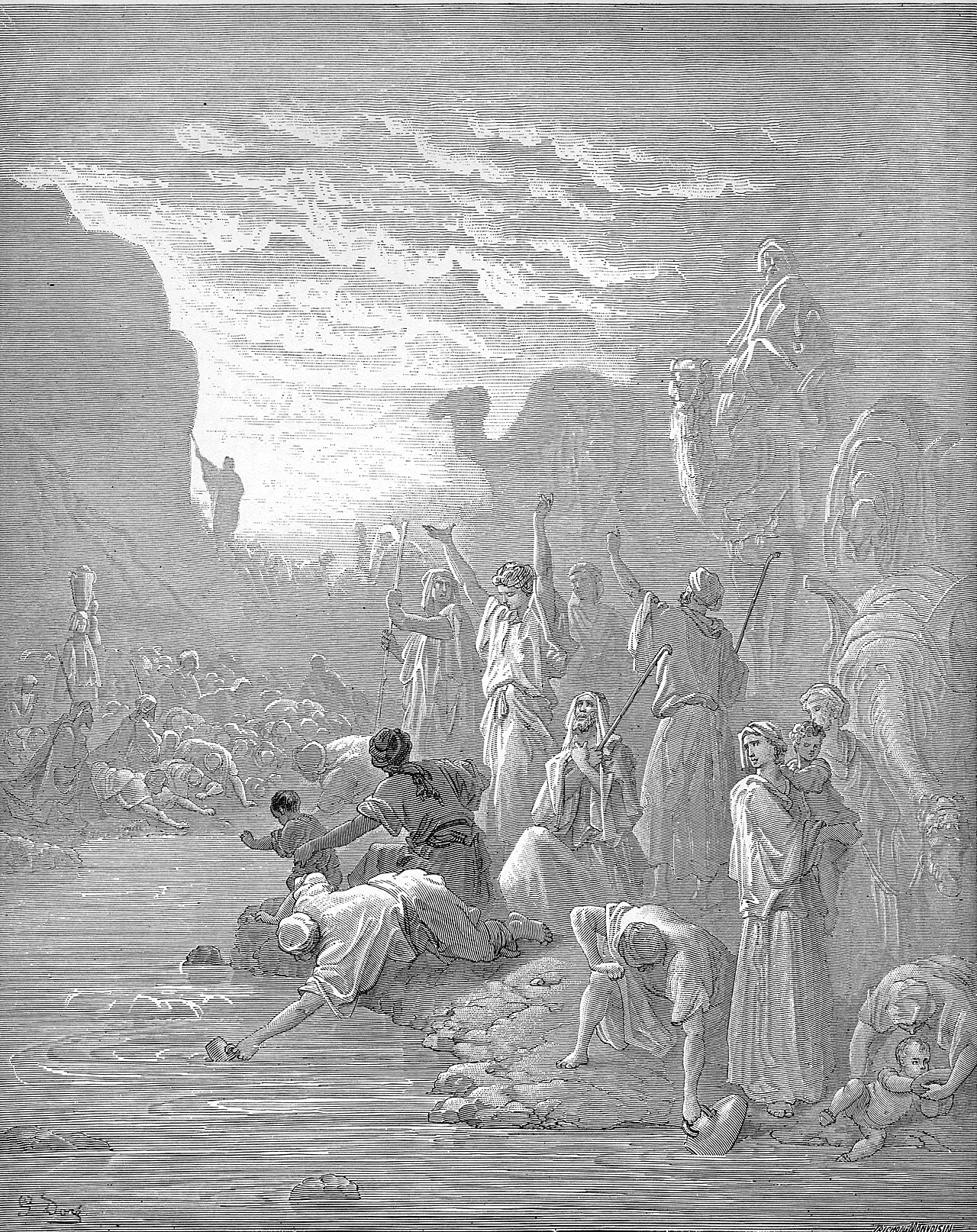
when Moses held up his hand
on Exodus 17:11-13
The battle rises and falls with the hand on the hill rather than with the fighting in the valley, and the verse says it twice so the reader cannot miss it. What the raised hand means has been read two ways, as a banner lifted to rally the men, and as the posture of prayer, which is how the Targum renders it and how John Gill reports the older Jewish readers. A stone is put under Moses and two men hold his arms steady until sundown, so the thing the day turns on is the thing that gives out first. Joshua wins the field with the edge of the sword, and the account still gives him the credit by name.
The record, by era
The Puritans and the Awakening1 voice
Note, Weapons formed against God's Israel cannot prosper long, and shall be broken at last. The cause of God and his Israel will be victorious. Though God gave the victory, yet it is said, Joshua discomfited Amalek, because Joshua was a type of Christ, and of the same name, and in him it is that we are more than conquerors.
The Nineteenth Century3 voices
A commentator
Jamieson, Fausset & Brown1802–1910
Commentary Critical and Explanatory on the Whole Bible (1871)
proposed
Joshua discomfited Amalek--Victory at length decided in favor of Israel, and the glory of the victory, by an act of national piety, was ascribed to God (compare 1Jo 5:4).
Joshua discomfited Amalek and his people - Amalek might have been the name of the ruler of this people continued down from their ancestor, (see Clarke on Exo 17:8 (note)), as Pharaoh was the name of all succeeding kings in Egypt. If this were the case, then Amalek and his people mean the prince and the army that fought under him. But if Amalek stand here for the Amalekites, then his people must mean the confederates he had employed on this occasion.
A commentator
Albert Barnes1798–1870
Notes, Explanatory and Practical, on the Old and New Testaments (1832-1869)
proposed
With the edge of the sword - This expression always denotes a great slaughter of the enemy.
How the passage was read
What the Jewish commentators add
There is no difference between va-yachalosh. Which is an efol. (discomfited or weakened) and va-yechelash. Which is an efal.
2 more on this passage, in their own words ▾
AND HIS HANDS WERE ‘EMUNAH’. This means that they remained steadily uplifted. The usage of the word is similar to the expressions: ‘va’amanah’ (And a sure) ordinance concerning the singers, as every day required; 465 Nehemiah:23. And yet for all this we make ‘amanah’ (a sure) covenant, 466 Ibid.,:1.
Rabbi Abraham ibn Ezra commented. This quote from Ibn Ezra is found in his commentary to Numbers:14. Part of it is also found here. that “this was a known book, namely, the book of the wars of the Eternal, 472 Numbers:14.
This section is reception history: how the passage was read and kept in the Jewish tradition. Where a reading parts from an essential of the Christian faith, the section says so at that point.
Texts and citation data: Sefaria; each excerpt follows its version’s licence. 2 further sources are cited on this chapter that carry no English text this site may quote or only restate the verse.
The words behind it
8 Hebrew wordsEvery Hebrew word of this verse in the order it stands, with what it means and the door to its own study. The last column counts the times a word stands in the whole Bible: the rarer the word, the more the places it appears belong together.
| Hebrew | Sound | Meaning | Word study | In the Bible |
|---|---|---|---|---|
| וַיַּחֲלֹ֧שׁ | vaiyachalosh | and he defeated | H2522 → | |
| יְהוֹשֻׁ֛עַ | yehoshua' | Joshua | H3091 → | 218 times |
| אֶת־ | ʾet- | <obj.> | H853 → | 10935 times |
| עֲמָלֵ֥ק | ʾamalek | Amalek | H6002 → | 39 times |
| וְאֶת־ | veet | and <obj.> | H853 → | 10935 times |
| עַמּ֖וֹ | amo | people its | H5971 → | 1873 times |
| לְפִי־ | lefi- | to [the] mouth of | H6310 → | 498 times |
| חָֽרֶב׃ פ | charev | [the] sword | H2719 → | 413 times |
וַיַּחֲלֹ֧שׁand he defeated
vaiyachaloshH2522 →
יְהוֹשֻׁ֛עַJoshua
yehoshua'H3091 →218 times
אֶת־<obj.>
ʾet-H853 →10935 times
עֲמָלֵ֥קAmalek
ʾamalekH6002 →39 times
וְאֶת־and <obj.>
veetH853 →10935 times
עַמּ֖וֹpeople its
amoH5971 →1873 times
לְפִי־to [the] mouth of
lefi-H6310 →498 times
חָֽרֶב׃ פ[the] sword
charevH2719 →413 times
A shaded row is a word that stands 400 times or fewer in the Bible.
The walk
8 stopsEach card is a verse this one points to, and under it the verses that one points to in turn. Where several paths arrive at the same place, that place is listed first: the text keeps returning to it.
Through
Joshua 11:12Joshua captured all these kings and their cities and put them to the sword. He devoted them to destruction, as Moses the LORD’s servant had commanded.
it leads to
- Deuteronomy 7:2
and when the LORD your God has delivered them over to you to defeat them, then you must devote them to complete destruction. Make no treaty with them and show them no mercy.
Reached by 2 separate paths from here.
- Deuteronomy 20:16–17
However, in the cities of the nations that the LORD your God is giving you as an inheritance, you must not leave alive anything that breathes.
- Numbers 33:50–53
On the plains of Moab by the Jordan across from Jericho, the LORD said to Moses,
- Deuteronomy 7:2
Through
Joshua 10:42And because the LORD, the God of Israel, fought for Israel, Joshua captured all these kings and their land in one campaign.
it leads to
- Joshua 10:14
There has been no day like it before or since, when the LORD listened to the voice of a man, because the LORD fought for Israel.
- Psalms 46:7
The LORD of Hosts is with us; the God of Jacob is our fortress. Selah
- Psalms 80:3
Restore us, O God, and cause Your face to shine upon us, that we may be saved.
- Joshua 10:14
Through
Joshua 10:28On that day Joshua captured Makkedah and put it to the sword, along with its king. He devoted to destruction everyone in the city, leaving no survivors. So he did to the king of…
it leads to
- Joshua 6:21
At the edge of the sword they devoted to destruction everything in the city—man and woman, young and old, oxen, sheep, and donkeys.
- Joshua 10:32
And the LORD delivered Lachish into the hand of Israel, and Joshua captured it on the second day. He put all the people to the sword, just as he had done to Libnah.
- Joshua 6:21
Where this verse is studied
About Exodus
Who and where
1 name in this verse with a page on the site.
This page draws on Adam Clarke, Commentary on the Bible; Albert Barnes, Notes, Explanatory and Practical, on the Old and New Testaments (1832-1869); Charles Spurgeon, The Metropolitan Tabernacle Pulpit, Sermon No. 712: War With Amalek; Jamieson, Fausset & Brown, Commentary Critical and Explanatory on the Whole Bible; John Gill, Exposition of the Old Testament (1748-1763); John Gill, Exposition of the Old Testament and Matthew Henry, Commentary on the Whole Bible.