
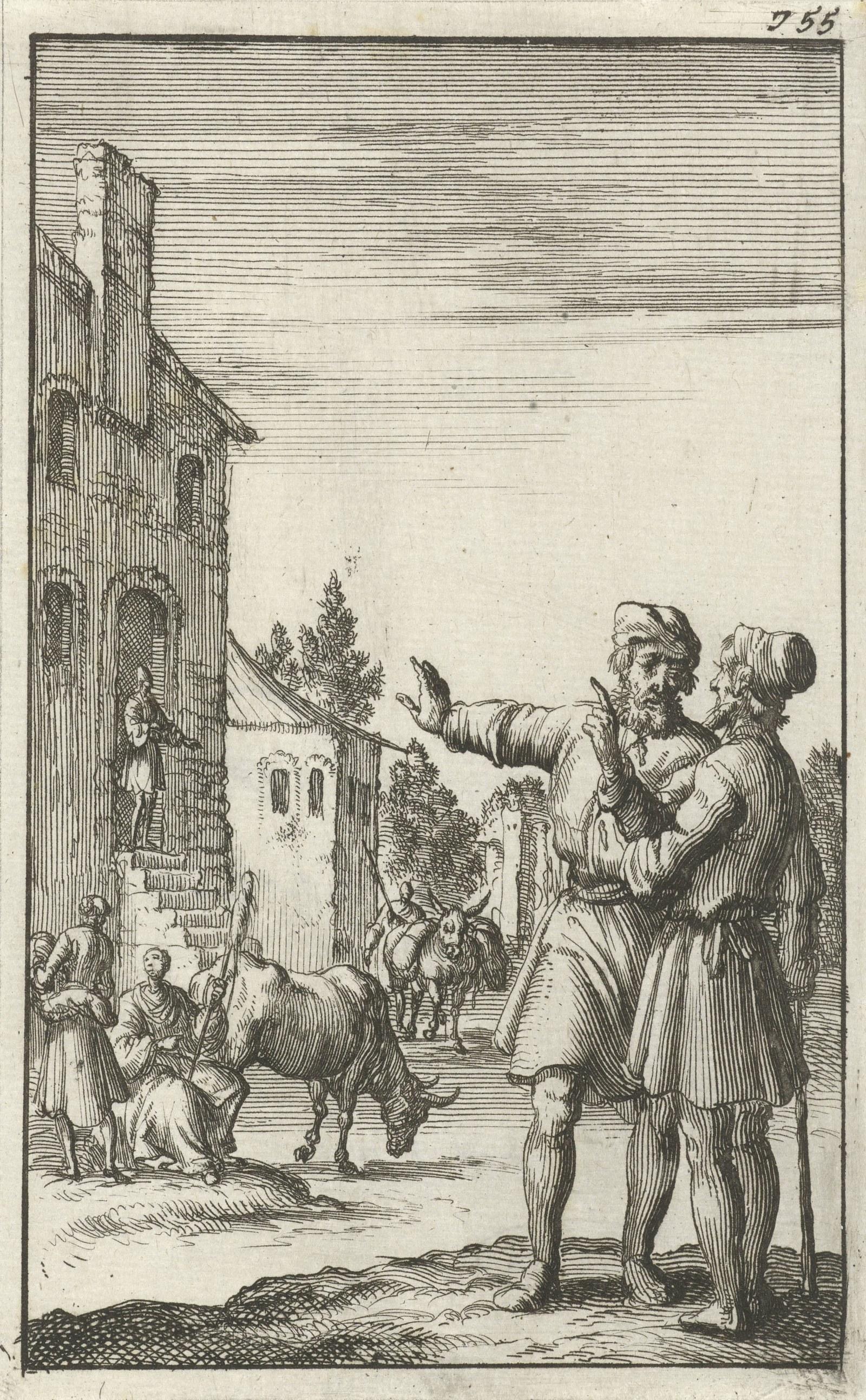
Jan Luyken, You Shall Not Covet What Belongs to Your Neighbour, 1685. Public domain.
Micah 2 · Subject · Featured Study
The Family Inheritance and the Seizing of Fields
Micah charged the powerful men of Judah with taking the fields and houses of the families that held them.
In Hebrew, the verse of the seizure has desire as its first word and inheritance as its last.
The land must not be sold permanently, because it is Mine, and you are but foreigners and residents with Me.
The land must not be sold permanently, because it is Mine, and you are but foreigners and residents with Me.
- Books
- Micah, Leviticus
- Hold in memory
- Micah 2:2
Summary
The law of Moses gave each family of Israel a share of the land by lot. Micah 2:3 to 5 answers the seizure of those shares with a disaster for the nation and a lament over lost fields.
- Isaiah, who prophesied under the same kings, gave a woe to those who join field to field.
- Boaz and Jeremiah each bought land to keep it in their families.
- Four commentators give three answers on whose wives and children Micah means.
The Woe on the Field Takers
Micah 2:1 to 2 names the deed before it gives the sentence.
Woe to those who devise iniquity and plot evil on their beds! At morning’s light they accomplish it because the power is in their hands.The woe sets out the charge that Micah 2:2 then spells out.
They covet fields and seize them; they take away houses. They deprive a man of his home, a fellow man of his inheritance.This verse names the sin that the rest of the chapter answers.
Jamieson, Fausset and Brown note that Micah's first chapter rebukes sins against God. This one rebukes sins against a neighbour, the second table of the Ten Commandments. John Wesley, in his Explanatory Notes upon the Old Testament, said the seizure broke an ancient right. God had forbidden the families to sell their heritage.
The Land Law Step by Step
Texts from Leviticus, Numbers, Deuteronomy and Joshua stand before the two verses of Micah 2.
The land law runs from the LORD's ownership to the Jubilee, and Micah 2 shows fields taken against it.
- The step
- The owner of the land
- The step
- The division by lot
- The step
- The lots cast at Shiloh
- The step
- Each tribe's share kept
- The step
- The boundary marker
- The step
- The kinsman's right to buy back
- The step
- The return in the Jubilee
- The step
- The fields seized
- The step
- The lot in the assembly of the LORD
Each step names one text on the land, and its reference opens the verse in the Berean text.
Leviticus 25:28, Micah 2:2, Micah 2:5
The Jubilee was the fiftieth year, a year of release proclaimed through the land. Wesley, writing on Micah 2:9, held that the law secured the children's estates against any sale beyond the Jubilee.
The Same Wrong in Other Prophets
Two prophets of Micah's day speak of the same sin, and 1 Kings tells one case of it.
Woe to you who add house to house and join field to field until no place is left and you live alone in the land.Isaiah's woe follows his song of the vineyard, in which the LORD looked for justice in Judah.
The princes of Judah are like those who move boundary stones; I will pour out My fury upon them like water.Hosea turns the crime of Deuteronomy 19:14 into a charge against the rulers of the south.
But Naboth replied, “The LORD forbid that I should give you the inheritance of my fathers.”Naboth's answer shows one farmer keeping the law of Numbers 36:7 against a king.
Buying Back a Family Field
Ruth 4 and Jeremiah 32 show the right of redemption at work.
Boaz acted as kinsman redeemer at the gate of Bethlehem for the land of Elimelech.
And he said to the kinsman-redeemer, “Naomi, who has returned from the land of Moab, is selling the piece of land that belonged to our brother Elimelech. I thought I should inform you that you may buy it back in the presence of those seated here and in the presence of the elders of my people. If you want to redeem it, do so. But if you will not redeem it, tell me so I may know, because there is no one but you to redeem it, and I am next after you.” “I will redeem it,” he replied.The verse shows the order of kin at work, since the nearer relative is asked before Boaz.
Then, as the LORD had said, my cousin Hanamel came to me in the courtyard of the guard and urged me, ‘Please buy my field in Anathoth in the land of Benjamin, for you own the right of inheritance and redemption. Buy it for yourself.’” Then I knew that this was the word of the LORD. So I bought the field in Anathoth from my cousin Hanamel, and I weighed out seventeen shekels of silver.The purchase follows the order of the law, since Jeremiah is the next of kin.
For this is what the LORD of Hosts, the God of Israel, says: Houses, fields, and vineyards will again be bought in this land.”The verse gives the reason for a purchase made while the army of Babylon besieged Jerusalem.
The Hebrew Words of Micah 2
Four Hebrew words of Micah 2:2 and Micah 2:5 carry the chapter's charge and its sentence.
chamad, to desire
25 uses in the canon
The verb of the tenth commandment, used here for the men who want their neighbours' fields.
nachalah, inheritance
222 uses in the canon
A family's share of the land, handed down from father to son.
chebel, a measuring line
62 uses in the canon
The cord that marked out a share of land when the lots were cast.
goral, a lot
78 uses in the canon
A small stone drawn to decide which family received which share.
The Identity of the Field Takers
Micah 2 leaves two facts about the field takers untold.
No verse of the chapter names one of the field takers or the town where he lived.
No verse of Micah 2 says whether a court approved the seizures or what the men paid, if they paid at all.
The Lot Taken Away
Readers differ on whom the sentence of Micah 2:3 to 5 strikes.
In that day they will take up a proverb against you and taunt you with this bitter lamentation: ‘We are utterly ruined! He has changed the portion of my people. How He has removed it from me! He has allotted our fields to traitors.’”John Gill names more than one speaker for this lament in his Exposition of the Old Testament.
Therefore, you will have no one in the assembly of the LORD to divide the land by lot.Micah 2:5 closes the sentence of Micah 2:3 to 5 with the casting of the lot.
Readers name three groups who lose the lot. Jamieson, Fausset and Brown, in their Commentary Critical and Explanatory, read the field takers, who had forfeited their portion by greed and violence. Albert Barnes, in his Notes, Explanatory and Practical, reads the unrepentant of Micah's day, who would have no share when God gathered the remnant in Micah 2:12. Adam Clarke, in his Commentary on the Bible, reads the verse as a word to the people, whose inheritance would no more be divided to them by lot.
Albert Barnes on Micah 2
A nineteenth-century commentator explains the tense of the charge in Micah 2:1 to 3.
Albert Barnes (1798 to 1870)
Micah speaks of past deeds in the present tense, and a Hebrew habit of speech explains it.
“Such had been their habitual doings. They had done all this, he says, as one continuous act, up to that time. They were habitually devisers of iniquity, doers of evil. It was ever-renewed. By night they sinned in heart and thought; by day, in act. And so he speaks of it in the present. They do it. But, although renewed in fresh acts, it was one unbroken course of acting. And so he also uses the form, in which the Hebrews spoke of uninterrupted habits, They have coveted, they have robbed, they have taken. Now came God’s part.”
Albert Barnes · Notes, Explanatory and Practical, on the Old and New Testaments (1832-1869) · on Micah 2:3Evangelical
Who Were the Women of Micah 2:9?
Three readings of the women driven from their homes, each with its holders and the objection to it.
You drive the women of My people from their pleasant homes. You take away My blessing from their children forever.Micah 2:9 is the one place in the chapter where the victims are named as women and children.
Widows of men the field takers killedJamieson, Fausset and Brown, Commentary Critical and Explanatory
Jamieson, Fausset and Brown read the women as the widows of men slain by the field takers, whose homes were then seized. They read the children as the orphans of those widows.
The objection: Micah 2:2 speaks of fields and houses seized, and Barnes reads the husbands as stripped of their land.
Widows of men stripped of their landAlbert Barnes, Notes, Explanatory and Practical
Barnes noted that the Hebrew reads each woman from her own pleasant house. He held that these were probably the widows of the men the field takers had stripped.
The objection: Barnes gives the reading as probable, and Gill reads them as captives.
Women taken as captivesJohn Gill, Exposition of the Old Testament; Adam Clarke, Commentary on the Bible
John Gill and Adam Clarke tied Micah 2:9 to the war against King Ahaz. In that war the army of Israel took women and children of Judah to Samaria. Clarke added that Micah lived in the days of Ahaz and might have seen these things.
Then the Israelites took 200,000 captives from their kinsmen—women, sons, and daughters. They also carried off a great deal of plunder and brought it to Samaria.Gill and Clarke found Micah's women among the captives this verse counts.
The objection: Micah 2:9 speaks of homes the women were driven from, and Jamieson, Fausset and Brown read their homes as seized.
Each Man Under His Own Vine
And each man will sit under his own vine and under his own fig tree, with no one to frighten him. For the mouth of the LORD of Hosts has spoken.Micah 4:4 gives back to every household what Micah 2 shows taken from some.
The same oracle of the last days, in Micah 4:3, has the nations beat their swords into plowshares.
Sources
Scripture is the Berean Standard Bible.
- Hebrew lexicon entries for chamad, nachalah, chebel and goral, with the tagged Hebrew text of Micah 2:2 and Micah 2:5.
- Matthew Henry, Commentary on the Whole Bible (1710); John Gill, Exposition of the Old Testament (1748 to 1763); John Wesley, Explanatory Notes upon the Old Testament (1765); Adam Clarke, Commentary on the Bible (1832); Albert Barnes, Notes, Explanatory and Practical (1832 to 1869); Jamieson, Fausset and Brown, Commentary Critical and Explanatory on the Whole Bible (1871)
Keep Studying
Symbols2