

Place
Mount Hermon
Also known as Sirion · Senir · Baal-hermon · Jebel esh-Sheikh
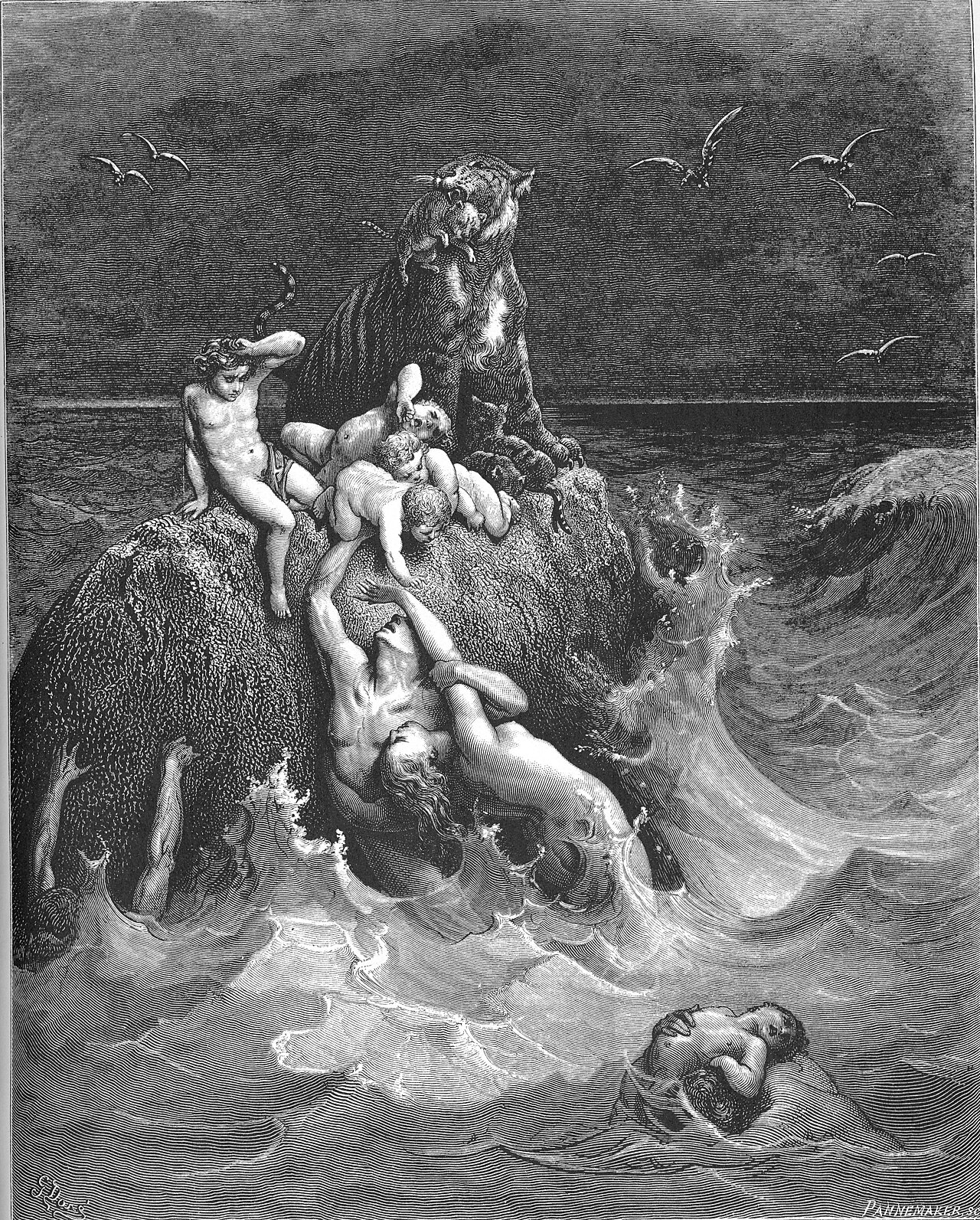
Gustave Doré, La Sainte Bible (Tours: Alfred Mame et fils, 1866). Public domain.
Summary
The snow-capped peak at the north of the land, the mountain whose dew Psalm 133 praises, the border of Israel in Joshua, and the mountain 1 Enoch names as the place where the Watchers came down.
- Hermon is the northern marker of the promised land. Every conquest summary from Deuteronomy 3 to Joshua 13 runs from the Arnon Valley as far as Mount Hermon.
- It carries four names in Scripture. The Sidonians called it Sirion, the Amorites called it Senir, Deuteronomy 4:48 calls it Siyon, and Judges 3:3 calls it Baal-hermon.
- Og of Bashan, the last of the Rephaim, ruled Mount Hermon by name in Joshua 12:5, which ties the high country to the giant clans the spies feared.
- 1 Enoch 6:6 says two hundred angels came down on the summit of this mountain in the days of Jared and bound themselves by an oath. Genesis 6 gives no location at all, and 1 Enoch is a study resource on this site and never Scripture.
- Peter confessed Jesus as the Christ at Caesarea Philippi, at the mountain's southern foot, and six days later three disciples saw Him transfigured on a high mountain the Gospels never name.
On this page
In Scripture
- Verses
- 12
- Books
- 7
Near Mount Hermon
- Dan27 km · 17 mi SW
- Damascus44 km · 27 mi E
- Zarephath52 km · 32 mi W
- Tyre64 km · 40 mi W
- Capernaum65 km · 40 mi SW
- Sea of Galilee71 km · 44 mi S
Straight-line distances, computed from the gazetteer coordinates.
Where it is
the country around it
- Modern name
- Jabal al-Shaykh
- Coordinates
- 33.4161° N, 35.8575° Eopen the Atlas →
- Region
- Anti-Lebanon range, north of the Golan
- Kind of place
- Mountain
1 place the record names with Mount Hermon, the farthest 64 km away
- Located: the gazetteer fixes one site
- A dashed line ends at a place the gazetteer does not fix
Not located: Bashan. The gazetteer records no location for it, so it is not marked.
Why Mount Hermon matters
What has been found
the evidence, and where it is disputed
The confession and the transfiguration
Matthew 16:13 to 17:9, at the foot of the mountain and then on the height, six days apart
Read Matthew 16:13 to 17:9, at the foot of the mountain and then on the height, six days apart
- The question, in the country of Caesarea PhilippiMatthew 16:13When Jesus came to the region of Caesarea Philippi, He questioned His disciples: “Who do people say the Son of Man is?”
- The confessionMatthew 16:16Simon Peter answered, “You are the Christ, the Son of the living God.”
- Not from flesh and bloodMatthew 16:17Jesus replied, “Blessed are you, Simon son of Jonah! For this was not revealed to you by flesh and blood, but by My Father in heaven.
- The gates of Hades will not prevailMatthew 16:18And I tell you that you are Peter, and on this rock I will build My church, and the gates of Hades will not prevail against it.
- Six days later, up a high mountainMatthew 17:1After six days Jesus took with Him Peter, James, and John the brother of James, and led them up a high mountain by themselves.
- His face shone like the sunMatthew 17:2There He was transfigured before them. His face shone like the sun, and His clothes became as white as the light.
- Moses and ElijahMatthew 17:3Suddenly Moses and Elijah appeared before them, talking with Jesus.
- The voice from the cloudMatthew 17:5While Peter was still speaking, a bright cloud enveloped them, and a voice from the cloud said, “This is My beloved Son, in whom I am well pleased. Listen to Him!”
- The three fall on their facesMatthew 17:6When the disciples heard this, they fell facedown in terror.
- Coming down, told to say nothing yetMatthew 17:9As they were coming down the mountain, Jesus commanded them, “Do not tell anyone about this vision until the Son of Man has been raised from the dead.”
Matthew and Mark say the transfiguration came six days after the confession; Luke 9:28 says about eight days, counting the days at both ends. The Gospels call the place a high mountain and never name it. 2 Peter 1:18 calls it the holy mountain. Caesarea Philippi stood at Hermon's southern foot, so a reader who takes the six days at face value has the party somewhere in this country when they went up.
The Transfiguration: the full studyWhat happened here, in order
in the order the canon tells it
- The land taken across the Jordan reaches HermonDeuteronomy 3:8At that time we took from the two kings of the Amorites the land across the Jordan, from the Arnon Valley as far as Mount Hermon—
- Sidonians call it Sirion, Amorites call it SenirDeuteronomy 3:9which the Sidonians call Sirion but the Amorites call Senir—
- Og of Bashan, the last of the Rephaim, and his iron bedDeuteronomy 3:11(For only Og king of Bashan had remained of the remnant of the Rephaim. His bed of iron, nine cubits long and four cubits wide, is still in Rabbah of the Ammonites.)
- A fourth name, Siyon, and the same mountainDeuteronomy 4:48extending from Aroer on the rim of the Arnon Valley as far as Mount Siyon (that is, Hermon),
- The Hivites at the foot of Hermon join the northern coalitionJoshua 11:3to the Canaanites in the east and west; to the Amorites, Hittites, Perizzites, and Jebusites in the hill country; and to the Hivites at the foot of Hermon in the land of Mizpah.
- The conquest stops at Baal-gad below HermonJoshua 11:17from Mount Halak, which rises toward Seir, as far as Baal-gad in the Valley of Lebanon at the foot of Mount Hermon. He captured all their kings and struck them down, putting them to death.
- Og ruled Mount Hermon by nameJoshua 12:5He ruled over Mount Hermon, Salecah, all of Bashan up to the border of the Geshurites and Maacathites, and half of Gilead to the border of Sihon king of Heshbon.
- All of Mount Hermon falls inside the allotmentJoshua 13:11also Gilead and the territory of the Geshurites and Maacathites, all of Mount Hermon, and all Bashan as far as Salecah—
- The mountain was reached and never clearedJudges 3:3the five rulers of the Philistines, all the Canaanites, the Sidonians, and the Hivites who lived in the mountains of Lebanon from Mount Baal-hermon to Lebo-hamath.
- Half of Manasseh settles under the mountain of three names1 Chronicles 5:23Now the people of the half-tribe of Manasseh were numerous. They settled in the land from Bashan to Baal-hermon (that is, Senir, also known as Mount Hermon).
- Sirion skips like a young wild ox under the voice of the LORDPsalms 29:6He makes Lebanon skip like a calf, and Sirion like a young wild ox.
- An exile remembers God from the peaks of HermonPsalms 42:6O my God, my soul despairs within me. Therefore I remember You from the land of Jordan and the peaks of Hermon— even from Mount Mizar.
- Tabor and Hermon shout for joy at His namePsalms 89:12North and south You created; Tabor and Hermon shout for joy at Your name.
- The dew of Hermon becomes the picture of brotherly lovePsalms 133:3It is like the dew of Hermon falling on the mountains of Zion. For there the LORD has bestowed the blessing of life forevermore.
- The bride is called down from the summits of Senir and HermonSong of Solomon 4:8Come with me from Lebanon, my bride, come with me from Lebanon! Descend from the peak of Amana, from the summits of Senir and Hermon, from the dens of the lions, from the mountains of the leopards.
- Tyre builds its ships with cypress from SenirEzekiel 27:5They constructed all your planking with cypress from Senir. They took a cedar from Lebanon to make a mast for you.
- Jesus asks who He is in the region of Caesarea PhilippiMatthew 16:13When Jesus came to the region of Caesarea Philippi, He questioned His disciples: “Who do people say the Son of Man is?”
- Six days later, three disciples go up a high mountainMatthew 17:1After six days Jesus took with Him Peter, James, and John the brother of James, and led them up a high mountain by themselves.
- Peter calls it the holy mountain2 Peter 1:18And we ourselves heard this voice from heaven when we were with Him on the holy mountain.
Where it points
The voices
each quoted from the work named
Like the dew of Hermon, which runs down upon Mount Zion. The dew of Hermon. We read a certain apocryphal book, that at the time when the sons of God descended to the daughters of men, they descended upon Mount Hermon, and there entered into a covenant, how they might come to the daughters of men, and join them to themselves. It is a most manifest book, and it is reckoned among the apocrypha, and the ancient interpreters have said some things about it: but we say this, not for authority, but for remembrance.
As the dew of Hermon, and as the dew that descended upon the mountains of Zion. From the loftier mountains the moisture appears to be wafted to the lesser hills: the dews of Hermon fall on Zion. The Alpine Lebanon ministers to the minor elevation of the city of David; and so does brotherly love descend from the higher to the lower, refreshing and enlivening in its course. Holy concord is as dew, mysteriously blessed, full of life and growth for all plants of grace.
Hermon, the southern and culminating point of the range of Lebanon, was also the religious center of primaeval Syria. Its Baal sanctuaries not only existed but gave it a name before the Exodus. Hence, the careful specification of the various names by which the mountain was known.
4 more teachers on these versesAlbert Barnes · Irenaeus · Augustine of Hippo · Adam Clarke
Baal-gad Jos 12:7; Jos 13:5 is probably Paneas, the Caesarea Philippi of later times. The name means “troop or city of Baal,” or a place where Baal was worshipped as the giver of “good luck.”
And for a very long while wickedness extended and spread, and reached and laid hold upon the whole race of mankind, until a very small seed of righteousness remained among them: and illicit unions took place upon the earth, since angels were united with the daughters of the race of mankind; and they bore to them sons who for their exceeding greatness were called giants.
All that we indubitably know, from the authentic Scripture in the Hebrew and Christian traditions, is the fact that in the period before the flood there were many giants, all of whom belonged to the earthly city in human society, and that there were sons of God descended from Seth who abandoned their holiness and sank down into this city of men.
A high mountain - I have conjectured, Mat 17:1, that this was one of the mountains of Galilee: some say Hermon, some Tabor; but Dr. Lightfoot thinks a mountain near Caesarea Philippi to be more likely.
Mount Hermon in Scripture
12 verses name it, or one of its other names (Sirion, Senir, Baal-hermon), in 7 books
Open a book to read its mentions here. Text: Berean Standard Bible.
Old TestamentNew Testamentsegment width = share of mentions
Old Testament7 books · 12 mentions
Deuteronomy2 mentions
Joshua5 mentions
- Joshua 11:17from Mount Halak, which rises toward Seir, as far as Baal-gad in the Valley of Lebanon at the foot of Mount Hermon. He captured all their kings and struck them down, putting them to death.
- Joshua 12:1Now these are the kings of the land whom the Israelites struck down and whose lands they took beyond the Jordan to the east, from the Arnon Valley to Mount Hermon, including all the Arabah eastward:
- Joshua 12:5He ruled over Mount Hermon, Salecah, all of Bashan up to the border of the Geshurites and Maacathites, and half of Gilead to the border of Sihon king of Heshbon.
- Joshua 13:5the land of the Gebalites; and all Lebanon to the east, from Baal-gad below Mount Hermon to Lebo-hamath.
- Joshua 13:11also Gilead and the territory of the Geshurites and Maacathites, all of Mount Hermon, and all Bashan as far as Salecah—
Judges1 mention
1 Chronicles1 mention
Psalms1 mention
Song of Solomon1 mention
The account
Read the account as one telling
Mount Hermon is the southern end of the Anti-Lebanon range, a long ridge rather than a single cone, with three principal summits and a high point near 2,814 metres. It is the highest ground in the biblical land and the only part of it that carries snow through most of the year. That snowpack is the reason the mountain matters to everything downstream. Meltwater feeds the springs at Banias and at Dan, two of the three headwaters of the Jordan, and the third rises on the western side. The river Israel crossed to enter the land begins on the mountain that marks the land's northern edge. The modern Arabic name, Jabal al-Shaykh, is usually explained as the mountain of the elder, from the white head the snow gives it.
The mountain was holy ground before Israel came near it, and Scripture records the fact in the name it uses. Judges 3:3 and 1 Chronicles 5:23 call it Baal-hermon. Albert Barnes made the point from the text alone in the nineteenth century, writing on Deuteronomy 3:9 that Hermon was the religious center of primaeval Syria and that its Baal sanctuaries existed and gave it a name before the exodus. The archaeology set out below filled that reading out rather than overturning it.
The second record of the mountain is Jewish and older than the New Testament. 1 Enoch, a Second Temple study resource that this site holds in the R. H. Charles translation of 1917 and never receives as Scripture, opens its account of the fall of the Watchers on this summit. "And they were in all two hundred; who descended in the days of Jared on the summit of Mount Hermon, and they called it Mount Hermon, because they had sworn and bound themselves by mutual imprecations upon it" (1 Enoch 6:6). The chapters that follow say the Watchers took wives, taught charms and metalwork and astrology, and fathered giants who turned on mankind, until the cry of the earth reached heaven and Michael was told to bind Semjâzâ and his associates "till the day of their judgement" (1 Enoch 10:12). The writer knows the local map. He puts Enoch himself "at the waters of Dan, in the land of Dan, to the south of the west of Hermon" (1 Enoch 13:7), and the Watchers waiting between Lebanon and Senir.
None of that is in Genesis. Genesis 6:1 to 6:4 tells of the sons of God, the daughters of men and the Nephilim, and gives no place at all. The summit belongs to 1 Enoch and to no book of the sixty-six. The book itself is old and Jewish and pre-Christian, attested in Aramaic among the Dead Sea Scrolls and published from Cave 4 by J. T. Milik with Matthew Black in 1976, and the related Book of Giants survives in fragments from the same cave. Jubilees, written in the same period, also places the descent of the Watchers in the days of Jared. That the tradition is ancient is one claim. That it is true is a different claim, and the page keeps them apart.
Israel reached the mountain in the generation of Moses. Deuteronomy 3:8 records the land taken across the Jordan from the Arnon Valley as far as Mount Hermon, and 3:9 preserves the Sidonian name Sirion and the Amorite name Senir. The king who held that country was Og of Bashan, whom Deuteronomy 3:11 calls the last of the remnant of the Rephaim and whose iron bed was still kept at Rabbah, and whom Joshua 12:5 says ruled Mount Hermon, Salecah and all of Bashan. Deuteronomy 2:21 says the Rephaim stood as tall as the Anakites, and the spies in Numbers 13:33 traced the Anakim back to the Nephilim. This site's tradition reads that family line back to Genesis 6:4 and forward from Genesis 3:15, and says plainly that Scripture states the relationship without explaining the mechanism.
The conquest reached the mountain and never took it. Joshua 11:17 and 13:5 set the northern limit at Baal-gad below Hermon, Joshua 13:11 puts all of Mount Hermon inside the allotment, and Judges 3:3 says the Hivites were still living in that high country from Mount Baal-hermon to Lebo-hamath. 1 Chronicles 5:23 has the half-tribe of Manasseh settled under it and stacks three of its names in one verse.
After the conquest the mountain becomes a picture. Psalm 29:6 has Sirion skip like a young wild ox under the voice of the LORD. Psalm 42:6 puts an exile at the peaks of Hermon, north of everything he loves, remembering God from there. Psalm 89:12 pairs Tabor and Hermon shouting for joy. Psalm 133:3 takes the heaviest dew in the country and makes it the picture of brothers living together in harmony. Song of Songs 4:8 calls the bride down from the summits of Senir and Hermon, and Ezekiel 27:5 has Tyre planking its ships with cypress from Senir.
In the centuries before Christ the slopes filled with sanctuaries. The Ituraeans held the mountain, and their temples and cult places, together with farmsteads, villages and mines, are what the modern survey of the southern and western slopes recovered. At the southern foot, where a spring rises out of a cave in a cliff, stood a sanctuary of the Greek god Pan. The place was called Paneas, which in local Arabic became Banias. Josephus reports that Herod built a temple of white stone for Augustus near the Panion, and Herod's son Philip refounded the town and named it Caesarea for Tiberius and for himself.
Common questions
Does the Bible say the fallen angels came down on Mount Hermon?
No. Genesis 6:1 to 6:4 describes the sons of God taking wives among the daughters of men and gives no location at all. The mountain is named by 1 Enoch, which says two hundred Watchers came down in the days of Jared on the summit of Mount Hermon and swore an oath there, and reads the name out of that oath.
1 Enoch is a Second Temple study resource on this site and never Scripture. Wherever the two records meet on this page, the page says which book is speaking.
What is 1 Enoch, and why does Jude quote it?
1 Enoch is a Jewish book from the centuries before Christ. It survives complete in Ethiopic and is attested in Aramaic among the Dead Sea Scrolls, where J. T. Milik and Matthew Black published the Aramaic fragments from Cave 4 in 1976. Jude 14 to 15 quotes its opening prophecy almost word for word and names Enoch the seventh from Adam as the speaker.
The early church argued about what that meant. Tertullian defended the book around AD 200, Jerome reported that some rejected the letter of Jude because of the quotation, and Augustine held that the prophecy was genuine while the writings circulating under Enoch's name were not authoritative. Quoting a book is not the same as receiving it as Scripture. This site treats 1 Enoch the way Jerome did, as worth remembering and not as authority.
What does the New Testament make of the fallen angels?
It uses the picture without naming the mountain and without calling 1 Enoch Scripture. Jude 1:6 says the angels who abandoned their proper dwelling are kept in eternal chains under darkness, bound for judgment on that great day. 2 Peter 2:4 says God did not spare the angels when they sinned but cast them into chains of darkness, and the very next sentence moves to the flood.
That is the order 1 Enoch tells the story in, and both apostles write as though their readers knew it. Neither writer says where it happened.
Were the sons of God in Genesis 6 angels or the line of Seth?
Readers differ; the positions are named
The reading that they were angelic beings is the older one, and it is what 1 Enoch, Jubilees, Jude 6 and 2 Peter 2:4 assume. Philo, Irenaeus, Tertullian, Eusebius, Ambrose and Jerome all hold it. This site's tradition follows that reading and teaches it at full strength.
The reading that they were the godly line of Seth marrying into the line of Cain is held by Augustine in City of God 15.23, by John Cassian, and later by Calvin, and it became the majority Western reading. It is presented here in the words of the men who held it, with respect. Both sides agree that Genesis 6 describes a corruption grave enough to bring the flood.
Was Jesus transfigured on Mount Hermon or Mount Tabor?
Readers differ; the positions are named
The Gospels say only a high mountain and a mountain, and 2 Peter 1:18 says the holy mountain. Every identification is an inference from the surrounding text.
The Tabor tradition is the older one. Cyril of Jerusalem places the scene on Tabor in his twelfth catechetical lecture in the middle of the fourth century, Hilary of Arles calls it a tradition around 449, a basilica was built there, and pilgrims have gone ever since. Readers who prefer Hermon point out that Matthew and Mark set the preceding scene at Caesarea Philippi at its foot, that Hermon reaches about 2,814 m against Tabor's 588 m, and that Tabor carried a settlement in the first century, which sits awkwardly with going up by themselves.
Adam Clarke laid all three options out in 1832, including John Lightfoot's preference for a mountain near Caesarea Philippi, and chose none of them. This page does the same.
Why does the Bible give Hermon so many names?
Because four peoples named it and Scripture records what each called it. Deuteronomy 3:9 says the Sidonians call it Sirion and the Amorites call it Senir. Deuteronomy 4:48 gives Siyon. Judges 3:3 and 1 Chronicles 5:23 give Baal-hermon, the name that says what was worshipped on it.
Barnes read the three names stacked in 1 Chronicles 5:23 as three parts of one mountain rather than three mountains, which fits a ridge with three summits. Psalm 42:6 speaks of the peaks of Hermon in the plural for the same reason.
How can the dew of Hermon fall on Zion when they are so far apart?
Readers differ; the positions are named
Psalm 133:3 compares brothers living in harmony to the dew of Hermon falling on the mountains of Zion, and the two stand about 190 km apart, so nobody reads the verse as a weather report. The commentators answered it in three ways.
John Gill held that the Zion in view is the Sion of Deuteronomy 4:48, which is Hermon itself. Adam Clarke took the same line and added Henry Maundrell's report from 1697 that the dew there soaked a traveller's tent as though it had rained all night. Spurgeon read it as a comparison rather than an identification, with moisture carried from the higher mountains to the lesser hills and brotherly love descending the same way. The verse works on any of the three.
What was Caesarea Philippi, and why did Jesus ask the question there?
It was the town at Hermon's southern foot, built around a spring that rises out of a cave. A sanctuary of the Greek god Pan stood at the cave and gave the place its older name of Paneas. Herod built there for Augustus, and his son Philip refounded the town and named it for Tiberius and for himself, which is the name Matthew 16:13 uses.
Jerome describes the site in his commentary on Matthew and names the springs of the Jordan there. Epiphanius Scholasticus asked in the sixth century why the Lord went so far north into Gentile country to ask who He was. The page leaves that question with the reader.
Are the giants of Bashan connected to the Nephilim of Genesis 6?
The text makes the link twice. Numbers 13:33 says the spies saw the Nephilim, the descendants of Anak who come from the Nephilim. Deuteronomy 2:20 to 2:21 says the Rephaim were as tall as the Anakites.
Deuteronomy 3:11 calls Og of Bashan the last of the remnant of the Rephaim and records the measurement of his iron bed, and Joshua 12:4 to 12:5 says he ruled Mount Hermon. This site's tradition reads that family line back to Genesis 6:4 and the seed war of Genesis 3:15. Scripture states the relationship and does not explain the mechanism.
Notable art
1 verified piece depicting Mount Hermon
Sources cited
- OpenBible.info Bible Geocoding: Mount Hermonread 2026-09-02The coordinates on this page. Used under CC-BY with attribution to OpenBible.info.
- R. H. Charles, The Book of Enoch (London: SPCK, 1917)The public-domain translation of 1 Enoch that this site carries and the source of every 1 Enoch quotation on this page. A Second Temple study resource, not Scripture.
- J. T. Milik with Matthew Black, The Books of Enoch: Aramaic Fragments of Qumrân Cave 4 (Oxford: Clarendon Press, 1976)The Aramaic manuscripts of Enoch from Cave 4, including 4Q201 and 4Q202, and the Book of Giants fragments.
- George W. E. Nickelsburg, "Enoch, Levi, and Peter: Recipients of Revelation in Upper Galilee," Journal of Biblical Literature 100 (1981)The proposal that reads the Hermon cult material alongside the Enochic tradition, and the translation of the summit inscription given on this page.
- Shimon Dar, Settlements and Cult Sites on Mount Hermon, Israel, British Archaeological Reports International Series 589 (Oxford, 1993)The survey of settlements, cult places and temples on the southern and western slopes, Ituraean and Roman periods.
- Charles Warren, Palestine Exploration Fund, 1869The visit to the summit at Qasr Antar and the removal of the inscribed limestone stele, now in the British Museum.
- Flavius Josephus, Antiquities of the Jews 15.363 to 364 and The Jewish War 1.404 to 406Herod's temple of white stone for Augustus near the Panion. Whiston translation, public domain.
- J. Andrew Overman and the Macalester College excavations at Horvat Omrit, from 1999The alternative identification of Herod's Augusteum, against the identification at Banias by Zvi Uri Ma'oz and Ehud Netzer.
- Charles H. Spurgeon, The Treasury of David, volumes 2 (1870), 4 (1874) and 7 (1885)Spurgeon on Psalm 29:6, Psalm 89:12 and Psalm 133:3. Public domain.
- Jerome, Homily 45 on Psalm 132; Commentary on Matthew; De Viris Illustribus section 4The Hermon tradition named as apocryphal and remembered anyway, the description of Caesarea Philippi, and the note on Jude's quotation. Public domain.
- Augustine of Hippo, City of God 15.23 and 18.38; Exposition on Psalm 133The Sethite reading of Genesis 6, the judgment on the writings under Enoch's name, and the reading of Hermon as a light on a high place. Public domain.
- Irenaeus, The Demonstration of the Apostolic Preaching, sections 18 to 19The angelic reading of Genesis 6 in the earliest voice this page carries. Public domain.
- Tertullian, On the Dress of Women 3.3The early defense of the book of Enoch, cited on this page only for the fact that he defended it. Public domain.
- Cyril of Jerusalem, Catechetical Lecture 12:16, and Hilary of Arles, Introductory Commentary on 2 PeterThe two earliest dated witnesses on this site for the Tabor identification of the transfiguration. Public domain.
- Albert Barnes, Notes, Explanatory and Practical, on the Old and New Testaments (1832 to 1869)The Baal sanctuaries on Hermon before the exodus, the three summits of 1 Chronicles 5:23, and Baal-gad as the later Caesarea Philippi. Public domain.
- Adam Clarke, Commentary on the Bible (1832)The three positions on the mountain of the transfiguration, and Henry Maundrell's 1697 report of the dew. Public domain.
- John Gill, Exposition of the Old Testament (1748 to 1763)The reading of Psalm 133:3 that takes the Zion in view as the Sion of Deuteronomy 4:48. Public domain.
- Michael S. Heiser, Reversing Hermon (2017), and The Unseen Realm (2015)Named on this page as the holder of the gates-of-Hades reading at Banias and of the Bashan serpent proposal. In copyright, so no quotation is used.
- Gustave Doré, La Sainte Bible (Tours: Alfred Mame et fils, 1866)The two engravings on this page. Public domain.
Keep studying
On this page
Studies18
Every page that names it1
Books that name it7
Show the next 1 title
Doorway2
Keep this page