
Place
Zarephath
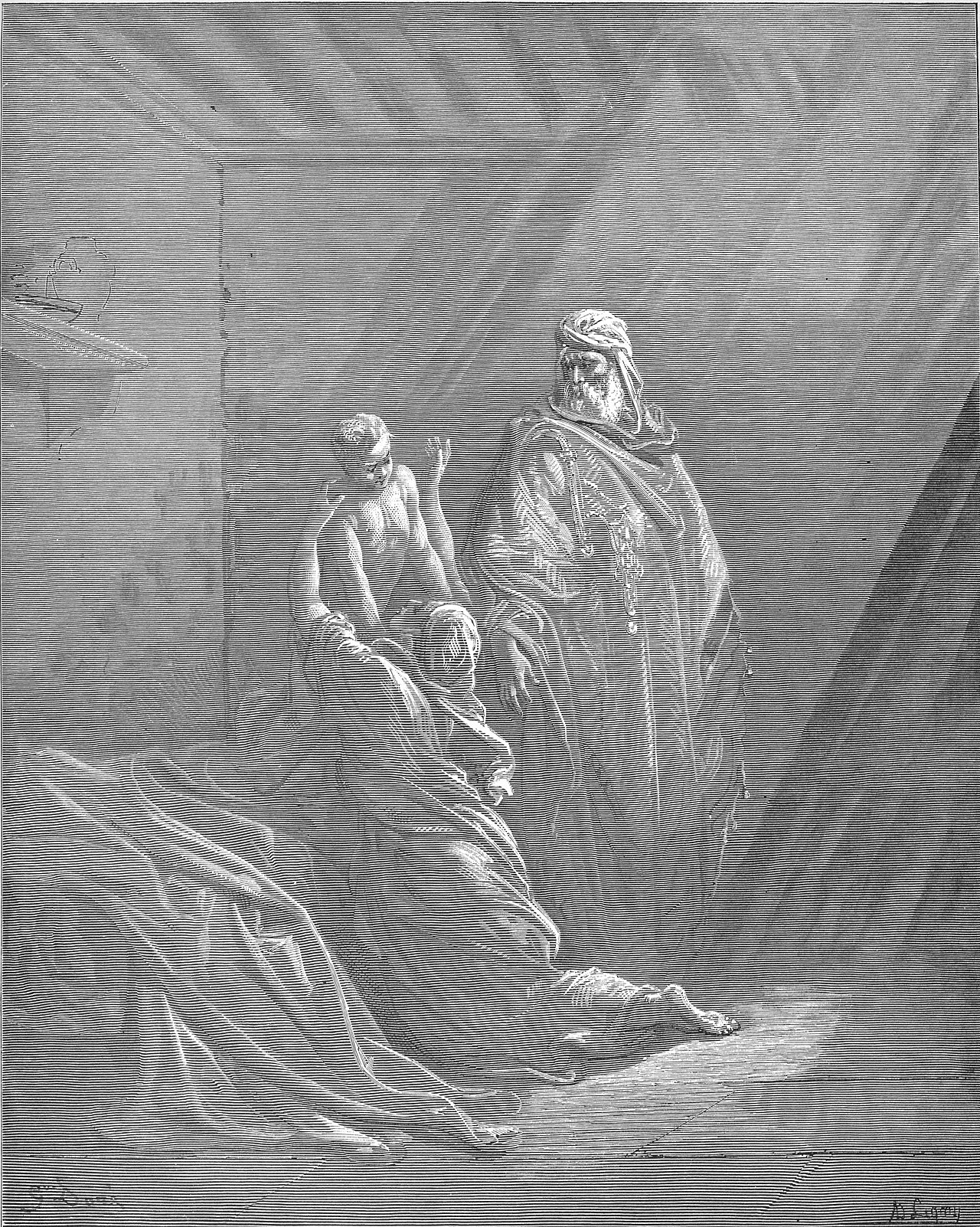
Gustave Doré, La Sainte Bible (Tours: Alfred Mame et fils, 1866). Public domain.
Summary
The Sidonian town where a starving Gentile widow shared her last meal with Elijah and her jar of flour did not run out, the story Jesus cited at Nazareth.
- Zarephath was a Sidonian town, Gentile territory outside Israel, where the LORD sent Elijah when the brook that had fed him ran dry.
- A widow there was down to a handful of flour and a little oil, gathering sticks for a last meal for herself and her son, when Elijah met her at the gate.
- She fed him first on his word, and the jar of flour and the jug of oil did not run out until the drought ended.
- When her son later died, Elijah stretched himself over the boy three times and the LORD returned his life.
- Jesus named this widow at Nazareth, in Luke 4, as the one example of God's grace reaching outside Israel during Elijah's day, and the crowd tried to kill him for saying it.
On this page
In Scripture
- Verses
- 4
- Books
- 3
Near Zarephath
- Tyre20 km · 13 mi SW
- Dan39 km · 24 mi SE
- Mount Hermon52 km · 32 mi E
- Capernaum67 km · 41 mi SE
- Sea of Galilee73 km · 46 mi S
- Cana of Galilee76 km · 47 mi S
Straight-line distances, computed from the gazetteer coordinates.
Where it is
the country around it
- Coordinates
- 33.4333° N, 35.3000° Eopen the Atlas →
- Region
- Sidon
- Kind of place
- Town
1 place the record names with Zarephath, the farthest 81 km away
- Located: the gazetteer fixes one site
- A dashed line ends at a place the gazetteer does not fix
Why Zarephath matters
The widow's flour, oil, and son
1 Kings 17:8-24, in the order it happens
Read 1 Kings 17:8-24, in the order it happens
- Sent from the dried-up brook to Zarephath1 Kings 17:9“Get up and go to Zarephath of Sidon, and stay there. Behold, I have commanded a widow there to provide for you.”
- A widow gathering sticks at the gate1 Kings 17:10So Elijah got up and went to Zarephath. When he arrived at the city gate, there was a widow gathering sticks. Elijah called to her and said, “Please bring me a little water in a cup, so that I may drink.”
- Her last meal, before she and her son die1 Kings 17:12But she replied, “As surely as the LORD your God lives, I have no bread—only a handful of flour in a jar and a little oil in a jug. Look, I am gathering a couple of sticks to take home and prepare a meal for myself and my son, so that we may eat it and die.”
- The word: the jar and the jug will not run out1 Kings 17:14for this is what the LORD, the God of Israel, says: ‘The jar of flour will not be exhausted and the jug of oil will not run dry until the day the LORD sends rain upon the face of the earth.’
- It held out, exactly as promised1 Kings 17:16The jar of flour was not exhausted and the jug of oil did not run dry, according to the word that the LORD had spoken through Elijah.
- Her son becomes ill and dies1 Kings 17:17Later, the son of the woman who owned the house became ill, and his sickness grew worse and worse, until no breath remained in him.
- Elijah stretches himself over the child1 Kings 17:21Then he stretched himself out over the child three times and cried out to the LORD, “O LORD my God, please let this boy’s life return to him!”
- "Now I know"1 Kings 17:24Then the woman said to Elijah, “Now I know that you are a man of God and that the word of the LORD from your mouth is truth.”
Jesus cites this exact story at Nazareth, in Luke 4:25-26, as proof that God's grace has always reached outside Israel's own borders when he sends it there. This is not a claim that Israel was set aside; it is the same point Obadiah makes in reverse, naming Zarephath as a boundary of Israel's own future restoration.
What happened here, in order
in the order the canon tells it
- The Brook of Cherith dries up1 Kings 17:7Some time later, however, the brook dried up because there had been no rain in the land.
- Elijah is sent to Zarephath1 Kings 17:9“Get up and go to Zarephath of Sidon, and stay there. Behold, I have commanded a widow there to provide for you.”
- The widow's last meal1 Kings 17:12But she replied, “As surely as the LORD your God lives, I have no bread—only a handful of flour in a jar and a little oil in a jug. Look, I am gathering a couple of sticks to take home and prepare a meal for myself and my son, so that we may eat it and die.”
- The jar and jug hold out1 Kings 17:16The jar of flour was not exhausted and the jug of oil did not run dry, according to the word that the LORD had spoken through Elijah.
- The child's life returns1 Kings 17:22And the LORD listened to the voice of Elijah, and the child’s life returned to him, and he lived.
- The widow's confession1 Kings 17:24Then the woman said to Elijah, “Now I know that you are a man of God and that the word of the LORD from your mouth is truth.”
- Zarephath named as a boundary of Israel's restorationObadiah 1:20And the exiles of this host of the Israelites will possess the land of the Canaanites as far as Zarephath; and the exiles from Jerusalem who are in Sepharad will possess the cities of the Negev.
- Jesus names the famine and Elijah's day at NazarethLuke 4:25But I tell you truthfully that there were many widows in Israel in the time of Elijah, when the sky was shut for three and a half years and great famine swept over all the land.
- The widow of Zarephath named directlyLuke 4:26Yet Elijah was not sent to any of them, but to the widow of Zarephath in Sidon.
- The crowd's fury at what Jesus saidLuke 4:28On hearing this, all the people in the synagogue were enraged.
Zarephath in Scripture
4 verses name it, in 3 books
Open a book to read its mentions here. Text: Berean Standard Bible.
Old TestamentNew Testamentsegment width = share of mentions
Old Testament2 books · 3 mentions
1 Kings2 mentions
- 1 Kings 17:9“Get up and go to Zarephath of Sidon, and stay there. Behold, I have commanded a widow there to provide for you.”
- 1 Kings 17:10So Elijah got up and went to Zarephath. When he arrived at the city gate, there was a widow gathering sticks. Elijah called to her and said, “Please bring me a little water in a cup, so that I may drink.”
New Testament1 book · 1 mention
Common questions
Why did the word of the LORD send Elijah outside Israel, to a Gentile widow, during the famine?
Scripture states it as God's own choice, not as an accident of geography. Elijah's own word had shut up the sky over Israel, and the LORD sent him to a widow in Sidonian territory who had already been chosen and commanded to provide for him before he ever arrived. Israel remained under the judgment Elijah himself had pronounced.
What does Jesus mean by citing the widow of Zarephath at Nazareth, and why did it enrage the crowd?
Jesus names God's grace reaching a Gentile widow while many widows inside Israel went unhelped during the same famine. This is not a claim that Israel is set aside; this site's tradition holds that Israel is never replaced, and Jesus himself was born under the law and ministered first to Israel throughout his life. The crowd heard the example as a rebuke of their own unbelief, and their fury followed immediately.
Why does the widow's confession come only after her son is raised, and not after the flour and oil held out?
The provision of flour and oil sustained her household through the famine, but her own words after it are not recorded. It is the raising of her son, the greater and more personal miracle, that finally draws her direct confession that Elijah is a man of God and that his word is true.
What does Obadiah 20 add to the story of Zarephath?
Obadiah names Zarephath as a boundary marker for Israel's future restoration, the northern edge of the territory its returning exiles will possess. A town where Israel's own prophet once took refuge among Gentiles becomes, in Obadiah's prophecy, a marker of Israel's own promised return.
Where is Zarephath, and how confident is the identification?
Zarephath was a Phoenician coastal town between Tyre and Sidon. Its location is identified with the modern site of Sarafand on the Lebanese coast, an identification that carries the town's name forward and is not disputed the way some inland biblical sites are.
Sources cited
- OpenBible.info Bible Geocoding: Zarephathread 2026-08-20The coordinates on this page. Used under CC-BY with attribution to OpenBible.info.
- Berean Standard BiblePublic domain since 2023. All Scripture quoted on this page, from the site's own verse store.
Keep studying
Keep this page