
Subject
Creation
How Scripture says the world began, who made it, and what He called good.
Part of What God has done
Also called: the beginning, made the world, Genesis 1, the six days, creator, the heavens and the earth
This subject covers what Scripture says God made, in what order, and what He said about it. The wisdom by which He made it belongs to Wisdom. What went wrong afterwards, and what God does about it, belongs to Redemption.
What Creation covers, and where it stops
This subject covers what Scripture says God made, in what order, and what He said about it. The wisdom by which He made it belongs to Wisdom. What went wrong afterwards, and what God does about it, belongs to Redemption.
On this page, 7 sections
The one drawing
Across the canon
Old Testament
New Testament
The other 48 books of the canon carry none.
12 passages
Where Scripture speaks
The passages this subject stands on, in canon order.
In the beginning God created the heavens and the earth.And God said, “Let there be light,” and there was light.So God created man in His own image; in the image of God He created him; male and female He created them.And God looked upon all that He had made, and indeed, it was very good. And there was evening, and there was morning—the sixth day.And by the seventh day God had finished the work He had been doing; so on that day He rested from all His work.Then the LORD God formed man from the dust of the ground and breathed the breath of life into his nostrils, and the man became a living being.And to Adam He said: “Because you have listened to the voice of your wife and have eaten from the tree of which I commanded you not to eat, cursed is the ground because of you; through toil you will eat of it all the days of your life.For in six days the LORD made the heavens and the earth and the sea and all that is in them, but on the seventh day He rested. Therefore the LORD blessed the Sabbath day and set it apart as holy.Where were you when I laid the foundations of the earth? Tell Me, if you have understanding.When I behold Your heavens, the work of Your fingers, the moon and the stars, which You have set in place—The heavens declare the glory of God; the skies proclaim the work of His hands.For He spoke, and it came to be; He commanded, and it stood firm.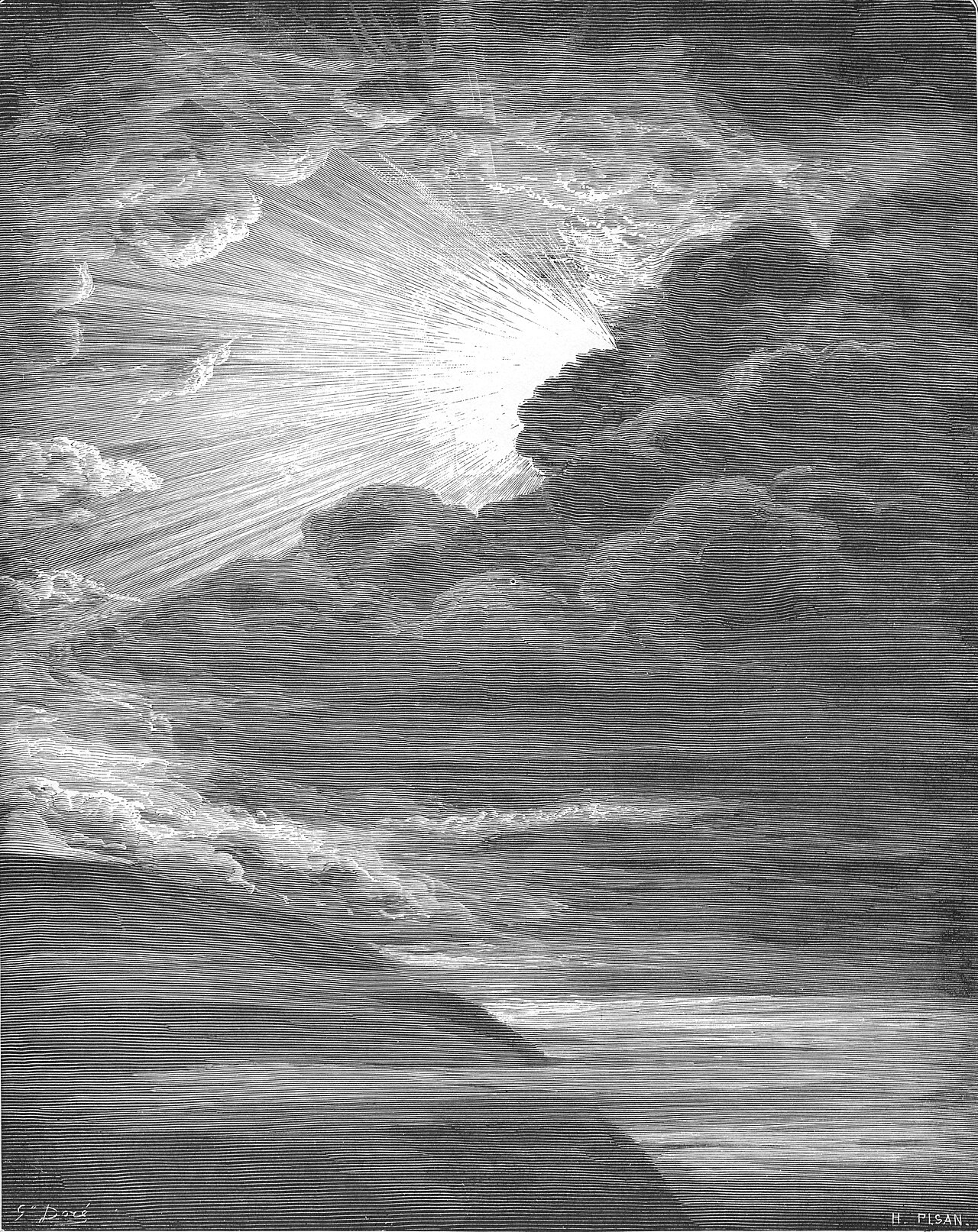
Creation in Scripture, in full
Scripture opens with a claim, not an argument: "In the beginning God created the heavens and the earth" (Gen 1:1). The Genesis account moves in an ordered six-day sequence — light, sky and sea, dry land and vegetation, sun and moon and stars, sea and air creatures, land animals and humanity — each day closed by the formula "evening and morning," and the whole pronounced "very good"
(Gen 1:31) before God rests on the seventh day (Gen 2:1-3), the pattern Exodus 20:11 later cites as the ground of Israel's Sabbath. Genesis 2 zooms in on day six: man formed from dust and given the breath of life, then given a wife, a garden, and work — image-bearing (Gen 1:27) paired with a mandate to fill and rule the earth.
That original goodness is not the permanent state of the world: Genesis 3's fall brings a curse on the ground itself (Gen 3:17), and creation's fracture becomes a running biblical fact, not a footnote.
The wisdom and prophetic books treat creation as a live witness. Job is answered not with an explanation of his suffering but with a tour of the created order — "where wast thou when I laid the foundations of the earth?" (Job 38:4). The Psalms return to creation again and again as evidence and worship: the heavens "declare the glory of God" wordlessly, day after day (Ps 19:1); the world exists because "he spake, and it was done" (Ps 33:9); its variety reflects wisdom, not accident (Ps 104:24).
Proverbs personifies wisdom as present with God "in the beginning of his way, before his works of old" (Prov 8:22), Isaiah names the Creator's power as the antidote to Israel's weariness (Isa 40:28), and Jeremiah sets that same power against the idols of the nations (Jer 10:12) — then Isaiah reaches forward to a promise: God will make "new heavens and a new earth" (Isa 65:17), the first statement of a hope the New Testament will pick up at the very end of the canon.
The New Testament reads Genesis 1 christologically. John opens his Gospel by echoing the Septuagint's own wording for Genesis 1:1 and naming the eternal Word as the one "without [whom] was not anything made that hath been made" (John 1:1, 3). Paul assigns Christ both the agency and the goal of creation — "in him were all things created... and in him all things consist" (Col 1:16-17, ASV; KJV "by him") — and Hebrews applies Creator-language to the Son directly (Heb 1:2).
Read together, these texts describe creation as a Trinitarian act: the Father as source, the Son as active agent, the Spirit moving over the waters in Genesis 1:2. Jesus himself treats the creation narrative as settled history, not myth, grounding his teaching on marriage in "the beginning of the creation" (Mark 10:6) — a detail that matters because Paul's Adam-Christ argument (Rom 5; 1 Cor 15) depends on a real, historical first Adam, not a literary figure.
The epistles extend creation language into present experience and future hope. Paul tells the Romans that "the whole creation groaneth and travaileth in pain together" (Rom 8:22), waiting on the same resurrection that will renew believers' bodies — creation's fate is tied to redemption's, not separate from it. The same vocabulary describes conversion: to be "in Christ" is to be "a new creature" (2 Cor 5:17), the old order already breaking in.
Revelation closes the canon where Isaiah pointed: "a new heaven and a new earth" (Rev 21:1), with the redeemed worshiping the Creator directly — "thou didst create all things, and because of thy will they were, and were created" (Rev 4:11, ASV; KJV "for thy pleasure they are and were created"). Genesis 1:1's "heavens and earth" and Revelation 21:1's "new heaven and new earth" bookend the whole Bible.
The honest tension sits mainly on one word: how long is a "day" (Hebrew yom) in Genesis 1?
The widely held reading is six ordinary, sequential days and a young earth, reading Exodus 20:11's Sabbath parallel and the unbroken Genesis 5/11 genealogies as decisive; conservative scholars who hold the same authority of Scripture have argued instead for a day-age reading (Hugh Ross), a literary framework (Meredith Kline), or a functional "cosmic temple" reading (John Walton) — real, named positions within the wider church.
A second, narrower question is whether Genesis 1:1 describes creation from true nothing or God's ordering of already-present unformed matter (Gen 1:2's "waste and void," KJV "without form, and void"); the traditional and majority reading takes verse 1 as the absolute beginning, which is also the reading this theme's verse list assumes throughout.
4 voices
What teachers have said
“And thou, Lord, in the beginning hast laid the foundation of the earth, and the heavens are the work of thy hands. The Lord Christ had the original right to govern the world, because he made the world in the beginning.”
Matthew Henry · Commentary on the Whole Bible, 1710
“And for this reason did the Lord most plainly manifest Himself and the Father to His disciples, lest, forsooth, they might seek after another God besides Him who formed man, and who gave him the breath of life; and that men might not rise to such a pitch of madness as to feign another Father above the Creator.”
Irenaeus · Against Heresies Book V
Written before 202.
“The very creation, by its harmony and ordering, proclaims the majesty of the divine nature.”
John Damascene · Orthodox Faith 1.1
Written before 749.
“That is a still grander statement which you will find expressly made in the Gospel: ‘In the beginning was the Word, and the Word was with God, and the Word was God.’ There was One ‘who was,’ and there was another ‘with whom’ He was.”
Tertullian · Against Praxeas
Written before 220.
The words underneath
Each card is one Hebrew or Greek word behind creation. It gives the sense, the count across the canon, and the number in Strong's 1890 concordance.
bara: to create
Hebrew · H1254Strong's entry: (absolutely) to create; (qualified) to cut down (a wood), select, feed (as formative processes)
used only of God's creative act, never of human making
55 times in the Old Testament · bara, in full →
ktistes: creator
Greek · G2939Strong's entry: a founder, i.e. God (as author of all things)
a founder, the one title reserved for God as author of all
1 times in the New Testament · ktistes, in full →
ktisis: creation
Greek · G2937Strong's entry: original formation (properly, the act; by implication, the thing, literally or figuratively)
both the act of forming and the thing that was formed
18 times in the New Testament · ktisis, in full →
ktizo: to create
Greek · G2936Strong's entry: to fabricate, i.e. found (form originally)
the Greek verb behind every NT mention of creation
15 times in the New Testament · ktizo, in full →
22 verses
The complete list
This subject carries 34 curated verses. 12 of them are quoted above, and the other 22 stand here, book by book. Open a book to read the references with a clause of each verse.
Psalms3
- Psalms 90:2Before the mountains were born or You brought forth the earth and the world, from everlasting...
- Psalms 104:24How many are Your works, O LORD! In wisdom You have made them all; the earth is full of Your...
- Psalms 148:5Let them praise the name of the LORD, for He gave the command and they were created.
Ecclesiastes1
Isaiah3
- Isaiah 40:28Do you not know? Have you not heard? The LORD is the everlasting God, the Creator of the ends...
- Isaiah 45:18For thus says the LORD, who created the heavens—He is God; He formed the earth and fashioned...
- Isaiah 65:17For behold, I will create new heavens and a new earth. The former things will not be...
John2
Romans2
2 Corinthians1
What God has done
The subjects beside it
On this page