
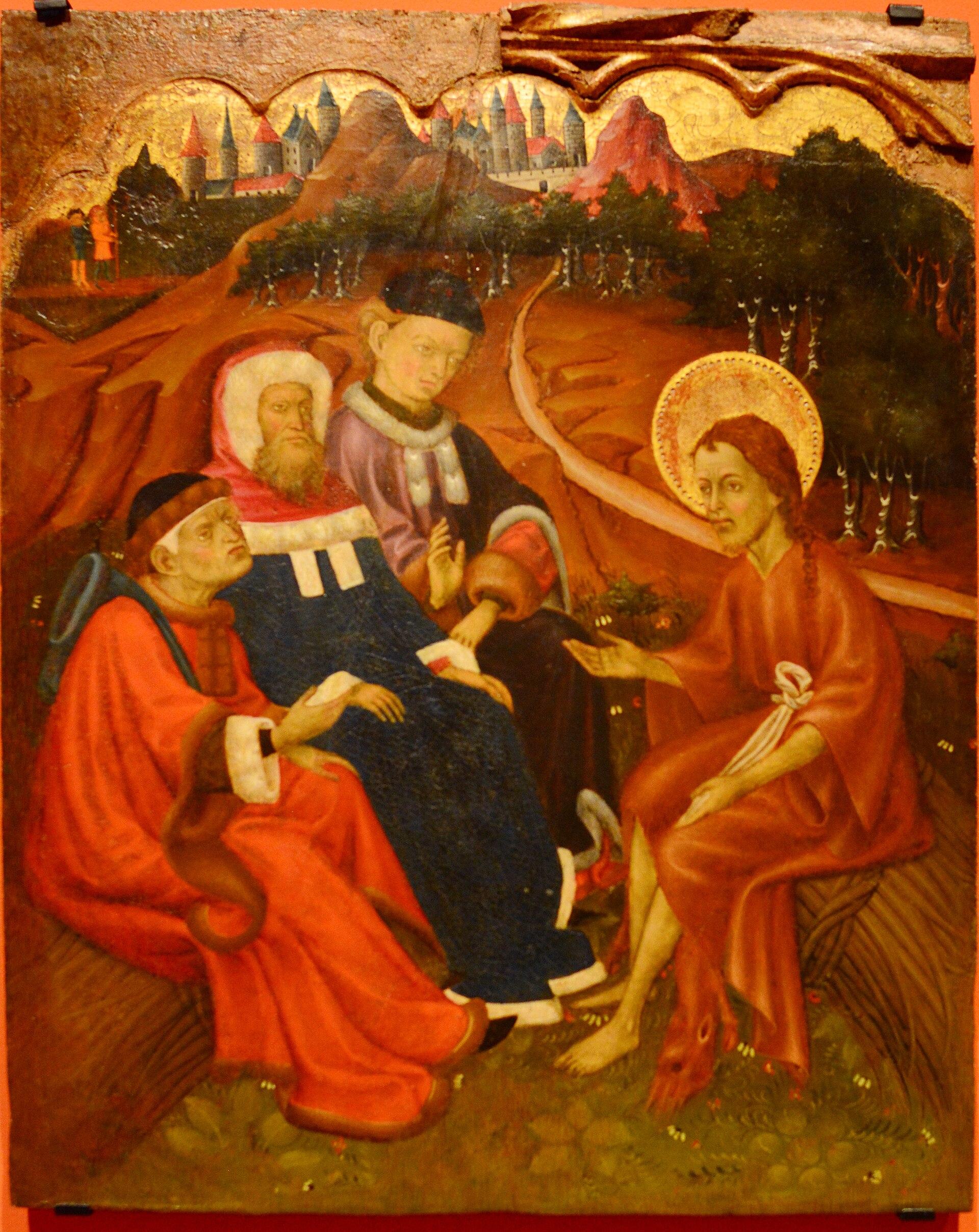
Bernat Martorell, John the Baptist Debating with the Priests and Levites, about 1450. Public domain.
John 1:19 to 25 · Doctrine · Featured Study
The Christ, Elijah and the Prophet
Each of the three names put to John the Baptist at the Jordan points back to a promise in the Law or the Prophets.
Jesus said the Baptist was the Elijah who was to come, though the Baptist himself denied it.
asked him, “Why then do you baptize, if you are not the Christ, nor Elijah, nor the Prophet?”
- First taught
- Deuteronomy 18:15 “The LORD your God will raise up for…”
- Fullest statement
- John 1:21 “Then who are you?” they inquired. “Are you…”
Summary
The leaders in Jerusalem hoped for the Christ, for Elijah and for the Prophet. John the Baptist told their men he was none of these, and later the crowds asked the same about Jesus.
- The Christ is the king God promised from David's family.
- The Prophet goes back to a promise Moses made in Deuteronomy 18.
- Crowds in John 6 and John 7 asked whether Jesus was the Prophet or the Christ.
Three Questions at the Jordan
Three names stood behind the delegation's questions at the Jordan.
The Jews of Jerusalem sent priests and Levites to ask John who he was, and Pharisees were among those sent (John 1:19 and John 1:24). John was baptizing at Bethany beyond the Jordan (John 1:28).
He did not refuse to confess, but openly declared, “I am not the Christ.” “Then who are you?” they inquired. “Are you Elijah?” He said, “I am not.” “Are you the Prophet?” He answered, “No.”John gives a shorter answer each time, and he says nothing yet about who he is.
Asked who he was, John answered in the words of Isaiah 40:3. He called himself a voice calling in the wilderness to make straight the way for the Lord (John 1:23).
From Moses to the Crowds
Each of the three figures has a promise in the Old Testament and a question in John's Gospel.
Four promises from the Law and the Prophets stand behind the questions at the Jordan and in Jerusalem.
- What this step says
- Moses promises that God will raise up a prophet like him from among his brothers.
- What this step says
- God promises David a descendant whose throne He will establish forever.
- What this step says
- A ruler over Israel is to come out of Bethlehem.
- What this step says
- The last of the prophets ends with a promise of Elijah's return.
- What this step says
- The question at the Jordan names Elijah and the Prophet after the Christ.
- What this step says
- After the loaves, the people call Jesus the Prophet who is to come.
- What this step says
- In Jerusalem some call Him the Prophet, others the Christ, and others point to David and Bethlehem.
- What this step says
- Jesus gives John the name of Elijah, if the crowds will accept it.
- What this step says
- Peter names Jesus as the prophet Moses promised.
Nine steps, from the promises to the crowds, to Jesus and to Peter.
John 7:40 to 42, Matthew 11:14, Acts 3:22
The Crowds Ask Again
Twice in John's Gospel the crowds called Jesus by names the messengers had put to John.
After Jesus fed the five thousand, the people called Him the Prophet who is to come (John 6:14). Jesus saw that they meant to make Him king by force, and He withdrew to the mountain alone (John 6:15).
Others declared, “This is the Christ.” But still others asked, “How can the Christ come from Galilee? Doesn’t the Scripture say that the Christ will come from the line of David and from Bethlehem, the village where David lived?”The crowd's own appeal to Scripture becomes the ground of its division over Jesus (John 7:43).
The crowd divided over Him (John 7:43). The Pharisees answered Nicodemus that no prophet comes out of Galilee (John 7:52).
“These verses show us, for one thing, how useless is knowledge in religion, if it is not accompanied by grace in the heart. We are told that some of our Lord's hearers knew clearly where Christ was to be born. They referred to Scripture, like men familiar with its contents. ‘Has not the Scripture said that Christ comes of the seed of David, and out of the town of Bethlehem, where David was?’ And yet the eyes of their understanding were not enlightened. Their own Messiah stood before them, and they neither received, nor believed, nor obeyed Him.”
J.C. Ryle · Expository Thoughts on the Gospels: John (lightly modernized text, Grace Gems edition) · on John 7:40 to 53Reformed Evangelical
The Three Hopes in the Old Testament
The law and the prophets gave Israel a king to wait for, a prophet to listen to and a forerunner to watch for.
Christ is the Greek form of Messiah, the Anointed One (John 1:41). The hope of an anointed king rests on God's word to David in 2 Samuel 7.
He will build a house for My Name, and I will establish the throne of his kingdom forever.The promise of a throne that lasts forever is the root of the hope for a king from David's line.
Albert Barnes wrote that the Jews of Jesus' day expected the real Elijah to come back from heaven before the Messiah.
Moses told Israel that God would put His words in the mouth of a prophet like him (Deuteronomy 18:18). Jamieson, Fausset and Brown observed that the Jews of John's day were not agreed whether that prophet was the Messiah himself.
The Prophet and the Christ
The Prophet of Deuteronomy 18 returns in Peter's sermon in Acts 3.
John Chrysostom held that the messengers asked about that Prophet foretold by Moses, and that this Prophet was Christ. John denied being that Prophet, Chrysostom wrote, without denying that he was a prophet.
For Moses said, ‘The Lord your God will raise up for you a prophet like me from among your brothers. You must listen to Him in everything He tells you.In Peter's sermon Moses' promise is applied to Jesus, the reading Chrysostom gives of John 1:21.
John wrote his Gospel so that its readers would believe that Jesus is the Christ, the Son of God (John 20:31).
Voices on John's Answers
Cyril of Alexandria and Augustine read John's answer, a voice in the wilderness, as a word that points to Christ.
Cyril of Alexandria (died 444)
Cyril of Alexandria wrote that John came to say one thing only, that the One the people looked for was at the doors. Cyril heard in the answer a call to leave the way given through Moses for the way of Christ.
Augustine set John beside a herald. A herald makes men stand back from the judge, he wrote, and John calls them to come to Him.
Was John the Elijah Malachi Promised?
Readers from Hippolytus on have read Malachi's promise of Elijah in three ways.
Elijah in spirit and powerGregory the Great, Forty Gospel Homilies 7; Origen, Commentary on the Gospel of John 6
Gregory pointed to the angel's word that John would go before the Lord in the spirit and power of Elijah (Luke 1:17). John was Elijah in spirit, Gregory wrote, and he was not Elijah in person. Origen held that the messengers asked whether John was the very Elijah who had been taken up, come back without a birth.
The objection: Matthew 11:14 and Matthew 17:12 to 13 give John the name without any such division between spirit and person.
The Baptist alone fulfils the promiseJohn Wesley, Explanatory Notes upon the Old Testament, on Malachi 4:5; Adam Clarke, Commentary on the Bible, on Malachi 4:5
Wesley wrote that Malachi's Elijah is John the Baptist, who bears the prophet's name because of the gift Luke 1:17 describes. Clarke held that Malachi meant John alone.
The objection: after the Transfiguration Jesus also spoke of Elijah as coming to restore all things (Matthew 17:11).
Elijah himself will come before the Lord's returnHippolytus of Rome, On the Antichrist 46; Victorinus of Pettau, Commentary on the Apocalypse
Hippolytus read Malachi 4:5 of forerunners who will appear before Christ is shown from heaven as judge. Victorinus of Pettau read Elijah the prophet as the forerunner of the times of Antichrist.
The objection: Jesus told His disciples that Elijah has already come, and they understood Him to mean John (Matthew 17:12 to 13).
The One Who Comes After Me
John's last answer to the messengers turned them toward Jesus.
“I baptize with water,” John replied, “but among you stands One you do not know. He is the One who comes after me, the straps of whose sandals I am not worthy to untie.”These are the last words John speaks to the messengers in the Gospel.
The next day John saw Jesus coming toward him and called Him the Lamb of God (John 1:29).
Sources
Scripture is the Berean Standard Bible.
- Gregory the Great (Gregory the Dialogist), Forty Gospel Homilies, Homily 7 (sixth century), on John 1:19 to 25.
- Cyril of Alexandria, Commentary on the Gospel of John, Book 1 (fifth century), on John 1:23.
- Victorinus of Pettau, Commentary on the Apocalypse (about 304), on Malachi 4:5.
- Origen of Alexandria, Commentary on the Gospel of John, Book 6 (third century), on John 1:21.
- John Chrysostom, Homilies on the Gospel of John, Homily 16 (fourth century), on John 1:21.
- Hippolytus of Rome, On the Antichrist 46 (third century), on Malachi 4:5.
- John Wesley, Explanatory Notes upon the New Testament (1755), on John 1:21, and Explanatory Notes upon the Old Testament, on Malachi 4:5.
- Augustine of Hippo, Tractates on the Gospel of John 4 (fifth century), on John 1:23.
- Adam Clarke, Commentary on the Bible (1832), on Malachi 4:5.
- Albert Barnes, Notes on the New Testament (1832 to 1869), on John 1:21.
- Jamieson, Fausset and Brown, Commentary Critical and Explanatory on the Whole Bible (1871), on John 1:21.
- J. C. Ryle, Expository Thoughts on the Gospels: John (1869), on John 7:40 to 53.
Keep Studying
Read it5
Studies5
Doctrines2