
431 and 451 to today · The churches · Featured Study
The Oriental Orthodox Churches and the Church of the East
The ancient churches of Egypt, Ethiopia, Eritrea, Armenia, Syria and India, and the Church of the East that reached China.
A stone the Church of the East set up at Ch'ang-an in 781 tells the nativity in its own words: “A bright star announced the felicitous event. Persians saw its splendour and came with tribute.”
- Began
- Parted from the imperial church after 431 and 451
- Bodies
- Ethiopia, Egypt, Eritrea, India, Armenia, Syria, The Assyrian Church of the East
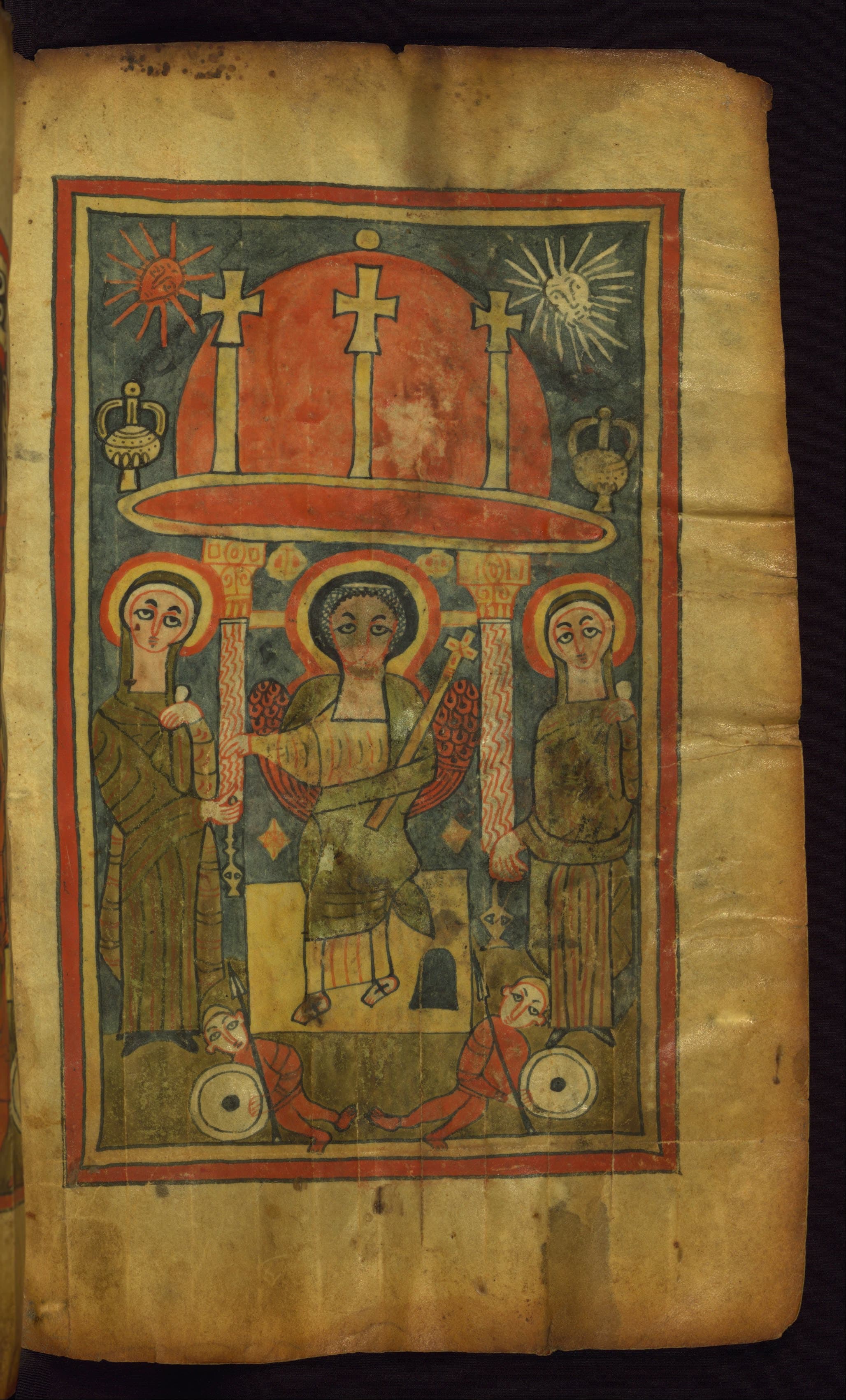
Mätre Krestos, Christ's Resurrection, Flanked by Two Women, early 14th century. Public domain.
The Word became flesh and made His dwelling among us. We have seen His glory, the glory of the one and only Son from the Father, full of grace and truth.
Summary
These churches did not receive the Council of Chalcedon of 451, and the Church of the East parted after Ephesus in 431. Their heads have since signed declarations with Rome that confess one Christ.
- The Coptic church traces itself to Mark, as Eusebius reports the tradition.
- The Ethiopian church is the largest of the family.
- A declaration of 1994 calls the old divisions largely misunderstandings.
The Texts These Churches Confess
The texts come from Philippians 2, Acts 8, Matthew 2 and Matthew 28.
Paul's words on Christ's emptying stand behind the Coptic declaration of 1973.
The servant's form
Who, existing in the form of God, did not consider equality with God something to be grasped, but emptied Himself, taking the form of a servant, being made in human likeness.
The declaration of 1973 takes its words on the servant's form from Philippians 2:7.
An Ethiopian in Acts
So he started out, and on his way he met an Ethiopian eunuch, a court official in charge of the entire treasury of Candace, queen of the Ethiopians. He had gone to Jerusalem to worship,
Acts names this convert an Ethiopian, the name the largest church of the family bears today.
Acts 8:27BSB
The star the stele retells
After Jesus was born in Bethlehem in Judea, during the time of King Herod, Magi from the east arrived in Jerusalem, asking, “Where is the One who has been born King of the Jews? We saw His star in the east and have come to worship Him.”
It is the Gospel account the stele retells in Chinese.
The commission they carried
Therefore go and make disciples of all nations, baptizing them in the name of the Father, and of the Son, and of the Holy Spirit,
It is the commission on which the apostolic claims of these churches rest.
Acts 8:27, Matthew 2:1 to 2, Matthew 28:19
The Two Branches in the Family of Churches
From the church of Jerusalem to the declarations of 1973 and 1994.
Each branch parts from the imperial church at a council and meets Rome again in a joint declaration.
Pentecost
431
- The Council of Ephesus
- The Church of the East, apart after Ephesus
451
- The Council of Chalcedon
- The Oriental Orthodox churches, apart after Chalcedon
- The Eastern Orthodox churches, who received the council
635 to 781
- Olopun at Ch'ang-an
- The stele set up at Ch'ang-an in 781
1973 to 1994
- The Coptic declaration with Rome
- The Assyrian declaration with Rome, 1994
The Christian Traditions dates Ephesus, Schaff dates Chalcedon, the stele in Legge's English dates 635 and 781, and vatican.va prints the declarations.
The Christian Traditions sets both branches beside the other families of the churches, each with the date on which it began.
How the Two Families Came to Stand Apart
Ephesus in 431, Chalcedon in 451, and the apostles the churches name.
The Christian Traditions dates the parting of the Church of the East to the Council of Ephesus in 431, which condemned Nestorius, Patriarch of Constantinople.
Schaff dates the Definition of the Council of Chalcedon to 22 October 451. In Schaff's English it confesses “one and the same Christ, Son, Lord, Only-begotten, to be acknowledged in two natures, inconfusedly, unchangeably, indivisibly, inseparably.”
Pew, summing up as an outsider in 2017, calls Oriental Orthodoxy “non-Chalcedonian.”
The tradition says Mark founded the church of Alexandria. Eusebius finished his Church History about 324. In McGiffert's English of 1890 he reports that “they say” Mark was the first sent to Egypt and “first established churches in Alexandria.”
Thomas in India, as the later tradition tells it1 paragraph
The later tradition says Thomas reached India. The Acts of Thomas, a legend whose date is not known, set the apostle in the cities of India at the court of the king Gundaphoros.
Who wrote these records, and with what interest1 paragraph
Eusebius marks the founding of Alexandria as report, and the Acts of Thomas are a later legend. Each declaration speaks for the churches whose heads put their names to it.
The Truth They Keep: One Christ, True God and True Man
The confession the Coptic pope signed with Rome in 1973.
On 10 May 1973 Pope Paul VI and Shenouda III, “Pope of Alexandria and Patriarch of the See of St Mark,” signed a Common Declaration.
They confessed that Christ “is perfect God with respect to His divinity, perfect man with respect to His humanity.”
They went on, “In Him His divinity is united with His humanity in a real, perfect union without mingling, without commixtion, without confusion, without alteration, without division, without separation.”
The Church of the East and Rome in 1994
The Common Christological Declaration of 11 November 1994.
On 11 November 1994 Pope John Paul II and Mar Dinkha IV, Catholicos-Patriarch of the Assyrian Church of the East, signed a Common Christological Declaration. It records the title by which the Assyrian church addresses the Virgin Mary in its prayer, “the Mother of Christ our God and Saviour.”
The same text says the Catholic tradition addresses her as “the Mother of God” and also as “the Mother of Christ.”
The two churches wrote, “We both recognize the legitimacy and rightness of these expressions of the same faith.”
The Oriental Churches Today
Pew's estimates of 2017 for the family, for Ethiopia and for Egypt.
Pew Research Center estimated in 2017, from censuses, surveys and its projections of 2015, that Oriental Orthodoxy “accounts for roughly 20% of the worldwide Orthodox population” of nearly 260 million.
Pew found Orthodox Christians in Ethiopia “more religiously observant, by several common measures, than Orthodox Christians in Europe.”
Pew estimated in 2017, from censuses and surveys, that Ethiopia's church holds nearly one in seven of the world's Orthodox, and its Egyptian figure is an estimate for a population it could not survey.
| Church | Pew's estimate |
|---|---|
| The Ethiopian Orthodox Tewahedo Church | 36 million adherents, nearly 14 percent of the world's Orthodox |
| The Orthodox of Egypt, mainly Coptic | 4 million, 5 percent of Egypt's population |
The Church of the East Reaches the Tang Capital
What the stone of 781 records, in James Legge's English of 1888.
James Legge, professor of Chinese at Oxford, translated the stele in 1888. It says Olopun “made his way through difficulties and perils” and arrived at Ch'ang-an “In the ninth year of the period Chang-kwan.”
The stone was set up by the church it praises, 146 years after the arrival it records, and it praises the emperors who favoured that church. Its account of 635 stands on this one witness.
The stele dates the arrival, a proclamation and its own erection.
| Year | What the stele records |
|---|---|
| 635 | Olopun arrives at Ch'ang-an, and the Scriptures are translated in the Library. |
| 638 | In the twelfth Chang-kwan year a proclamation is issued for the teaching. |
| 781 | The stone is erected on the seventh day of the first month, a Sunday, with a Syriac line naming the patriarch Hanan-Yeshu'. |
The Anathemas and the Declarations That Answered Them
What the churches said of their old condemnations in 1994, and what Chalcedon still says.
The declaration of 1994 names the old failure: “The controversies of the past led to anathemas, bearing on persons and on formulas.”
It goes on, “The Lord’s Spirit permits us to understand better today that the divisions brought about in this way were due in large part to misunderstandings.”
that all of them may be one, as You, Father, are in Me, and I am in You. May they also be in Us, so that the world may believe that You sent Me.Christ prayed that His people be one, the prayer the anathemas broke and the declarations sought to answer.
The strongest evidence against reading the parting as a quarrel over words is Chalcedon's own Definition, which makes “in two natures” the test of the faith. The declarations of 1973 and 1994 confess one faith in different formulas, and the Definition stands as the council wrote it.
Books to Read Next
The Nestorian Monument of Hsî-an Fû
James Legge · 1888
Legge gives the stele's text in English; his title uses “Nestorian,” a name others gave the Church of the East.
Free at the Internet ArchiveThe Creeds of Christendom, volume 2
Philip Schaff · 1877
It prints the Definition of Chalcedon in Schaff's English, with his notes.
Free at the Christian Classics Ethereal LibraryChurch History
Eusebius, translated by Arthur Cushman McGiffert · 1890
Eusebius records the tradition of Mark at Alexandria.
Free at the Christian Classics Ethereal LibraryWhat These Churches Hand On
These churches show that Christians who parted over the words used of Christ can come to confess the same Lord again.
The Church of the East also shows that a church outside the councils of the empire carried the gospel to the far end of Asia.
The line through this page
The verse whose work this page shows continuing, then 1 link to other pages, in order of date.
The verse whose work this page shows continuing.
The first century, as Eusebius reports the tradition, disputed
The Apostolic Age to The Oriental Orthodox Churches and the Church of the East
The tradition says Mark founded the church of Alexandria.
This page
The Oriental Orthodox Churches and the Church of the East
Sources
Scripture is the Berean Standard Bible.
- The Holy Bible, Berean Standard Bible (read 2026)
- The Definition of the Council of Chalcedon (22 October AD 451), in Philip Schaff, The Creeds of Christendom, volume 2, sixth edition.
- Common Declaration of Pope Paul VI and Pope Shenouda III, 10 May 1973.
- Common Christological Declaration between the Catholic Church and the Assyrian Church of the East, 11 November 1994.
- Eusebius, Church History 2.16.1 (completed about 324), translated by Arthur Cushman McGiffert, in the Nicene and Post-Nicene Fathers, second series, volume 1 (New York, 1890)
- Acts of the Holy Apostle Thomas, in the Ante-Nicene Fathers, volume 8, the date of the Acts not known (read 2026)
- James Legge, The Nestorian Monument of Hsî-an Fû in Shen-hsî, China (London: Trübner, 1888), the inscription, paragraphs 4 and 7 and the closing lines.
- Pew Research Center, Orthodox Christianity in the 21st Century, 8 November 2017, with its sidebar Eastern Orthodoxy vs. Oriental Orthodoxy.
Keep Studying
Studies1
Subjects1
People and groups4