
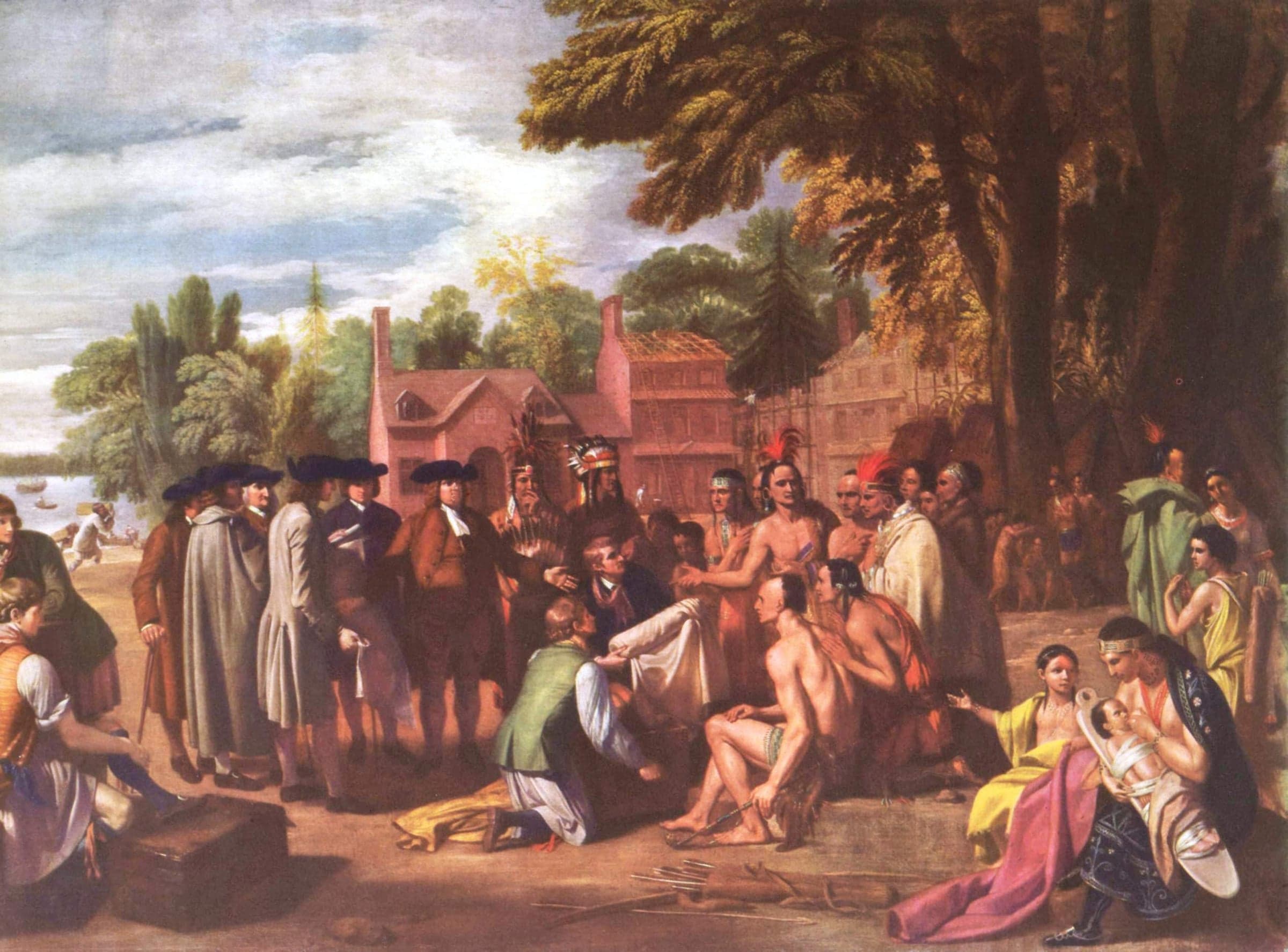
Benjamin West, Penn’s Treaty with the Indians, 1771 to 1772. Public domain.
1647 to today · The churches · Featured Study
The Religious Society of Friends
A society of seventeenth-century England whose name began as a taunt of its enemies.
Robert Barclay signed his theses as “one of those who in derision are called Quakers.”
The true Light who gives light to every man was coming into the world.
- Began
- 1647 to 1650 in the English Midlands, as Fox's Journal gives it (probable)
- Bodies
- The Friends World Committee for Consultation
Robert Barclay signed his theses as “one of those who in derision are called Quakers.”
Summary
The Friends gathered around George Fox's preaching in England from 1647. Robert Barclay's confession of 1675 makes the Spirit the first guide, and it treats baptism and the supper as inward.
- A justice at Derby first called them Quakers in 1650, by Fox's account.
- In 1688 four Friends at Germantown protested slavery to meetings that would not rule on it.
- Later Friends split over the place of Scripture, from Crewdson in 1836 to Rowntree in 1895.
The Texts the Friends Stood On
The texts come from John 1 and Isaiah 66.
Robert Barclay's fifth proposition of 1675, on the light given to every man, cites John 1:9 in its margin.
The light in every man
The true Light who gives light to every man was coming into the world.
Barclay cites it in the margin of his fifth proposition, on the universal light.
John 1:9BSB
The word behind the name
Has not My hand made all these things? And so they came into being,” declares the LORD. “This is the one I will esteem: he who is humble and contrite in spirit, who trembles at My word.
Fox's phrase about trembling at the word matches this verse, though he does not cite it.
Isaiah 66:2BSB
Isaiah 66:2
The Friends' Branch of the Family of Churches
The branch runs from Fox's preaching of 1647 to the Manchester Conference of 1895.
The Friends run from Fox's preaching to an evangelical and a liberal reading of their first rule.
1647 to 1650
- Fox's preaching in the Midlands
- The name Quakers, given by Justice Bennet of Derby
1653 to 1654
- The Northern Quakers
- The name in the journals of the House of Commons
1675
- Barclay's Theses
- Barclay's Apology, dated at Ury in November
1688
- The Germantown protest
- The Yearly Meeting at Burlington, which would not judge
1836
- The Beacon controversy
- The evangelical reading of the word and the Spirit
1895
- The Manchester Conference
- The liberal reading of 1895
Each generation is dated from the record that names it.
The other families of the churches stand together with the dates on which each began.
How the Friends Began and Got Their Name
Fox tells of 1647 and 1650, and a hostile minister writes of 1653.
The Journal of George Fox is a memoir, printed after his death in 1690. Its eighth edition, issued in 1901, says its text was carefully read and collated with the first edition.
Fox and Higginson, each an interested witness, give the name Quakers two origins.
| Witness | What he wrote | His interest |
|---|---|---|
| Fox, on 1647 | A voice said, “There is one, even Christ Jesus, that can speak to thy condition;” and when he heard it, his heart “did leap for joy.” | Fox, writing of himself |
| Fox, on 1650 | “This was Justice Bennet of Derby, who was the first that called us Quakers, because I bid them tremble at the word of the Lord.” | Fox, writing of himself |
| Francis Higginson, A Brief Relation of the Irreligion of the Northern Quakers (London, 1653) | Under the heading “Of their Quaking Fits” he describes followers who fall as in a swoon, tremble and “foam at the mouth,” and he says the people earned “the name of Quakers” from these fits. | A minister writing against them |
| The editor's footnote, unsigned | “The first use of the term in the records of Parliament, occurs in the journals of the House of Commons in 1654.” | An editor's note, which the 1901 issue keeps from the seventh edition |
The Hebrew word for trembling1 paragraph
The Hebrew adjective chârêd, glossed “fearful” and “trembling,” stands in six verses, Isaiah 66:2 and Isaiah 66:5 among them.
The Truth They Kept: the Spirit as the First Guide
Barclay's third proposition stands first, and three readings of the Scriptures follow from 1675 to 1895.
Robert Barclay, a Scot, dedicated his Apology for the True Christian Divinity to Charles II, writing from Ury on 25 November 1675. In his third proposition he calls the Spirit “the first and principal Leader.”
However, when the Spirit of truth comes, He will guide you into all truth. For He will not speak on His own, but He will speak what He hears, and He will declare to you what is to come.It is the verse Barclay sets in the margin of his third proposition.
The Friends' readings of the Scriptures and the Spirit changed over two centuries.
Three Friends across 220 years read the place of the Scriptures in three ways.
| Reader | Year | What he held |
|---|---|---|
| Robert Barclay, Theses Theologicae, Proposition 3 | 1675 | The Scriptures “are not to be esteemed the principal ground of all truth and knowledge,” but “they are and may be esteemed a secondary rule, subordinate to the Spirit.” |
| Isaac Crewdson, A Defence of the Beacon | 1836 | He held “that the inspired word, as we have it in Scripture is the instrument, and the Holy Spirit is Himself the agent.” |
| John Wilhelm Rowntree, at the Manchester Conference, as Rufus M. Jones prints him in The Later Periods of Quakerism (1921) | 1895 | “One moment the Bible seems taken from us, the next it is restored, more living than before and with a new light upon its page.” |
Rowntree at Manchester, as Jones prints him2 paragraphs
At the Manchester Conference of November 1895 Rowntree asked whether Quakerism had a message for the time. He answered that if men can no longer believe without knowing why they believe, “then such a change will bring, as its ultimate result, not weakness but new strength.”
Rufus M. Jones prints the address with approval in 1921 and calls Rowntree “This illumined young leader.”
Their Own Statement of Faith: Barclay's Theses
Five theses speak on revelation, the ministry, worship, baptism and the supper.
Philip Schaff prints Barclay's fifteen Theses Theologicae in The Creeds of Christendom (1877) as the confession of the Society of Friends of 1675. His text follows the eighth English edition, printed at Birmingham in 1765.
Barclay's theses keep revelation, preaching, worship and the ordinances inward and spiritual.
| Proposition | The words |
|---|---|
| 2, on revelation | “these divine inward revelations, which we make absolutely necessary for the building up of true faith, neither do nor can ever contradict the outward testimony of the Scriptures, or right and sound reason” |
| 10, on the ministry | Those with the gift “may and ought to preach the gospel, though without human commission or literature.” |
| 11, on worship | Prayers, praises and preachings are offered only “where and when we are moved thereunto by the secret inspirations of his Spirit.” |
| 12, on baptism | Baptism “is a pure and spiritual thing, to wit, the baptism of the Spirit and Fire,” and “As to the baptism of infants, it is a mere human tradition.” |
| 13, on the supper | The breaking of bread was “a figure, which they even used in the Church for a time.” |
The Friends Today
One worldwide count gives the number of the Friends.
The World Office of the Friends World Committee for Consultation released a map in 2017 that gives approximately 380,000 Friends worldwide, Friends Journal reported on 13 September 2017.
The report calls the counting far from exact, and it warns against reading the figures of 2012 and 2017 as a trend.
Where the Friends Went
Six places carry dates from 1647 to 1895.
The printed record places the Friends in the English Midlands and North first, and later in Scotland and at Germantown.
| Place | Year | The record |
|---|---|---|
| Derbyshire | 1647 | Fox's Journal, where his account of that year opens after he left the priests |
| Derby | 1650 | Fox's Journal, on Justice Bennet, before whom Fox was brought that year |
| The North of England | 1653 | Higginson's title, which names the Northern Quakers |
| Ury, Scotland | 1675 | Barclay's Apology, whose dedication to Charles II he wrote from his native Scotland |
| Germantown and Burlington | 1688 | The protest of four Friends, and the Yearly Meeting's minute on it at Burlington |
| Manchester | 1895 | The Manchester Conference, at which Rowntree spoke, as Jones records it in 1921 |
The Germantown Protest of 1688 and the Meetings' Refusal
The protest passed through three meetings, and a denunciation came later.
In 1688 Gerret Hendericks, Derick up de Graeff, Francis Daniell Pastorius and Abraham up den Graef signed a protest against slavery at Germantown. Their protest reads, “we shall doe to all men licke as we will be done ourselves.”
In everything, then, do to others as you would have them do to you. For this is the essence of the Law and the Prophets.The protest's own words echo this command.
The protest went from Dublin Monthly Meeting to the Quarterly Meeting, which found it “a thing of too great a weight for this meeting to determine.”
At Burlington the Yearly Meeting minuted, “It was adjudged not to be so proper for this meeting to give a positive judgment in the case.”
Anne Moore Mueller's exhibit for the Tri-College Libraries says the Society of Friends officially denounced slavery 88 years after the protest. The exhibit gives no year for it.
Books to Read Next
The Journal of George Fox
George Fox · 1901 issue of the eighth edition
Fox tells the voice of 1647 and the naming of 1650 in his own words.
Free at Project GutenbergAn Apology for the True Christian Divinity
Robert Barclay · 1765 edition
It is Barclay's longer work, from the same year as the theses.
Free at Project GutenbergThe Later Periods of Quakerism, volume 2
Rufus M. Jones · 1921
It is Jones's history of the later Friends.
Free at the Internet ArchiveA Defence of the Beacon
Isaac Crewdson · 1836
Crewdson argues for the word and the Spirit together.
Free at the Internet ArchiveWhat the Friends Hold
Barclay's theses hold that the light of Christ reaches every man, and that the Spirit leads worship and ministry with or without a human commission.
Sources
Scripture is the Berean Standard Bible.
- The Holy Bible, Berean Standard Bible (read 2026)
- George Fox, The Journal of George Fox, eighth (Bi-Centenary) edition (London: Friends' Tract Association, issue of 1901), the chapter for 1624 to 1647, the account of 1650 and footnote 8.
- George Fox, A Journal, or Historical Account (London: J. Sowle, 1709), title page and the account of 1647.
- Robert Barclay, Theses Theologicae (1675), Propositions 2, 3, 5, 10, 11, 12 and 13, in Philip Schaff, The Creeds of Christendom, volume 3 (1877), from the eighth English edition (Birmingham, 1765)
- Robert Barclay, An Apology for the True Christian Divinity, eighth English edition (Birmingham: John Baskerville, 1765), the dedication to Charles II.
- Isaac Crewdson, A Defence of the Beacon (London, 1836)
- Rufus M. Jones, The Later Periods of Quakerism (London: Macmillan, 1921), volume 2, chapter XXIV, pages 971 to 974, with John Wilhelm Rowntree's address of 1895.
- Anne Moore Mueller, Early Protests, Quakers and Slavery (Tri-College Libraries, undated; read 2026), quoting the Yearly Meeting's minutes, volume A2, page 18.
- New Worldwide Quaker Map Released, Friends Journal, 13 September 2017.
- James Strong, Hebrew and Chaldee Dictionary (1890), entry 2730, chârêd, and the six verses tagged with it.
Keep Studying
Subjects1
Church history1
People and groups2
Trials of life1