
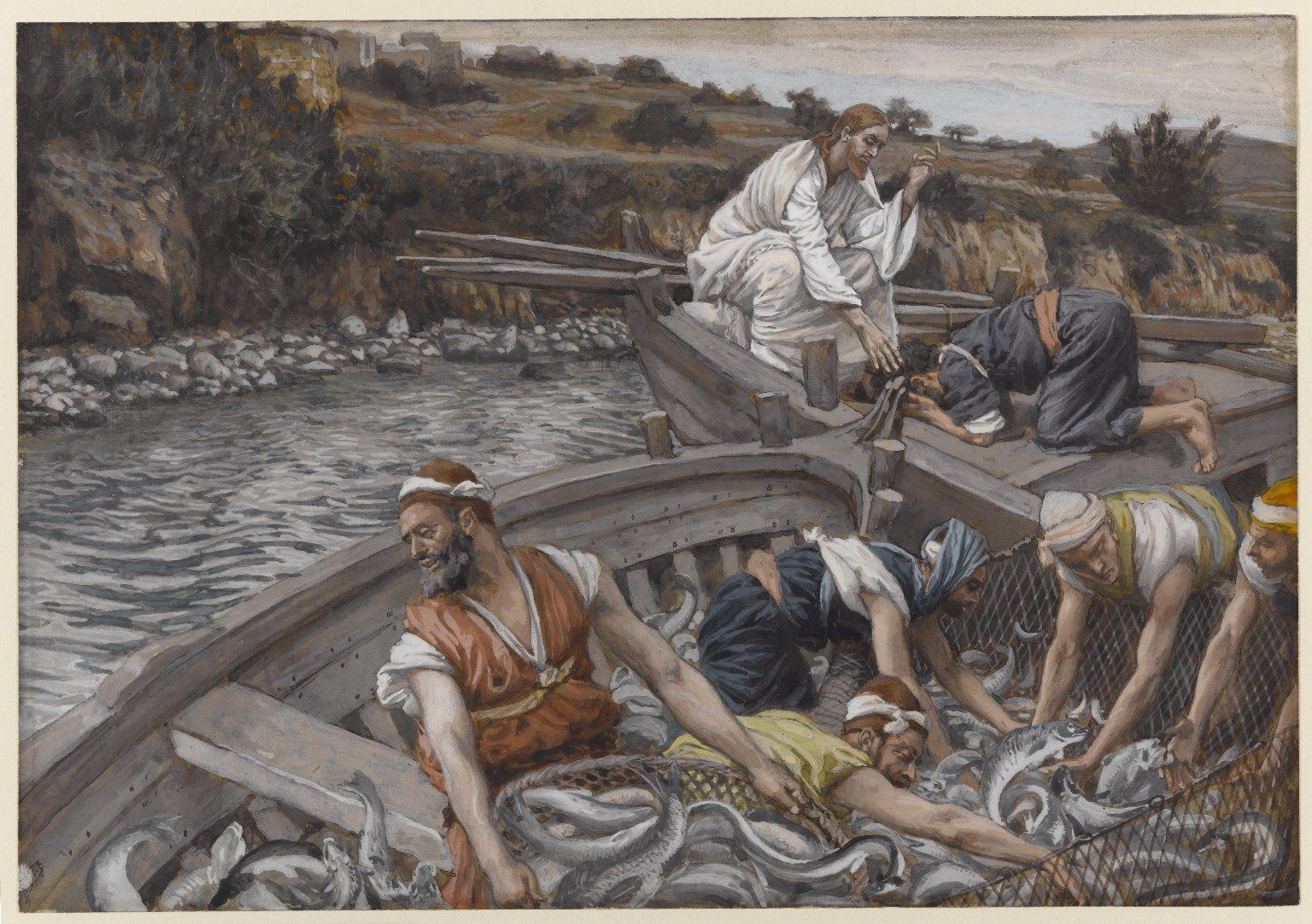
James Tissot, The Miraculous Draught of Fishes, 1886 to 1894. Public domain.
Luke 5:1 to 11 · Story · Featured Study
The Call of the First Disciples
Luke tells how Jesus called His first followers away from their daily work.
and so were his partners James and John, the sons of Zebedee. “Do not be afraid,” Jesus said to Simon. “From now on you will catch men.”
- Where
- Sea of Galilee
- Who
- Jesus of Nazareth, Peter
- When
- Luke 5:1 to 11 and Luke 5:27 to 32
Simon had fished all night for nothing, and at a word from Jesus he let the nets down again.
Summary
Simon was fishing on the Lake of Gennesaret when Jesus borrowed his boat to teach the crowd. By the end of that day Simon and his partners had become disciples of Jesus.
- Jesus' promise turned three fishermen of Galilee into His disciples.
- Soon after, Levi left his tax booth to follow Jesus.
- Augustine asked how Luke's account fits with the calls told by Mark and by John.
The Catch on the Lake
Luke sets the call on the Lake of Gennesaret, where a crowd had pressed in to hear Jesus.
Jesus got into Simon's boat and taught the people from a little way off the shore (Luke 5:1 to 3).
“Master,” Simon replied, “we have worked hard all night without catching anything. But because You say so, I will let down the nets.”Simon obeys a command that his own night of work tells him is useless.
The nets filled until they began to tear, and both boats sank low under the fish (Luke 5:6 to 7). Bede explained that the Lake of Gennesaret is the water also called the Sea of Galilee and the Sea of Tiberias.
Where the First Disciples Met Jesus
Andrew and Simon came from Bethsaida, and Simon had a house in Capernaum.
John sets the first meeting by the Jordan, and Mark and Luke set the call beside the lake.
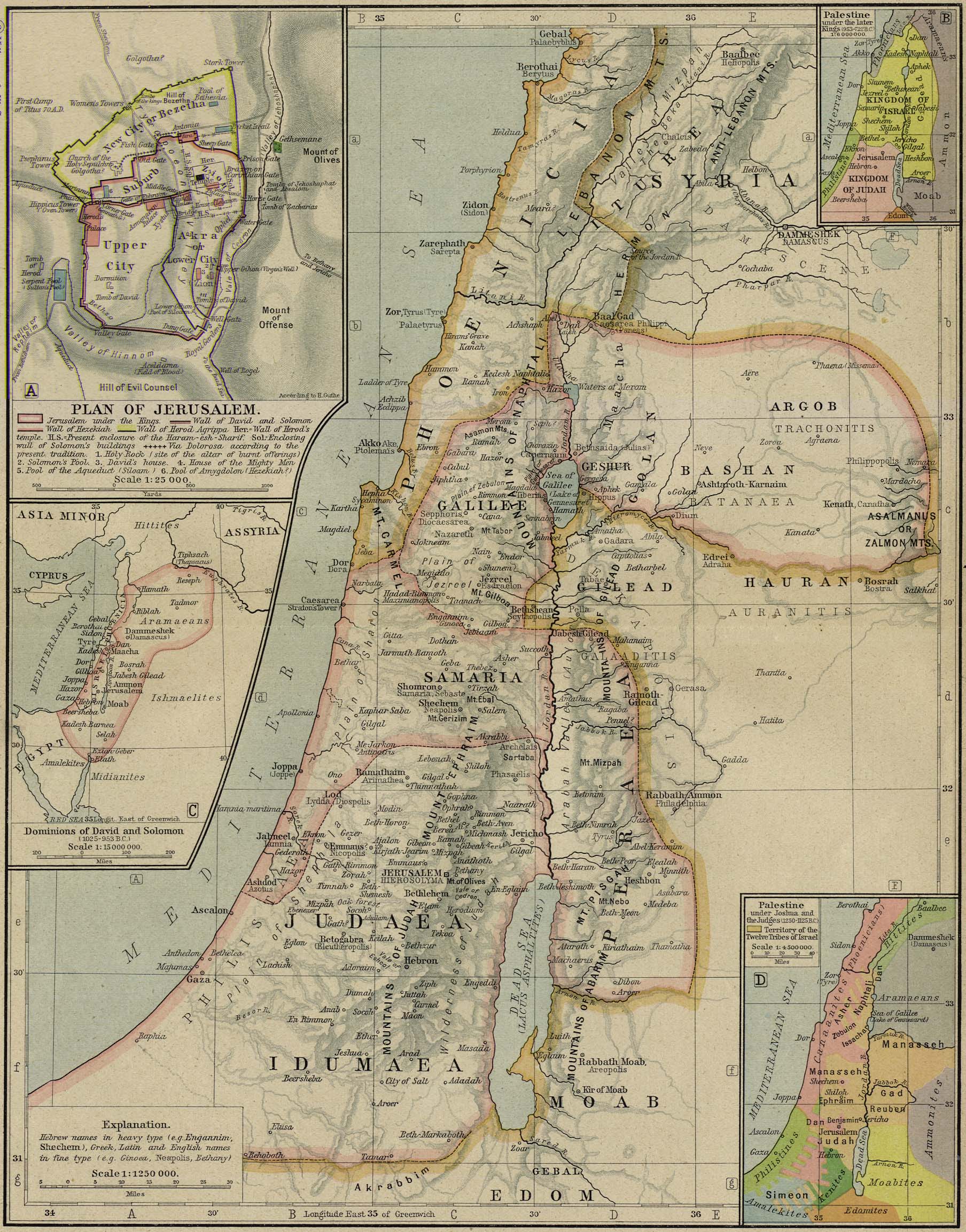
- Located: the site is known
- Identified: the point stands for an area, or is rounded
- Proposed: one candidate among several
- 1Bethany beyond the Jordan, Andrew and another disciple of John follow Jesus, John 1:28
- 2?Bethsaida, The home town of Andrew and Peter, John 1:44
- 3Capernaum, Jesus teaches there and heals in Simon's house, Luke 4:31 to 38
- 4Sea of Galilee, The catch and the call of Simon, James and John, Luke 5:1
Base map: Reference map of ancient Palestine, Rand McNally reference map (1926), public domain. Places with a place page stand at its coordinates and the others at the point cited for each, set on the plate by Jerusalem and Damascus, as the plate prints them.
Bethsaida stands at et-Tell, the site OpenBible.info ranks first with a score of 330 of 1,000.
Simon at the Knees of Jesus
Peter's first answer to the miracle was a confession of his own sin.
When Simon Peter saw this, he fell at Jesus’ knees. “Go away from me, Lord,” he said, “for I am a sinful man.”Simon's fear shows that the catch has told him who Jesus is.
Albert Barnes read the request as humility. Peter felt unworthy to stand in the presence of a holy messenger from God.
Matthew Henry drew a lesson from Simon's words. Even the best men are sinful, he wrote, and should own it to Jesus Christ, who came into the world to save sinners.
Levi at the Tax Booth
Jesus spoke two words, and a man who collected taxes got up from his work.
After this, Jesus went out and saw a tax collector named Levi sitting at the tax booth. “Follow Me,” He told him, and Levi got up, left everything, and followed Him.Levi leaves everything as the fishermen had, with a tax booth in place of boats.
Bede identified Levi as Matthew. He explained that Luke and Mark use the name Levi out of respect, while Matthew names himself the tax collector.
Levi then held a great banquet for Jesus, and the Pharisees and their scribes complained that He ate with tax collectors and sinners (Luke 5:29 to 30).
Jesus answered, “It is not the healthy who need a doctor, but the sick. I have not come to call the righteous, but sinners, to repentance.”Jesus answers the complaint by naming whom He came to call.
Three Gospels, Three Scenes
The three Gospels differ on who came first and on the words Jesus spoke.
Mark gives the shortest account, Luke adds the catch, and John adds an earlier meeting.
| Point | Mark 1 | Luke 5 | John 1 |
|---|---|---|---|
| The place | beside the Sea of Galilee | the Lake of Gennesaret | by the Jordan, where John baptized |
| Who comes first | Simon and Andrew, then James and John | Simon, then his partners James and John | Andrew and another disciple of John |
| What Jesus says | I will make you fishers of men | From now on you will catch men | Come and see |
| What they leave | their nets, and their father in the boat | everything | nothing is said |
He first found his brother Simon and told him, “We have found the Messiah” (which is translated as Christ). Andrew brought him to Jesus, who looked at him and said, “You are Simon son of John. You will be called Cephas” (which is translated as Peter).John's account gives Simon his new name at his first meeting with Jesus.
From Now On You Will Catch Men
Jesus answered Simon's fear with a new work, named in a fisherman's word.
The Greek verb Jesus used, zōgreō, means to capture alive. Paul uses the same verb for people the devil has taken captive (2 Timothy 2:26).
And when they had brought their boats ashore, they left everything and followed Him.Luke ends the scene with the three men leaving their boats and the catch on the shore.
One Call or Two?
Readers since Augustine have asked whether Luke and Mark tell the same morning by the lake.
One call, told briefly and at lengthAugustine, The Harmony of the Gospels, Book 2, in Thomas Aquinas, Catena Aurea, on Luke 5:10
Luke's catch came first, and Mark's call laterAugustine, The Harmony of the Gospels, Book 2, in Thomas Aquinas, Catena Aurea, on Luke 5:10
Augustine also allowed a second order. On this reading Jesus only foretold at the catch that Simon would catch men, the men went back to fishing, and the call of Mark 1:16 to 20 came afterward.
The objection: Luke says they left everything when they brought the boats ashore (Luke 5:11), and his account leaves no return to the nets.
Mark's call came first, and Luke's catch marked a new stageJamieson, Fausset and Brown, Commentary Critical and Explanatory on the Whole Bible (1871), on Luke 5:10
Jamieson, Fausset and Brown read the words from now on as the mark of a new stage. The earlier call had promised only to make them fishers of men.
The objection: Mark tells the call by the lake as the moment the men left their nets and followed Jesus (Mark 1:18).
From Followers to Apostles
Luke names the fishermen and the tax collector again when Jesus chose the Twelve.
Simon, whom He named Peter, and his brother Andrew; James and John; Philip and Bartholomew; Matthew and Thomas; James son of Alphaeus and Simon called the Zealot;The list holds Simon and Andrew, James and John, and Matthew, the men called at the lake and the tax booth.
Jesus chose them after a night of prayer on a mountain, and He named the twelve apostles (Luke 6:12 to 13).
Sources
Scripture is the Berean Standard Bible.
- Bede (735), on Luke 5:1 and Luke 5:27, in Thomas Aquinas, Catena Aurea (1264)
- Albert Barnes, Notes, Explanatory and Practical, on the Old and New Testaments (1832 to 1869), on Luke 5:8.
- Matthew Henry, Commentary on the Whole Bible (1710), on Luke 5:8.
- Augustine (430), The Harmony of the Gospels, Book 2, on Luke 5:10, in Thomas Aquinas, Catena Aurea (1264)
- Jamieson, Fausset and Brown, Commentary Critical and Explanatory on the Whole Bible (1871), on Luke 5:10.
- OpenBible.info, Bible Geocoding Data, ancient.jsonl, the identifications of Bethsaida.
Keep Studying
People and groups7
Places2
Doctrines1