
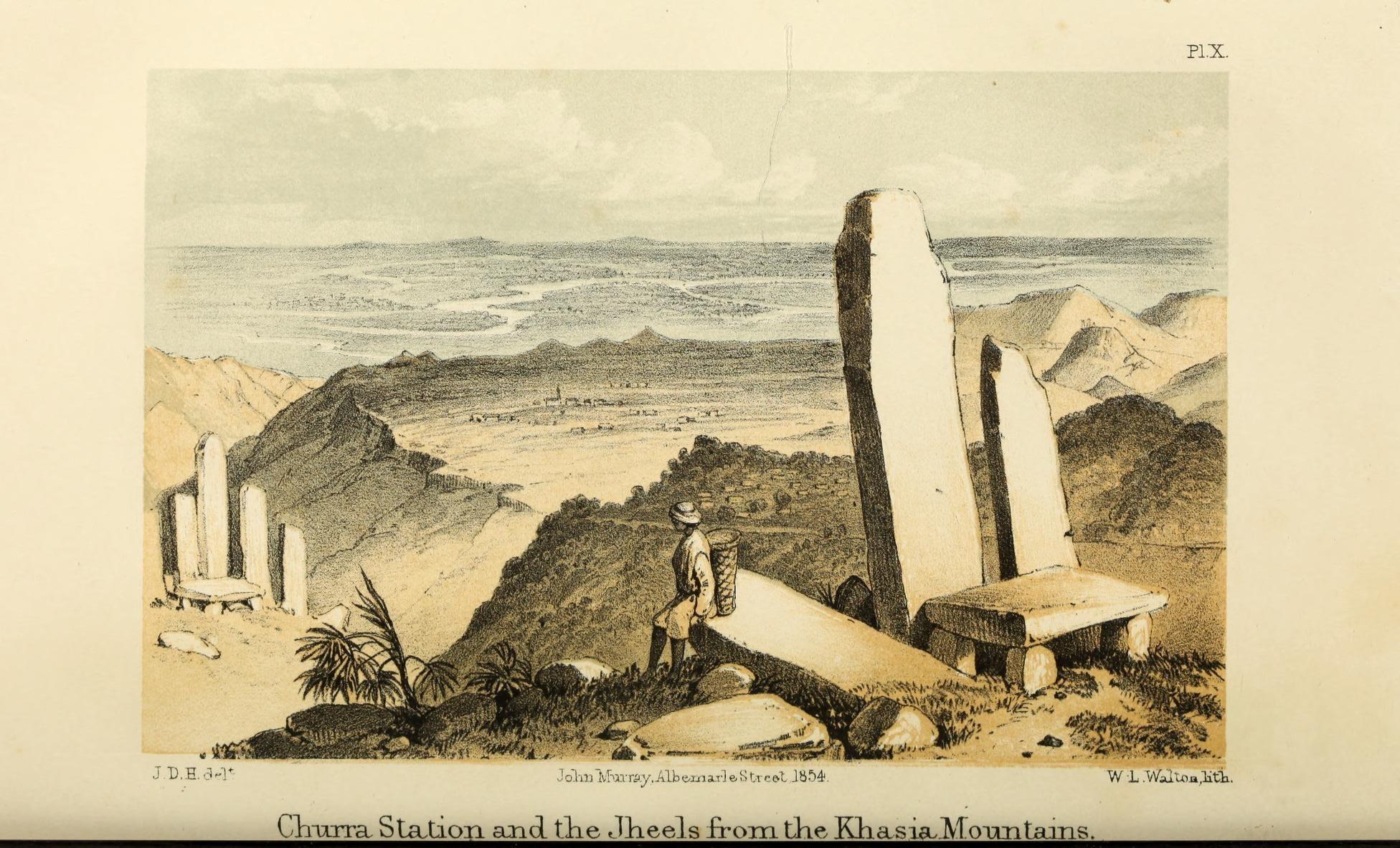
Churra Station and the Jheels from Khasia Mountains, W. L. Walton after J. D. Hooker, 1854. Public domain.
Mawphlang to Mairang · Story · Featured Study
The Khasi Hills Revival of 1905
Welsh mission churches in the hills of Assam broke into confession, song and dancing from March.
- Where
- Mawphlang, Pariong, Cherrapunji, Mairang
- Who
- E. H. Williams, U Ruton, Ka Simal, Howard Agnew Johnston
- When
- March 1905
A Welsh missionary asked “Dancing in the house of God?” from the Hills, and he said a year earlier the idea “would have been repugnant” to every missionary there.
I myself did not know Him, but the One who sent me to baptize with water told me, ‘The man on whom you see the Spirit descend and rest is He who will baptize with the Holy Spirit.’
Summary
The Hills lie in north-east India. News of the revival in Wales reached the churches there late in 1904.
- The Assembly at Mairang asked for 10,000 rupees in thanks, and nearly 20,000 came in.
- The people sang Welsh hymn tunes in harmony, which John Roberts had taught them.
- The mission's historian says the revival's effects lasted three or four years.
The Texts the Witnesses Name
One lesson at Mawphlang came before the outbreak at Pariong, and the Mairang Assembly drew on the Old Testament.
E. H. Williams, the missionary in charge at Mawphlang, wrote that his Sunday School was studying John 1:33 on 5 March. The lesson was “about the baptism of the Holy Spirit, and the hindrances to obtain this blessing”.
They feast on the abundance of Your house, and You give them drink from Your river of delights.
Helen Dyer set this verse over her chapter on the Mairang Assembly.
Psalm 36:8BSB
The jar of flour was not exhausted and the jug of oil did not run dry, according to the word that the LORD had spoken through Elijah.
A poor widow at Mairang who promised to feed five and fed fifty applied this verse to what she had to give them, Dyer writes.
Then Elijah approached all the people and said, “How long will you waver between two opinions? If the LORD is God, follow Him. But if Baal is God, follow him.” But the people did not answer a word.
An Indian pastor appointed to preach on church polity at Mairang preached on this question instead.
But the chief priests and scribes were indignant when they saw the wonders He performed and the children shouting in the temple courts, “Hosanna to the Son of David!”
Mrs. John Roberts set the children of Jowai beside the children in the temple, whose praise was met with displeasure.
1 Kings 17:16, 1 Kings 18:21, Matthew 21:15
The Stations in the Order of the Record
The record runs from one church through eight places in a little over a year.
The revival moved from church to church across the Hills within months.
| Place | When | What is recorded | Who records it |
|---|---|---|---|
| Mawphlang | 5 March | A Sunday School ended in weeping at a brother's prayer | E. H. Williams |
| Pariong | About three weeks after the February Assembly; the day is not known | A Presbytery ended in prayer, weeping and fainting | E. H. Williams; J. Hughes Morris |
| Shangpoong | 21 March | The children began to pray at night | A lady's letter, written some days later |
| Nongsawlia and Cherra | The last Sunday of March | A girl's prayer set a communion service crying for pardon | Mrs. Roberts; a letter of that week |
| Shillong | 1 April | The week's closing prayer meeting turned | One who was present, in Mrs. Roberts |
| Jowai | 8 May | The children began it, and sixty backsliders returned | Mrs. Roberts |
| Lawbyrtun | May | Ninety-eight converts came to a community of fifty-nine | Helen Dyer |
| Mairang | 16 to 19 March 1906 | An Assembly drew a crowd reckoned at 8,000 to 10,000 | Helen Dyer; Gerlan Williams |
Lawbyrtun, Mairang
From the Monday Prayer Meeting to the Assembly at Mairang
The story runs through two Presbyteries and two Assemblies.
The church at Mawphlang decided early in 1903 to meet every Monday night to pray for an outpouring on the Hills. Williams counted over eighty converts from those meetings. Mrs. Roberts of Cherrapunji says that many others had grown listless, “at ease in Zion”.
The mission's paper, Nongialam Khristan, carried the reports from Wales month by month. In the new year after the news Mawphlang went to prayer every night. The Assembly at Cherra that February brought high hopes. Mrs. Roberts writes that “the thing which was so much looked for was not experienced at that time”.
The pastor of the churches of Ranthong says, in Dyer, that they prayed daily for ten days before the Presbytery at Pariong. At the close of the third service on the Sunday, before the Benediction, a man named U Ruton began to pray from the midst of the congregation.
Williams writes that some cried aloud for mercy, some men fainted and nearly all wept. Then someone began the Welsh hymn “Dyma gariad fel y moroedd,” and they sang it over and over “until some were nearly dancing from emotion”. Men who had spoken against the excitement had to be held up by their friends.
An evangelist of Nongsawlia carried the account home from Pariong. On the communion Sunday a girl named Ka Simal rose at the five o'clock meeting, and as she prayed she wept. A letter of that week says “Then all the people began to cry for pardon”. It says that some sang one hymn and some another, “no order, yet all order”.
Confession brought restitution. One woman went to a shopkeeper about a debt long since crossed out and paid a first instalment. A man at Nongbah took his family out of the chapel, saying “Come out of this place lest this madness affect you”. Mrs. Roberts says he wandered about the next day like one insane.
J. Pengwern Jones, a Welsh missionary at Sylhet, reached Cherra on 28 June. He found a second wave three months after the first, “a fulness of joy,” with people dancing in the chapel. At the Presbytery in Shillong that August, which ran from Saturday to Thursday, 450 new members on probation were reported.
The next year's Assembly went to Mairang, a village of about forty houses, at the plea of its Rajah, who was a deacon. He admitted afterwards that he had expected about 2,000. Girls in a trance first sang the new “Heavenly Songs,” and they were noted down at the time.
The Field Before the Revival
The Welsh had been on these hills for sixty-four years, and the man who began the work had not stayed with them.
Thomas Jones reached Cherrapunji on 22 June 1841 and opened his first three schools early the next year. The Dictionary of Welsh Biography records that he married again without his committee's approval and could not get on with his colleagues. He resigned in 1847 to farm.
The census counted 1,895 Native Christians in the district in 1881 and 17,125 in 1901. The Census of 1911 prints 17,321 for 1901 under all Christians. B. C. Allen, a civil servant, wrote in 1906 that by the missionaries' own returns their following was about 23,000. He counted twenty-one missionaries at nine stations.
What the Count Shows
The round figures of the revival's friends run higher than the mission's own table of communicants.
Dyer gives over five thousand brought in during the first twelve months. The same missionary wrote in February 1907 of between 7,000 and 8,000 in two years. Morris, from the mission's returns, gives 4,568 enquirers on probation in the first year.
The same returns show communicants rising from 6,180 in 1904 to 9,013 in 1907. Most of the new names therefore stood on probation or among the adherents. The total in the churches rose by 4,183 in the first year and by 580 in the third.
W. B. Boggs, an American Baptist, repeated the higher figure and also wrote that “for the most part the revival has been confined to professed Christians”. The Census of 1921 counted 41,122 Christians in the district, and it says that the rise among Presbyterians fell short of what many had expected.
How the Key Verse Was Taught
Four teachers from Augustine to Reinhard Bonnke on the one who baptizes with the Holy Spirit.
Augustine of Hippo (died 430)
Tractates on John 5, on John 1:33
Augustine, against the Donatists, drew from the verse that the power stays with Christ and only the service passes to His servants.
“Therefore, lest as many baptisms should be spoken of as there are servants who received power from the Lord to baptize, the Lord kept to Himself the power of baptizing, and gave to His servants the ministry.”
Patristic
Adam Clarke (1762 to 1832)
Commentary on the Bible, on John 1:33
Adam Clarke drew from the verse that John was directed at each step by God.
“From this we may clearly perceive that John had a most intimate acquaintance with the Divine Being; and received not only his call and mission at first, but every subsequent direction, by immediate, unequivocal inspiration.”
Methodist
Jamieson, Fausset & Brown (1802 to 1910)
Commentary Critical and Explanatory on the Whole Bible, on John 1:33
Jamieson, Fausset and Brown tie John's knowledge of Jesus to the sign he had been told to expect.
“But the sign which he was told to expect was the visible descent of the Spirit upon Him as He emerged out of the baptismal water.”
Evangelical
Reinhard Bonnke (1940 to 2019)
Holy Spirit: Are We Flammable or Fireproof? (7-day study, YouVersion)
Reinhard Bonnke, a Pentecostal evangelist, reads the descent as the pattern for everyone who follows.
“Christ had a human experience from God to show what the perfect human experience should be. He was the first of multitudes. He was the first Holy Spirit-baptized man on earth.”
on John 1:33Pentecostal-evangelical
In Their Own Words
Two prayers from the meetings as the missionaries took them down, and two sentences of a missionary judging what he saw.
U Ruton
Prayer at the Presbytery of Pariong, reported by E. H. Williams in Mrs. Roberts, The Revival in the Khasia Hills, chapter 1
Do not send us away empty
“O God, pour down Thy Spirit upon us all now; whilst Thou art blessing the people of Wales so much, do not send us away empty.”
Khasi Presbyterian
About this saying1 paragraph
These are the words that stopped the Benediction at Pariong in 1905, as Williams reports them through Mrs. Roberts.
E. H. Williams
The prayer of one brother at Mawphlang, 5 March 1905, reported in Mrs. Roberts, The Revival in the Khasia Hills, chapter 1
Our stony hearts
“Break our hearts, O Lord, break our stony hearts to pieces. When Jesus has done so much for us, we are ashamed of ourselves, because we are so hard.”
Welsh Calvinistic Methodist missionary
About this saying1 paragraph
An unnamed brother prayed this in 1905 at the close of the Sunday School at Mawphlang, and Williams says it would long be remembered.
J. Pengwern Jones
Report from the Khassia Hills, The Missionary Review of the World 28:10
They would have voted against it
“If God had consulted them as to the form the revival should take, not one would have suggested the form it has taken, and I believe they would have voted against it.”
Welsh Calvinistic Methodist missionary
About this saying1 paragraph
Pengwern Jones wrote this of his fellow missionaries in 1905, and he was a mission witness defending what he saw.
J. Pengwern Jones
Report from the Khassia Hills, The Missionary Review of the World 28:10
This form can not last
“The revival in this present form can not last, nor is it necessary that it should do so.”
Welsh Calvinistic Methodist missionary
About this saying1 paragraph
The same report of 1905 says that the meetings as they stood would pass, and it goes on that their effect would never be effaced.
Where the Record Divides
Nearly all of this record comes from the mission, and it answers all three questions only in part.
Did the revival come from Wales?2 paragraphs
Dyer calls it the Welsh revival reproduced on the Welsh corner of the field, and she writes that Christians in Wales were “praying for Khassia with deepened intensity”. Williams, in Mrs. Roberts's book, has Mawphlang praying from 1903, before the news came.
The objection to the first reading is the date of Mawphlang's prayer. The objection to the second is that the witnesses themselves say the Welsh reports deepened it, and no like outbreak stands in the record before the news.
Why did people join the churches?2 paragraphs
Every missionary witness gives a spiritual cause, and each is an interested witness. Allen stood outside the mission and says nothing of the revival. He wrote that “it is the correct thing in the Khasi and Jaintia Hills to be a Christian”, and he credited the mission's medicines and schools.
J. McSwiney wrote of the province's converts in the Census of 1911 that “No material inducements are offered”, and in the same sentence that the missionaries' care and schools influenced them. Allen's account covers the growth before the revival, and the spiritual account leaves unexplained the small gain of the third year.
Did word of it reach Korea?2 paragraphs
Howard Agnew Johnston, an American Presbyterian minister visiting Korea, told Christians in Seoul in the autumn of 1906 of Wales and of India. His book of 1908 says that “certain Welsh missionaries in northern India began to pray,” and it never names the Khasi Hills.
Dyer tells the same story of Welsh prayer with the name Khassia Hills, and the Missionary Review of August 1906 called the Mairang field “North India”. Johnston never gives the name and Dyer does, so the reading that he means these hills is an inference. Prayer at Wonsan from 1903 came before Johnston's visit, so this is a line of report and has not been proved a line of cause.
Books to Read Next
Revival in India
Helen S. Dyer · 1907
Dyer compiled this account from the missionaries' letters, and she owes her story of the Hills to the Welsh missionary at Sylhet.
Read Dyer free at the Internet ArchiveThe Famine and the Bread
Howard Agnew Johnston · 1908
Johnston prints the story of the Welsh missionaries' prayer in northern India.
Read Johnston free at the Internet ArchiveThe Story of Our Foreign Mission
J. Hughes Morris · 1930
Morris was the mission's own historian, and his book prints its returns for the years of the revival.
What the Revival Left
The mission's return for 1929 counts 15,724 communicants and 43,954 in the churches.
Sources
Scripture is the Berean Standard Bible.
- The Holy Bible, Berean Standard Bible (read 2026)
- Helen S. Dyer, Revival in India (London: Morgan and Scott, 1907)
- Mrs. John Roberts, The Revival in the Khasia Hills (London, about 1909, by J. Edwin Orr's list), the preface and chapters 1 to 5.
- The Missionary Review of the World, August and October 1905, August 1906 and December 1908.
- J. Hughes Morris, The Story of Our Foreign Mission (Presbyterian Church of Wales) (Liverpool: Hugh Evans, 1930)
- B. C. Allen, Assam District Gazetteers, volume 10 (1906)
- Census of India 1911, volume 3, Assam, part 1, J. McSwiney.
- Census of India 1921, volume 3, Assam, part 1, G. T. Lloyd.
- Howard Agnew Johnston, The Famine and the Bread (New York: YMCA Press, 1908)
- J. Edwin Orr, The Flaming Tongue, second edition (1975)
- W. B. Boggs, The Revival in India (American Baptist Missionary Union, undated)
- R. T. Jenkins, "Thomas Jones", and the entry "John Roberts", Dictionary of Welsh Biography.
- The Korea Mission Field 3:3 (Seoul, March 1907)
- Augustine of Hippo, Tractates on John 5, on John 1:33, Nicene and Post-Nicene Fathers, first series, volume 7 (1888)
- Adam Clarke, Commentary on the Bible (1832), on John 1:33.
- Jamieson, Fausset and Brown, Commentary Critical and Explanatory on the Whole Bible (1871), on John 1:33.
- Reinhard Bonnke, Holy Spirit: Are We Flammable or Fireproof?
Keep Studying
Read it1
People and groups11