
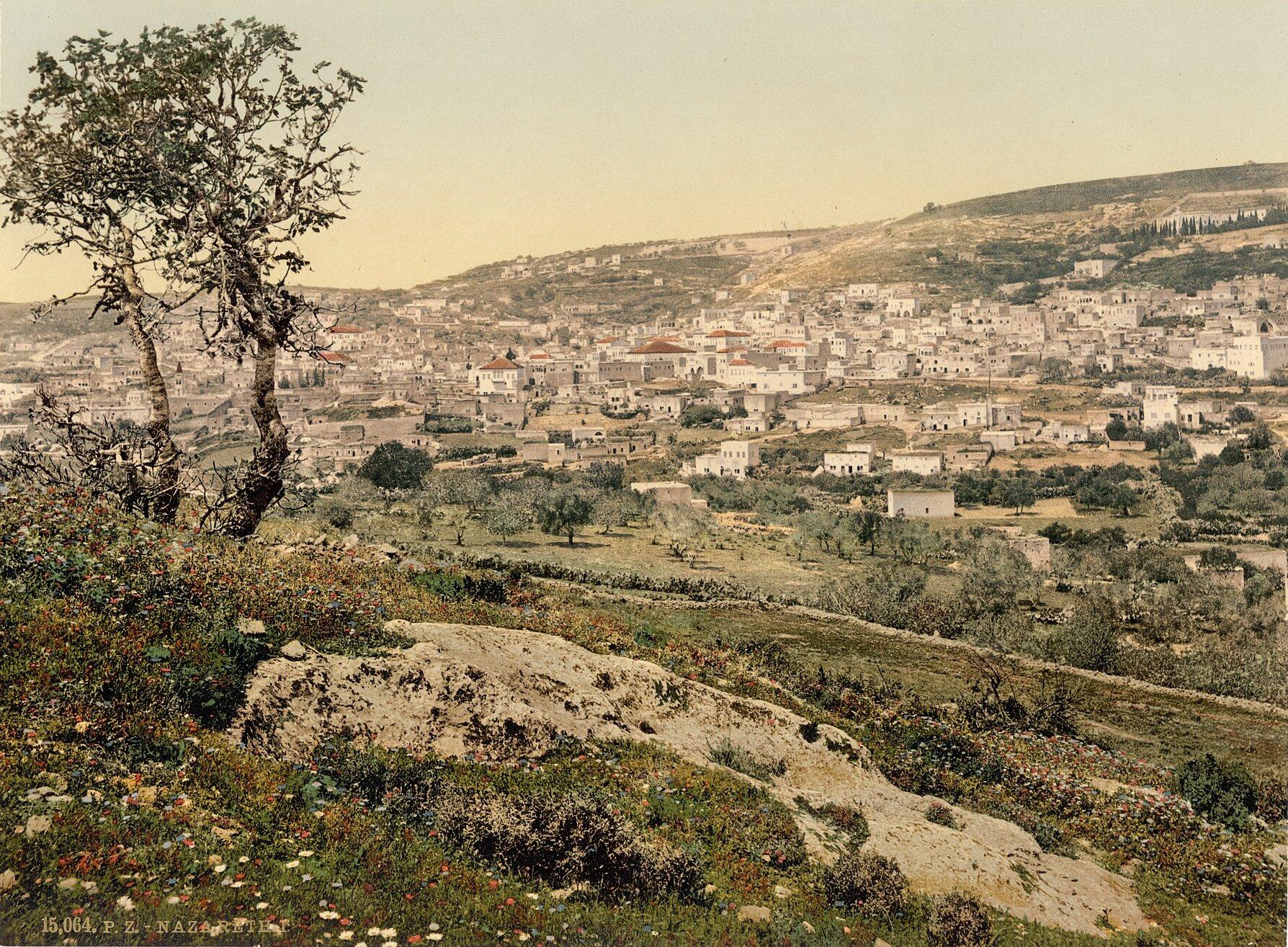
From the East, Nazareth, 1890 to 1900. Public domain.
Matthew 2:23, Luke 4:16 and John 1:46 · Place · Featured Study
Nazareth
Nazareth was the town in Galilee where Jesus grew up, and the Gospels and Acts call Him Jesus of Nazareth.
and he went and lived in a town called Nazareth. So was fulfilled what was spoken through the prophets: “He will be called a Nazarene.”
- Today
- Nazareth, Israel
- Region
- Lower Galilee
- Site
- 32.702, 35.298
- First named
- Matthew 2:23 “…lived in a town called Nazareth. So was…”
- Last named
- Acts 26:9 “…the name of Jesus of Nazareth.”
Jesus came to Nazareth, where He had been brought up, and on the Sabbath He stood up to read in its synagogue.
Summary
Nazareth was a village of Lower Galilee that the Old Testament, Josephus and the Talmud never name. Jesus grew up there under Joseph and Mary, read in its synagogue and was driven out of it. Pilate's notice on the cross named Him by the town. Excavators have found a house of the village of His day.
- Twenty-seven verses of the Berean text name Nazareth, all of them in the Gospels and Acts.
- No verse of the Old Testament names the town.
- Readers have given at least three accounts of the prophecy Matthew cites at Matthew 2:23.
Nazareth in the Gospels
Luke begins the story of Jesus' birth in Nazareth, and Matthew brings the family back to it.
In the sixth month, God sent the angel Gabriel to a town in Galilee called Nazareth,Matthew says Joseph took the child and His mother there after Herod's death, so that a word of the prophets would be fulfilled.
Nazareth on Smith's Plate
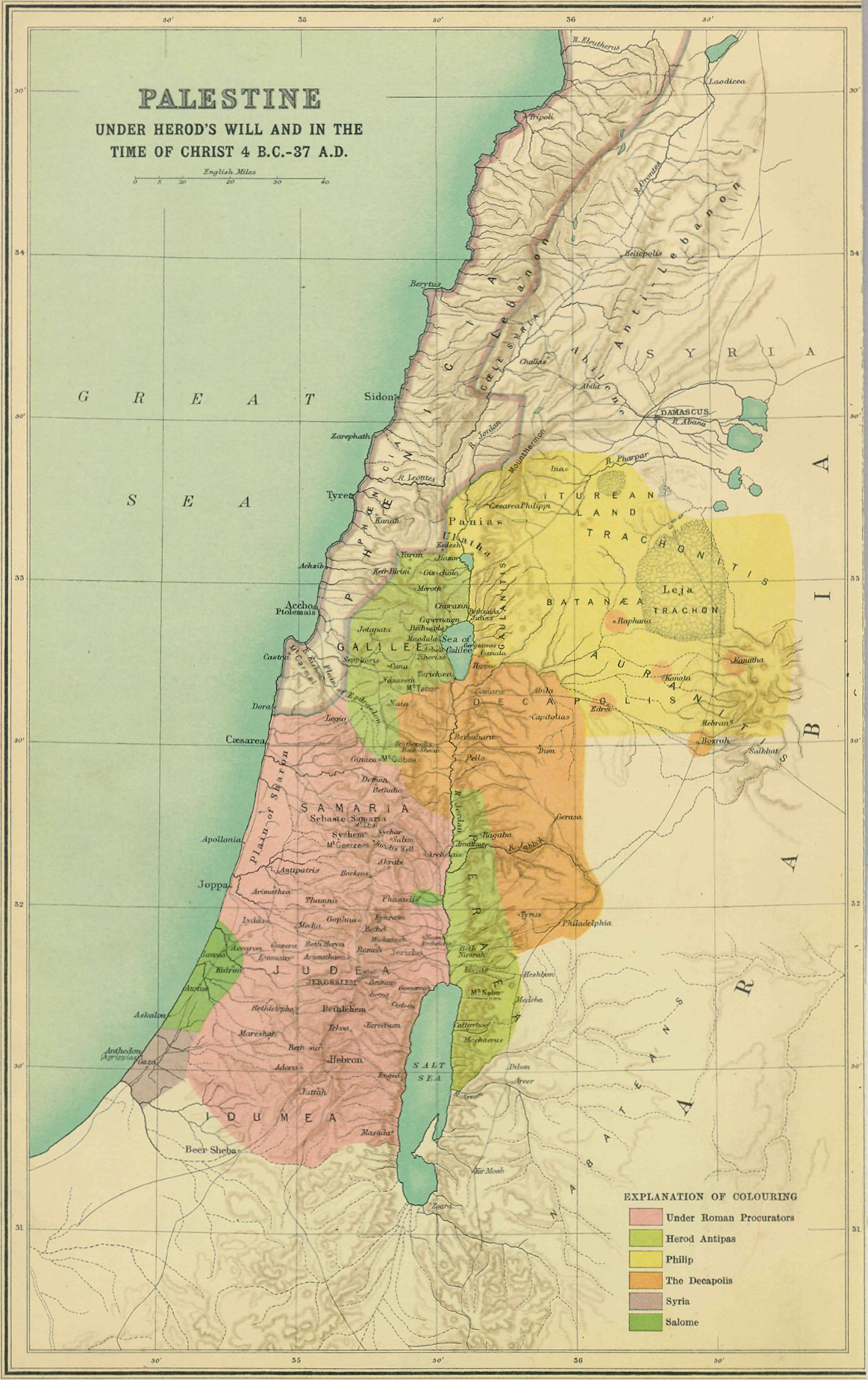
Nazareth stands in the hills of Galilee on George Adam Smith's plate of 1915, south-west of the Sea of Galilee.
Nazareth lay north of the plain the plate names Esdraelon, with Cana and Capernaum to its north-east.
- Known: a score of 800 or more
- Probable: a score of 500 to 799
- 1Nazareth, The home of Joseph and Mary Luke 2:39
- 2Cana, The town of the wedding, in the same hills John 2:1
- 3Capernaum, The town Jesus went to live in when He left Nazareth Matthew 4:13
- 4Bethlehem, Where Joseph went up from Nazareth to register Luke 2:4
- 5Jerusalem, The city Jesus left with His parents to go down to Nazareth Luke 2:51
Base map: Palestine in the time of Christ, George Adam Smith, Atlas of the Historical Geography of the Holy Land (1915), public domain. Each place stands at its place page's coordinates, set on the plate by Jerusalem and Tyre, as the plate prints them.
Five places, each with its verse. Each ring follows the OpenBible.info identification score out of 1,000, as the key gives it.
Nazareth in Scripture, in Order
These ten verses carry the town from the angel's visit to the notice on the cross.
Ten verses that name Nazareth, from Gabriel's visit to the cross.
- LukeGabriel is sent to a town in Galilee called NazarethLuke 1:26
- LukeJoseph goes up from Nazareth to BethlehemLuke 2:4
- MatthewJoseph settles the family in Nazareth after EgyptMatthew 2:23
- LukeThe parents return to their own town of NazarethLuke 2:39
- LukeJesus goes down to Nazareth with His parentsLuke 2:51
- MarkJesus comes from Nazareth to be baptized in the JordanMark 1:9
- JohnNathanael asks whether anything good can come from NazarethJohn 1:46
- LukeThe Sabbath visit that ends with the town driving Him outLuke 4:16
- MatthewJesus leaves Nazareth and lives in CapernaumMatthew 4:13
- JohnPilate's notice reads Jesus of NazarethJohn 19:19
Luke gives five of the ten.
John, Luke, Matthew
The Sabbath at Nazareth
Luke 4:16 to 30 tells how the synagogue that heard Him read turned against Him.
He read from the scroll of the prophet Isaiah and said that the Scripture was fulfilled in their hearing. The people asked whether this was the son of Joseph.
Then He added, “Truly I tell you, no prophet is accepted in his hometown.When He named the widow of Zarephath and Naaman the Syrian, all the people in the synagogue were enraged.
They got up, drove Him out of the town, and led Him to the brow of the hill on which the town was built, in order to throw Him over the cliff.This verse gives the Gospels' one picture of the town's ground: a town built on a hill.
A Town First Named in the Gospels
Nazareth enters the written record with the Gospels.
The Hebrew Scriptures never mention the town. The Jewish Encyclopedia notes that neither Josephus nor the Talmud names it.
A marble fragment of a Hebrew inscription, found at Caesarea Maritima in 1962, is the first to name Nazareth outside the New Testament and later writings. It belonged to a list of the priestly courses with the home town of each, and it names Nazareth as the home of the eighteenth course, Hapizzez.
What the Excavators Found
Three excavations have searched the ground of the town of Jesus' day.
Under the Church of the AnnunciationBellarmino Bagatti, from 1955
The old church on the site was taken down in 1955 for Bellarmino Bagatti's Franciscan excavations and for the present basilica, erected in 1969.
A house beside the basilicaYardenna Alexandre, 2009
In a dig announced in December 2009, Yardenna Alexandre of the Israel Antiquities Authority found an Early Roman house next to the basilica. She said that it showed, for the first time, a house from the Jewish village of Nazareth.
Under the Sisters of Nazareth conventKen Dark, reported in 2015
Ken Dark identified a Byzantine church with a cellar holding a house of the first century AD, with pieces of what may be limestone vessels. He said that whether Jesus grew up there is impossible to say on archaeological grounds.
What the Gospels Leave Unsaid
Luke gives two verses to the years between the temple visit and the baptism.
Luke 2:52 says only that Jesus grew in wisdom and stature and in favor with God and man. Luke 3:23 gives His age at the start of His ministry as about thirty.
The Gospels describe neither the house nor the synagogue, and they name no hill. Albert Barnes recorded that a cliff south of the town was shown in his day as the Mount of Precipitation.
Can Anything Good Come from Nazareth?
John sets a disciple's doubt about the town beside the title Pilate wrote over the cross.
“Can anything good come from Nazareth?” Nathanael asked. “Come and see,” said Philip.Pilate also had a notice posted on the cross. It read: JESUS OF NAZARETH, THE KING OF THE JEWS.The town Nathanael doubted is the town Pilate's notice put beside the words King of the Jews.
Voices on Nazareth
Three teachers from the fourth, fifth and eighteenth centuries wrote on the town and its people.
Ambrose of Milan (died 397)
Ambrose of Milan wrote on Luke 4:24 that Christ loved His fellow citizens.
“Therefore, the Savior excuses that he has not worked any miracles of virtue in his own country, so that no one might think that he should have a lower affection for his country. For he could not fail to love his fellow citizens, since he loved all. But those who envy have cast themselves out, through their lack of love for their country. For love does not envy... does not boast (1 Corinthians 13:4). However, the homeland is not devoid of divine blessings. For what greater miracle is there than that Christ was born in her?”
Ambrose of Milan · Commentary on Luke · on Luke 4:24Patristic
Cyril of Alexandria (died 444)
Cyril of Alexandria read Nathanael's words as an expectation of something great out of Nazareth.
“Nathanael readily agrees that something great and most fair is that which is expected to appear out of Nazareth. It is, I suppose, perfectly clear, that not only did he take Nazareth as a pledge of that which he sought, but bringing together knowledge from the law and Prophets, as one fond of learning he gained swift understanding. Come and see. Sight will suffice for faith, says he, and having only conversed with Him you will confess more readily, and will unhesitatingly say that He is indeed the Expected One.”
Cyril of Alexandria · Commentary on the Gospel of John, Book 2 · on John 1:46Patristic
Matthew Henry (1662 to 1714)
Matthew Henry wrote on Luke 4:24 that those well known as private men are seldom honored as prophets.
“Familiarity breeds contempt; and we are apt to think meanly of those whose conversation we have been accustomed to; and they will scarcely be duly honoured as prophets who were well known when they were in the rank of private men. That is most esteemed that is far-fetched and dear-bought, above what is home-bred, though really more excellent.”
Matthew Henry · Commentary on the Whole Bible · on Luke 4:24Puritan
He Will Be Called a Nazarene
Readers have explained the prophecy Matthew cites in three ways.
Holy, or the Branch of Isaiah 11:1Jerome; Cyril of Alexandria
Jerome held that Matthew took the sense of the prophets and not their words, and read Nazarene as holy, which he said all Scripture testifies of the Lord. He offered a second reading: in the Hebrew of Isaiah 11:1 a Nazarene shall grow out of the root of Jesse. Cyril of Alexandria read the name both as holy and through the branch and flower of Isaiah 11.
The objection: John Wesley wrote that none of the prophets says it in express words.
Despised and rejectedJohn Chrysostom; John Wesley
Chrysostom wrote that the place was of little esteem, and that Nathanael's question shows it. Wesley held that the prophets said in effect that He would be despised and rejected, and that the name Nazarene carried that contempt.
The objection: Jerome and Cyril read the name as a title of honor.
A prophecy now lostJohn Chrysostom
Chrysostom also wrote that many prophetic writings had been lost, and told his hearers not to be curious about which prophet said it.
The objection: Jerome held that the plural shows Matthew took the sense of many passages and not the words of one.
The vow of Numbers 6, which Adam Clarke tied to the name, is taught at The Nazirite Vow.
Anointed with Power
Peter told Cornelius what the man from Nazareth had done.
how God anointed Jesus of Nazareth with the Holy Spirit and with power, and how Jesus went around doing good and healing all who were oppressed by the devil, because God was with Him.Sources
Scripture is the Berean Standard Bible.
- James Strong, Exhaustive Concordance of the Bible (1890), Greek dictionary, entries 3478 and 3480, with the STEP Bible brief lexicon.
- OpenBible.info, Bible-Geocoding-Data, ancient.jsonl, entries Nazareth (score 1000), Cana (score 690), Capernaum (score 842), Bethlehem and Jerusalem (each score 1000)
- George Adam Smith, Atlas of the Historical Geography of the Holy Land, London, Hodder and Stoughton, 1915, the plate Palestine under Herod's Will and in the Time of Christ.
- Ambrose of Milan, Commentary on Luke (about 390), on Luke 4:24.
- Cyril of Alexandria, Commentary on the Gospel of John, Book 2, on John 1:46.
- Cyril of Alexandria, Fragment 16 on Matthew, on Matthew 2:23.
- Jerome, Commentary on Matthew, on Matthew 2:23, in the Catena Aurea of Thomas Aquinas.
- John Chrysostom, Homily 9 on the Gospel of Matthew, on Matthew 2:23.
- John Wesley, Explanatory Notes upon the New Testament (1755), on Matthew 2:23.
- Adam Clarke, Commentary on the Bible (1832), on Matthew 2:23.
- Albert Barnes, Notes, Explanatory and Practical, on the Old and New Testaments (1832 to 1869), on Luke 4:29.
- Matthew Henry, Commentary on the Whole Bible (1710), on Luke 4:24.
- Isidore Singer and George A. Barton, Nazareth, The Jewish Encyclopedia, volume 9, page 195.
- Anson F. Rainey, Archaeological News from Israel, JASA 15 (June 1963), 60 to 62, in the archive Science in Christian Perspective, on the Caesarea fragments and M. Avi-Yonah's reconstruction in Israel Exploration Journal 12, 137 to 139.
- Israel Antiquities Authority, press release of December 2009, Excavation Discovers Remains of Building from Time of Jesus, as the Jewish Virtual Library publishes it.
- Joseph Patrich, Leah Di Segni and team, A Digital Corpus of Early Christian Churches and Monasteries in the Holy Land (Institute of Archaeology, the Hebrew University of Jerusalem), record 13671, Nazareth, Church of the Annunciation.
- Terra Sancta Museum, Ave Maria: the origins of the Marian cult, online exhibition of 24 March 2020.
- University of Reading, press release, Could Jesus' house in Nazareth have been found?, 3 March 2015, quoting Ken Dark.
Keep Studying
Read it5
Studies7
People and groups5