
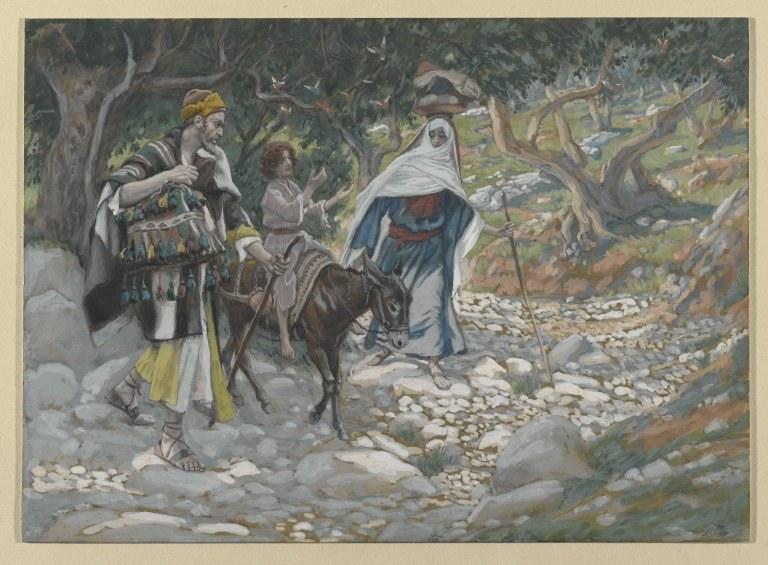
James Tissot, The Return from Egypt, 1886 to 1894. Public domain.
Matthew 2:23 · Symbol · Featured Study
He Will Be Called a Nazarene
Matthew says the prophets foretold that Jesus would be called a Nazarene, and no single verse holds those words.
and he went and lived in a town called Nazareth. So was fulfilled what was spoken through the prophets: “He will be called a Nazarene.”
- The word
- Ναζωραῖος (Nazōraios), G3480
- First appears
- Matthew 2:23 “and he went and lived in a town…”
Joseph's choice of a small town in Galilee gave Jesus the name He was known by.
Summary
Joseph took Jesus to live in Nazareth after Herod died. Matthew saw a word of the prophets fulfilled in the move. Readers have long asked which prophets he meant.
- Matthew writes the prophets in the plural here, and in his other formula quotations a single prophet.
- The Hebrew word for a branch in Isaiah 11:1 sounds like the name of Nazareth.
- The name later marked His followers, whom their accusers called the sect of the Nazarenes.
The Return to Nazareth
Joseph turned north to Galilee after a dream, because Archelaus ruled in Judea.
But when he learned that Archelaus was reigning in Judea in place of his father Herod, he was afraid to go there. And having been warned in a dream, he withdrew to the district of Galilee,The verse gives the reason the family did not go back to Bethlehem.
Luke adds that Nazareth was already the family's own town (Luke 2:39). Matthew gives the move a reason from Scripture instead.
Where the Name Stands
Friends, enemies and Jesus Himself used the name from Matthew 2 to the trial of Paul.
Six people in the New Testament call Jesus or His followers by the name of His town.
- Matthew, citing the prophetsthe family's home in GalileeMatthew 2:23
- A man with an unclean spiritthe synagogue at CapernaumMark 1:24
- A servant girl in the courtyardthe gateway of the courtyardMatthew 26:71
- Pilatethe notice on the crossJohn 19:19
- The risen Jesusthe road to DamascusActs 22:8
- Tertullus, against Paulthe court of FelixActs 24:5
The uses of the name in the order of the story, each with its place.
Nazareth, the Town Jesus Grew Up In
The Old Testament never names Nazareth, and the Gospels record that others thought little of it.
“Can anything good come from Nazareth?” Nathanael asked. “Come and see,” said Philip.Nathanael's question is the plainest record of how the town was regarded.
Jesus grew up in Nazareth and was subject to His parents there (Luke 2:51). His neighbours later took offence at Him in the synagogue (Matthew 13:54 to 57).
The Words Behind the Name
Two Greek spellings of the name and two Hebrew words it has been heard in.
Ναζωραῖος Nazōraios
13 uses in the canon
A Nazarene, a man of Nazareth, the spelling Matthew uses.
Ναζαρηνός Nazarēnos
6 uses in the canon
The same name in the spelling Mark uses for the demon's cry.
נֵצֶר netser
4 uses in the canon
A shoot or branch, the word of Isaiah's promise to Jesse's line.
נָזִיר nazir
16 uses in the canon
One separated or consecrated, the word for a Nazirite under vow.
Which Prophets Did Matthew Mean?
Five readings answer the verse, from the church fathers to Adam Clarke.
The Branch of Isaiah 11:1Jerome, Commentary on Matthew; Adam Clarke, Commentary on the Bible, on Matthew 2:23
Then a shoot will spring up from the stump of Jesse, and a Branch from his roots will bear fruit.This is the Branch passage that Jerome and Clarke both cite for Matthew 2:23.
Jerome rendered the verse by the Hebrew, so that a Nazarene shall grow out of Jesse's roots. Adam Clarke named it one of the two passages usually cited and said it refers to Christ.
The objection: Jeremiah 23:5 and Zechariah 6:12 call the promised king the Branch with another Hebrew word, tsemach, as Clarke himself noted.
The Nazirite set apart to GodAdam Clarke, Commentary on the Bible, on Matthew 2:23
For behold, you will conceive and give birth to a son. And no razor shall come over his head, because the boy will be a Nazirite to God from the womb, and he will begin the deliverance of Israel from the hand of the Philistines.”Clarke reports that Bible margins usually send Matthew 2:23 to this verse.
Clarke judged that the passages in Judges and Isaiah, and the whole law of the Nazirite in Numbers 6, may have been in Matthew's mind.
The objection: Jesus took no Nazirite vow, and His enemies called Him a drunkard (Matthew 11:19).
The despised one of the prophetsJohn Wesley, Explanatory Notes upon the New Testament, on Matthew 2:23
John Wesley held that Nazareth was a place contemptible to a proverb. In his reading the name meant that Jesus would be despised and rejected, as several prophets had said in effect.
He was despised and rejected by men, a man of sorrows, acquainted with grief. Like one from whom men hide their faces, He was despised, and we esteemed Him not.Isaiah's Servant is the despised and rejected one Wesley had in mind.
The objection: no prophet names Nazareth, and the scorn of the town is first recorded in the Gospels (John 1:46).
The holy oneJerome, in Thomas Aquinas, Catena Aurea; Cyril of Alexandria, Fragment 16 on Matthew
Jerome argued from the plural. Had Matthew meant one text he would have written the prophet, so he took the sense of the whole, and Jerome read Nazarene as holy.
Cyril of Alexandria read the name as holy or as flower. He found the flower in Isaiah's branch from the stock of Jesse.
The objection: the Greek name means a man of Nazareth, as Strong's lexicon glosses it, and holy is a sense drawn from nazir.
A prophecy now lostPseudo-Chrysostom, in Thomas Aquinas, Catena Aurea
Pseudo-Chrysostom suggested that Matthew read the words in prophets outside the canon, such as Nathan or Esdras. He found support in Philip's words that the prophets wrote of Jesus of Nazareth (John 1:45).
The objection: Matthew's other formula quotations come from books the church still reads, and the plural fits a sense drawn from many of them.
One of Matthew's Formula Quotations
Matthew 2:23 belongs to the set of formula quotations in Matthew's Gospel.
Ten times Matthew himself stops the story to say that a word of the prophets was fulfilled, and Matthew 2:23 is the fourth of them.
Sources
Scripture is the Berean Standard Bible.
- Jerome, Commentary on Matthew, on Matthew 2:23, and the same note in Thomas Aquinas, Catena Aurea.
- Adam Clarke, Commentary on the Bible (1832), on Matthew 2:23.
- John Wesley, Explanatory Notes upon the New Testament (1755), on Matthew 2:23.
- Cyril of Alexandria, Fragment 16 on Matthew, on Matthew 2:23.
- Pseudo-Chrysostom, Unfinished Work on Matthew, on Matthew 2:23, in Thomas Aquinas, Catena Aurea.
- Strong's lexicon entries g3480, g3479, h5342 and h5139, with their counts of uses.
Keep Studying
Read it5
People and groups4