
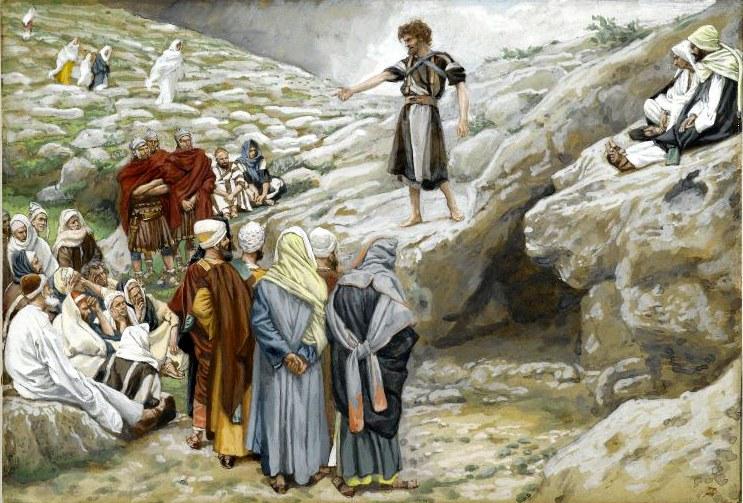
James Tissot, Saint John the Baptist and the Pharisees, 1886 to 1894. Public domain.
Luke 3:15 and John 1:19 to 25 · Subject · Featured Study
The Messianic Hope in Second Temple Judaism
The Gospels, the Dead Sea Scrolls and Josephus record what Jews of the time of Jesus expected of the Messiah.
The people were waiting expectantly and were all wondering in their hearts if John could be the Christ.
The men sent from Jerusalem to the Jordan came with a list of the people their nation was waiting for.
Summary
Messiah means the anointed one. Before Jesus came, many Jews hoped God would send one to save Israel. They did not all wait for the same person.
- Some hoped for a king, some for a prophet like Moses, and some for a priest beside the king.
- Several men in those years claimed to lead Israel to freedom, and each one died.
- Matthew answers the hope with Jesus, the Christ who must suffer before His glory.
Three Questions at the Jordan
John the Baptist answered the priests and Levites with three denials.
asked him, “Why then do you baptize, if you are not the Christ, nor Elijah, nor the Prophet?”The question shows that the leaders expected baptism from one of these three figures.
Origen of Alexandria read the order of the questions as an order of rank in the people's hope.
“Once the priests and Levites, who were sent from Jerusalem, have heard that he is not the awaited Christ, they inquire if he might be Elijah, the person who held the second rank in honor as an object of their hope. He says that he is not Elijah, again confessing the truth through the expression ‘I am not.’”
Origen of Alexandria · Commentary on the Gospel of John 6.44 · on John 1:21Patristic
The Hope in the Writings of the Period
Five writings outside the Bible name an anointed one still to come.
The writings that name an anointed one run from before the time of Jesus to after the fall of the temple.
To scale: 3 of 5 stops dated; a bar is a span.
- The Parables of Enoch, 1 Enoch 37 to 7194 to 64 BC (R. H. Charles, 1913)
- The Psalms of Solomon, Psalm 1763 to 48 BC (G. Buchanan Gray, 1913)
- The Damascus Document18 to 8 BC (R. H. Charles, 1913)
- The Rule of the Community, 1QSFound at Qumran in 1947
- Fourth Ezra, 2 Esdras 3 to 14Final form AD 100 to 135 (G. H. Box, 1913)
Four dates are their English editors' own, and the Rule of the Community is dated by the year it was found.
The Hope as the Gospels Report It
The Gospel writers record what the crowds and the scribes said about the Christ.
Now there was a man in Jerusalem named Simeon, who was righteous and devout. He was waiting for the consolation of Israel, and the Holy Spirit was upon him.Simeon is the first person Luke shows waiting for the promised comfort.
Doesn’t the Scripture say that the Christ will come from the line of David and from Bethlehem, the village where David lived?”This verse shows that the crowd knew Micah's promise of Bethlehem and God's promise to David.
Herod's scribes gave the same answer from Micah 5:2 when the wise men came (Matthew 2:4 to 6). Others held that no one would know where the Christ came from (John 7:27).
to ask Him, “Are You the One who was to come, or should we look for someone else?”John asks from prison whether Jesus fulfils the hope he had preached.
“Art thou the Messiah promised, or not? It is taken for granted that the Messiah should come. It was one of the names by which he was known to the Old-Testament saints, he that cometh or shall come, Ps. cxviii.”
Matthew Henry · Commentary on the Whole Bible · on Matthew 11:2 to 6Puritan
Kings and Claimants
Josephus and Gamaliel name men who rose in those years and came to nothing.
After Herod died, Josephus reports, Simon, a former slave of Herod, put a crown on his head. A shepherd named Athronges did the same, and Judas, son of Ezekias, seized the palace at Sepphoris out of a desire for royal rank.
Some time ago Theudas rose up, claiming to be somebody, and about four hundred men joined him. He was killed, all his followers were dispersed, and it all came to nothing. After him, Judas the Galilean appeared in the days of the census and drew away people after him. He too perished, and all his followers were scattered.Gamaliel used these failed leaders to warn the council against killing the apostles.
Josephus also wrote that an ambiguous oracle in their sacred writings moved the Jews to war with Rome. It said that one from their country would govern the world, and Josephus applied it to Vespasian.
Then Jesus, realizing that they were about to come and make Him king by force, withdrew again to a mountain by Himself.This verse shows how quickly a sign could turn a crowd toward crowning a king.
Who Was Expected
Each figure the crowds named rests on a promise in the Law or the Prophets.
The son of David2 Samuel 7:12 to 13; Psalms of Solomon 17
And when your days are fulfilled and you rest with your fathers, I will raise up your descendant after you, who will come from your own body, and I will establish his kingdom. He will build a house for My Name, and I will establish the throne of his kingdom forever.God's promise of a lasting throne to David's line is the root of the royal hope.
The seventeenth Psalm of Solomon asks God to raise up their king, the son of David, to purge Jerusalem from the nations that trample her. It calls him the anointed of the Lord (Psalms of Solomon 17:36).
G. Buchanan Gray noted that the Greek and Syriac copies read the anointed, the Lord, the title the angel gives at Luke 2:11.
The prophet like MosesDeuteronomy 18:15; John 6:14
The LORD your God will raise up for you a prophet like me from among your brothers. You must listen to him.This promise is the source of the title the Prophet in the Gospels.
When the people saw the sign that Jesus had performed, they began to say, “Truly this is the Prophet who is to come into the world.”This verse shows the crowds still looking for that prophet in the days of Jesus.
Elijah before the dayMalachi 4:5; Matthew 17:10
Behold, I will send you Elijah the prophet before the coming of the great and awesome Day of the LORD.This is the last promise of the Old Testament, and the questioners at the Jordan still waited for it.
The scribes taught that Elijah must come first, and the disciples asked Jesus about it after the transfiguration (Matthew 17:10).
A priest beside the kingZechariah 4:14; Zechariah 6:13
So he said, “These are the two anointed ones who are standing beside the Lord of all the earth.”This verse gives the hope of two anointed figures a root in the Prophets.
Zechariah later says that the Branch will rule on his throne and be a priest on his throne, with peaceful counsel between the two (Zechariah 6:13).
Messiah and Christ
The Hebrew title and the Greek word that translates it, each with its count of uses.
מָשִׁיחַ mashiach
39 uses in the canon
Anointed, the word for a king or priest set apart with oil.
Χριστός Christos
523 uses in the canon
Anointed, the Greek word John gives when he explains Messiah (John 1:41).
A Messiah Who Dies in Fourth Ezra
One Jewish writing after AD 70 speaks of the Messiah's death.
In Fourth Ezra, God's Son the Messiah is revealed and gives joy to the survivors for four hundred years, and then he dies with all who have human breath (2 Esdras 7:28 to 29).
The King James Apocrypha reads my son Jesus at 2 Esdras 7:28, following the Latin. G. H. Box noted that the Syriac reads my Son the Messiah.
The crowd replied, “We have heard from the Law that the Christ will remain forever. So how can You say that the Son of Man must be lifted up? Who is this Son of Man?”The crowd's objection shows a hope that left no room for a Messiah lifted up to die.
One Messiah or Two at Qumran?
R. H. Charles and Jona Lendering read the anointed of Aaron and Israel in two ways.
One Messiah from both linesR. H. Charles, Fragments of a Zadokite Work, 1913
The Damascus Document waits for the Messiah from Aaron and from Israel. Charles read the phrase as one Messiah, in the singular, and he listed six places where it stands.
The objection: the Rule of the Community, found at Qumran after Charles wrote, speaks of the anointed ones of Aaron and Israel in the plural (1QS 9:11).
Two anointed ones, a priest and a kingJona Lendering, Qumran's dual Messianism, Livius.org
Lendering reads 1QS 9:11 as the coming of the prophet and two anointed ones, one of Aaron and one of Israel. In his reading the plural of the Rule stands against the singular of the Damascus Document.
The Hope Named at Caesarea Philippi
Peter's confession at Caesarea Philippi gives the hope its name in Matthew.
Simon Peter answered, “You are the Christ, the Son of the living God.”Peter gives Jesus the royal title, the Christ.
The crowds had named John the Baptist, Elijah, Jeremiah or one of the prophets (Matthew 16:14). Jesus then began to teach that He must suffer and be killed in Jerusalem (Matthew 16:21).
Sources
Scripture is the Berean Standard Bible.
- The Psalms of Solomon, translated and edited by G. Buchanan Gray, in R. H. Charles (ed.), The Apocrypha and Pseudepigrapha of the Old Testament, vol. 2 (Oxford, 1913), pp. 625 to 652.
- R. H. Charles, Fragments of a Zadokite Work, in The Apocrypha and Pseudepigrapha of the Old Testament, vol. 2 (Oxford, 1913), pp. 785 to 834.
- R. H. Charles, The Book of Enoch, in The Apocrypha and Pseudepigrapha of the Old Testament, vol. 2 (Oxford, 1913), with his translation of 1917.
- G. H. Box, IV Ezra, in The Apocrypha and Pseudepigrapha of the Old Testament, vol. 2 (Oxford, 1913); 2 Esdras 7:28 to 29 in the King James Apocrypha.
- Jona Lendering, Qumran's dual Messianism, Livius.org.
- Flavius Josephus, The Jewish War 6.5.4 and The Antiquities of the Jews 17.10.5 to 8, translated by William Whiston (London, 1737)
- Origen of Alexandria, Commentary on the Gospel of John 6.44, on John 1:21.
- Matthew Henry, Commentary on the Whole Bible (1710), on Matthew 11:2 to 6.
- Strong's lexicon entries h4899 and g5547, with their counts of uses.
Keep Studying
Read it5
Studies11
People and groups9
Doctrines5
Subjects5
Go further2