
Study trail
Typology of Christ
Every major Old Testament figure foreshadows the coming Messiah.
Where this trail goes
Long before Bethlehem, God was drawing a portrait. This walk follows nine Old Testament figures and moments (a beloved son carried up a mountain, a brother sold for silver, a spotless lamb, a serpent lifted on a pole, a leader named Yeshua, a kinsman who redeems, a king promised an everlasting throne, a prophet three days in the deep, a fourth man walking in fire) and watches each one trace the same silhouette. These are types: real people and real events that God shaped in advance to foreshadow the Messiah. None of them is forced; Jesus Himself claimed the serpent and the sign of Jonah as pictures of His own death and rising. Walk the stops in order, and the portrait assembles itself, until John the Baptist points and gives it a name.
The route
The stops are not in the Bible's order. Each one builds on the stop before it.
The route: 10 stops, Genesis 22:2 to John 1:29
10 stops, in order
Stop 1 of 10: Genesis 22:2
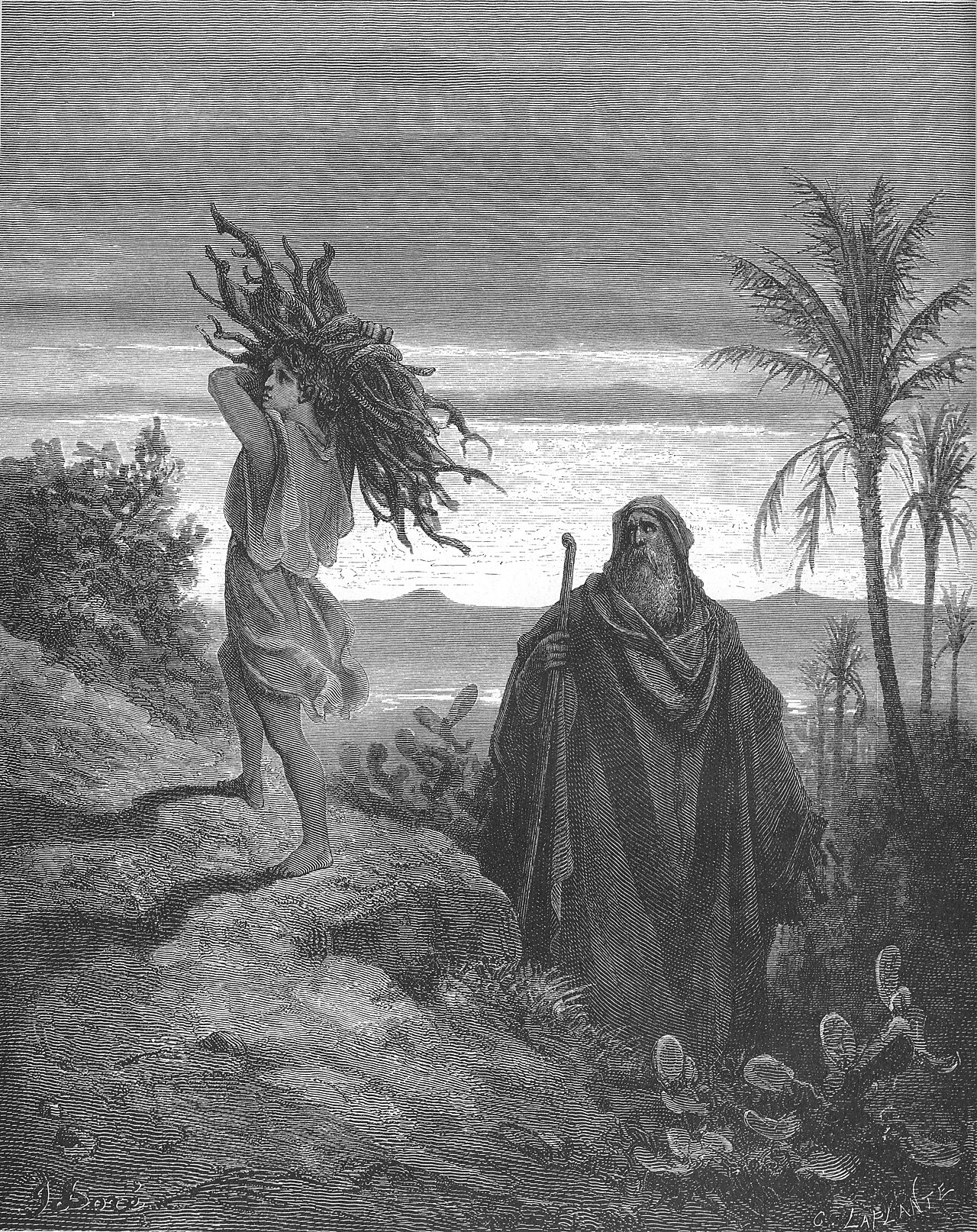
“Take your son,” God said, “your only son Isaac, whom you love, and go to the land of Moriah. Offer him there as a burnt offering on one of the mountains, which I will show you.”The portrait opens: a father offering his beloved only son on Moriah, where Christ would later die.
"Thy son, thine only son Isaac, whom thou lovest"
: the first time the Bible uses the word love, it is a father's for a son he is about to give up. Moriah is the ridge where the temple would stand (2 Chronicles 3:1) and where the crucifixion would happen. Isaac carries the wood up the hill on his own back.
Show more on this stopthe exposition
The exposition on this verse
your only son Isaac, whom you love: The command names the cost three times over, your only son Isaac, whom you love. Clarke, following Warburton, marks how each clause raises the price. Love is named here for the first time in Scripture, and it is a father's love for the son he is told to offer.
This exposition draws on Adam Clarke, Commentary on the Bible and Jerome, Hebrew Questions on Genesis.
Stop 2 of 10: Genesis 37:28
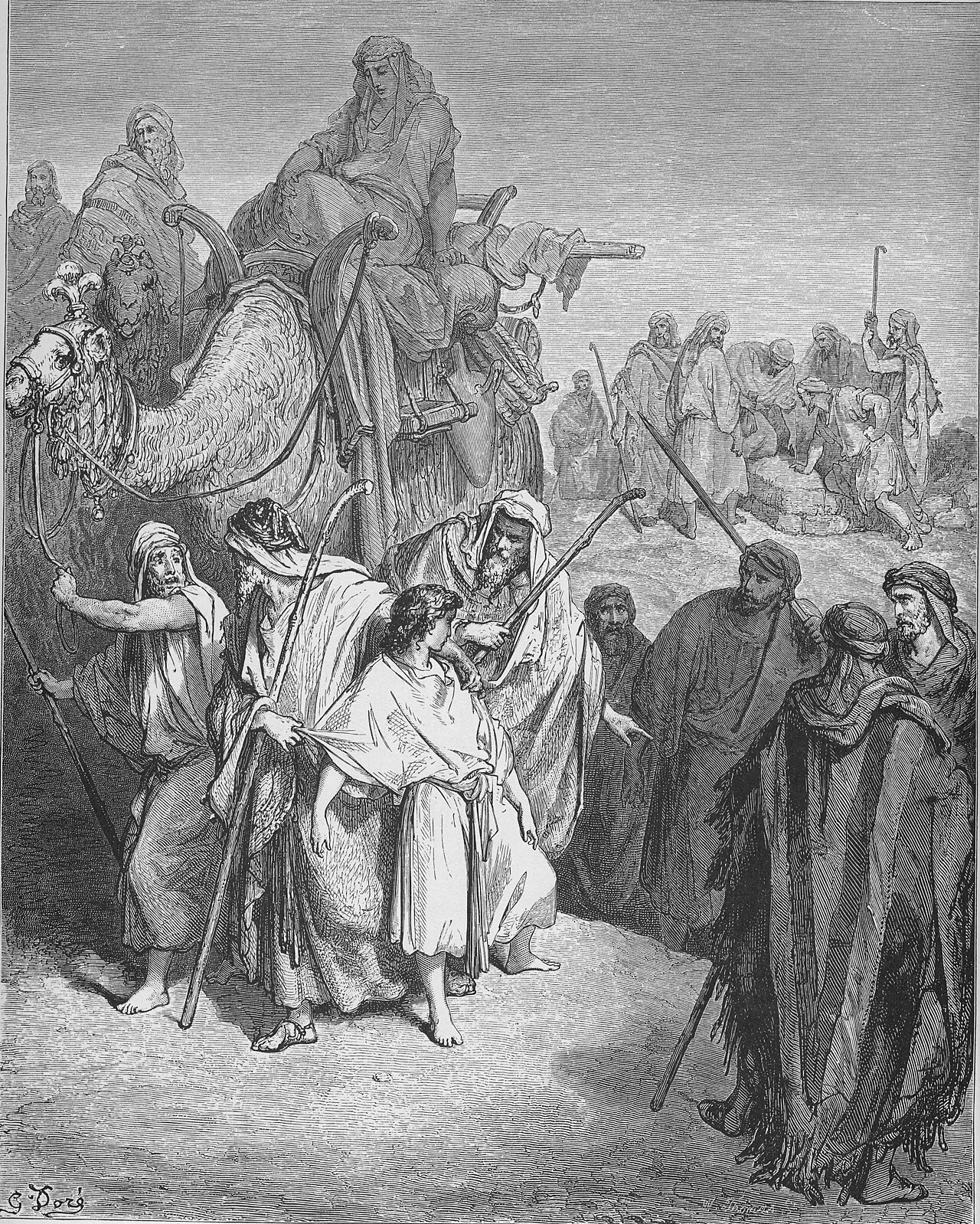
So when the Midianite traders passed by, his brothers pulled Joseph out of the pit and sold him for twenty shekels of silver to the Ishmaelites, who took him to Egypt.Adds rejection to the pattern: sold for silver by his brothers, then exalted to become their savior.
Twenty pieces of silver was the going price of a slave, and the brothers who sold him do not recognize him when they stand before him in power. Joseph supplies the shape rejection takes: betrayed by his own, numbered with two prisoners (one restored and one executed), raised to a throne, and used to keep the guilty alive.
Show more on this stopthe exposition
The exposition on this verse
sold him for twenty shekels of silver: Twenty shekels is the price Leviticus 27:5 fixes for a male between five and twenty years old. The buyers are Ishmaelites, descended from the elder son passed over for Isaac at Genesis 17:19, and they carry a younger son down into Egypt. Joseph goes down into Egypt first and alone.
This exposition draws on Adam Clarke, Commentary on the Bible and John Gill, Exposition of the Old Testament.
Stop 3 of 10: Exodus 12:5
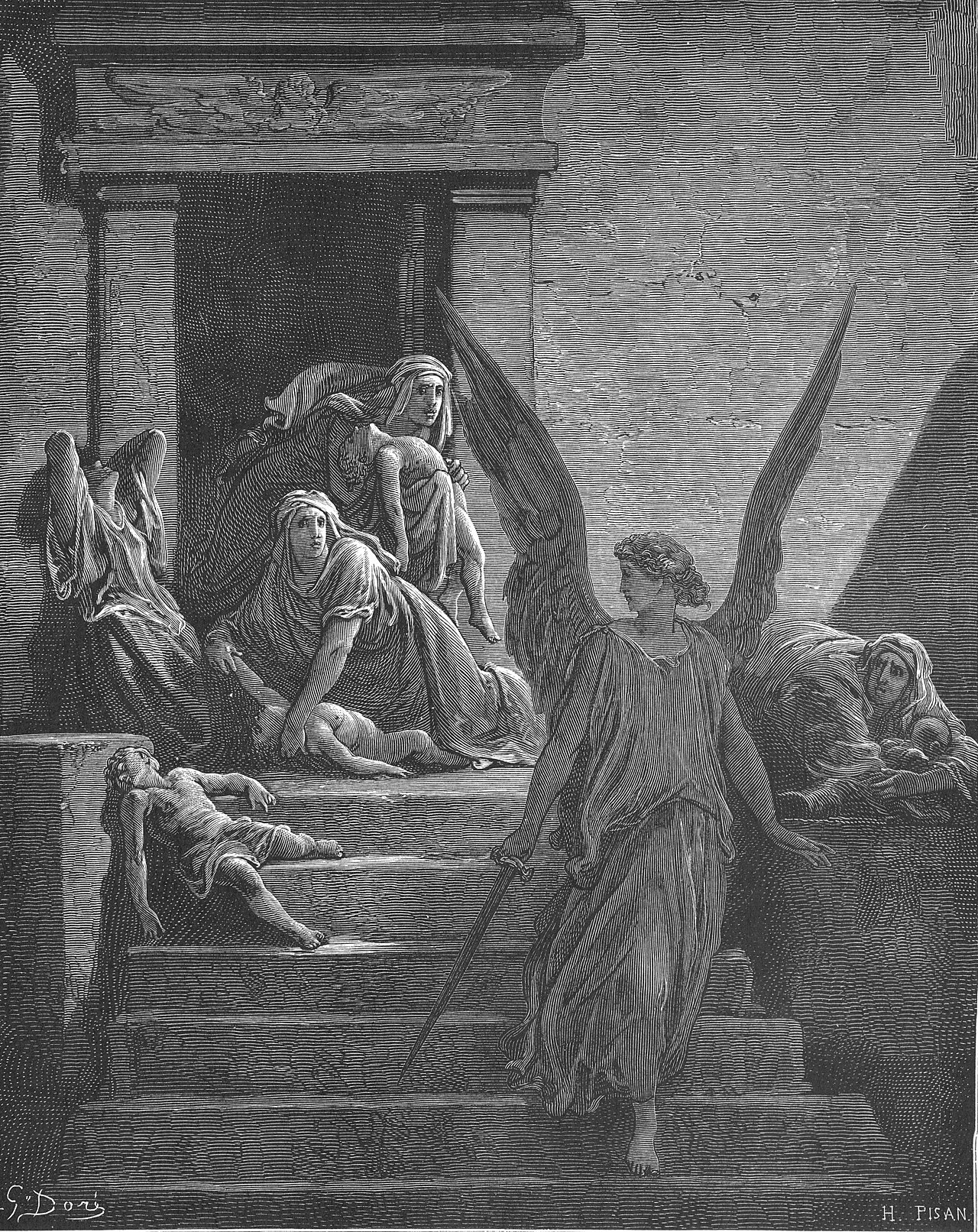
Your lamb must be an unblemished year-old male, and you may take it from the sheep or the goats.The type gains its requirement: the substitute must be without blemish, and its blood shields from death.
The lamb had to be without blemish, a male of the first year, taken into the house on the tenth day and killed on the fourteenth: four days of inspection. Jesus entered Jerusalem on the tenth of Nisan and was examined publicly for four days, and Pilate returns the required verdict:
"I find in him no fault at all."
Show more on this stopthe exposition
The exposition on this verse
the tenth day of this month: The lamb is chosen four days before it is killed and reckoned by households. The word congregation occurs here for the first time in Scripture, so Israel is named an assembly on the night it becomes a nation.
Your lamb must be an unblemished: Albert Barnes finds a special reason for the rule, for the lamb stood in place of each household's firstborn male. He calls the limit to a year-old animal unique in the law.
This exposition draws on Albert Barnes, Notes, Explanatory and Practical, on the Old and New Testaments; John Gill, Exposition of the Old Testament and Matthew Henry, Commentary on the Whole Bible.
Stop 4 of 10: Numbers 21:9
So Moses made a bronze snake and mounted it on a pole. If anyone who was bitten looked at the bronze snake, he would live.The dying live by looking at what is lifted up: Jesus claims this picture for His cross.
Jesus applies this to Himself in John 3:14, the one Old Testament type He explicitly claims for His own cross. Paul finishes the logic: He was made sin for us (2 Corinthians 5:21).
Show more on this stopthe exposition
The exposition on this verse
So Moses made a bronze snake: Moses made the fiery serpent of bronze, and the Hebrew words for serpent and bronze share their consonants. At 2 Kings 18:4 Hezekiah demolished the bronze snake called Nehushtan, for up to that time the Israelites had burned incense to it. The cure had become an idol.
This exposition draws on Adam Clarke, Commentary on the Bible and John Gill, Exposition of the Old Testament.
Stop 5 of 10: Joshua 1:1
Now after the death of His servant Moses, the LORD spoke to Joshua son of Nun, Moses’ assistant, saying,Moses the lawgiver dies; a leader named Yeshua, Jesus' own name, brings the people into promise.
Joshua is Yehoshua, shortened to Yeshua, the name the angel gives Mary's son. Moses the lawgiver cannot bring Israel in; his successor crosses the river and takes the land. The type is the office, not the man: the law walks you to the border, Yeshua takes you over it.
Show more on this stopthe exposition
The exposition on this verse
after the death of His servant Moses: The book opens with a conjunction, so it reads as the next line of Deuteronomy 34, and gives Moses the title that closes the Torah. Joshua carries a smaller one, “Moses’ assistant”, the word of Exodus 33:11, and is called the servant of the LORD only in 24:29.
This exposition draws on Albert Barnes, Notes on the Old Testament and Keil and Delitzsch, Biblical Commentary on the Old Testament: Joshua, Judges, Ruth.
Stop 6 of 10: Ruth 4:14
Then the women said to Naomi, “Blessed be the LORD, who has not left you this day without a kinsman-redeemer. May his name become famous in Israel.To redeem is to buy someone back out of a place he cannot leave on his own.
Redemption takes a shape: a kinsman with the right to redeem, who purchases and gives rest.
The kinsman-redeemer had to meet three tests (he had to be a relative, he had to be able to pay, and he had to be willing) and Boaz meets all three, paying at the gate before ten witnesses. The nearer kinsman refuses because redeeming would damage his own inheritance. That is the exact opposite of Philippians 2.
Show more on this stopthe exposition
The exposition on this verse
Then the women said to Naomi: The women bless the LORD before the woman who asked at 1:20 to be called Mara. They give the newborn the title "kinsman-redeemer", held by Boaz since 3:9. Seven sons marks a full house, as at Job 1:2, and a Moabite daughter-in-law is "better to you than seven sons".
This exposition draws on Keil and Delitzsch, Biblical Commentary on the Old Testament: Joshua, Judges, Ruth and Matthew Henry, Commentary on the Whole Bible.
Stop 7 of 10: 2 Samuel 7:12
And when your days are fulfilled and you rest with your fathers, I will raise up your descendant after you, who will come from your own body, and I will establish his kingdom.A covenant is a binding agreement, sworn once and kept for good.
The pattern becomes covenant: God swears David a seed whose kingdom He Himself will establish forever.
David offers to build God a house and God reverses it: He will build David one, a seed, a throne, a kingdom "for ever." The type here is a covenant rather than a character, and Gabriel quotes it back word for word to Mary in Luke 1:32–33. Six centuries with no king on the throne did not cancel it.
Show more on this stopthe exposition
The exposition on this verse
I will raise up your descendant after you: The house becomes a seed, a kingdom, and a throne established for ever. The nearest fulfillment is Solomon, who will build the house for my name that David himself wanted to build. Hebrews 1:5 and Luke 1:32-33 carry the same throne of his father David forward to Christ.
This exposition draws on Jamieson Fausset and Brown, Commentary Critical and Explanatory on the Whole Bible and Matthew Henry, Commentary on the Whole Bible.
Stop 8 of 10: Jonah 1:17
Now the LORD had appointed a great fish to swallow Jonah, and Jonah spent three days and three nights in the belly of the fish.Three days and nights in the deep: the one sign Jesus gave of His death and resurrection.
"Three days and three nights"
is the only sign Jesus said He would give an evil generation (Matthew 12:39–40). Jonah dies to his own mission, is swallowed, is put back on land alive, and preaches to Gentiles who repent. The pattern carries the outcome as well as the timing.
Show more on this stopthe exposition
The exposition on this verse
Now the LORD had appointed a great fish: The LORD appoints the fish, and the sea that was to kill Jonah becomes his rescue. At Matthew 12:40 Jesus sets His own "three days and three nights in the heart of the earth" beside Jonah's. He gives the same sign at Matthew 16:4 and Luke 11:30.
This exposition draws on Carl Friedrich Keil, The Twelve Minor Prophets and Edward Bouverie Pusey, The Minor Prophets: A Commentary.
Stop 9 of 10: Daniel 3:25
“Look!” he exclaimed. “I see four men, unbound and unharmed, walking around in the fire—and the fourth looks like a son of the gods!”A fourth man walks unhurt in the furnace: the type of Christ present with His own in fire.
Nebuchadnezzar counts four men in a furnace he had heated for three, and says the fourth is
"like the Son of God."
Nothing burns but the ropes. The type is not rescue from the fire but presence in it: a distinction the three men had already made before they were thrown in (verses 17–18).
Show more on this stopthe exposition
The exposition on this verse
Did we not throw three men: Nebuchadnezzar sees “four men, unbound and unharmed,” the fourth like “a son of the gods,” which Keil takes as a heavenly being. This site teaches that the fourth is Christ before his incarnation, keeping in person Isaiah 43:2, and other readings see a created angel.
like a son of the gods: Readers divide over the fourth figure. John Wesley saw God's Son appearing before his incarnation as the Angel of the covenant. John Calvin and Adam Clarke took the king's phrase, “a son of the gods,” as a pagan's name for an angel or divine being.
This exposition draws on Adam Clarke, Commentary on the Bible; Carl Friedrich Keil, Biblical Commentary on the Book of Daniel; John Calvin and John Wesley, Explanatory Notes upon the Old Testament.
Stop 10 of 10: John 1:29
The next day John saw Jesus coming toward him and said, “Look, the Lamb of God, who takes away the sin of the world!To redeem is to buy someone back out of a place he cannot leave on his own.
The shadows converge and get a name: John points at Jesus and calls Him the Lamb.
"Behold the Lamb of God, which taketh away the sin of the world."
John uses the definite article twice: THE Lamb, THE sin. Every shadow on this walk (the bound son, the sold brother, the Passover, the lifted serpent, Yeshua, the redeemer, the throne, the three days, the fourth man) converges on a man walking toward him.
Show more on this stopthe exposition
The exposition on this verse
the Lamb of God, who takes away the sin of the world: The Lamb of God gathers the Passover lamb of Exodus 12 and the lamb offered morning and evening at the temple. It also gathers the lamb led to slaughter at Isaiah 53:7.
This exposition draws on Alexander Maclaren, Expositions of Holy Scripture, John and Matthew Henry, Commentary on the Whole Bible.
What this trail means
Stand back from the ten stops and one thing becomes unmistakable: this is design, not coincidence. Across roughly fifteen centuries, different authors, different genres, and different circumstances keep producing the same figure: a beloved only son offered on Moriah's range, a rejected brother whose betrayal becomes his brothers' salvation, a lamb that must be without blemish, a cursed thing lifted up so that the dying live by looking, a leader bearing Jesus' own name who brings the people into the promise Moses could not, a kinsman with the right and the will to redeem, a seed of David whose kingdom God Himself establishes, three days and nights in the belly of the deep, a fourth man in the furnace so that fire does no hurt.
No single type carries the whole weight. Isaac is offered but spared; Joseph saves but dies; the Passover lamb dies but cannot rise. Each figure holds one facet and breaks under the rest, which is exactly what a shadow does. Shadows have edges but no substance.
Then the Jordan, and a man pointing: "Behold, the Lamb of God, that taketh away the sin of the world!" (John 1:29). Not a lamb for one household, as in Egypt: the Lamb, for the world. Every line of the portrait converges on Jesus of Nazareth. The Old Testament was never a different story. It was this story, told in advance.
Show the verses this closing names1 verses
The next day John saw Jesus coming toward him and said, “Look, the Lamb of God, who takes away the sin of the world!Show what you now know
- A type is not a coincidence read backwards. Jesus and the apostles name these patterns themselves: the serpent (John 3:14), Jonah (Matthew 12:40), the Passover lamb (1 Corinthians 5:7).
- The shadows carry detail: the wood on Isaac's back, the price of a slave, four days of inspection, three days in the dark, a fourth man in the fire.
- The types run across every kind of writing (narrative, law, history, prophecy) and across a thousand years of authors who could not coordinate.
- They all converge on one sentence spoken at the Jordan: "Behold the Lamb of God."