
Matthew 17:1
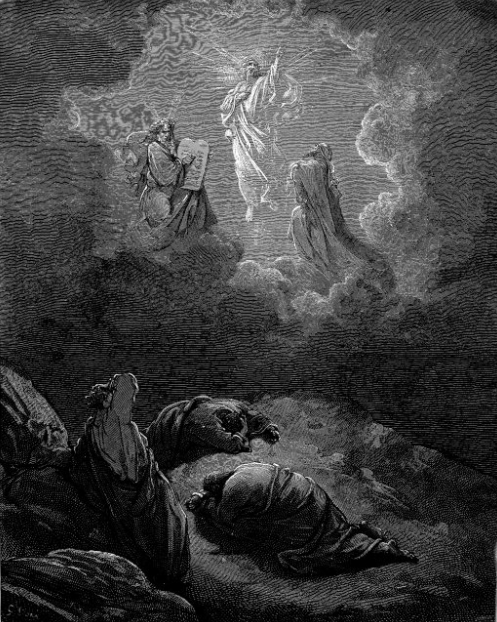
in Matthew 17After six days Jesus took with Him Peter, James, and John the brother of James, and led them up a high mountain by themselves.
BSB
The same verse in ASV and KJV ▾
ASV
And after six days Jesus taketh with him Peter, and James, and John his brother, and bringeth them up into a high mountain apart:
KJV
And after six days Jesus taketh Peter, James, and John his brother, and bringeth them up into an high mountain apart,
⋯
This verse in Matthew 17
Commentary
6 notes on this verse(Chapter 17 - Verse 1) And after six days, Jesus took Peter and James, and John his brother. Why Peter, James, and John are separated from the others in some places in the Gospels, or what privilege they have over the other apostles, we have frequently discussed. Now it is asked how he assumed them after six days, and led them to a high mountain apart: since the evangelist Luke mentions the number eight (Luke 9). But the answer is easy, because here the intermediate days are placed, the first and the last are added.
This site's exposition
an high mountain apart
on Matthew 17:1-2
Six days after Peter's confession and rebuke, Jesus takes the same three he will later bring nearest him in Gethsemane, Peter, James and John, up a high mountain the tradition has argued between Tabor and Hermon, with Hermon's nearness to Caesarea Philippi favored by the older harmonists. Luke's about eight days is not a contradiction but an inclusive count against Matthew's exclusive one, both reckoning the same interval by different customary methods. Transfigured, metamorphothe in the Greek, describes a change from within shining outward, his face as the sun and his raiment white as the light, language that echoes Moses' own shining face after Sinai in Exodus 34 and anticipates the promised brightness of the resurrected in Daniel 12:3.
The record, by era
The Puritans and the Awakening2 voices
That is, so long after Christ's conversation with his disciples at Caesarea Philippi, Peter's confession of him, and the reproof he gave him, upon his intimating that he should suffer and die, and Christ's resentment of it; after he had discoursed about his disciples taking up their cross, and following him; and of men's losing and finding their lives; and after the promise, or prophecy, that he had given out, that some then present should not die, until he came into his kingdom.
They were present when he raised the damsel to life, Mark v. 37 . They were afterward to be the witnesses of his agony, and this was to prepare them for that. Note, A sight of Christ's glory, while we are here in this world, is a good preparative for our sufferings with him, as these are preparatives for the sight of his glory in the other world.
The Nineteenth Century2 voices
A commentator
Albert Barnes1798–1870
Notes, Explanatory and Practical, on the Old and New Testaments (1832-1869)
Mat 17:1-9. See also Mar 9:2-10; Luk 9:28-36. And after six days - That is, six days from the conversation recorded in the last chapter. Luke Luk 9:28 says, about an eight days after. Matthew mentions the six days that intervened between the day of the conversation and the transfiguration. Luke includes both those days, and thus reckons eight. Besides, Luke does not pretend to fix the precise time. He says, “about an eight days after.” Taketh Peter, and James, and John - These three disciples were with him, also, in the garden of Gethsemane, Mar 14:
on Matthew 17:1-13
These verses contain one of the most remarkable events in our Lord’s earthly ministry, the event commonly called the transfiguration. The order in which it is recorded is beautiful and instructive. The latter part of the last chapter showed us the cross; here we are graciously allowed to see something of the coming reward. The hearts which have just been saddened by a plain statement of Christ’s sufferings are at once gladdened by a vision of Christ’s glory. Let us mark this. We often lose much by not tracing the connection between chapter and chapter in the Word of God.
The words behind it
24 Greek wordsEvery Greek word of this verse in the order it stands, with what it means and the door to its own study. The last column counts the times a word stands in the whole Bible: the rarer the word, the more the places it appears belong together.
| Greek | Sound | Meaning | Word study | In the Bible |
|---|---|---|---|---|
| Καὶ | kai | And | G2532 → | 9120 times |
| μεθ᾽ | meth᾽ | after | G3326 → | 461 times |
| ἡμέρας | hemeras | days | G2250 → | 389 times |
| ἓξ | hex | six | G1803 → | |
| παραλαμβάνει | paralambanei | takes with [Him] | G3880 → | 49 times |
| ὁ | ho | <the> | G3588 → | 19766 times |
| Ἰησοῦς | iesous | Jesus | G2424 → | 908 times |
| τὸν | ton | <the> | G3588 → | 19766 times |
| Πέτρον | petron | Peter | G4074 → | 155 times |
| καὶ | kai | and | G2532 → | 9120 times |
| Ἰάκωβον | iakobon | James | G2385 → | 42 times |
| καὶ | kai | and | G2532 → | 9120 times |
| Ἰωάννην | ioannen | John | G2491 → | 134 times |
| τὸν | ton | the | G3588 → | 19766 times |
| ἀδελφὸν | adelphon | brother | G80 → | 343 times |
| αὐτοῦ | autou | of him | G846 → | 5565 times |
| καὶ | kai | and | G2532 → | 9120 times |
| ἀναφέρει | anapherei | brings up | G399 → | |
| αὐτοὺς | autous | them | G846 → | 5565 times |
| εἰς | eis | into | G1519 → | 1755 times |
| ὄρος | oros | a mountain | G3735 → | 62 times |
| ὑψηλὸν | hupselon | high | G5308 → | |
| κατ᾽ | kat᾽ | on | G2596 → | 468 times |
| ἰδίαν. | idian | [their] own. | G2398 → | 114 times |
ΚαὶAnd
kaiG2532 →9120 times
μεθ᾽after
meth᾽G3326 →461 times
ἡμέραςdays
hemerasG2250 →389 times
ἓξsix
hexG1803 →
παραλαμβάνειtakes with [Him]
paralambaneiG3880 →49 times
ὁ<the>
hoG3588 →19766 times
ἸησοῦςJesus
iesousG2424 →908 times
τὸν<the>
tonG3588 →19766 times
ΠέτρονPeter
petronG4074 →155 times
καὶand
kaiG2532 →9120 times
ἸάκωβονJames
iakobonG2385 →42 times
καὶand
kaiG2532 →9120 times
ἸωάννηνJohn
ioannenG2491 →134 times
τὸνthe
tonG3588 →19766 times
ἀδελφὸνbrother
adelphonG80 →343 times
αὐτοῦof him
autouG846 →5565 times
καὶand
kaiG2532 →9120 times
ἀναφέρειbrings up
anaphereiG399 →
αὐτοὺςthem
autousG846 →5565 times
εἰςinto
eisG1519 →1755 times
ὄροςa mountain
orosG3735 →62 times
ὑψηλὸνhigh
hupselonG5308 →
κατ᾽on
kat᾽G2596 →468 times
ἰδίαν.[their] own.
idianG2398 →114 times
A shaded row is a word that stands 400 times or fewer in the Bible.
The walk
8 stopsEach card is a verse this one points to, and under it the verses that one points to in turn. Where several paths arrive at the same place, that place is listed first: the text keeps returning to it.
Through
2 Corinthians 13:1This is the third time I am coming to you. “Every matter must be established by the testimony of two or three witnesses.”
it leads to
- Matthew 18:16
But if he will not listen, take one or two others along, so that ‘every matter may be established by the testimony of two or three witnesses.’
- Deuteronomy 19:15
A lone witness is not sufficient to establish any wrongdoing or sin against a man, regardless of what offense he may have committed. A matter must be established by the testimony of two or…
- Deuteronomy 17:6
On the testimony of two or three witnesses a man shall be put to death, but he shall not be executed on the testimony of a lone witness.
- John 8:17–18
Even in your own Law it is written that the testimony of two men is valid.
- Numbers 35:30
If anyone kills a person, the murderer is to be put to death on the testimony of the witnesses. But no one is to be put to death based on the testimony of a…
- Matthew 18:16
Through
2 Peter 1:18And we ourselves heard this voice from heaven when we were with Him on the holy mountain.
it leads to
- Matthew 17:6
When the disciples heard this, they fell facedown in terror.
- Matthew 17:6
Through
Matthew 26:37He took with Him Peter and the two sons of Zebedee and began to be sorrowful and deeply distressed.
it leads to
- Matthew 4:21
Going on from there, He saw two other brothers, James son of Zebedee and his brother John. They were in a boat with their father Zebedee, mending their nets. Jesus called them,
- Matthew 4:21
Through
Mark 5:37And He did not allow anyone to accompany Him except Peter, James, and John the brother of James.
it leads to
- Acts 9:40
Then Peter sent them all out of the room. He knelt down and prayed, and turning toward her body, he said, “Tabitha, get up!” She opened her eyes, and seeing Peter, she sat up.
- Acts 9:40
Where this verse is studied
On this page
About Matthew
This page draws on Adam Clarke, Commentary on the Bible; Albert Barnes, Notes, Explanatory and Practical, on the Old and New Testaments (1832-1869); J.C. Ryle, Expository Thoughts on the Gospels: Matthew; Jerome, Commentary on Matthew; John Calvin, Commentary on a Harmony of the Evangelists; John Gill, Exposition of the New Testament (1746-1748) and Matthew Henry, Commentary on the Whole Bible.