
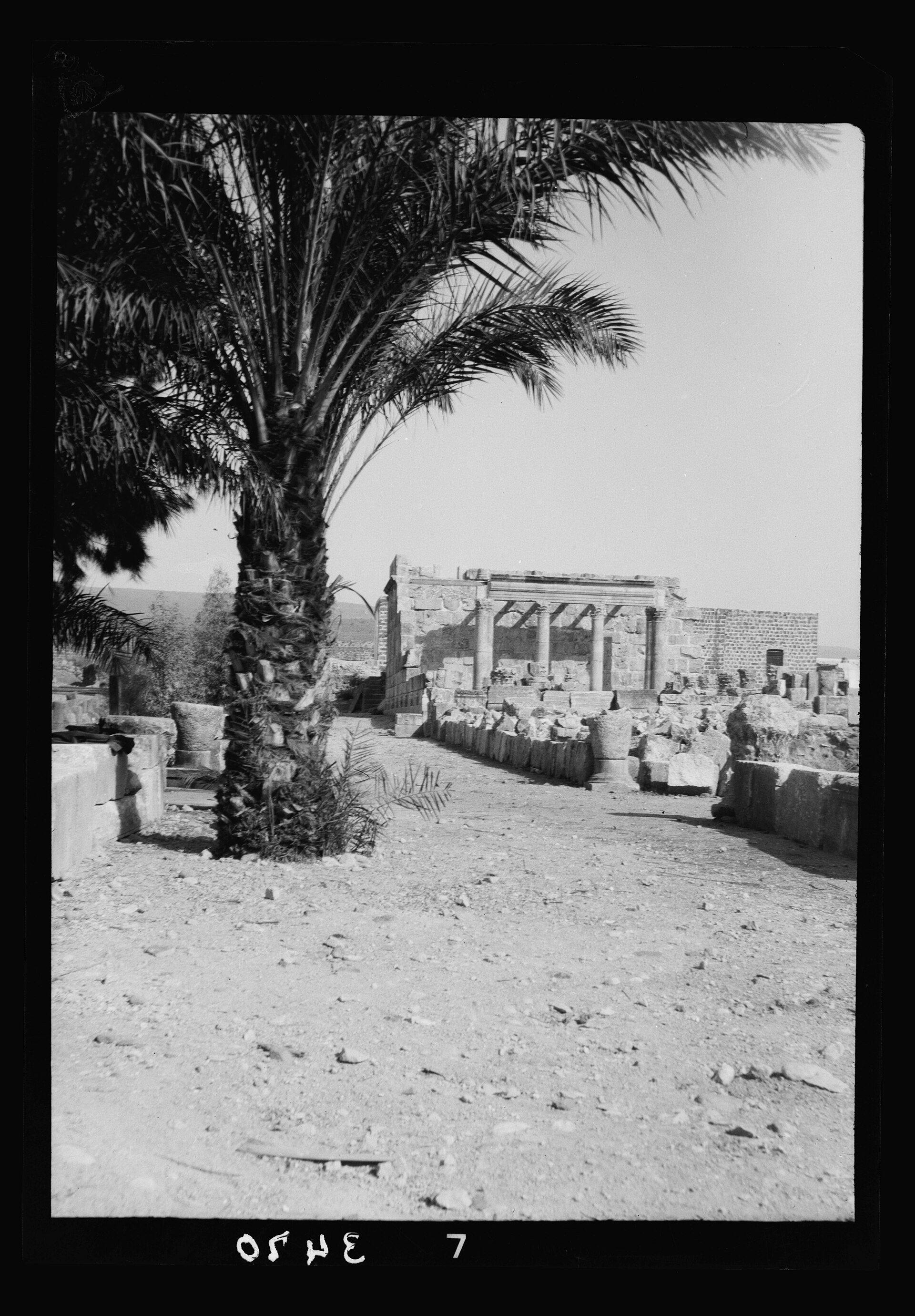
Unrecorded photographer, Capernaum, 1920. Public domain.
Matthew 4:13, Mark 2:1 and John 6:59 · Place · Featured Study
Capernaum
Capernaum stood on the north shore of the Sea of Galilee, and Jesus made it His home during His ministry.
Simon and Andrew kept a home in this town, and Jesus preached in its synagogue.
Leaving Nazareth, He went and lived in Capernaum, which is by the sea in the region of Zebulun and Naphtali,
Leaving Nazareth, He went and lived in Capernaum, which is by the sea in the region of Zebulun and Naphtali,
- Today
- Kfar Nahum, Israel
- Region
- Galilee
- Site
- 32.881, 35.575
- First named
- Matthew 4:13 “…He went and lived in Capernaum, which is…”
- Last named
- John 6:59 “…teaching in the synagogue in Capernaum.”
Summary
Jesus taught in the synagogue of Capernaum and healed in its houses. When He came back to the town, Mark says He was home. A centurion who had built its synagogue sent elders to Him. Jesus also named Capernaum among the towns that saw His miracles and did not repent.
- Sixteen verses of the Berean text name Capernaum, all of them in the four Gospels.
- Josephus names a spring and a village of the same name.
- The ruins the excavators uncovered stand on the north shore of the lake at Tell Hum.
His Own Town
Matthew reads the move by Isaiah's word about the land of Zebulun and Naphtali.
A few days later Jesus went back to Capernaum. And when the people heard that He was home,The healing of the paralytic follows in this house, Mark 2:3 to 12.
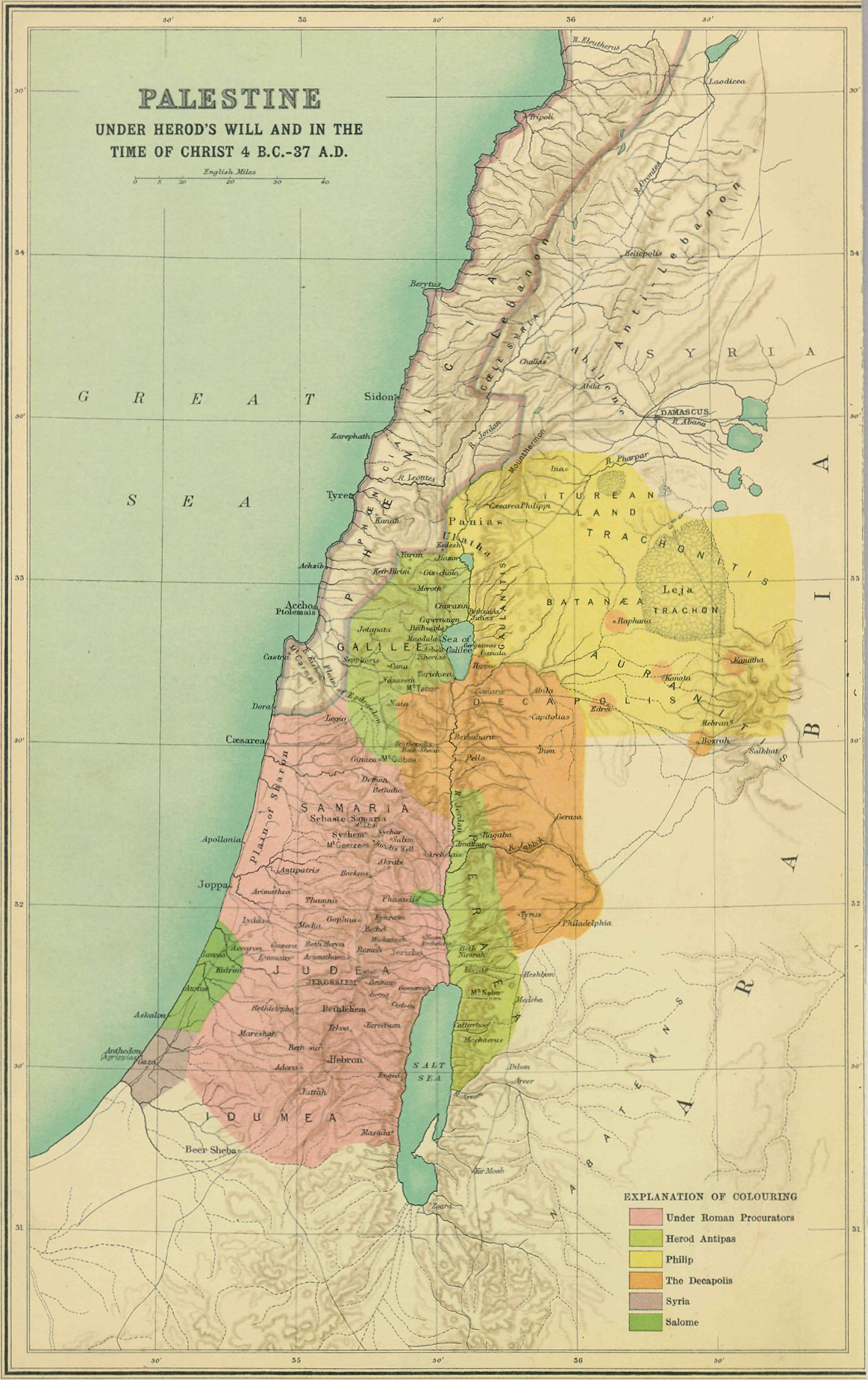
Capernaum on Smith's Plate
Capernaum stands on the north-west shore of the Sea of Galilee on George Adam Smith's plate of 1915.
Chorazin lay a short way inland, north of Capernaum and its shore.
about 50 km (31 miles)
- Known: a score of 800 or more
- Probable: a score of 500 to 799
- Proposed: a score under 500
- 1Capernaum, The town of the synagogue the centurion built Luke 7:5
- 2Chorazin, Named with Bethsaida and Capernaum in the woes Matthew 11:21
- 3?Bethsaida, Named with Chorazin and Capernaum in the woes Matthew 11:21
- 4Tiberias, The town whose boats landed near the place of the loaves John 6:23
- 5Cana, Where Jesus told the official from Capernaum that his son would live John 4:46
- 6Nazareth, The town where Jesus was brought up Luke 4:16
Base map: Palestine in the time of Christ, George Adam Smith, Atlas of the Historical Geography of the Holy Land (1915), public domain. Places with a place page stand at its coordinates and the others at the point cited for each, set on the plate by Jerusalem and Tyre, as the plate prints them.
Six places, each with its verse. Each ring follows the OpenBible.info identification score out of 1,000, as the key gives it.
Capernaum in Scripture, in Order
Ten verses set something Jesus did or said at Capernaum, in the order of the canon.
Ten things the Gospels set at Capernaum, from Matthew 4 to John 6.
- MatthewJesus leaves Nazareth and lives in CapernaumMatthew 4:13
- MatthewA centurion pleads for his paralyzed servantMatthew 8:5
- MatthewThe collectors of the two-drachma tax question PeterMatthew 17:24
- MarkJesus teaches in the synagogue on the SabbathMark 1:21
- MarkA paralytic is lowered through the roof of the houseMark 2:1
- MarkIn the house, Jesus asks what they had discussed on the wayMark 9:33
- LukeJesus teaches the people on the SabbathLuke 4:31
- LukeJesus comes to the town after His discourseLuke 7:1
- JohnJesus stays a few days with His mother, brothers and disciplesJohn 2:12
- JohnJesus teaches the bread of life in the synagogueJohn 6:59
Matthew and Mark give three of the ten each, and Luke and John two each.
Luke, John
Josephus on Capernaum
Josephus wrote of the place in his Life and in the Jewish War.
In his Life, Josephus says that when his horse fell into a quagmire in a fight near the Jordan, he was carried into a village named Cepharnome, or Capernaum. In the Jewish War he writes that the plain of Gennesaret is watered by a fountain the people of the country call Capharnaum.
What the Excavators Found
Digging at Tell Hum since 1905 has uncovered a synagogue and a house made into a church.
The synagogueHeinrich Kohl and Carl Watzinger from 1905; Virgilio Corbo and Stanislao Loffreda from 1968
The synagogue that stands was built of white limestone, probably in the fourth or fifth century. Under it lies an older foundation of basalt, which Loffreda suggests was a synagogue of the first century.
The house and the octagonVirgilio Corbo and Stanislao Loffreda
The excavators found a house turned step by step into a church in the fourth and fifth centuries, and an octagonal church built over it. A memorial church was dedicated above the remains in 1990.
What the Gospels Leave Unsaid
The Gospels say nothing of the town's size or of its end.
They give no count of its people and no measure of its streets.
The Gospels do not say when Capernaum was left empty.
A Great Light, and a Woe
Matthew reads Jesus' coming to Capernaum by Isaiah's light, and later records the woe on the town.
the people living in darkness have seen a great light; on those living in the land of the shadow of death, a light has dawned.”And you, Capernaum, will you be lifted up to heaven? No, you will be brought down to Hades! For if the miracles that were performed in you had been performed in Sodom, it would have remained to this day.The town that saw the light of Matthew 4:16 is the town told it would be brought down to Hades.
Voices on Capernaum
Three teachers from the fourth, fifth and nineteenth centuries wrote on Capernaum's place in the Gospels.
Eusebius of Caesarea (died 339)
Eusebius of Caesarea set the elders' plea beside the reason Jesus went.
“And the elders of the Jews indeed demand favours for a small sum spent in the service of the synagogue, but the Lord not for this, but a higher reason, manifested Himself, wishing in truth to beget a belief in all men by His own power, as it follows, Then Jesus went with them.”
Eusebius of Caesarea · Catena Aurea by Aquinas · on Luke 7:4 to 6Patristic
Cyril of Alexandria (died 444)
Cyril of Alexandria set the gospel against the lamp of the law.
“And the ‘great light’ is Christ our Lord and the brightness of the gospel preaching. It is not, in fact, the law, which was likened to a lamp. For this reason a lamp always burned in the tabernacle, on account of the shortness of the law's rays, which had strength to extend their light only within the confines of the Jewish territories. Therefore the Gentiles were ‘in darkness,’ not having this lamplight.”
Cyril of Alexandria · FRAGMENT 34.15 · on Matthew 4:16Patristic
J.C. Ryle (1816 to 1900)
Ryle drew a warning from the crowds at the house in Capernaum.
“This passage shows our Lord once more at Capernaum. Once more we find Him doing His accustomed work, preaching the word, and healing those that were sick. We see, in these verses, what great spiritual privileges some people enjoy, and yet make no use of them . This is a truth which is strikingly illustrated by the history of Capernaum. No city in Palestine appears to have enjoyed so much of our Lord's presence, during His earthly ministry, as did this city. It was the place where He dwelt, after He left Nazareth. (Matt. 4:13.)”
J.C. Ryle · Expository Thoughts on the Gospels: Mark (lightly modernized text, Grace Gems edition) · on Mark 2:1 to 12Reformed Evangelical
Where Was Capernaum?
Tell Hum has been named as Capernaum since 1866, while earlier readers held the site uncertain.
Tell HumCharles William Wilson, 1866; the excavators since 1905
Charles William Wilson identified the ruins called Tell Hum as Capernaum in 1866. The synagogue and the house made into a church found there match the pilgrim account in the record above.
The objection: Albert Barnes held that the site was uncertain.
The site uncertainAlbert Barnes
Albert Barnes held that Capernaum, once a city of renown, stood on a site now uncertain.
The objection: the synagogue and the house-church at Tell Hum match the pilgrim account.
Sources
Scripture is the Berean Standard Bible.
- James Strong, Exhaustive Concordance of the Bible (1890), Greek dictionary, entry 2584, with the STEP Bible brief lexicon.
- OpenBible.info, Bible-Geocoding-Data, ancient.jsonl, entries Capernaum (score 842), Chorazin (786), Bethsaida 1 (466), Tiberias (1000), Cana (690), Nazareth (1000)
- George Adam Smith, Atlas of the Historical Geography of the Holy Land, London, Hodder and Stoughton, 1915, the plate Palestine under Herod's Will and in the Time of Christ.
- Eusebius of Caesarea, on Luke 7:4 to 6, in the Catena Aurea of Thomas Aquinas.
- Cyril of Alexandria, Fragment 34.15 on Matthew, on Matthew 4:16.
- J.C. Ryle, Expository Thoughts on the Gospels: Mark (1857), on Mark 2:1 to 12.
- Flavius Josephus, The Life of Flavius Josephus 72, translated by William Whiston (1737)
- Flavius Josephus, The Wars of the Jews 3.10.8, translated by William Whiston (1737)
- Wikipedia, Capernaum, the sections on the name, the identification and the excavations, citing Stanislao Loffreda, Cafarnao II (1974), Jonathan L. Reed, Archaeology and the Galilean Jesus (2002), and the Israel Ministry of Foreign Affairs, Capernaum: City of Jesus and its Jewish Synagogue.
- Stanislao Loffreda, Capharnaum, the Town of Jesus: The Insula Sacra, Studium Biblicum Franciscanum (2001)
- Peter the Deacon, Liber de Locis Sanctis, the pilgrim account of Capernaum, in the English of Vatican News, Following in Jesus' Footsteps: Capernaum, August 2026.
- Albert Barnes, Notes, Explanatory and Practical, on the Old and New Testaments (1832 to 1869), on Matthew 4:13.
Keep Studying
Read it5
People and groups3