
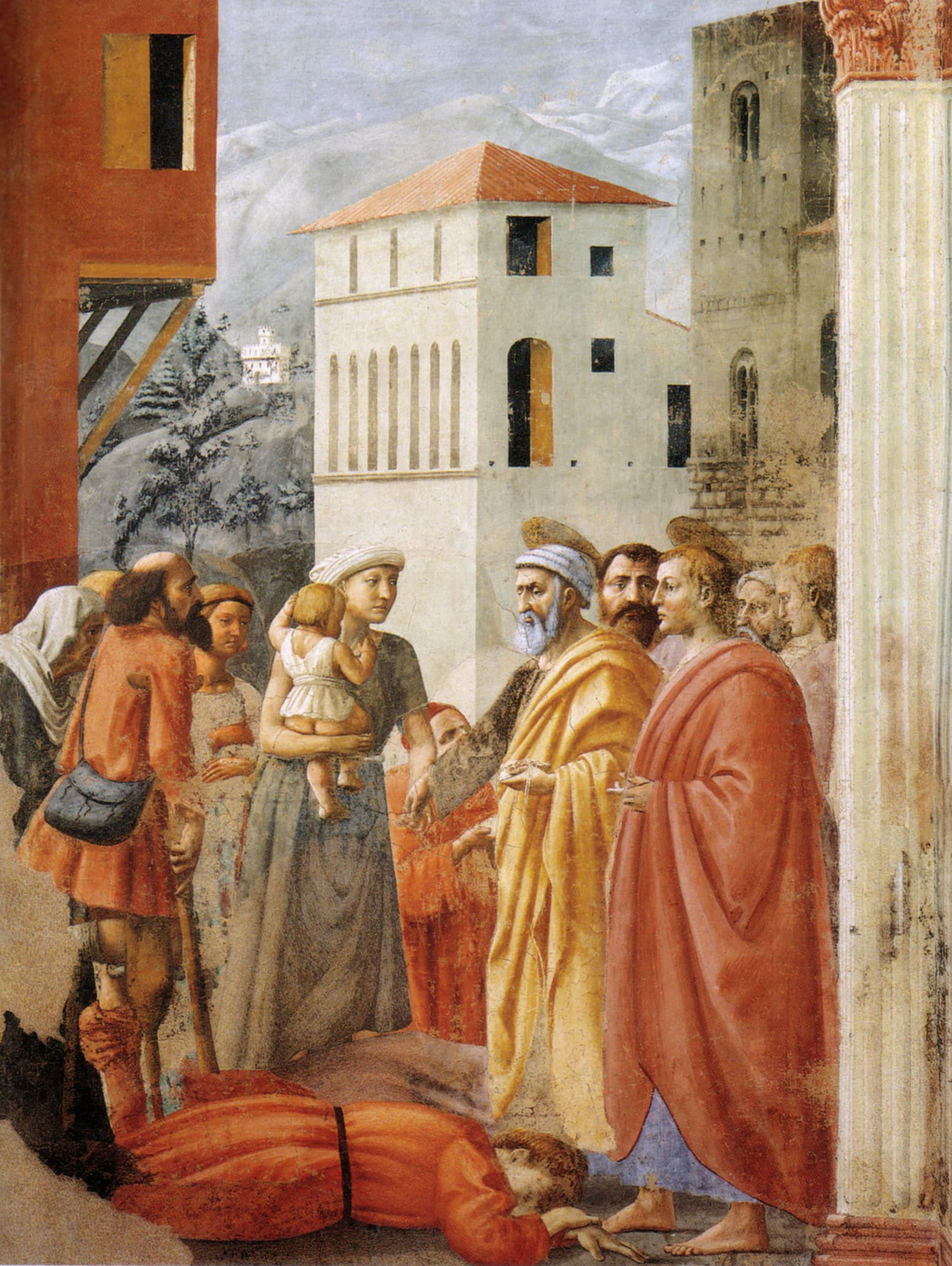
Acts 2:42 to 47 · Passage · Unity and Fellowship
The Fellowship of Acts 2
Acts 2:42 to 47 describes how the first believers in Jerusalem lived together.
An early church manual, the Didache, told any believer at odds with another to stay away from the breaking of bread until the two were reconciled.
They devoted themselves to the apostles’ teaching and to the fellowship, to the breaking of bread and to prayer.
- The passage
- Acts 2:42 to 47, Acts 4:32 to 35
- Book
- Acts
- Hold in memory
- Acts 2:42
Summary
Luke describes the church that formed in Jerusalem after Peter's sermon at Pentecost. Its members held to the apostles' teaching, the fellowship, the breaking of bread and prayer, and awe came on everyone as the apostles did wonders and signs. They were together and held what they had in common. Luke closes the account with praise, goodwill and daily growth.
- The fellowship of Acts 2:42 is the Greek koinonia, which Strong's dictionary defines as partnership or participation.
- Luke tells of the same sharing a second time in Acts 4:32 to 35.
- Readers have divided over whether the sharing was a rule for every church or a free response to need.
The First Believers
The church of Acts 2:42 is made of those baptized in Acts 2:41.
The Fellowship of Acts 2 studies Acts 2:42 to 47, the first of Luke's two accounts of the sharing in the Jerusalem church. It belongs to the value of unity, because Luke shows a new community held together by one teaching, one table and a shared purse.
The question the study answers is what the first believers devoted themselves to and how far their sharing went. The answer comes from the Greek words of the passage, from Acts 4 and from readers between Chrysostom and Albert Barnes.
Those who embraced his message were baptized, and about three thousand were added to the believers that day.The verse gives the size of the company Luke goes on to describe.
The verb rendered devoted in Acts 2:42, proskartereo, returns in Acts 2:46 for the daily meeting. Luke had used it before, with homothumadon, “with one accord”, of the disciples at prayer.
With one accord they all continued in prayer, along with the women and Mary the mother of Jesus, and with His brothers.The verse shows the praying company already joined as the larger church would be.
From Awe to Growth
The verses after the four devotions show the life that grew from them.
Luke's account runs from awe at the apostles' signs, through the sharing and the daily meetings, to the growth the Lord gave.
| Verse | The step | The Berean words | What it shows |
|---|---|---|---|
| Acts 2:43 | Awe | “A sense of awe came over everyone,” | Luke sets the apostles' wonders and signs beside the awe. |
| Acts 2:44 | Together | “All the believers were together” | Albert Barnes reads together as united in one community. |
| Acts 2:45 | Need | “they shared with anyone who was in need.” | Whoever was in need received a share. |
| Acts 2:46 | Temple and home | “with gladness and sincerity of heart,” | The common meals at home were marked by gladness. |
| Acts 2:47 | Growth | “the Lord added to their number” | Luke credits each new believer to the Lord. |
The Four Devotions
Luke names four things the believers held to, and commentators have weighed each one.
Adam Clarke, in his Commentary on the Bible (1832), said of the apostles' teaching that “They received it, retained it, and acted on its principles.”
Clarke took the fellowship as “association for religious and spiritual purposes” and held it apart from the sharing of goods, which Luke tells two verses later.
Clarke judged of the breaking of bread that “Whether this means the holy eucharist, or their common meals, it is difficult to say”.
Is not the cup of blessing that we bless a participation in the blood of Christ? And is not the bread that we break a participation in the body of Christ?Paul uses the word of Acts 2:42, rendered participation here, for the cup and the bread of the Lord's table.
John Wesley, in his Explanatory Notes upon the New Testament (1755), read the breaking of bread in Acts 2:46 as the Lord's Supper, “as did many Churches for some ages.”
Of the prayers, Jamieson, Fausset and Brown read the daily meeting in the temple courts of Acts 2:46 as “observing the hours of Jewish worship.”
Everything in Common
The word for in common and the daily distribution show how the sharing worked.
The adjective koinos, rendered in common, stands in Acts 2:44 and again in Acts 4:32.
The multitude of believers was one in heart and soul. No one claimed that any of his possessions was his own, but they shared everything they owned.Luke's second account of the sharing opens with this verse.
There were no needy ones among them, because those who owned lands or houses would sell their property, bring the proceeds from the sales, and lay them at the apostles’ feet for distribution to anyone as he had need.The two verses show the apostles receiving the proceeds and handing them out.
The sharing went on as the church grew, and it came under strain.
In those days when the disciples were increasing in number, the Grecian Jews among them began to grumble against the Hebraic Jews because their widows were being overlooked in the daily distribution of food.The complaint over the daily distribution shows the sharing still running in Jerusalem, and its first quarrel.
Voices on the Common Life
Two fathers, one Greek and one Latin, describe the way of life of the first church.
died 407 · John Chrysostom
Chrysostom stands here for what the believers' common life showed to the people around them.
Read the page on John Chrysostom
“See of how many things he bears witness to them! Genuine faith, upright conduct, perseverance in hearing, in prayers, in singleness, in cheerfulness. ‘Praising God.’ Two things there were which might deject them; their abstemious living, and the loss of their property. Yet on both these accounts did they rejoice. ‘And having favor with all the people.’ For who but must love men of this character, as common fathers? They conceived no malice toward each other; they committed all to the grace of God. ‘With all the people.’ Fear there was none; yea, though they had taken their position in the midst of dangers.”
John Chrysostom · Homily on Acts 7 · on Acts 2:46Patristic
died 430 · Augustine of Hippo
Augustine stands here for the tie between the first church and Psalm 133.
Read the page on Augustine of Hippo
“They first dwelt together in unity; who sold all they had, and laid the price of their goods at the Apostles' feet, as is read in the Acts of the Apostles. And distribution was made to each one as he had need, and none called anything his own, but they had all things common. And what is ‘together in unity’? They had, he says, one mind and one heart God-wards. So they were the first who heard, Behold how good and how pleasant is it, that brethren dwell together.”
Augustine of Hippo · Exposition on the Psalms, Psalm 133 · on Acts 2:45Patristic
A Rule for Every Church or a Free Gift?
Methodist, Presbyterian and Baptist commentators have answered the question differently.
Did it not belong to you before it was sold? And after it was sold, was it not at your disposal? How could you conceive such a deed in your heart? You have not lied to men, but to God!”Peter's two questions to Ananias are the words each reading must account for.
A measure of love meant to continueJohn Wesley
John Wesley wrote on Acts 2:45 that “if the whole Christian Church had continued in this spirit, this usage must have continued through all ages”.
To say that Christ did not mean it to continue, he added, “is neither more nor less than to affirm, that Christ did not design this measure of love should continue.”
The objection: in Acts 5:4 Peter treats the sale as Ananias's free choice.
A free gift fitted to the first convertsAlbert Barnes; John Gill
Albert Barnes, in his Notes on the New Testament, wrote on Acts 2:44 that the sharing “was, therefore, perfectly voluntary”. It was, he added, “as evidently adapted to the special circumstances of the early converts.”
John Gill, in his Exposition of the New Testament (1746 to 1748), wrote on Acts 2:45 that “the rich sold their estates, and divided them among the poor”. Or they gave, he wrote, “such a portion thereof as their present exigencies required.”
The objection: Luke describes the sharing as the habit of the whole company, in both of his accounts.
Grace upon Them All
Luke's second account puts grace at the center of the common life.
A church of thousands stayed one because its members kept to the same teaching and table and gave up their goods to one another's need.
With great power the apostles continued to give their testimony about the resurrection of the Lord Jesus. And abundant grace was upon them all.The verse stands here because Luke sets it between the two halves of his second account of the sharing.
Sources
Scripture is the Berean Standard Bible.
- STEP Bible, Translators Amalgamated Greek New Testament, the tagged Greek text (Tyndale House, Cambridge), CC BY 4.0.
- James Strong, A Concise Dictionary of the Words in the Greek Testament (1890), entry G2842.
- Adam Clarke, Commentary on the Bible (1832), on Acts 2:42.
- John Wesley, Explanatory Notes upon the New Testament (1755), on Acts 2:45 and Acts 2:46.
- Robert Jamieson, A. R. Fausset and David Brown, Commentary Critical and Explanatory on the Whole Bible (1871), on Acts 2:46.
- The Didache (The Teaching of the Twelve Apostles), chapter 14.
- Albert Barnes, Notes, Explanatory and Practical, on the New Testament (1832 to 1869), on Acts 2:44.
- John Gill, Exposition of the New Testament (1746 to 1748), on Acts 2:45.
- John Chrysostom, Homilies on the Acts of the Apostles, Homily 7, on Acts 2:46 to 47.
- Augustine of Hippo, Exposition on the Psalms, on Psalm 133.
Keep Studying
Read it1
In this value4
People and groups10
Places1