
Matthew 14:29
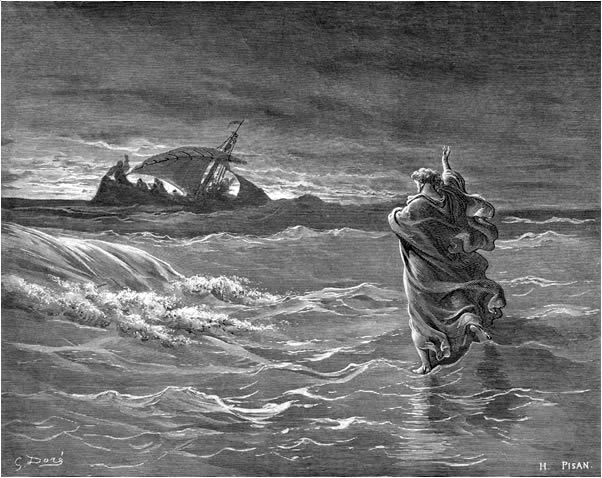
in Matthew 14“Come,” said Jesus. Then Peter got down out of the boat, walked on the water, and came toward Jesus.
BSB
The same verse in ASV and KJV ▾
ASV
And he said, Come. And Peter went down from the boat, and walked upon the waters to come to Jesus.
KJV
And he said, Come. And when Peter was come down out of the ship, he walked on the water, to go to Jesus.
⋯
This verse in Matthew 14
Commentary
14 notes on this verseLet those who think that the Lord's body was not real, because He walked upon the yielding waters as a light æthereal substance, answer here how Peter walked, whom they by no means deny to be man.
This site's exposition
bid me come unto thee on the water
on Matthew 14:28-31
Peter's request, bid me come unto thee on the water, is unique to Matthew among the Gospels, and the bench reads it as characteristic of the man, bold faith reaching past what the other eleven attempted. He walked on the water so long as his eyes stayed on the word that called him, and began to sink the moment he saw the wind boisterous, the fourth sounding of the little-faith refrain, O thou of little faith, wherefore didst thou doubt, spoken to a disciple in the very act of doing what no disciple had done before, faith enough to step out and too little to finish the walk.
The record, by era
The Church Fathers4 voices
(Serm. 76.) For in one Apostle, namely Peter, first and chief in the order of Apostles in whom was figured the Church, both kinds were to be signified; that is, the strong, in his walking upon the waters; the weak, in that he doubted, for to each of us our lusts are as a tempest. Dost thou love God? Thou walkest on the sea; the fear of this world is under thy feet. Dost thou love the world? It swallows thee up. But when thy heart is tossed with desire, then that thou mayest overcome thy lust, call upon the divine person of Christ.
Or; That Peter alone out of all the number of those that were in the vessel has courage to answer, and to pray that the Lord would bid him come to Him upon the waters, figures the frowardness of his will in the Lord's passion, when following after the Lord's steps he endeavoured to attain to despise death. But his fearfulness shows his weakness in his after trial, when through fear of death, he was driven to the necessity of denial. His crying out here is the groaning of his repentance there.
(Verse 28, 29.) But Peter, responding, said: Lord, if it is you, command me to come to you on the water. And he said: Come. In all places, Peter is found to have the most fervent faith. When the disciples were asked who they said Jesus, the Son of God, confesses. He prevents him from going to his passion, and although he may be mistaken in understanding, he is not mistaken in his feelings: not wanting him to die, whom he had confessed as the Son of God just a little while before. He is the first among the first to ascend the mountain with the Savior, and in his passion he alone follows, washing away with bitter tears the sin of denial that had descended from sudden fear. After the passion, when they were in the lake of Genesareth, fishing, and the Lord was standing on the shore, as others were slowly sailing, he did not allow any delays, but girding himself with his own girdle, he immediately threw himself into the waves. Therefore, with the same ardor of faith as always, now also, while others are silent, he believes that he can do by the will of the master what he could do by nature. Command me to come to you over the waters. You give the order, and immediately the waves will be still, and the body which is naturally heavy will become light. And when Peter descended from the boat, he walked on the water to come to Jesus. Those who think that the body of the Lord was not true, because he walked on soft waters, let them explain how Peter walked, whom they certainly will not deny to be a real human being.
A commentator
John ChrysostomHomily on the Gospel of Matthew 50 · Written in the 5th century.
proposed
"And he said, Come. And when Peter was come down out of the ship, he walked on the water, and came to Jesus. But when he saw the wind boisterous, he was afraid; and beginning to sink, he cried, saying, Lord, save me. And immediately Jesus stretched forth His hand and caught him, and saith unto him, O thou of little faith, wherefore didst thou doubt?" This is more wonderful than the former. Therefore this is done after that. For when He had shown that He rules the sea, then He carries on the sign to what is yet more marvellous. Then He rebuked the winds only; but now He both walks Himself, and permits another to do so; which thing if He had required to be done at the beginning, Peter would not have so well received it, because he had not yet acquired so great faith. Wherefore then did Christ permit him? Why, if He had said, "thou canst not," Peter being ardent would have contradicted Him again. Wherefore by the facts He convinces him, that for the future he may be sobered. But not even so doth he endure. Therefore having come down, he becomes dizzy; for he was afraid. And this the surf caused, but his fear was wrought by the wind. Peter then having come down from the ship went unto Him, not rejoicing so much in walking on the water, as in coming unto Him. And when he had prevailed over the greater, he was on the point of suffering evil from the less, from the violence of the wind, I mean, not of the sea. For such a thing is human nature; not seldom effecting great things, it exposes itself in the less; as Elias felt toward Jezebel, as Moses toward the Egyptian, as David toward Bathsheba. Even so then this man also; while their fear was yet at the height, he took courage to walk upon the water, but against the assault of the wind he was no longer able to stand; and this, being near Christ. […]
The Medieval Church1 voice
Then the sign is presented; hence he said come. And Peter going down out of the boat, walked upon the water to come to Jesus. And this is against the Manicheans who said that Christ did not have a true body; because if Christ did …
7 more voices on this verse
The Medieval Church1 voice
The Lord laid the sea down beneath Peter's feet, revealing His power. See how Peter prevailed over that which was greater, the sea, but was afraid of the lesser peril, the wind; such is the weakness of human nature. And it was as soon as …
The Puritans and the Awakening1 voice
And he said, come,....
The Nineteenth Century5 voices
Peter - walked on the water - However impossible the thing commanded by Christ may appear, it is certain he will give power to accomplish it to those who receive his word by faith; but we must take care never to put Christ’s power to the proof for the gratification of a vain curiosity; or even for the strengthening of our faith, when the ordinary means for doing that are within our reach.
The history contained in these verses is one of singular interest. The miracle here recorded brings out in strong light the character both of Christ and his people. The power and mercy of the Lord Jesus, and the mixture of faith and unbelief in his best disciples, are beautifully illustrated. We learn in the first place, from this miracle what absolute dominion our Saviour has over all created things. We see him “walking on the sea,” as if it was dry land.
A commentator
Charles Spurgeon1834–1892
The Metropolitan Tabernacle Pulpit, Sermon No. 3562: “Peter Walking on the Sea” (lightly modernized text, CCEL edition) · Written before 1892.
A FEW reflections will be sure to cross the mind of any thoughtful reader of this narrative. I. THE MIXED CHARACTER OF THE BELIEVER'S EXPERIENCE is here very palpably suggested to us. Peter was undoubtedly a bold believer in Jesus Christ. He addresses his Master devoutly, calling Him, "Lord"—a name of reverence, the use of which evidences the change that had been worked in his character, and the obedient spirit it had produced. But the misgivings implied in that, "if—"if it is You"—savors rather of unbelief!
The history contained in these verses is one of singular interest. The miracle here recorded brings out in strong light the character both of Christ and his people. The power and mercy of the Lord Jesus, and the mixture of faith and unbelief in his best disciples, are beautifully illustrated. We learn in the first place, from this miracle what absolute dominion our Saviour has over all created things. We see him “walking on the sea,” as if it was dry land. Those angry waves, which tossed the ship of his disciples to and fro, obey the Son of God and become a solid floor under his feet. That liquid surface, which was agitated by the least breath of wind, bears up the feet of our Redeemer like a rock. To our poor, weak minds, the whole event is utterly incomprehensible. The picture of two feet walking on the sea is said by Doddridge to have been the Egyptian emblem of an impossible thing; the man of science will tell us that for material flesh and blood to walk on water is a physical impossibility. Even for us to know that it was done. Enough for us toremember that to him who created the seas at the beginning, it must have been perfectly easy to walk over their waves when he pleased. There is encouragement here for all true Christians. Let them know that there is nothing created which is not under Christ’s control: all things serve him. He may allow his people to be tried for a season, and to be tossed to and fro by storms of trouble; he may be later than they wish in coming to their aid, and not draw near till the “fourth watch of the night:” but never let them forget that winds, and waves and storms are all Christ’s servants. They cannot move without Christ’s permission. “The lord on high is mightier tha the voice of many waters, yea than the mighty waves of the sea.” ( Psalm 93:4 ).
A commentator
Charles Spurgeon1834–1892
The Metropolitan Tabernacle Pulpit, Sermon No. 3562: “Peter Walking on the Sea” (lightly modernized text, CCEL edition) · Written before 1892.
proposed
A FEW reflections will be sure to cross the mind of any thoughtful reader of this narrative. I. THE MIXED CHARACTER OF THE BELIEVER'S EXPERIENCE is here very palpably suggested to us. Peter was undoubtedly a bold believer in Jesus Christ. He addresses his Master devoutly, calling Him, "Lord"—a name of reverence, the use of which evidences the change that had been worked in his character, and the obedient spirit it had produced. But the misgivings implied in that, "if—"if it is You"—savors rather of unbelief! And yet we find this hesitancy immediately followed by an expression of such strong confidence that we marvel at the request he uttered, "Bidme come to You on the water."Then cheered by the Lord's prompt answer, "Come," we find him showing his courage by descending from the vessel, setting foot on the sea and actually walking on the water! Thus did he participate in the wonder which Christ worked and share in the miracle of subduing the elements. His valor, however, soon evaporates. For, "when he saw that the wind was boisterous, he was afraid." The faith that buoyed him up gave place to a fear that bowed him down. He who was walking on the liquid wave, one instant, is sinking beneath the surge the next! The gallant cry, "Bid me come to You on the water," is quickly exchanged for the grievous wail, "Lord, save me!" So great his pluck, so dire his panic! And is this a common experience? Are all God's people thus subject to changes—alternating between calm trust and cowardly fear? Can they be neither one thing or the other—neither altogether believing or totally unbelieving? We think it is even so. We will not say how much frailty of the creature is mixed up with fealty to Christ in the best of men, nor how far the Grace of God may protect us from the guilt of double-dealing in the conduct of our lives.
The words behind it
20 Greek wordsEvery Greek word of this verse in the order it stands, with what it means and the door to its own study. The last column counts the times a word stands in the whole Bible: the rarer the word, the more the places it appears belong together.
| Greek | Sound | Meaning | Word study | In the Bible |
|---|---|---|---|---|
| ὁ | ho | <the> | G3588 → | 19766 times |
| δὲ | de | And | G1161 → | 2765 times |
| εἶπεν· | eipen | He said; | G2036 → | 925 times |
| ἐλθέ. | elthe | do come. | G2064 → | 628 times |
| καὶ | kai | And | G2532 → | 9120 times |
| καταβὰς | katabas | having descended | G2597 → | 81 times |
| ἀπὸ | apo | from | G575 → | 640 times |
| τοῦ | tou | the | G3588 → | 19766 times |
| πλοίου | ploiou | boat | G4143 → | 67 times |
| ὁ | ho | <the> | G3588 → | 19766 times |
| Πέτρος | petros | Peter | G4074 → | 155 times |
| περιεπάτησεν | periepatesen | walked | G4043 → | 94 times |
| ἐπὶ | epi | upon | G1909 → | 883 times |
| τὰ | ta | the | G3588 → | 19766 times |
| ὕδατα | hudata | water | G5204 → | 76 times |
| καὶ | kai | and | G2532 → | 9120 times |
| ἦλθεν | elthen | came | G2064 → | 628 times |
| πρὸς | pros | to | G4314 → | 700 times |
| τὸν | ton | <the> | G3588 → | 19766 times |
| Ἰησοῦν. | iesoun | Jesus. | G2424 → | 908 times |
ὁ<the>
hoG3588 →19766 times
δὲAnd
deG1161 →2765 times
εἶπεν·He said;
eipenG2036 →925 times
ἐλθέ.do come.
eltheG2064 →628 times
καὶAnd
kaiG2532 →9120 times
καταβὰςhaving descended
katabasG2597 →81 times
ἀπὸfrom
apoG575 →640 times
τοῦthe
touG3588 →19766 times
πλοίουboat
ploiouG4143 →67 times
ὁ<the>
hoG3588 →19766 times
ΠέτροςPeter
petrosG4074 →155 times
περιεπάτησενwalked
periepatesenG4043 →94 times
ἐπὶupon
epiG1909 →883 times
τὰthe
taG3588 →19766 times
ὕδαταwater
hudataG5204 →76 times
καὶand
kaiG2532 →9120 times
ἦλθενcame
elthenG2064 →628 times
πρὸςto
prosG4314 →700 times
τὸν<the>
tonG3588 →19766 times
Ἰησοῦν.Jesus.
iesounG2424 →908 times
A shaded row is a word that stands 400 times or fewer in the Bible.
The walk
8 stopsEach card is a verse this one points to, and under it the verses that one points to in turn. Where several paths arrive at the same place, that place is listed first: the text keeps returning to it.
Through
Philippians 4:13I can do all things through Christ who gives me strength.
it leads to
- Isaiah 41:10
Do not fear, for I am with you; do not be afraid, for I am your God. I will strengthen you; I will surely help you; I will uphold you with My right hand…
- 2 Corinthians 12:9–10
But He said to me, “My grace is sufficient for you, for My power is perfected in weakness.” Therefore I will boast all the more gladly in my weaknesses, so that the power of…
- Colossians 1:11
being strengthened with all power according to His glorious might so that you may have full endurance and patience, and joyfully
- Ephesians 6:10
Finally, be strong in the Lord and in His mighty power.
- Isaiah 40:29–31
He gives power to the faint and increases the strength of the weak.
- Isaiah 41:10
Through
Mark 9:23“If You can?” echoed Jesus. “All things are possible to him who believes!”
it leads to
- Matthew 17:20
“Because you have so little faith,” He answered. “For truly I tell you, if you have faith the size of a mustard seed, you can say to this mountain, ‘Move from here to there,’…
Reached by 2 separate paths from here.
- Matthew 21:21–22
“Truly I tell you,” Jesus replied, “if you have faith and do not doubt, not only will you do what was done to the fig tree, but even if you say to this mountain,…
Reached by 2 separate paths from here.
- John 11:40
Jesus replied, “Did I not tell you that if you believed, you would see the glory of God?”
- Matthew 17:20
Where this verse is studied
About Matthew
This page draws on 12 works. Open the list of works
This page draws on Adam Clarke, Commentary on the Bible; Augustine of Hippo, Catena Aurea by Aquinas; Charles Spurgeon, The Metropolitan Tabernacle Pulpit, Sermon No. 3562: “Peter Walking on the Sea” (lightly modernized text, CCEL edition); Hilary of Poitiers, Catena Aurea by Aquinas; J.C. Ryle, Expository Thoughts on the Gospels: Matthew; Jerome, Catena Aurea by Aquinas; Jerome, Commentary on Matthew; John Chrysostom, Homily on the Gospel of Matthew 50; John Gill, Exposition of the New Testament (1746-1748); Matthew Henry, Commentary on the Whole Bible; Theophylact of Ohrid, Commentary on Matthew and Thomas Aquinas, Commentary on Matthew.