

Job 1–42 · The Question of Suffering · Featured Study
Not Why, Who
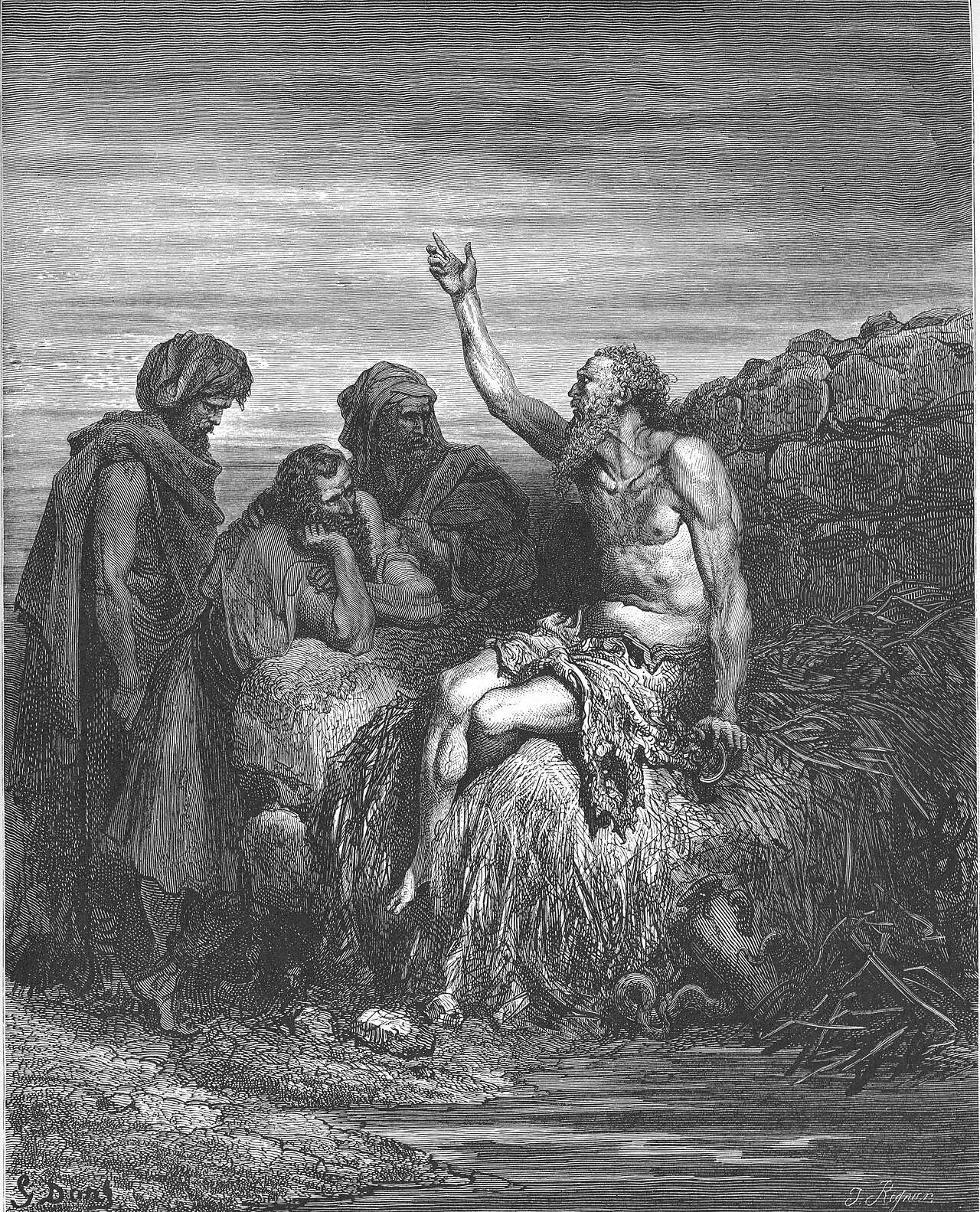
Job asks the question every generation asks: why do the righteous suffer? The book never answers it. Instead, three friends offer a tidy but false theology, Job demands a hearing he is never granted, and God finally speaks, not to explain the wager in heaven Job will die without ever learning of, but to unveil who He is. Job's own words end the question: not an argument won, but a Redeemer known.
Léon Bonnat, Job (1880) — Public domain, via Wikimedia Commons
Summary
This page walks through Job in order: the unseen wager, the friends' false theology, Job's rising cry for a mediator, and the whirlwind's questions. It closes with the epilogue's rebuke and restoration, and points to further reading beyond the page.
- The wager between God and the accuser happens in two scenes Job never learns of (Job 1:6-12 and 2:1-6).
- Job's cry for a mediator builds across three verses and peaks in his confession, “I know that my Redeemer liveth” (Job 19:25-27).
- God's answer from the whirlwind is over 70 questions, not one explanation.
- The epilogue rebukes the three friends by name and restores Job, but never tells him about the wager.
- Further reading points to Gregory the Great, C.S. Lewis, and D. Martyn Lloyd-Jones.
The Wager Job Never Learns
two court scenes, and a silence that never breaks
Before a word of the dialogue is spoken, the reader is let into a scene Job never sees: a heavenly council in which the accuser questions whether Job's righteousness is bought, and God stakes His own honor on it holding without a reward attached. The scene runs twice, escalating.
The satan questions whether Job's righteousness is bought: “doth Job fear God for nought?” God permits the first stripping: possessions and children, not Job's person.
Job 2:1–6The satan escalates: “skin for skin… touch his bone and his flesh.” God permits the second stripping: Job's own body, life spared. Job is never told either scene happened.
“The satan” here functions as an office within the divine council (the prosecutor, the tester), not yet the New Testament's fully personal, proper-named cosmic rebel; both readings hold together in MannaFest's posture (see the Contested Points on the book hub). Job dies without ever being told this scene happened.
Three Wrong Answers
the friends' retribution theology: confident, orthodox-sounding, and false
Eliphaz, Bildad, and Zophar argue from the same premise in different keys: suffering is the wages of sin, therefore Job's suffering proves hidden sin. The prologue has already told the reader this premise is false in Job's case; every speech below runs on dramatic irony.
“Who ever perished, being innocent?… they that plow iniquity, and sow trouble, reap the same.”
Job 4:7–8“Doth God pervert justice?… if thou wert pure and upright, surely now he would awake for thee.”
Job 8:3–6“Know therefore that God exacteth of thee less than thine iniquity deserveth… put away iniquity far from thy tent.”
Job 11:6, 14God's verdict, at the very end, is explicit and unsparing: “ye have not spoken of me the thing that is right, as my servant Job hath” (42:7). Elihu alone, of the four, is not named in that rebuke.
The Cry for a Mediator
three pleas, each louder than the last, climaxing in one confession
- 1
“There is no umpire betwixt us, that might lay his hand upon us both”: Job names what he lacks: an arbiter who can adjudicate between an infinite God and a finite man.
- 2Job 16:19–21the witness in heaven
“Even now, behold, my witness is in heaven… that he would maintain the right of a man with God, and of a son of man with his neighbor.” The plea sharpens: not just an arbiter, an advocate.
- 3Job 19:25–27go'el: kinsman-redeemer
“But as for me I know that my Redeemer liveth, and at last he will stand up upon the earth… Whom I, even I, shall see, on my side, and mine eyes shall behold, and not as a stranger.” The plea becomes a confession: Job expects to see his Vindicator with his own eyes.
“When Job had lost all his wealth and all his friends, yet he was not separated from Christ, nor cut off from his relation to him: ‘Still he is my Redeemer.’ That next kinsman adhered to him when all his other kindred forsook him, and he had the comfort of it.”
Matthew Henry, Commentary on the Whole Bible (1710), on Job 19:25 — public domain
Job asks for exactly what the New Testament declares exists: “there is one God, one mediator also between God and men, himself man, Christ Jesus” (1 Tim 2:5). Job's cry is answered, centuries later, by name.
The Whirlwind's Non-Answer
70+ unanswerable questions: a different question than the one Job asked
When God finally speaks, He never mentions the wager, never explains Job's suffering, and never answers why. Two speeches, overwhelmingly interrogative, argue from divine knowledge and power rather than propositional explanation, climaxing in the two largest exhibits, Behemoth and Leviathan.
Where wast thou when I laid the foundations of the earth?
Job 38:7The morning stars sang together, and all the sons of God shouted for joy — where wast thou?
Job 38:31Canst thou bind the cluster of the Pleiades, or loose the bands of Orion?
Job 39:1Knowest thou the time when the wild goats of the rock bring forth?
Job 40:9Hast thou an arm like God? Or canst thou thunder with a voice like him?
Job 41:1Canst thou draw out leviathan with a fish-hook?
Job answers twice, first in silence: ““Behold, I am insignificant. How can I reply to You? I place my hand over my mouth.” (40:4). Then in repentance: “My ears had heard of You, but now my eyes have seen You. Therefore I retract my words, and I repent in dust and ashes.”” (42:5–6). He repents not of hidden sin but of having spoken of what he did not understand.
Vindicated, Not Explained
the epilogue, and the reversal it does and does not give
God rebukes the three friends by name (not Elihu) for defending Him with a lie: “ye have not spoken of me the thing that is right, as my servant Job hath” (42:7). Job intercedes for them; his fortunes are restored double; three daughters are named where the sons are not (42:14–15); he dies old and full of days.
“God is about to be Job's Vindicator, but must first bring him to a right state of mind for receiving relief.”
Jamieson, Fausset & Brown, Commentary Critical and Explanatory on the Whole Bible (1871), on Job 38:2 — public domain
Nothing in the epilogue tells Job about the wager. The restoration answers his suffering; it does not explain it. What holds him, and what the book hands the reader, is not a settled ledger but a Redeemer known: “I know that my redeemer liveth.” The question of suffering does not get an answer in Job. It gets a Person.
Go Further Than This Page
the books that have carried this question: a free door for the oldest
Morals on the Book of Job (Moralia in Job)
Gregory the Great · c. 595
Thirty-five books on Job by the pope who read it as the church's manual of suffering, fourteen centuries later, still the deepest single well on this text.
READ IT FREE →The Problem of Pain
C.S. Lewis · 1940
The modern classic on this page's question (why a good God permits suffering), written with Lewis's gift for saying the hard thing plainly.
In print. Find it wherever books are sold.
Spiritual Depression: Its Causes and Cure
D. Martyn Lloyd-Jones · 1965
The pastoral companion: what the friends got wrong, done right: a physician-preacher walking sufferers out of the ash heap sermon by sermon.
In print. Find it wherever books are sold.
Word studies
The Hebrew and Greek under this study, each word in its own room.
Keep studying
By subject
On this page
Studies1
Symbols1
Words1
Go further1