
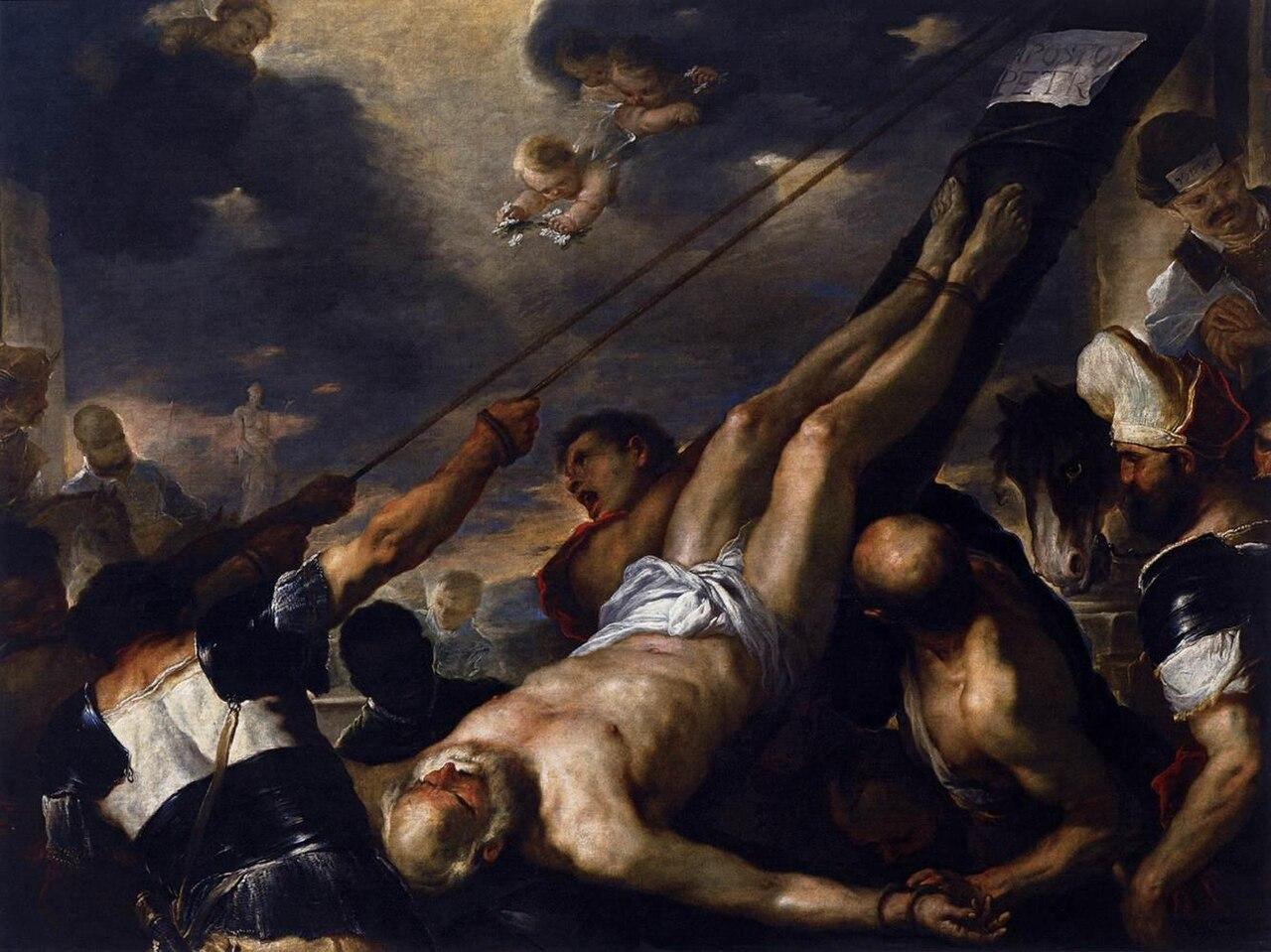
Luca Giordano, Crucifixion of Saint Peter, about 1660. Public domain.
John 21:18 to 19 · Story · Featured Study
The Death of Peter
After the resurrection Jesus told Peter how he would die, and the early church remembered him as a martyr.
Jesus said this to indicate the kind of death by which Peter would glorify God. And after He had said this, He told him, “Follow Me.”
- Where
- Rome
- Who
- Peter
- When
- the reign of Nero, by the early record (probable)
At the supper Peter promised to lay down his life for Jesus, and that same night he denied Him.
Summary
The earliest record of Peter's martyrdom is a letter sent from Rome about AD 97. Later writers say Peter died at Rome under Nero.
- Early readers took the stretched-out hands of John 21:18 as a sign of crucifixion.
- Later books, from the Acts of Peter to Jerome, say that Peter asked to hang head down.
- Two modern scholars, Michael Goulder and Otto Zwierlein, argue that Peter never went to Rome.
The Saying by the Sea
The saying stands in John's last chapter, after breakfast by the Sea of Tiberias.
Jesus had just asked Peter three times whether he loved Him, and each answer drew a charge to feed or shepherd His flock (John 21:15 to 17).
Truly, truly, I tell you, when you were young, you dressed yourself and walked where you wanted; but when you are old, you will stretch out your hands, and someone else will dress you and lead you where you do not want to go.”Jesus sets the freedom of Peter's youth beside an old age under another's hand.
In the verse that follows, John explains the saying with words he had used twice of Jesus' own death (John 12:33 and John 18:32).
The Witnesses in Order
Five writers, from Clement of Rome to Gaius, speak of Peter's death or of Peter at Rome.
Each witness adds to the record, from a martyrdom to the apostles' trophies at Rome.
- Clement of Rome, First Epistle to the Corinthians 5About AD 97, as the Ante-Nicene Fathers date itHe bore many labours, suffered martyrdom and went to his place of glory, with no city named.
- Ignatius of Antioch, Epistle to the Romans 4.3In Trajan's reign, by Eusebius's order of eventsIgnatius tells the Romans that he does not command them as Peter and Paul did.
- Dionysius of Corinth, Letter to the RomansWhen Soter was bishop of Rome, after about 165Peter and Paul taught together in Italy and were martyred at the same time.
- Irenaeus of Lyon, Against Heresies 3.1.1 and 3.3.2About AD 180Peter and Paul preached at Rome and founded and organized its church.
- Gaius of Rome, Disputation with ProclusAt the start of the third centuryThe trophies of the apostles stand at the Vatican and on the Ostian Way.
A timeline of five witnesses in their order, each with its work, its date and what it says of Peter.
What the Stretched-Out Hands Meant
Readers since Tertullian have heard a cross in the saying, and they read the binding in three ways.
Arms spread on the beam of a crossTertullian, Scorpiace 15; Augustine of Hippo, Tractates on John 123; Adam Clarke, Commentary on the Bible
“We read the lives of the Caesars: At Rome Nero was the first who stained with blood the rising faith. Then is Peter girt by another, when he is made fast to the cross.”
Tertullian · Scorpiace · on John 21:18Patristic
Augustine took the outstretched hands as crucifixion, and the leading as the walk to the place of death. Adam Clarke cited the scholar Wetstein for a Roman custom of the condemned.
In that custom a yoke was set on the neck, the arms were stretched out and fastened to it, and the prisoner was led through the city to the cross.
Bound to the crossJohn Wesley, Explanatory Notes upon the New Testament (1755); Albert Barnes, Notes on the New Testament
Wesley read the girding as the cords that held Peter to the cross until the nails were driven. Barnes added that the limbs of the crucified were often bound instead of nailed.
Bonds and prison before the endMatthew Henry, Commentary on the Whole Bible (1710)
Matthew Henry reported readers who took the girding as the chains and prisons of a man sentenced to death. On their reading the saying covers the whole road to the execution.
Rome Under Nero
The Roman historian who describes Nero's persecution names no apostle in it.
The Head-Downward Cross
Later sources add stories of Peter, among them a cross set head downward.
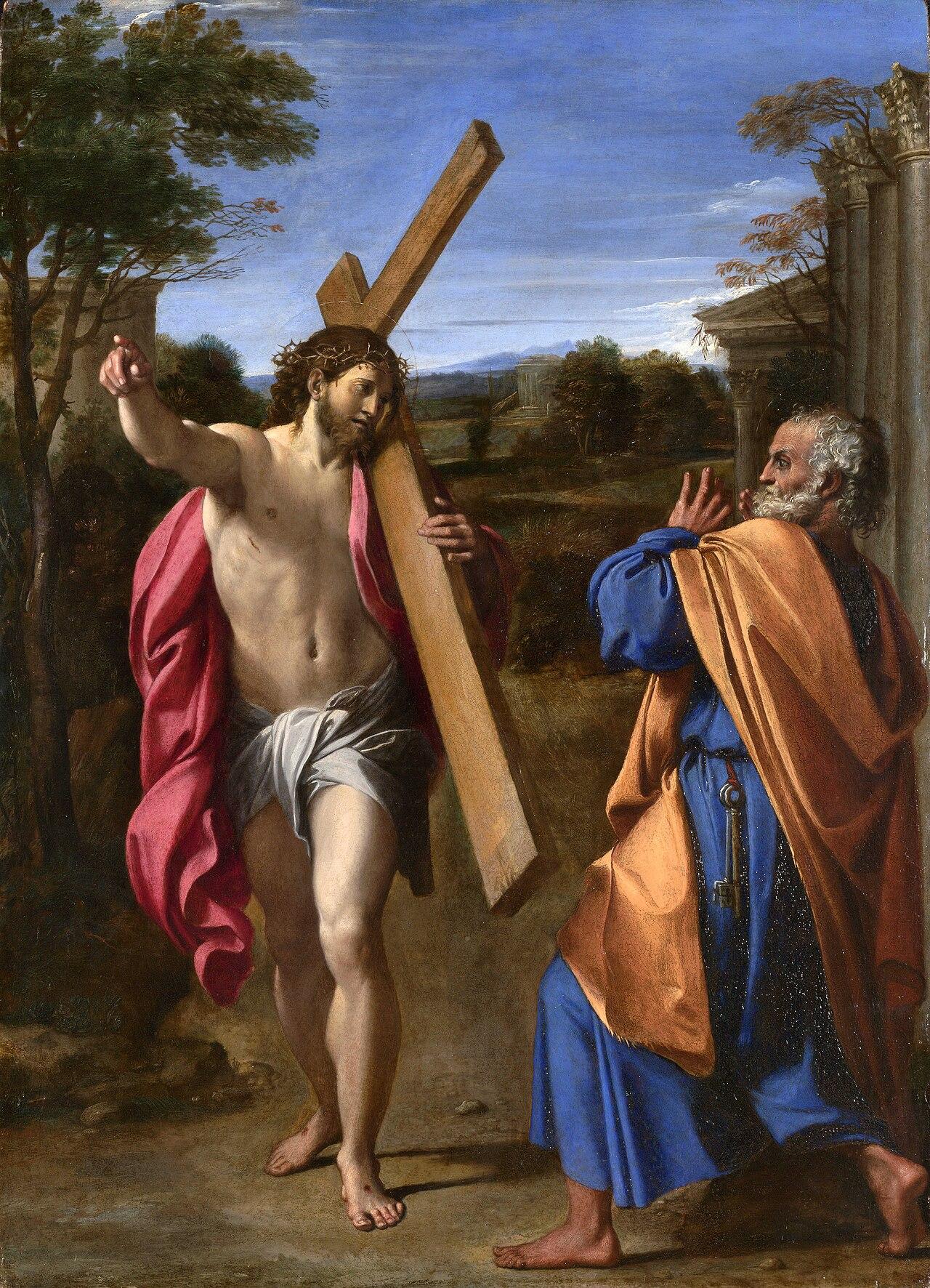
Annibale Carracci, Christ Appearing to Saint Peter on the Appian Way, between 1601 and 1602, National Gallery, London. Public domain; Wikimedia Commons, File:Domine, quo vadis.jpg.
Carracci painted the meeting on the road from the Acts of Peter, with keys hanging at Peter's belt.
The Acts of Peter tells of Peter's deeds at Rome. M. R. James, who translated it in 1924, judged it written not later than AD 200.
In it Peter leaves the city in disguise and meets the Lord on the road. The Lord says He is going into Rome to be crucified again, and Peter turns back.
Soldiers then bring Peter to Agrippa the prefect, who orders him crucified for godlessness. In the last chapter Nero blames Agrippa for putting Peter to death without his knowledge.
At the cross Peter asks the executioners to crucify him with his head downward. He calls the position a picture of the first man, who fell head downward.
Eusebius found the request in the third book of Origen's Commentary on Genesis.
“Peter appears to have preached in Pontus, Galatia, Bithynia, Cappadocia, and Asia to the Jews of the dispersion. And at last, having come to Rome, he was crucified head-downwards; for he had requested that he might suffer in this way.”
Eusebius of Caesarea · Church History (Book III), Chapter 1 · on John 21:18 to 19Patristic
Clement of Alexandria, as Eusebius quotes him, passed on a report that Peter saw his own wife led out to die. Peter called to her by name and told her to remember the Lord.
Jerome gave a reason for the request. Peter, he wrote, held himself unworthy to be crucified in the same manner as his Lord.
What the Record Leaves Unsaid
The New Testament foretells the death and never tells it.
No account by an eyewitness of Peter's death is known. Jerome, writing late in the fourth century, is the source of its year, the fourteenth year of Nero.
Following Him to the End
Augustine read Peter's death as the end of a road that began with his promise at the supper.
“Lord, where are You going?” Simon Peter asked. Jesus answered, “Where I am going, you cannot follow Me now, but you will follow later.”By the sea Jesus renews this call with the words Follow Me (John 21:19).
Augustine saw an order kept in the two sayings. Christ first died for Peter's salvation, and only then did Peter die for the preaching of Christ.
Chrysostom noticed that John wrote glorify God where he could have written die. To suffer for Christ, he taught, is glory and honour to the one who suffers.
Did Peter Die at Rome?
Three readings of the record are held today, each with its holders and an objection.
Martyred at RomeArthur Cushman McGiffert, notes on Eusebius (1890); Markus Bockmuehl, Scottish Journal of Theology 60 (2007)
Markus Bockmuehl holds that Jerome's account sums up the memory of the first two centuries, in the East and in the West. No other city, he notes, ever claimed Peter's martyrdom.
The objection: Michael Goulder answers that Clement's letter mentions neither Rome nor a martyrdom for Peter.
In Jerusalem, about AD 55Michael D. Goulder, Did Peter ever go to Rome?, Scottish Journal of Theology 57 (2004)
Goulder reads Paul and Acts as keeping Peter in Jerusalem after Easter, in charge of the mission to Palestine. He judges that Peter probably died in his bed in Jerusalem about AD 55.
The objection: Bockmuehl answers that Clement's letter still carries the Roman memory of the apostles' deaths, though it passes over the details.
A Roman story built from older textsOtto Zwierlein, Petrus in Rom (2009), with Pieter W. van der Horst's review (BMCR 2010)
Zwierlein argues that the earliest evidence for Peter at Rome dates from about AD 160 to 170. As van der Horst reports him, the later writers built the story by misreading older texts, John 21:18 to 19 among them.
The objection: McGiffert had argued that the early church could not have known of Peter's death without knowing where he died.
A Death That Glorified God
Peter's second letter has one line that looks back to the saying by the sea.
because I know that this tent will soon be laid aside, as our Lord Jesus Christ has made clear to me.The verse shows that Peter carried the saying with him to the end of his life.
Wesley wrote that the saints glorify God chiefly by suffering. He read the command Follow Me as one more sign of the death Peter would die.
Sources
Scripture is the Berean Standard Bible.
- Clement of Rome, First Epistle to the Corinthians 5, Ante-Nicene Fathers 1 (1885), with its introductory notice; and in J. B. Lightfoot's translation.
- Ignatius of Antioch, Epistle to the Romans 4.3, shorter recension, Ante-Nicene Fathers 1 (1885)
- Irenaeus of Lyon, Against Heresies 3.1.1 and 3.3.2, Ante-Nicene Fathers 1 (1885)
- Tertullian, Scorpiace 15 and The Prescription Against Heretics 36, Ante-Nicene Fathers 3.
- Eusebius of Caesarea, Church History 2.25.5 to 8 and 3.1.2 to 3, tr. A. C. McGiffert, Nicene and Post-Nicene Fathers, Second Series 1 (1890), with Dionysius of Corinth and Gaius quoted there.
- Arthur Cushman McGiffert, notes 542, 543 and 1082 to Eusebius, Church History, NPNF2 1 (1890)
- Lactantius, Of the Manner in Which the Persecutors Died 2, Ante-Nicene Fathers 7; with Jerome, Lives of Illustrious Men 80.
- Jerome, Lives of Illustrious Men 1, NPNF2 3.
- The Acts of Peter (Vercelli Acts) 33 to 41, tr. M. R. James, The Apocryphal New Testament (Oxford: Clarendon Press, 1924)
- Tacitus, Annals 15.44, tr. A. J. Church and W. J. Brodribb.
- Augustine of Hippo, Tractates on the Gospel of John 123.
- John Chrysostom, Homilies on the Gospel of John 88.
- Adam Clarke, Commentary on the Bible, on John 21:18.
- John Wesley, Explanatory Notes upon the New Testament (1755), on John 21:18 and 21:19.
- Albert Barnes, Notes, Explanatory and Practical, on John 21:18.
- Matthew Henry, Commentary on the Whole Bible (1710), on John 21:18.
- Michael D. Goulder, Did Peter ever go to Rome?, Scottish Journal of Theology 57.4 (2004), pages 377 to 396.
- Markus Bockmuehl, Peter's death in Rome? Back to front and upside down, Scottish Journal of Theology 60.1 (2007), pages 1 to 23.
- Otto Zwierlein, Petrus in Rom: die literarischen Zeugnisse (de Gruyter, 2009), with his English summary and Pieter W. van der Horst's review, BMCR 2010.03.25.
Keep Studying
Studies5
People and groups5
Places1
Go further3