
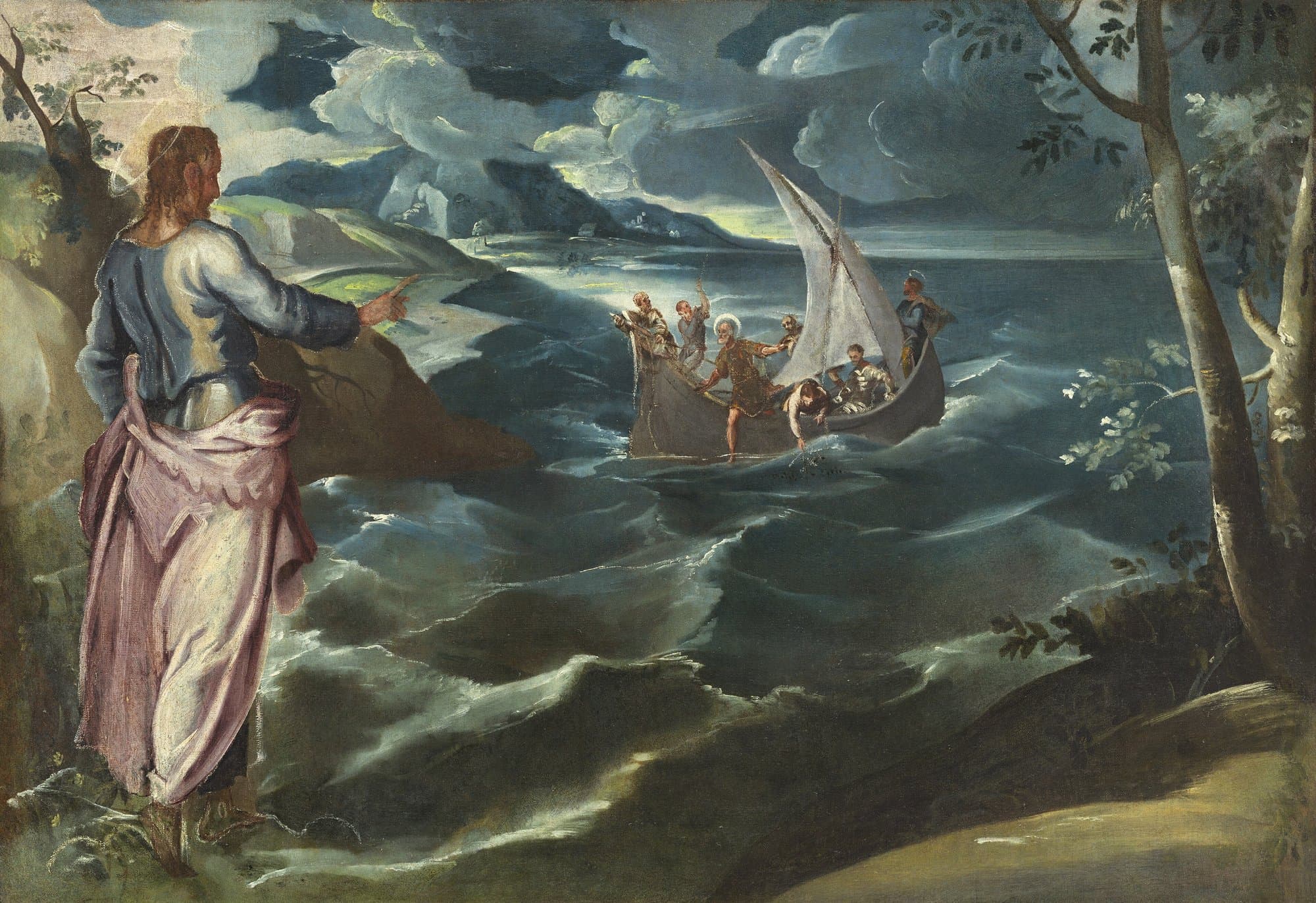
John 21 · Story · Failure and Restoration
Feed My Sheep
John 21:15 to 19 records what the risen Jesus said to Peter after breakfast by the Sea of Tiberias.
Each of Peter's three answers rested on what Jesus already knew of him.
Jesus asked a third time, “Simon son of John, do you love Me?” Peter was deeply hurt that Jesus had asked him a third time, “Do you love Me?” “Lord, You know all things,” he replied. “You know I love You.” Jesus said to him, “Feed My sheep.
- Where
- Sea of Galilee
- Who
- Jesus of Nazareth, Peter
Summary
Peter's fall was his own sin, the denial of the Lord he followed. After the resurrection Jesus met him by the Sea of Tiberias, questioned him about his love, and entrusted His flock to him. The restoration began at the Lord's initiative, at a breakfast He had prepared on the shore.
- Before the arrest Peter promised to lay down his life for Jesus, and Jesus foretold that he would deny Him three times before the rooster crowed (John 13:37 to 38).
- In the courtyard of the high priest Peter denied three times that he was a disciple of Jesus (John 18:17 and John 18:25 to 27).
- Jesus foretold that Peter would die in old age by a death that would glorify God, and then told him to follow (John 21:18 to 19).
- Adam Clarke and Albert Barnes took the threefold question as an answer to the threefold denial, while Augustine and Clarke divide over whether the two Greek verbs for love differ.
Peter after the Denial
John 21 is the last chapter of the Gospel of John.
Failure and restoration, the trial this study belongs to, asks what becomes of a believer after a fall of his own making. In the Gospels Peter's denial of Jesus on the night of the arrest is such a fall, and John 21 records how the risen Lord met him afterward.
This study answers how Jesus restored Peter and what the restoration gave him. It follows the scene from the breakfast on the shore to the call to follow, and it gives the readings of two disputed questions with the teachers who hold them.
On the night of the supper Jesus had already told Peter, "I have prayed for you, Simon, that your faith will not fail. And when you have turned back, strengthen your brothers" (Luke 22:32).
Seven disciples went fishing on the Sea of Tiberias and caught nothing that night (John 21:2 to 3). Early in the morning Jesus, whom they did not yet recognize, told them where to cast the net, and they hauled in 153 large fish (John 21:4 to 11). They came ashore to a charcoal fire with fish on it and bread, and Jesus gave them breakfast (John 21:9 to 13).
The Greek word for that fire, anthrakia, stands in the New Testament only here and at John 18:18, where Peter warmed himself among the high priest's servants on the night he denied Jesus. The Cambridge Bible for Schools and Colleges points out the two places in its note on John 21:9.
Three Denials and Three Questions
John 18 and John 21 each record three exchanges.
Three times Peter said "I am not," and three times he answered "You know I love You."
| Turn | The denial in John 18 | The question in John 21 | The charge |
|---|---|---|---|
| 1 | John 18:17: "I am not," he answered. | John 21:15: "Simon son of John, do you love Me more than these?" | "Feed My lambs." |
| 2 | John 18:25: He denied it and said, "I am not." | John 21:16: "Simon son of John, do you love Me?" | "Shepherd My sheep." |
| 3 | John 18:27: Peter denied it once more, and immediately a rooster crowed. | John 21:17: "Do you love Me?" | "Feed My sheep." |
The charges use two Greek verbs. Boskō, to pasture, stands in John 21:15 and John 21:17, and poimainō, to tend as a shepherd, stands in John 21:16. The Cambridge Bible reads poimainō as guidance and oversight of the flock as well as feeding.
The Story Told in Order
The scenes of John 21:15 to 19 are told one by one with their verses.
Jesus asked whether Peter loved Him more than theseJohn 21:15
Readers have asked what the word these points to in the first question. Albert Barnes wrote in his Notes that it may refer to "his boat, his fishing utensils, and his employments" or to the other apostles.
Adam Clarke, in his Commentary on the Bible, called the question "a kind of reproach to Peter" for the boast he had made before the arrest.
Peter said to Him, “Even if all fall away on account of You, I never will.”Peter's boast that he alone would stand is the profession Clarke heard behind the first question.
The second question dropped the comparisonJohn 21:16
Jesus asked a second time without the words more than these. Jamieson, Fausset and Brown read the change as tenderness and wrote that "Peter's silence on that point was confession enough of his sin and folly."
The third question grieved PeterJohn 21:17
John's word for Peter's hurt is lupeō, to distress or to grieve.
Adam Clarke, citing Chrysostom, wrote that Peter was grieved "lest Christ saw something in his heart which he saw not himself, and which might lead to another fall".
Jesus spoke of stretched-out hands and called Peter to followJohn 21:18 to 19
Truly, truly, I tell you, when you were young, you dressed yourself and walked where you wanted; but when you are old, you will stretch out your hands, and someone else will dress you and lead you where you do not want to go.” Jesus said this to indicate the kind of death by which Peter would glorify God. And after He had said this, He told him, “Follow Me.”The charge to feed the sheep is followed at once by the cost it would bring Peter, so the restoration carries a death with it.
On the night of the supper Jesus had told Peter, "Where I am going, you cannot follow Me now, but you will follow later" (John 13:36).
Near the end of his life Peter wrote that his death was near, "as our Lord Jesus Christ has made clear to me" (2 Peter 1:14).
A teacher of the early church read the girding of John 21:18 as fulfilled in Peter's martyrdom.
“We read the lives of the Caesars: At Rome Nero was the first who stained with blood the rising faith. Then is Peter girt by another, when he is made fast to the cross.”
Tertullian · Scorpiace · on John 21:18Patristic
What the Text Leaves Unsaid
Two things a reader may want to know are left untold in the account.
The risen Lord had already appeared to Peter on his own (Luke 24:34 and 1 Corinthians 15:5), and neither account records what passed between them.
In John 21:15 to 17 neither Jesus nor Peter names the denial, and John adds no comment of his own on why the question came three times.
Teachers on Peter's Restoration
Jerome joined Peter's weeping to the charge he was given.
died 420 · Jerome
LETTER 38.1
The quotation1 quotation
“If the faith of the apostle Peter is shaken by his Lord's passion, it is so that with bitter weeping he may hear the soothing words ‘Feed my sheep.’”
Jerome · LETTER 38.1 · on John 21:16Patristic
Three Times and Two Verbs
Teachers have asked why the question came three times and whether its two verbs for love differ.
The three questions answer the three denialsAdam Clarke; Albert Barnes
Adam Clarke wrote that "Peter had thrice denied his Lord, and now Christ gives him an opportunity in some measure to repair his fault by a triple confession."
Albert Barnes judged in his Notes that "It is probable that Jesus proposed this question three times because Peter had thrice denied him."
The repetition shows the weight of the chargeJohn Chrysostom, Homilies on John 88
John Chrysostom, in his Homilies on John as the Catena Aurea gathers them, wrote that the question came a third time "to show of what importance He esteems the superintendence of His own sheep".
Agapaō and phileō differ in sense hereAdam Clarke; the Cambridge Bible for Schools and Colleges
Clarke held that agapaō "signifies to love affectionately, ardently, supremely, perfectly".
He took phileō to signify "to love, to like, to regard, to feel friendship for another."
The Cambridge Bible notes that in the third question Jesus took up phileō, Peter's own word, and reads Peter's grief as his response to it.
Agapaō and phileō as synonyms in John 21Augustine of Hippo, Tractates on John 123
Augustine wrote that the passage shows "that love and liking are one and the same thing; for the Lord also in the last question said not Diligis me? but, Amas me?"
Shepherd God's Flock
Peter's first letter closes with a word to the elders of the churches.
Peter wrote to the elders as a fellow elder and a witness of Christ's sufferings (1 Peter 5:1).
Be shepherds of God’s flock that is among you, watching over them not out of compulsion, but because it is God’s will; not out of greed, but out of eagerness;Peter charges the elders with poimainō, the verb of the second charge in John 21:16, so the work given to him on the shore passed through him to others.
Sources
Scripture is the Berean Standard Bible.
- STEP Bible, the Translators Amalgamated Greek New Testament (TAGNT), Tyndale House, Cambridge, CC BY 4.0, with Strong's numbers, morphology, glosses and transliterations.
- STEP Bible, the Brief lexicon of Extended Strongs for Greek (TBESG), Tyndale House, Cambridge, CC BY 4.0.
- Cambridge Bible for Schools and Colleges, The Gospel According to St John, on John 21:9, 21:16 and 21:17.
- Albert Barnes, Notes, Explanatory and Practical, on the New Testament, on John 21:15 and 21:17.
- Adam Clarke, Commentary on the Bible (1832), on John 21:15 and 21:17.
- Robert Jamieson, A. R. Fausset and David Brown, Commentary Critical and Explanatory on the Whole Bible (1871), on John 21:16.
- John Chrysostom, Homilies on the Gospel of John, 88, as Thomas Aquinas gathers it in the Catena Aurea on John 21:17.
- Augustine of Hippo, Tractates on the Gospel of John, 123.
- Jerome, Letter 38.
- Tertullian, Scorpiace.
Keep Studying
Read it1
Studies1
In this trial6
People and groups8
Places1
Values1
Doctrines2