
Matthew 5:37 · Passage · Truthfulness
Let Your Yes Be Yes
Matthew 5:33 to 37 is the teaching of the Sermon on the Mount on oaths, and James 5:12 gives the same command.
A court's oath, an oath of allegiance and a careless vow have all been weighed against these five verses.
Simply let your ‘Yes’ be ‘Yes,’ and your ‘No,’ ‘No.’ Anything more comes from the evil one.
- The passage
- Matthew 5:33 to 37, James 5:12
- Books
- Matthew, James
- Hold in memory
- Matthew 5:37, James 5:12
Summary
In the Sermon on the Mount Jesus sets His own word beside rules His hearers had received, and one of those rules concerned oaths and vows. Jesus told His disciples not to swear at all. He named four oaths His hearers used and gave a reason against each. The church has since divided over whether the command forbids every oath, a court's included, or the careless and evasive oath.
- The law required a man who swore an oath to do everything he had promised (Numbers 30:2).
- Jesus rejected a teaching of the scribes and Pharisees that some oaths bound the swearer and others did not (Matthew 23:16 to 22).
- James gives the command to the believers he wrote to and ties the plain word to escaping judgment (James 5:12).
- Jesus answered when the high priest put Him under oath at His trial (Matthew 26:63 to 64).
The Rule of the Ancients
Matthew 5:33 quotes the rule that Matthew 5:34 to 37 answers.
Let Your Yes Be Yes is a study of the oath and of the plain word Jesus set in its place. It belongs to the value of truthfulness because it asks a disciple's ordinary speech to carry the weight that others gave to an oath.
The question the study answers is what Jesus forbade when He said not to swear at all, and why. It sets out the four oaths He named and the law and the practice behind them. It then gives the two renderings of His last words, the same command in James, the two readings the church has held and the account of Jesus before the high priest.
Again, you have heard that it was said to the ancients, ‘Do not break your oath, but fulfill your vows to the Lord.’Jesus begins from a rule His hearers knew, which forbade a broken oath and required a vow to the Lord to be paid.
Matthew sets the saying after the words on divorce (Matthew 5:31 to 32) and before the words on revenge (Matthew 5:38 to 42).
The Four Oaths Jesus Names
Three of the four reasons Jesus gives echo words of Isaiah and of a psalm.
Every oath Jesus names reaches God through the thing it swears by.
| Row | Oath or source | The reason or the text | Verse |
|---|---|---|---|
| 1 | Heaven | "for it is God’s throne" | Matthew 5:34 |
| 2 | The earth | "for it is His footstool" | Matthew 5:35 |
| 3 | Jerusalem | "for it is the city of the great King" | Matthew 5:35 |
| 4 | One's own head | "for you cannot make a single hair white or black" | Matthew 5:36 |
| 1a | The prophet's words behind rows 1 and 2 | "Heaven is My throne, and earth is My footstool." | Isaiah 66:1 |
| 3a | The psalm's words behind row 3 | "Mount Zion, the city of the great King" | Psalm 48:2 |
The Law Behind the Saying
Leviticus and Deuteronomy give the rule that Matthew 5:33 sums up.
You must not swear falsely by My name and so profane the name of your God. I am the LORD.The law forbade a false oath because an oath sworn in the LORD's name made Him its witness.
Deuteronomy set a vow beside the freedom not to make one: "But if you refrain from making a vow, you will not be guilty of sin" (Deuteronomy 23:22).
Yes, No and the Evil One
Translators and commentators divide over the last words of Matthew 5:37.
The Greek of the close reads ek tou ponerou, a form that serves for evil as a thing or for the evil one as a person. The American Standard Version of 1901 renders it "is of the evil one".
Jamieson, Fausset and Brown (1871) read the words as evil in general. They granted that "of the evil one" is "an equally correct rendering of the words, and one which some expositors prefer".
When I planned this, did I do it carelessly? Or do I make my plans by human standards, so as to say “Yes, yes” when I really mean “No, no”? But as surely as God is faithful, our message to you is not “Yes” and “No.”Paul uses the doubled yes and no of the saying to defend his own word to the Corinthians, which God's faithfulness stands behind.
Oaths That Did Not Bind
Matthew 23 and a nineteenth-century commentator describe the practice Jesus opposed.
In His woes He quoted the teaching He opposed. It held that "If anyone swears by the temple, it means nothing; but if anyone swears by the gold of the temple, he is bound by his oath" (Matthew 23:16).
So then, he who swears by the altar swears by it and by everything on it. And he who swears by the temple swears by it and by the One who dwells in it. And he who swears by heaven swears by God’s throne and by the One who sits on it.Jesus answers the rule by tracing the altar, the temple and heaven to the One who sits enthroned over them.
Adam Clarke, in his Commentary on the Bible (1832), wrote on James 5:12 that the Jews were "notoriously guilty of common swearing". He held it "sufficiently proved" that their oaths by heaven, earth, Jerusalem, the temple, the altar and parts of the body were not considered binding.
The Same Command in James
James gives the command in the closing chapter of his letter.
Above all, my brothers, do not swear, not by heaven or earth or by any other oath. Simply let your “Yes” be yes, and your “No,” no, so that you will not fall under judgment.The verse stands here because James widens Jesus' list of oaths to any other kind.
The verses before it ask the readers to be patient "until the Lord’s coming" (James 5:7) and warn them that "the Judge is standing at the door" (James 5:9).
Matthew Henry, in his Commentary on the Whole Bible (1710), wrote on the verse that "All customary needless swearing is undoubtedly forbidden, and all along in scripture condemned, as a very grievous sin."
Voices on the Oath
Two fathers of the early church read the saying as a rule for the speech of every believer.
died 407 · John Chrysostom
John Chrysostom, in his eighth homily on Acts (fourth century), turns the command into church discipline for his own congregation.
Read the page on John Chrysostom
“Wherefore, with a loud and clear voice, I proclaim to all and testify, that those who are notorious for this transgression, who utter words which come ‘of the evil one,’ (for such is swearing,) shall not step over the threshold of the Church. Let this present month be the time allowed you for reforming in this matter. Talk not to me, ‘Necessity of business compels me to use oaths, else people do not believe me.’ To begin with this, retrench those oaths which come merely of habit.”
John Chrysostom · Homily on Acts 8 · on Matthew 5:37Patristic
died 420 · Jerome
Jerome, as the Catena Aurea gives him on Matthew 5:37, speaks for the reading that leaves the believer no oath at all.
“Therefore Evangelic verity does not admit an oath, since the whole discourse of the faithful is instead of an oath.”
Jerome · Catena Aurea by Aquinas · on Matthew 5:37Patristic
Does Jesus Forbid Every Oath?
A Quaker of the seventeenth century and two teachers of the Latin church answered the question in opposite ways.
A Christian takes no oath at allGeorge Fox
George Fox refused the oath of allegiance before the judges at Lancaster. His Journal records his words: "I never took an oath in my life, and Christ, the Saviour and Judge of the world, said, ‘Swear not at all.’"
The objection: Paul wrote "I call God as my witness" (2 Corinthians 1:23). He also wrote "I assure you before God that what I am writing to you is no lie" (Galatians 1:20), and the church received both letters as Scripture.
The oath is lawful, and the needless oath is forbiddenAugustine of Hippo; Thomas Aquinas
Augustine, as the Catena Aurea gives him on Matthew 5:34, wrote that "The Apostle has used oaths in his Epistles, and by this shows us how that ought to be taken". He read the command as a guard "lest by allowing ourselves to swear at all we come to readiness in swearing".
Thomas Aquinas, in the Summa Theologica (II-II, question 89, article 2), held that "an oath is in itself lawful and commendable". Hebrews speaks of the oath that "serves as a confirmation to end all argument" (Hebrews 6:16).
The objection: James 5:12 leaves no kind of oath outside his command, and Matthew 5:34 forbids swearing at all.
An Oath at the Trial
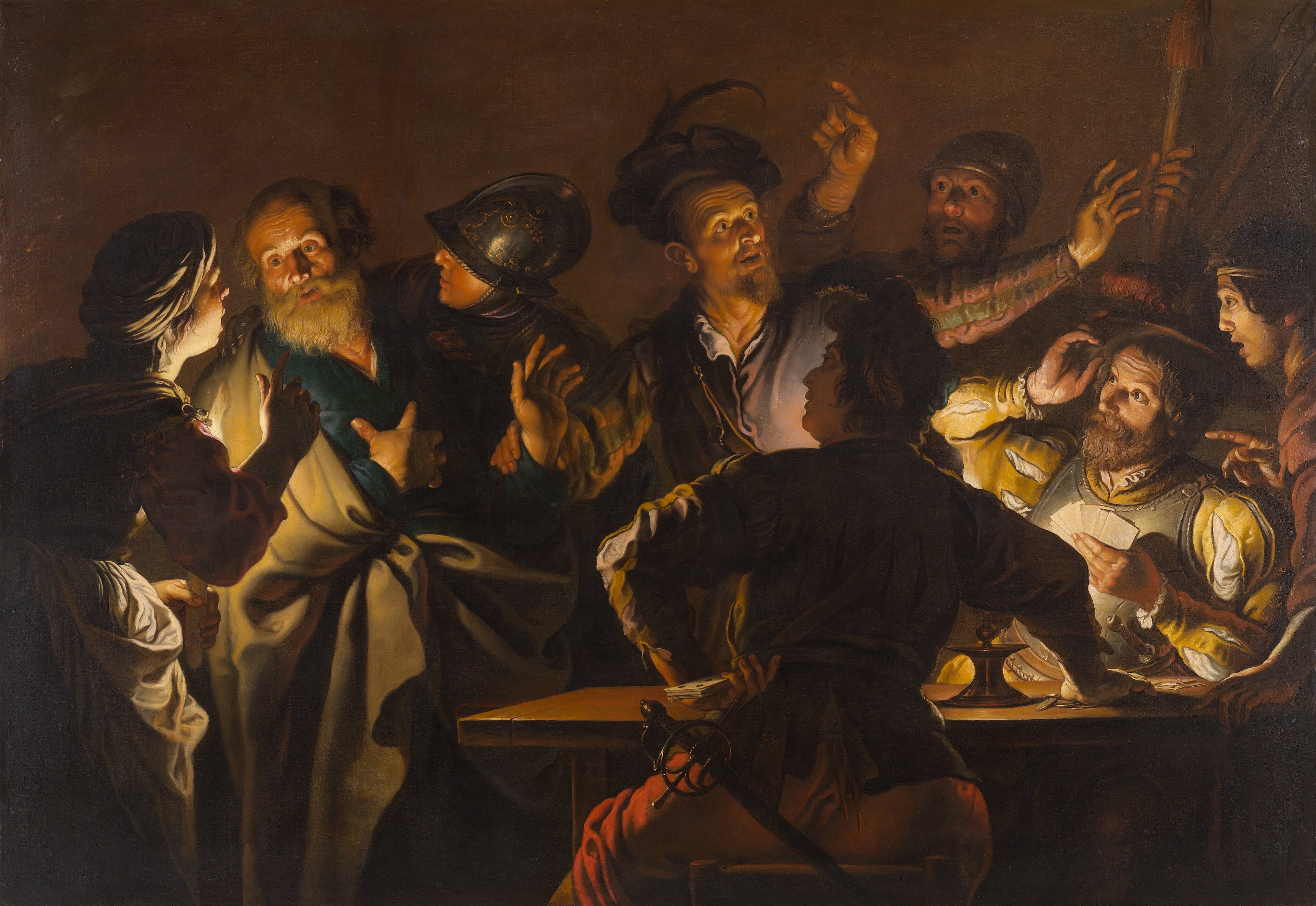
On the night of His arrest Jesus spoke under oath while Peter swore a false oath in the courtyard.
But Jesus remained silent. Then the high priest said to Him, “I charge You under oath by the living God: Tell us if You are the Christ, the Son of God.” “You have said it yourself,” Jesus answered. “But I say to all of you, from now on you will see the Son of Man sitting at the right hand of Power and coming on the clouds of heaven.”The charge came from the court that sought His death, and His reply stands as His testimony to who He is.
And again he denied it with an oath: “I do not know the man!”Peter added an oath to a lie, the use of an oath the saying of Matthew 5 had closed to the disciples.
The trial before the council and Peter's three denials are each taught in a study of their own.
Sources
Scripture is the Berean Standard Bible.
- The Holy Bible, American Standard Version (1901)
- STEP Bible, Translators Amalgamated Greek New Testament, the tagged Greek text (Tyndale House, Cambridge), CC BY 4.0.
- Robert Jamieson, A. R. Fausset and David Brown, Commentary Critical and Explanatory on the Whole Bible (1871), on Matthew 5:37.
- Adam Clarke, Commentary on the Bible (1832), on James 5:12.
- Matthew Henry, Commentary on the Whole Bible (1710), on James 5:12.
- John Chrysostom, Homilies on the Acts of the Apostles, Homily 8, Nicene and Post-Nicene Fathers, first series, vol. 11.
- Jerome on Matthew 5:37, in Thomas Aquinas, Catena Aurea, English translation (Oxford, 1841)
- Augustine on Matthew 5:34, in Thomas Aquinas, Catena Aurea, English translation (Oxford, 1841)
- George Fox, Journal, volume 2, edited by Norman Penney (London: Friends' Tract Association, 1901)
- Thomas Aquinas, Summa Theologica, II-II, question 89, article 2 (English translation, 1920)
Keep Studying
Studies5
In this value5
People and groups10
Places1
Doctrines1