
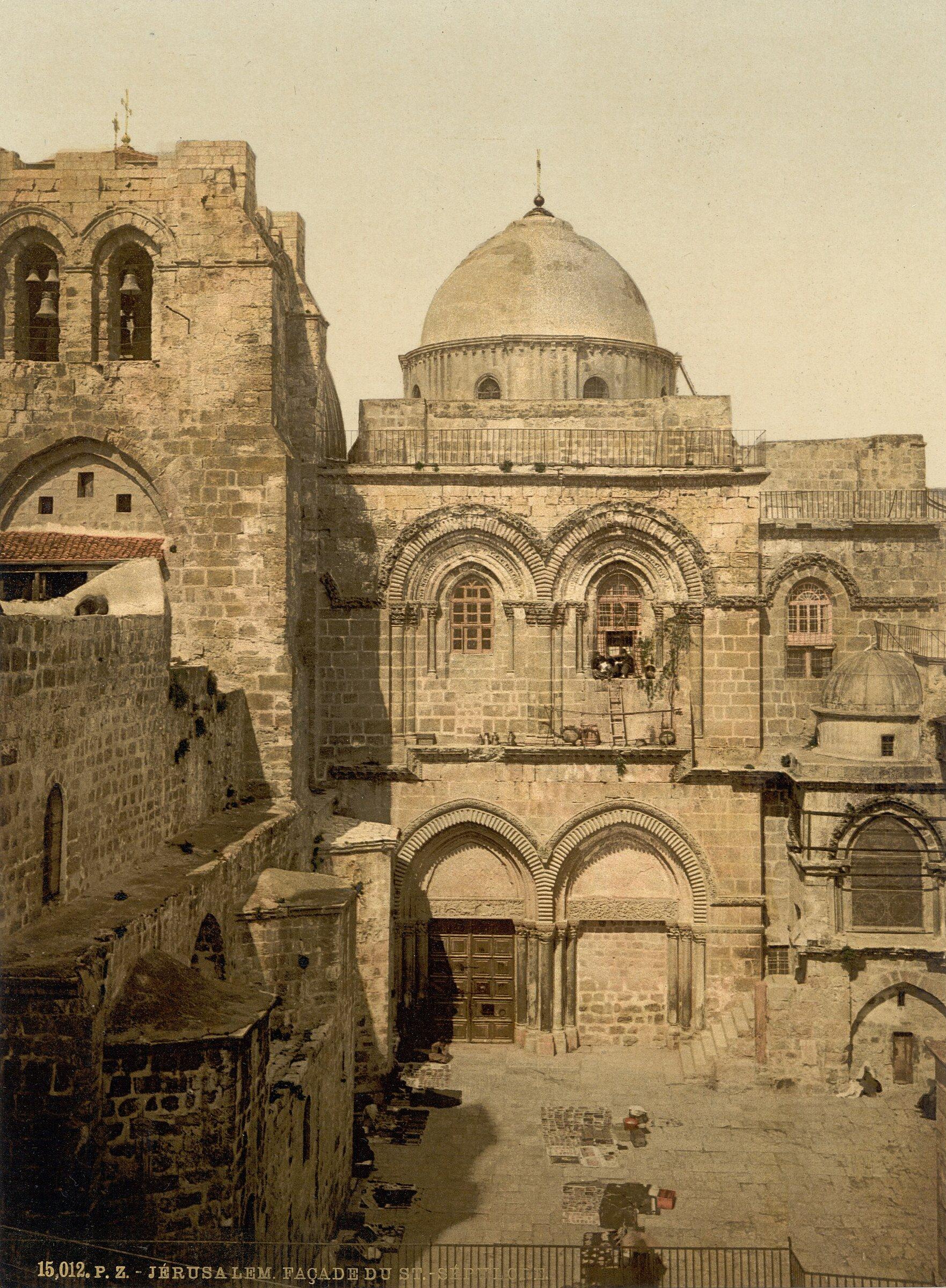
The Front of the Holy Sepulchre, photochrom print, 1890 to 1900. Public domain.
Matthew 27:33, Mark 15:22 and John 19:17 · Place · Featured Study
Golgotha
Jesus was crucified at Golgotha, the Place of the Skull, near Jerusalem and outside its gate.
Two sites are shown today, and each has its holders.
Carrying His own cross, He went out to The Place of the Skull, which in Hebrew is called Golgotha.
Carrying His own cross, He went out to The Place of the Skull, which in Hebrew is called Golgotha.
- Today
- Jerusalem, Old City and its north side
- Region
- Jerusalem
- Site
- 31.778, 35.230 (proposed)
- First named
- Matthew 27:33 “…came to a place called Golgotha, which means…”
- Last named
- John 19:17 “…which in Hebrew is called Golgotha.”
Summary
Matthew, Mark and John give the name Golgotha and translate it. Luke calls it The Skull. John says it was near the city, with a garden and a new tomb nearby, and Hebrews says Jesus suffered outside the city gate. Old writings and excavation bear on where the place stood.
- Three verses of the Berean text carry the name Golgotha.
- The Church of the Holy Sepulchre has been shown as the place since Constantine's builders uncovered a tomb there.
- The Garden Tomb north of the Damascus Gate was proposed in the nineteenth century.
The Name and the Place
Every Gospel names the place, and John says where it stood.
Matthew and Mark give the name Golgotha, the Place of the Skull, and Luke gives the meaning alone.
When they came to the place called The Skull, they crucified Him there, along with the criminals, one on His right and the other on His left.Many of the Jews read this sign, because the place where Jesus was crucified was near the city, and it was written in Hebrew, Latin, and Greek.Golgotha on the Plan of Jerusalem
The plan of the Baedeker guides, engraved by Wagner and Debes, is drawn at a scale of 1 to 8,350.
The two sites shown for Golgotha stand about six hundred meters apart, one inside the Old City wall and one outside it to the north.
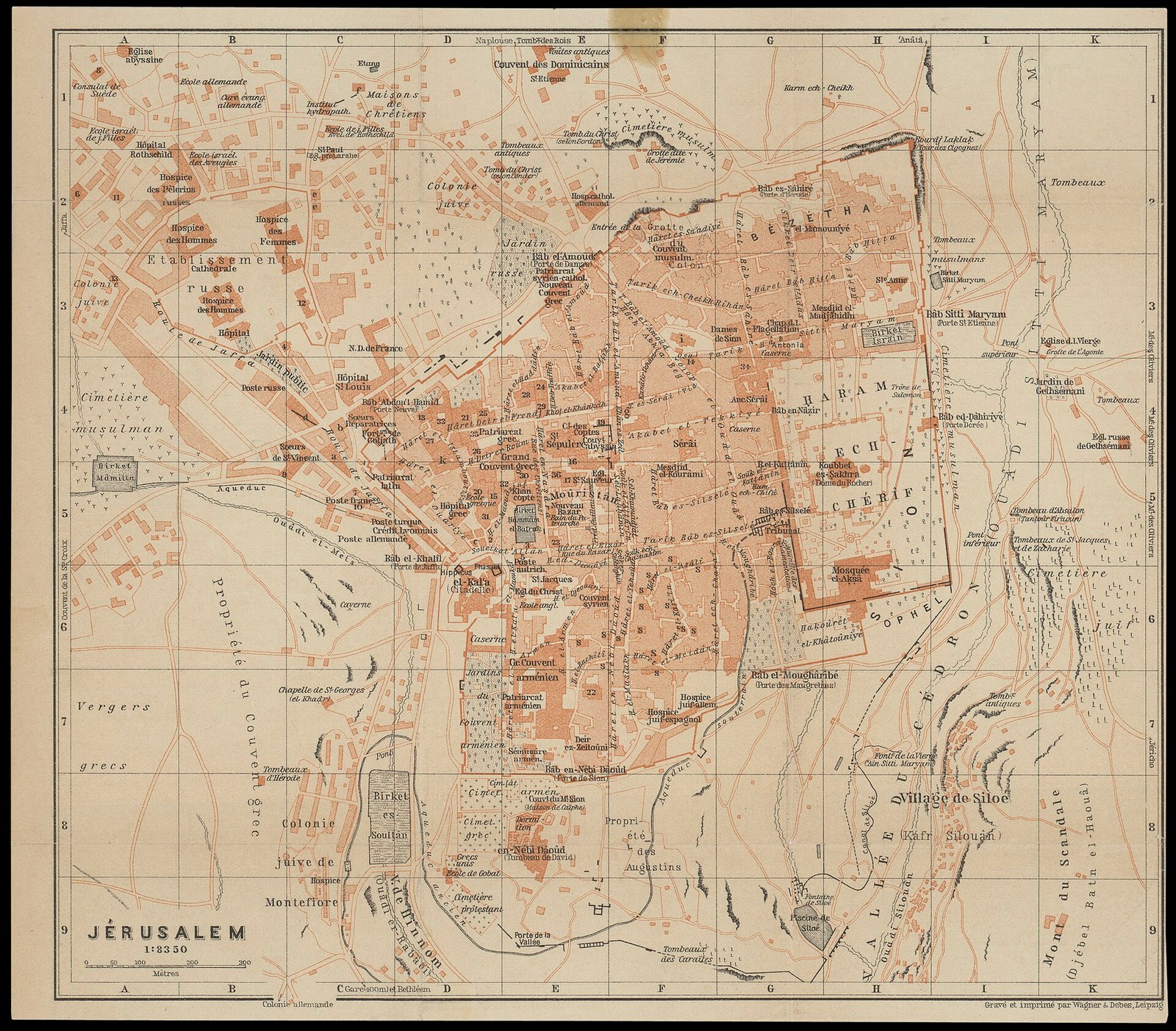
1 km (1 miles)
- Known: a score of 800 or more
- Proposed: a score under 500
- 1?The Church of the Holy Sepulchre, The site shown since the fourth century John 19:17
- 2?Gordon's Calvary and the Garden Tomb, The site proposed in 1842 and taken up by Gordon in 1883 John 19:41
- 3Gethsemane, The garden where Jesus prayed the night before Matthew 26:36
Base map: Plan of Jerusalem, Wagner and Debes, Leipzig, plan of Jerusalem for the Baedeker guides, public domain. Each place stands at the point cited for each, set on the plate by Damascus Gate and Dome of the Rock, as the plate prints them.
Three places, each with its verse. Each ring follows the OpenBible.info identification score out of 1,000, as the key gives it; both sites shown for Golgotha score under 500.
Golgotha in the Gospels, in Order
These six verses follow the day from the road out to the women watching.
Six verses on the road to the place and at the cross, in the order of the day.
- MarkSimon of Cyrene is forced to carry the crossMark 15:21
- MatthewThey come to a place called GolgothaMatthew 27:33
- LukeThey crucify Him there with the criminalsLuke 23:33
- JohnPilate's notice is posted on the crossJohn 19:19
- MatthewThose who pass by heap abuse on HimMatthew 27:39
- MarkWomen watch from a distanceMark 15:40
Matthew and Mark give two of the six each, and Luke and John one each.
Why the Place of the Skull?
The Gospels translate the name and do not explain it, and three explanations have been given.
The skull of AdamOrigen; Jerome's letter 46, in the names of Paula and Eustochium
Origen tied the name to a tradition about the skull of Adam. Letter 46 in Jerome's collection says the place is called Calvary because the skull of the first man was buried there.
The objection: Jerome's own commentary on Matthew calls this reading pleasing to the people but not true.
A place of executionJerome, Commentary on Matthew
Jerome held that the place took its name from the beheading of men condemned to death there, outside the city gates.
The objection: Letter 46 gives the skull of Adam as the reason instead.
A hill shaped like a skullThe Catholic Encyclopedia, 1908
The Catholic Encyclopedia of 1908 suggests that the name may have come from the shape of the place, a rounded hillock like a skull.
The objection: Jerome tied the name to the executions held there, and not to the shape of the ground.
Near the City, Outside the Gate
The ground under the traditional site was an old quarry outside the city of Jesus' day.
And so Jesus also suffered outside the city gate, to sanctify the people by His own blood.The letter makes the place outside the gate a picture of the sin offering.
Excavations under the Church of the Holy Sepulchre and the nearby Church of the Redeemer found a large quarry under both, worked until the first century BC. In the Redeemer excavations of 1970 to 1974, a sounding to the bedrock showed that the site lay outside the city walls in Jesus' time.
What the Gospels Leave Unsaid
The Gospels call Golgotha a place and give no hill, no measure and no landmark.
Each Gospel calls Golgotha a place, and none calls it a hill or a mount. None gives the distance from the gate, the road taken or the side of the city.
John 19:42 says the tomb was nearby. He names no landmark by which a later reader could find it.
The Tomb Nearby
John places the cross and the empty tomb side by side.
Now there was a garden in the place where Jesus was crucified, and in the garden a new tomb in which no one had yet been laid.He is not here; He has risen, just as He said! Come, see the place where He lay.Matthew 28:6 has the angel invite the women to see where He lay.
Voices on Golgotha
Three commentaries from the fifth, eighteenth and nineteenth centuries wrote on what was done at the place.
Cyril of Alexandria (died 444)
Cyril of Alexandria saw a purpose in the notice that passers-by near the city could read.
“It was providential and the fruit of God's inexpressible purpose that the title was written in three languages: one in Hebrew, another in Latin and another in Greek. For it lay in plain view, proclaiming the kingdom of our Savior Christ in the most widely known of all languages … fulfilling the prophecy that had been spoken concerning him. For the wise Daniel said that there was given him glory and a kingdom and that all nations and languages shall serve him.”
Cyril of Alexandria · Commentary on the Gospel of John, Book 12 · on John 19:20Patristic
Matthew Henry (1662 to 1714)
Matthew Henry set the place of the cross among the condemned against the altar of the temple.
“But thus the scripture was fulfilled, He was numbered among the transgressors. He did not die at the altar among the sacrifices, nor mingle his blood with that of bulls and goats; but he died among the criminals, and mingled his blood with theirs who were sacrificed to public justice.”
Matthew Henry · Commentary on the Whole Bible · on John 19:18Puritan
Jamieson, Fausset & Brown (1802 to 1910)
Jamieson, Fausset and Brown read the suffering outside the gate by the burning of the sin offerings outside the camp.
“The fiery ordeal of His suffering on the cross, answers to the burning of the victims; thereby His mere fleshly life was completely destroyed, as their bodies were; the second part of His offering was His carrying His blood into the heavenly holiest before God at His ascension, that it should be a perpetual atonement for the world's sin.”
Jamieson, Fausset & Brown · Commentary Critical and Explanatory on the Whole Bible · on Hebrews 13:12Reformed
Where Was Golgotha?
Two sites are held today, and each answers the other's case.
The Church of the Holy SepulchreEusebius, Life of Constantine 3.26 to 28; Cyril of Jerusalem, Lectures 10 and 13
Eusebius wrote that a shrine to the spirit called Venus had been built over the tomb, and that when Constantine had it cleared, the monument of the Saviour's resurrection was found. Cyril of Jerusalem told those he taught that they were gathered near Golgotha, the holy hill standing above them.
The objection: the church stands within the walls of the Old City today, and the New Testament puts the tomb outside the city. The Catholic Encyclopedia of 1910 held that masonry found east and south-east of the church seemed to prove the wall of that day had left the tomb outside.
Gordon's Calvary and the Garden TombOtto Thenius, 1842; Charles Gordon, 1883; the Garden Tomb Association, 1894
In 1842 Otto Thenius was one of the first to publish the hill above Jeremiah's Grotto as Golgotha, and saw in it the form of a skull. Charles Gordon took up the view during his stay in the Holy Land in 1883. The Garden Tomb (Jerusalem) Association, which bought the garden in 1894, calls the tomb beside the knoll an ancient Jewish tomb which many believe is the site of Jesus' burial and resurrection.
The objection: the archaeologist Gabriel Barkay dates the Garden Tomb to the eighth or seventh century before Christ, and John 19:41 calls Jesus' tomb new, with no one yet laid in it.
Outside the Camp
Hebrews draws a charge from the place where Jesus suffered.
Therefore let us go to Him outside the camp, bearing the disgrace He bore.Sources
Scripture is the Berean Standard Bible.
- James Strong, Exhaustive Concordance of the Bible (1890), Greek dictionary, entry 1115, with the STEP Bible brief lexicon.
- OpenBible.info, Bible-Geocoding-Data, ancient.jsonl, entry Golgotha (the Church of the Holy Sepulchre, score 426; Gordon's Calvary, score -24) and Gethsemane (score 1000)
- Wagner and Debes, Leipzig, plan of Jerusalem, the plan of the Baedeker guides (a smaller copy on Commons is dated 1906), National Library of Israel, Eran Laor Cartographic Collection.
- Eusebius of Caesarea, Life of Constantine 3.25 to 3.28, translated by Ernest Cushing Richardson, Nicene and Post-Nicene Fathers, series 2, volume 1 (1890)
- Cyril of Jerusalem, Catechetical Lectures 10.19 and 13.4, translated by Edwin Hamilton Gifford, Nicene and Post-Nicene Fathers, series 2, volume 7 (1894)
- Letter 46, Paula and Eustochium to Marcella, section 3, in the letters of Jerome, translated by W. H. Fremantle, Nicene and Post-Nicene Fathers, series 2, volume 6 (1893)
- Jerome, Commentary on Matthew, on Matthew 27:33, and the same in the Catena Aurea on John 19:17.
- Jordan Ryan, Golgotha and the Burial of Adam between Jewish and Christian Tradition: Text and Monument, Nordisk Judaistik / Scandinavian Jewish Studies 32:1 (2021), 3 to 29, quoting Origen, Commentary on Matthew 126, in translation.
- The Catholic Encyclopedia, volume 3 (New York, Robert Appleton Company, 1908), Mount Calvary.
- German Protestant Institute of Archaeology (GPIA, Dieter Vieweger), Through the Ages, the excavators' record of the excavations of 1970 to 1974 under the Church of the Redeemer: the Tour panel, Excavation: Sounding, Exhibition: Muristan and Exhibition: Sounding.
- Arthur McMahon, Holy Sepulchre, The Catholic Encyclopedia, volume 7 (New York, Robert Appleton Company, 1910)
- Charles W. Wilson, Golgotha and the Holy Sepulchre (London, Palestine Exploration Fund, 1906), pages 109 to 111 and Appendix VII.
- Charles George Gordon, Reflections in Palestine. 1883 (London, Macmillan, 1884), the Prefatory Note and pages 1 to 2.
- Gabriel Barkay, The Garden Tomb: Was Jesus Buried Here?, Biblical Archaeology Review 12:2 (March and April 1986), in the excerpt the Center for Online Judaic Studies prints.
- The Garden Tomb (Jerusalem) Association, the About page and the home page.
- Cyril of Alexandria, Commentary on the Gospel of John, Book 12, on John 19:20.
- Matthew Henry, Commentary on the Whole Bible (1710), on John 19:18.
- Jamieson, Fausset and Brown, Commentary Critical and Explanatory on the Whole Bible (1871), on Hebrews 13:12.
Keep Studying
Read it5
Studies7
People and groups3
Symbols1
Doctrines1