
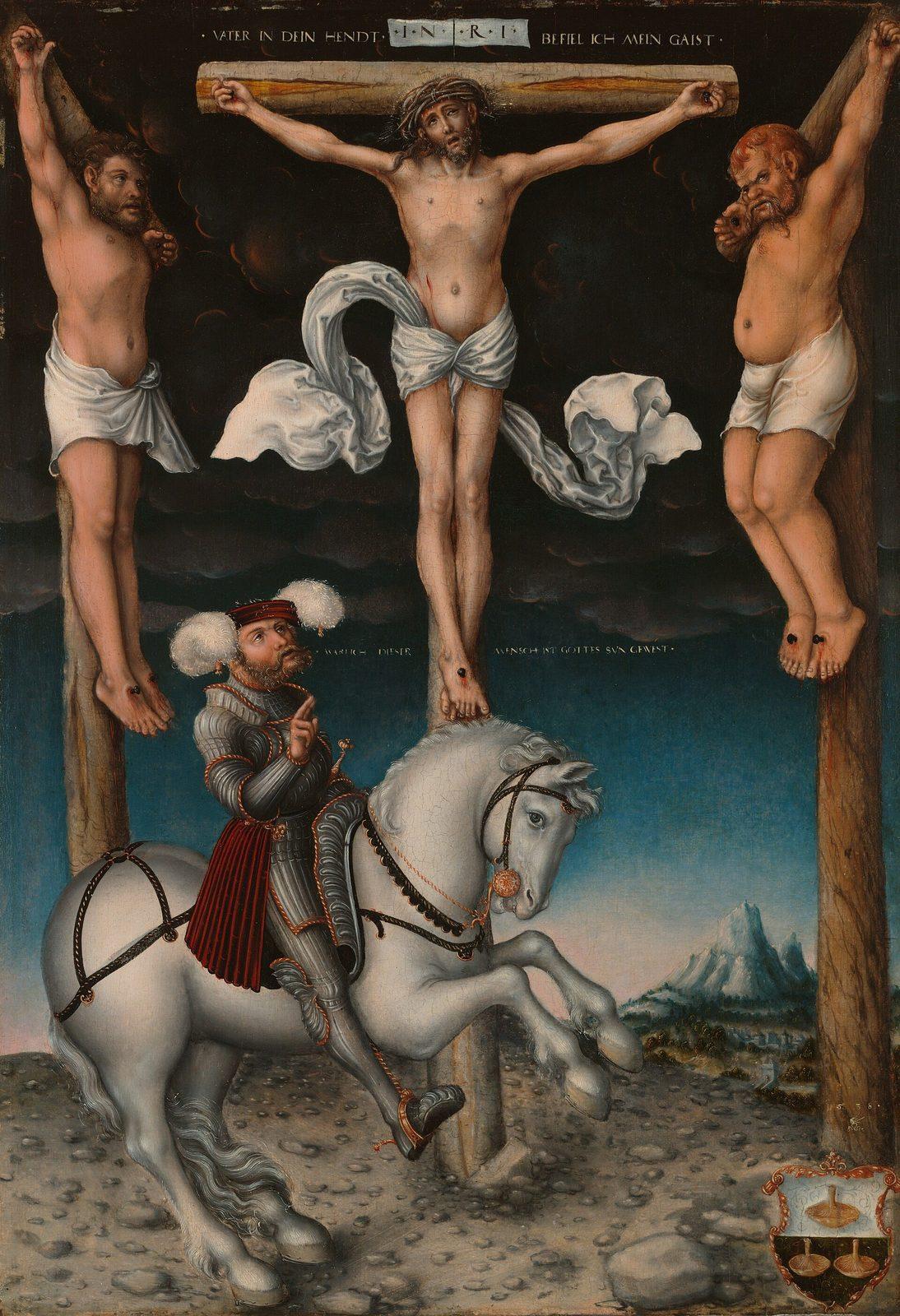
Lucas Cranach the Elder, The Crucifixion with the Converted Centurion, 1538. Public domain.
Mark 15:39 · Subject · Featured Study
The Centurion's Confession
The Roman officer in charge of the crucifixion called Jesus the Son of God.
A Gentile soldier who had just carried out the execution spoke Mark's verdict on Jesus.
This is the beginning of the gospel of Jesus Christ, the Son of God.
This is the beginning of the gospel of Jesus Christ, the Son of God.
- Book
- Mark
- Hold in memory
- Mark 15:39, Mark 1:1
Summary
A Roman centurion commanded the soldiers at the cross. He stood facing Jesus and saw how He died. Readers since Jerome have asked what the Gentile soldier meant by his words.
- Mark alone of the Gospels writes the officer's rank with a Latin loanword.
- Matthew adds the guard and the earthquake, and Luke adds the soldier's praise of God.
- Readers differ over whether the soldier confessed the faith or spoke as a pagan in awe.
Truly This Man Was the Son of God
Mark records what the officer saw and what he said in one verse.
When the centurion standing there in front of Jesus saw how He had breathed His last, he said, “Truly this man was the Son of God!”In Mark's story this is the one place where a person calls Jesus the Son of God outright.
Theophylact of Ohrid set the soldier beside the other people at the cross.
“The centurion, that is, the commander over a hundred soldiers, seeing that He died so sovereignly, was amazed and confessed. Notice how the order was reversed! The Jews put Him to death, a pagan confesses; the disciples scatter, the women remain.”
Theophylact of Ohrid · Commentary on Mark · on Mark 15:39Patristic
The Son of God From the First Line to the Cross
The title runs through Mark's story from the baptism to the cross.
God's voice names the Son twice and the spirits twice, the high priest asks, and the centurion affirms.
- A voice from heaven"You are My beloved Son"Mark 1:11
- The unclean spirits"You are the Son of God!"Mark 3:11
- Legion"Son of the Most High God"Mark 5:7
- The voice from the cloud"This is My beloved Son."Mark 9:7
- The high priest"the Son of the Blessed One?"Mark 14:61
- The centurion"the Son of God!"Mark 15:39
Jesus answers the high priest with I am, and the court condemns Him for it (Mark 14:62 to 64).
Three Tellings of His Words
Matthew and Luke each add a detail that Mark leaves out.
Matthew: the guard with himMatthew 27:54
When the centurion and those with him who were guarding Jesus saw the earthquake and all that had happened, they were terrified and said, “Truly this was the Son of God.”Matthew's wording is the one Augustine weighs against Luke's.
Luke: a righteous manLuke 23:47
When the centurion saw what had happened, he gave glory to God, saying, “Surely this was a righteous man.”Luke's wording, a righteous man, is the objection to reading the words as a full confession.
How the tellings agreeAugustine of Hippo, Harmony of the Gospels, Book 3
Augustine found no contradiction between the two. Matthew's account of all that had happened leaves room for the death itself, at which Luke's centurion wondered.
The Last Made First
Pseudo-Jerome and John Wesley each read the scene against those who rejected Jesus.
Pseudo-Jerome's comment turns on a saying of Jesus about the last and the first.
“But the last are now made the first. The Gentile people confesses. The blinded Jew denies, so that their error is worse than the first.”
Pseudo-Jerome · Catena Aurea by Aquinas · on Mark 15:39Patristic
John Wesley heard in the words an answer to the mockers, who had said that Jesus claimed to be the Son of God (Matthew 27:43).
What the Centurion Saw
The darkness, the cry and the death came before the soldier spoke.
Darkness covered the land from the sixth hour to the ninth, and at the ninth hour Jesus cried out the words of Psalm 22 (Mark 15:33 to 34). Then He gave a loud cry and died.
But Jesus let out a loud cry and breathed His last. And the veil of the temple was torn in two from top to bottom.The torn veil is the one event in the temple Mark sets beside the death.
Bede found the cause of the soldier's wonder in the manner of the death. In his reading Jesus sent forth His own spirit, which no one can do but the Creator of souls.
Pilate later sent for the same centurion to learn whether Jesus was already dead (Mark 15:44 to 45).
The Words of His Sentence
Three Greek words of Mark 15:39, each with its count of uses in the New Testament.
κεντυρίων kentyriōn
3 uses in the canon
A centurion, captain of a hundred soldiers.
ἀληθῶς alēthōs
18 uses in the canon
Truly, the word the bystanders used of Peter in the courtyard (Mark 14:70).
υἱός huios
377 uses in the canon
Son, written here with no article before it, son of God.
What Did the Centurion Mean?
Commentators from the fourth century to the nineteenth read his words in three ways.
A true confession of faithJerome, in Thomas Aquinas, Catena Aurea; Rabanus Maurus, the same
Jerome set the soldier's words against Arius, who called the Son a creature.
“Observe, that in the very midst of the offence of His passion the Centurion acknowledges the Son of God, while Arius in the Church proclaims Him a creature.”
Jerome · Catena Aurea by Aquinas · on Matthew 27:54Patristic
Rabanus Maurus saw in the centurion the faith of the Church.
“Whence with good reason by the Centurion is denoted the faith of the Church, which, when the veil of heavenly mysteries had been rent by the Lord's death, immediately asserts Jesus to be both very Man, and truly Son of God, while the Synagogue held its peace.”
Rabanus Maurus · Catena Aurea by Aquinas · on Matthew 27:54Patristic
The objection: Luke gives the soldier's words as a righteous man, which states less (Luke 23:47).
A pagan's words of aweAlbert Barnes, Notes on the New Testament, on Matthew 27:54; Adam Clarke, on the same verse
Albert Barnes held that a pagan soldier meant a son of a god in his own sense of the words. In his reading the soldier perhaps thought of Jesus as like the pagan heroes who had been made gods, yet took the wonders as proof that Jesus was what He claimed to be.
Barnes noted that the Greek reads a son of a god, words that suit a man who believed in many gods.
Adam Clarke likewise judged that the soldier did not use the words in the sense of the Jewish hope of the Messiah.
The objection: Mark sets the words at the end of a Gospel that opens with the same title, so the writer at least meant them in full (Mark 1:1).
Words that said more than he knewMatthew Henry, Commentary on the Whole Bible, on Mark 15:39
“‘Surely,’ thinks he, ‘this must be some divine person, highly beloved of God.’ This he expresses by such words as denote his eternal generation as God, and his special designation to the office of Mediator, though he meant not so. Our Lord Jesus, even in the depth of his sufferings and humiliation, was the Son of God, and was declared to be so with power.”
Matthew Henry · Commentary on the Whole Bible · on Mark 15:39Puritan
The objection: Henry's reading rests on a guess at the soldier's thoughts that the text does not give.
The Women Watching From a Distance
Mark ends the scene with the women who had followed Jesus from Galilee.
And there were also women watching from a distance. Among them were Mary Magdalene, Mary the mother of James the younger and of Joses, and Salome.The women are the witnesses who carry Mark's story from the cross to the tomb.
Mary Magdalene and Mary the mother of Joseph saw where His body was placed (Mark 15:47). When the Sabbath was over, Mary Magdalene, Mary the mother of James and Salome bought spices to anoint His body (Mark 16:1).
Sources
Scripture is the Berean Standard Bible.
- Theophylact of Ohrid, Commentary on Mark (about 1100), on Mark 15:39.
- Bede, on Mark 15:39, in Thomas Aquinas, Catena Aurea.
- Augustine of Hippo, Harmony of the Gospels, Book 3, chapter 20, in Thomas Aquinas, Catena Aurea.
- Jerome, on Matthew 27:54, in Thomas Aquinas, Catena Aurea.
- Rabanus Maurus, on Matthew 27:54, in Thomas Aquinas, Catena Aurea.
- Albert Barnes, Notes, Explanatory and Practical, on the New Testament (1832 to 1869), on Matthew 27:54.
- Adam Clarke, Commentary on the Bible (1832), on Matthew 27:54.
- Matthew Henry, Commentary on the Whole Bible (1710), on Mark 15:39.
- Pseudo-Jerome, on Mark 15:39, in Thomas Aquinas, Catena Aurea.
- John Wesley, Explanatory Notes upon the New Testament (1755), on Matthew 27:54.
- Strong's lexicon entry for g2760, with its count of uses.
Keep Studying
Read it5
Studies6
People and groups5
Go further8