
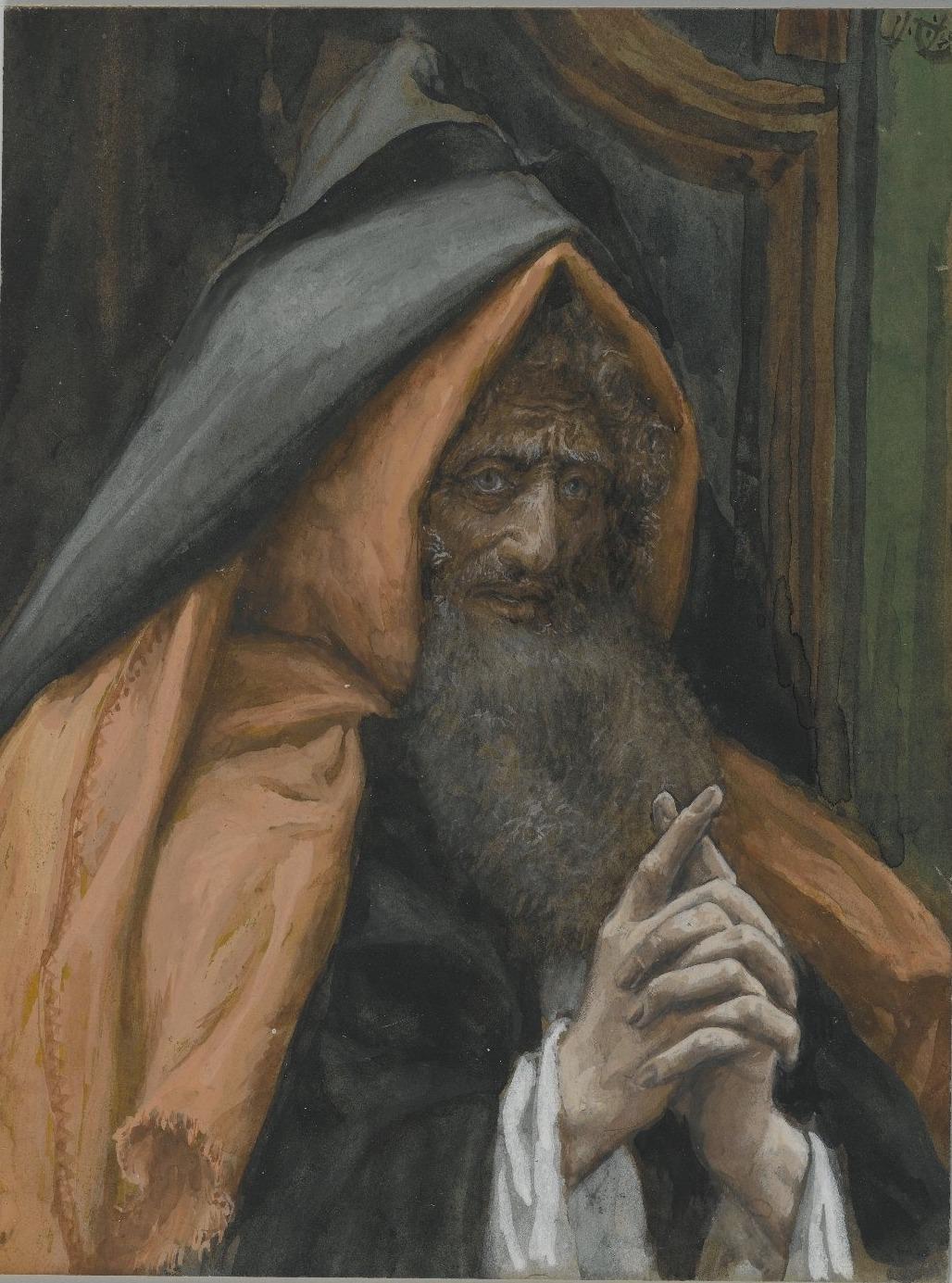
James Tissot, Joseph of Arimathaea, 1886 to 1894. Public domain.
Matthew 27:57 to 61 · Person · Featured Study
Joseph of Arimathea
Joseph of Arimathea was a rich council member who asked Pilate for the body of Jesus and buried it in his own new tomb.
Nicodemus came with him, bringing about seventy-five pounds of myrrh and aloes.
Joseph of Arimathea, a prominent Council member who himself was waiting for the kingdom of God, boldly went to Pilate to ask for the body of Jesus.
Joseph of Arimathea, a prominent Council member who himself was waiting for the kingdom of God, boldly went to Pilate to ask for the body of Jesus.
- Family
- family: not recorded
- Places
- Arimathea, a town of Judea, Jerusalem, the garden by Golgotha
- First named
- Matthew 27:57 “…rich man from Arimathea named Joseph, who himself…”
- Last named
- John 19:38 “Afterward, Joseph of Arimathea,…”
Summary
Joseph came from Arimathea, a town of Judea, and sat on the court in Jerusalem that condemned Christ. He had not agreed with its verdict. He followed Christ in secret for fear. On the evening of the crucifixion he went to the governor to ask for the dead Lord. He wrapped Him in linen and spices and laid Him in a grave cut in the rock. Scripture tells nothing of him before or after that evening.
- All four Gospels tell of his part in the burial.
- His tomb had never been used.
- Nicodemus helped him with the burial.
A Member of the Council
Two Gospels describe the man before they tell what he did.
Now there was a Council member named Joseph, a good and righteous man,Luke gives his character.
who had not consented to their decision or action. He was from the Judean town of Arimathea, and was waiting for the kingdom of God.Only Luke records his dissent and calls his town Judean.
The Burial in Order
Mark gives the hour, John the spices, and Matthew the stone.
The burial was finished as the Sabbath was beginning.
- Mark 15:42Evening comes on the day of Preparation, the day before the SabbathMark 15:42
- Mark 15:43He goes boldly to the governor with his requestMark 15:43
- Mark 15:44 to 45Pilate confirms the death with the centurion and grants the bodyMark 15:44 to 45
- Mark 15:46Joseph buys a linen cloth and takes the body downMark 15:46
- John 19:39 to 40They wrap the body in linen with the spices, by the Jewish burial customJohn 19:39 to 40
- John 19:41 to 42They lay Jesus in a new tomb in a garden near the place of the crossJohn 19:41 to 42
- Matthew 27:60Joseph rolls a great stone across the entrance and goes awayMatthew 27:60
- Matthew 27:61Mary Magdalene and the other Mary sit opposite the tombMatthew 27:61
Luke adds that the women went home to prepare spices and rested on the Sabbath.
Matthew 27:60, Matthew 27:61
Where Was Arimathea?
Ancient writers took Arimathea for the hometown of Samuel, and later readers proposed other sites.
Eusebius, in his list of the places of Scripture, identified Arimathea with Ramathaim-zophim, the town of Elkanah and Samuel. He placed it near Diospolis, in the region of Thamna. Bede repeated the same identification in his commentary on Luke.
The Cambridge Bible notes that the name is a form of Ramah, meaning a hill. Several towns have been proposed: Ramleh, Ramathaim in Ephraim, and Ramah in Benjamin. Edward Robinson wrote in 1841 that a link between Ramleh and Arimathea had been generally assumed since the time of the crusades.
The People Around the Tomb
Scripture names no family for Joseph, only the people of that evening.
A Pharisee, a governor, a centurion and two women from Galilee shared that evening with him.
| Person | Who they were | Told in |
|---|---|---|
| Nicodemus | A Pharisee and a leader of the Jews | John |
| Pontius Pilate | The governor who had sentenced Jesus | Matthew, Mark, John |
| The centurion | The officer guarding Jesus at the cross | Matthew, Mark |
| The council | The court on which Joseph sat | Mark, Luke |
| Mary Magdalene and the other Mary | Women who had followed Jesus from Galilee | Matthew, Mark, Luke |
His Places
His town lay in Judea, and his tomb lay close to Golgotha.
His story runs from a Judean town to a tomb near the city.
| Place | What the text or its readers say | Told by |
|---|---|---|
| Arimathea | His home town | Matthew, Mark, Luke, John |
| Ramathaim-zophim | Samuel's town, which Eusebius took for Arimathea | 1 Samuel; Eusebius |
| The tomb near Golgotha | Close at hand, so the burial could finish before the Sabbath | John |
The Stories Told of Him Later
A Christian writing outside the Bible and a medieval legend gave Joseph a longer life than Scripture does.
Joseph in the Gospel of NicodemusGospel of Nicodemus, also called the Acts of Pilate, chapters 12 and 15
The Gospel of Nicodemus tells that after the burial the chief priests and elders shut Joseph in a room with no window. They sealed the door. When they opened it on the first day of the week, they found him gone.
Glastonbury and the GrailGlastonbury Abbey; Robert de Boron
A later legend brought Joseph to Gaul in AD 63 and then to Britain. There he was said to have founded the first Christian chapel at Glastonbury. Francis Gigot, in the Catholic Encyclopedia of 1910, calls that legend fabulous. The oldest of the romances that tell the Grail's early history is Robert de Boron's Joseph d'Arimathie, written between 1170 and 1212. In it the Grail passes to Joseph, who uses it to catch the blood of Christ.
A Secret Disciple Made Bold
Matthew calls him a disciple, and John says he had kept it hidden until that evening.
When it was evening, there came a rich man from Arimathea named Joseph, who himself was a disciple of Jesus.It is the only verse that calls him rich.
Afterward, Joseph of Arimathea, who was a disciple of Jesus (but secretly for fear of the Jews), asked Pilate to let him remove the body of Jesus. Pilate gave him permission, so he came and removed His body.John names the fear that had kept him silent.
Adam Clarke notes that Joseph, a secret disciple until then, acted more openly than any of the other disciples on that evening. J. C. Ryle observes that Scripture gives no reason why he had not joined the disciples openly before.
Voices on Joseph
John Chrysostom and Bede wrote on his courage and his wealth.
John Chrysostom (died 407)
THE GOSPEL OF ST MATTHEW, HOMILY 88
Chrysostom, preaching on Matthew, weighed what the request cost Joseph.
“This was Joseph, who had been concealing his discipleship. Now he became very bold, after the death of Christ. For neither was he an obscure person nor unnoticed. He was one of the council, and highly distinguished, and as we see, courageous. For he exposed himself to death, taking upon himself the enmity of all by his affection to Jesus. He begged for the body and did not desist until he obtained it. Not only that, but by laying it in his own new tomb, he actively demonstrated his love and courage.”
on Mark 15:43Patristic
Bede (died 735)
On the Gospel of Mark 4.15
Bede gave a reason for his wealth.
“It was providentially ordered that he should be rich, in order that he might have access to the governor, and righteous, in order that he might merit the charge of our Lord's body.”
on John 19:38Patristic
Did Isaiah 53:9 Foretell Joseph's Tomb?
Isaiah says the servant's grave was with a rich man, and commentators divide over whether that points to Joseph.
He was assigned a grave with the wicked, and with a rich man in His death, although He had done no violence, nor was any deceit in His mouth.Commentators read this verse beside the burial of Jesus.
Yes: the rich man is JosephJamieson, Fausset and Brown; the Pulpit Commentary; John Gill
Jamieson, Fausset and Brown follow Hengstenberg. They read the verse as the intent of the servant's enemies to bury Him with the wicked, overturned when He lay with a rich man. The Pulpit Commentary says His grave would have been with the criminals but for Joseph. Gill notes that the words are generally taken of one who died between two thieves and was buried in a rich man's grave.
The objection: Ellicott notes that this reading must reverse the order of the verse's two clauses.
No: the rich are the wickedCharles Ellicott; Matthew Poole
Ellicott holds that the parallel lines require the rich to match the wicked, as the oppressors who grew rich by wrong. Matthew Poole judges the reference to Joseph not probable, since Scripture counts the burial of Christ as part of His humiliation.
The objection: Jamieson, Fausset and Brown answer that the Hebrew word means rich everywhere and never by itself ungodly.
A Tomb Where No One Had Been Laid
The women who had come with Jesus from Galilee followed, and they saw the tomb and how His body was placed.Luke 24:1 brings them back very early on the first day of the week.
Sources
Scripture is the Berean Standard Bible.
- Ellicott's Commentary for English Readers; Jamieson, Fausset and Brown, Commentary (1871); Matthew Poole, Annotations; John Gill, Exposition; the Pulpit Commentary; each on Isaiah 53:9; the Cambridge Bible for Schools and Colleges on Luke 23:51.
- Eusebius, Onomasticon, the entry Armathem Seipha, translated by C. Umhau Wolf (1971)
- Edward Robinson, Biblical Researches in Palestine, Mount Sinai and Arabia Petraea, volume 3 (Boston, Crocker and Brewster, 1841), section XIII, Er-Ramleh, pages 40 to 44.
- The Gospel of Nicodemus, or Acts of Pilate, chapters 12 and 15, Ante-Nicene Fathers vol. 8.
- Francis Gigot, Joseph of Arimathea, The Catholic Encyclopedia, vol. 8 (1910)
- Arthur F. J. Remy, The Holy Grail, The Catholic Encyclopedia, vol. 6 (1909)
- John Chrysostom, Homilies on Matthew 88; Bede, On the Gospel of Mark 4.15; J. C. Ryle, Expository Thoughts on the Gospels: Luke (1858), on Luke 23:50 to 56; Adam Clarke, Commentary on the Bible (1832) on Mark 15:43; Bede, On the Gospel of Luke, on Luke 23:51.
Keep Studying
Read it5
Studies6
People and groups6
Subjects1
Go further8