
John 19:14
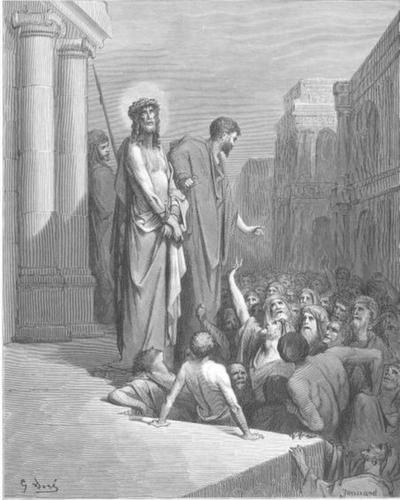
in John 19It was the day of Preparation for the Passover, about the sixth hour. And Pilate said to the Jews, “Here is your King!”
BSB
The same verse in ASV and KJV ▾
ASV
Now it was the Preparation of the passover: it was about the sixth hour. And he saith unto the Jews, Behold, your King!
KJV
And it was the preparation of the passover, and about the sixth hour: and he saith unto the Jews, Behold your King!
⋯
This verse in John 19
Commentary
24 notes on this verseThe Evangelist, when he thus speaks, throws the whole burden, as it were, of the charge of shedding Christ's blood upon the Jews. For he now clearly says, that Pilate was well-nigh overcome against his will by their opposition, so that he put away the thought of justice, and paid little heed to the consequence; and, therefore, he was dragged down to do the will of Christ's murderers, though he had often expressly told them, that Jesus had been found guilty of no fault at all, and it is this which will make Him subject to the worst of penalties.
This site's exposition
about the sixth hour
on John 19:14-15
John fixes the day and the hour, the Passover Preparation at about the sixth hour. Here is your King mocks the crowd, and the chief priests answer that they have no king but Caesar. Rome burned their temple within forty years.
The record, by era
The Church Fathers5 voices
On the day of the preparation, then, at the third hour, He received the sentence from Pilate, the Father permitting that to happen; at the sixth hour He was crucified; at the ninth hour He gave up the ghost; and before sunset He was buried. During the Sabbath He continued under the earth in the tomb in which Joseph of Arimathaea had laid Him.
(Tract. cxvii) Why then doth Mark say, And it was the third hour, and they crucified Him? (Mark 15:25) Because on the third hour our Lord was crucified by the tongues of the Jews, on the sixth by the hands of the soldiers. So that we must understand that the fifth hour was passed, and the sixth began, when Pilate sat down on the judgment seat, (about the sixth hour, John says,) and that the crucifixion, and all that took place in connection with it, filled up the rest of the hour, from which time up to the ninth hour there was darkness, according to Matthew, Mark, and Luke. But since the Jews tried to transfer the guilt of putting Christ to death from themselves to the Romans, i. e. to Pilate and his soldiers, Mark, omitting to mention the hour at which He was crucified by the soldiers, has expressly recorded the third hour; in order that it might be evident that not only the soldiers who crucified Jesus on the sixth hour, but the Jews who cried out for His death at the third, were His crucifiers. There is another way of solving this difficulty, viz. that the sixth hour here does not mean the sixth hour of the day; as John does not say, It was about the sixth hour of the day, but, It was the preparation of the passover, and about the sixth hour. Parasceve means in Latin, praeparatio. For Christ our passover, as saith the Apostle, is sacrificed for us. The preparation for which passover, counting from the ninth hour of the night, which seems to have been the hour at which the chief priests pronounced upon our Lord's sacrifice, saying, He is guilty of death, between it and the third hour of the day, when He was crucified, according to Mark, is an interval of six hours, three of the night and three of the day.
On Pilate's judgment and condemnation before the tribunal, they took the Lord Jesus Christ, about the sixth hour, and led Him away. "And He, bearing His cross, went forth into the place that is called Calvary, but in Hebrew, Golgotha; where they crucified Him." What else, then, is the meaning of the evangelist Mark saying, "And it was the third hour, and they crucified Him," but this, that the Lord was crucified at the third hour by the tongues of the Jews, at the sixth hour by the hands of the soldiers? That we may understand that the fifth hour was now completed, and there was some beginning made of the sixth, when Pilate took his seat before the tribunal, which is expressed by John as "about the sixth hour;" and when He was led forth, and nailed to the tree with the two robbers, and the events recorded were enacted beside His cross, the completion of the sixth hour was fully reached, being the hour from which, on to the ninth, the sun was obscured, and the darkness took place, we have it jointly attested on the authority of the three evangelists, Matthew, Mark, and Luke. But as the Jews attempted to transfer the crime of slaying Christ from themselves to the Romans, that is to say, to Pilate and his soldiers, therefore Mark suppresses the hour at which Christ was crucified by the soldiers, and which then began to enter upon the sixth, and remembers rather to give an express place to the third hour, at which they are understood to have cried out before Pilate, "Crucify, crucify him," that it not only may be seen that the former crucified Jesus, namely, the soldiers who hung Him on the tree at the sixth hour, but the Jews also, who at the third hour cried out to have Him crucified.
There is also another solution of this question, that we should not here understand the sixth hour of the day, because John says not, And it was about the sixth hour of the day, or about the sixth hour, but says, "And it was the parasceve of the passover, about the sixth hour." And parasceve is in Latin praeparatio (preparation); but the Jews are fonder of using the Greek words in observances of this sort, even those of them who speak Latin rather than Greek. It was therefore the preparation of the passover. But "our passover, Christ," as the apostle says, "has been sacrificed;" and if we reckon the preparation of this passover from the ninth hour of the night (for then the chief priests seem to have given their verdict for the sacrifice of the Lord, when they said, "He is guilty of death," and when the hearing of His case was still proceeding in the high priest's house: whence there is a kind of harmony in understanding that therewith began the preparation of the true passover, whose shadow was the passover of the Jews, that is, of the sacrificing of Christ, when the priests gave their sentence that He was to be sacrificed), certainly from that hour of the night, which is conjectured to have been then the ninth, on to the third hour of the day, when the evangelist Mark testifies that Christ was crucified, there are six hours, three of the night, and three of the day.
At that time, then, the Saviour appeared and showed His own body to the world, (born) of the Virgin, who was the "ark overlaid with pure gold," with the Word within and the Holy Spirit without; so that the truth is demonstrated, and the "ark" made manifest. From the birth of Christ, then, we must reckon the years that remain to make up the 6000, and thus the end shall be. And that the Saviour appeared in the world, bearing the imperishable ark, His own body, at a time which was the fifth and half, John declares: "Now it was the sixth hour," he says, intimating by that, one-half of the day. But a day with the Lord is 10000 years; and the half of that, therefore, is 500 years. For it was not meet that He should appear earlier, for the burden of the law still endured, nor yet when the sixth day was fulfilled (for the baptism is changed), but on the fifth and half, in order that in the remaining half time the gospel might be preached to the whole world, and that when the sixth day was completed He might end the present life.
17 more voices on this verse
The Church Fathers3 voices
It was the day of preparation, that is, the sixth holy day of the week, and it was about the sixth hour. For those who think that the words of the Evangelists are in contradiction, as some say at the third hour, others at about …
(Hom. lxxxiv) Pilate, despairing of moving them, did not examine Him, as he intended, but delivered Him up. And he saith unto the Jews, Behold your King!
After his public ministry, Jesus did not eat of the lamb, but he himself suffered as the true Lamb in the Paschal feast, as John, the divine and Evangelist teaches us in the Gospel written by him. "… And it was the preparation of the …
The Medieval Church6 voices
2404 The time of the condemnation is given when he says, Now it was the day of Preparation of the Passover; it was about the sixth hour. Among the Jews the Sabbath was in some respects more solemn than any other feast, insofar as out …
Parasceve, i. e. preparation. This was a name for the sixth day, the day before the Sabbath, on which they prepared what was necessary for the Sabbath; as we read, On the sixth day they gathered twice as much bread. (Exod. 16:22) As man was made on the sixth day, and God rested on the seventh; so Christ suffered on the sixth day, and rested in the grave on the seventh. And it was about the sixth hour.
And it was the preparation of the Passover.
Some suppose it to be a fault of the transcriber, who for the letter y, three, puts, six. As if to say, See the kind of Man whom ye suspect of aspiring to the throne, a humble person, who cannot have any such design.
The Evangelist Mark says that when Christ was crucified, "it was the third hour" (Mark 15:25), while John says that it was the "sixth" hour. How can this be? Some think to resolve this by saying that there is a scribal error. And that this …
Now it was the preparation. Behold, the time is added, because it was the sixth day of the week, which is called the preparation of the Passover, that is, the preparation of the Passover, because the preparation was made on Friday for the Sabbath day, …
The Puritans and the Awakening2 voices
And it was the preparation of the passover,.... So the Jews (x) say, that Jesus suffered on the eve of the passover; and the author of the blasphemous account of his life says (y), it was the eve both of the passover and the sabbath; which account so far agrees with the evangelic history; but then this preparation of the passover was not of the passover lamb, for that had been prepared and eaten the night before.
This is mentioned as an aggravation of their sin, in persecuting Christ with so much malice and fury, that it was when they should have been purging out the old leaven, to get ready for the passover; but the better the day the worse the deed. The hour: It was about the sixth hour. Some ancient Greek and Latin manuscripts read it about the third hour, which agrees with Mark xv.
The Nineteenth Century6 voices
It was the preparation of the Passover - That is, the time in which they were just preparing to kill the paschal lamb. Critics differ widely concerning the time of our Lord’s crucifixion; and this verse is variously understood. Some think it signifies merely the preparation of the Sabbath; and that it is called the preparation of the passover, because the preparation of the Sabbath happened that year on the eve of the Passover. Others think that the preparation of the Sabbath is distinctly spoken of in Joh 19:31, and was different from what is here mentioned.
PILATE said much more than he meant and, therefore, we shall not restrict our consideration of his words to what he intended. John tells us considering Caiaphas, "and this spoke he not of himself," and we may say the same of Pilate. Everything said or done in connection with the Savior during the day of His Crucifixion was full of meaning, far fuller of meaning than the speakers or actors were aware. Transformed by the Cross, even the commonplace becomes solemn and weighty!
A commentator
J.C. Ryle1816–1900
Expository Thoughts on the Gospels: John (lightly modernized text, Grace Gems edition) (1869)
proposed
Pilate said to the Jewish religious leaders, "Look, here is your king!" Then they shouted out, "Away with him! Away with him! Crucify him!" Pilate asked, "Shall I crucify your king?" The high priests replied, "We have no king except Caesar!" Then Pilate handed him over to them to be crucified. These verses exhibit to our eyes a wonderful picture, a picture which ought to be deeply interesting to all who profess and call themselves Christians. Like every great historical picture, it contains special points on which we should fix our special attention.
A commentator
J.C. Ryle1816–1900
Expository Thoughts on the Gospels: John (lightly modernized text, Grace Gems edition) (1869)
proposed
Pilate said to the Jewish religious leaders, "Look, here is your king!" Then they shouted out, "Away with him! Away with him! Crucify him!" Pilate asked, "Shall I crucify your king?" The high priests replied, "We have no king except Caesar!" Then Pilate handed him over to them to be crucified. These verses exhibit to our eyes a wonderful picture, a picture which ought to be deeply interesting to all who profess and call themselves Christians. Like every great historical picture, it contains special points on which we should fix our special attention. Above all, it contains three life-like portraits, which we shall find it useful to examine in order. The first portrait in the picture is that of our Lord JESUS CHRIST himself. We see the Savior of mankind scourged, crowned with thorns, mocked, smitten, rejected by His own people, unjustly condemned by a judge who saw no fault in Him, and finally delivered up to a most painful death. Yet this was He who was the eternal Son of God, whom the Father's countless angels delighted to honor. This was He who came into the world to save sinners, and after living a blameless life for thirty years, spent the last three years of His time on earth in going about doing good, and preaching the Gospel. Surely the sun never shone on a more wondrous sight since the day of its creation! Let us admire that love of Christ which Paul declares, "passes knowledge," and let us see an endless depth of meaning in the expression. There is no earthly love with which it can be compared, and no standard by which to measure it. It is a love that stands alone. Never let us forget when we ponder this tale of suffering, that Jesus suffered for our sins, the Just for the unjust, that He was wounded for our transgressions and bruised for our iniquities, and that with His stripes we are healed.
PILATE said much more than he meant and, therefore, we shall not restrict our consideration of his words to what he intended. John tells us considering Caiaphas, "and this spoke he not of himself," and we may say the same of Pilate. Everything said or done in connection with the Savior during the day of His Crucifixion was full of meaning, far fuller of meaning than the speakers or actors were aware. Transformed by the Cross, even the commonplace becomes solemn and weighty! When Caiaphas said that it was expedient that one man should die for the people, that the whole nation perish not, he little thought that he was enunciating the great Gospel principle of Substitution! When the Jewish people cried out before Pilate, "His blood be on us and on our children," they little knew the judgment which they were bringing upon themselves which would commence to be fulfilled at the siege of Jerusalem and follow them, hanging like a heavy cloud over their race, for centuries! When the soldier with a spear pierced His side he had no idea that he was bringing forth before all eyes that blood and water which are, to the whole Church, the emblems of the double cleansing which we find in Jesus, cleansing by atoning blood and sanctifying Grace. The fullness of time had come and all things were full. Each movement on that awful day was brimming with mystery. Neither could the Master or those around Him stir or speak without teaching some Gospel, or enforcing some lesson. Whereas on certain days frivolity seems to rule the hour and little is to be gathered from much that is spoken—on the day of the Passion even the most careless spoke as men inspired! Pilate, the undecided spirit, with no mind of his own, uttered language as weighty as if he, too, had been among the Prophets.
A commentator
Albert Barnes1798–1870
Notes, Explanatory and Practical, on the Old and New Testaments (1832-1869)
proposed
The preparation of the passover - See the notes at Mar 15:42. The sixth hour - Twelve o’clock noon. Mark says Mar 15:25 that it was the third hour. See the difficulty explained in the notes at that place.
The words behind it
17 Greek wordsEvery Greek word of this verse in the order it stands, with what it means and the door to its own study. The last column counts the times a word stands in the whole Bible: the rarer the word, the more the places it appears belong together.
| Greek | Sound | Meaning | Word study | In the Bible |
|---|---|---|---|---|
| ἦν | en | It was | G1510 → | 2333 times |
| δὲ | de | now | G1161 → | 2765 times |
| παρασκευὴ | paraskeue | [the] Day of Preparation | G3904 → | 6 times |
| τοῦ | tou | of the | G3588 → | 19766 times |
| πάσχα, | pascha | Passover, | G3957 → | 29 times |
| ὥρα | hora | [the] hour | G5610 → | 106 times |
| ἦν | en | was | G1510 → | 2333 times |
| ὡς | hos | about | G5613 → | 500 times |
| ἕκτη. | hekte | [the] sixth. | G1623 → | |
| καὶ | kai | And | G2532 → | 9120 times |
| λέγει | legei | he says | G3004 → | 1325 times |
| τοῖς | tois | to the | G3588 → | 19766 times |
| Ἰουδαίοις· | ioudaiois | Jews; | G2453 → | 192 times |
| ἴδε | ide | Behold | G2396 → | 30 times |
| ὁ | ho | the | G3588 → | 19766 times |
| βασιλεὺς | basileus | king | G935 → | 114 times |
| ὑμῶν. | humon | of you! | G4771 → | 2973 times |
ἦνIt was
enG1510 →2333 times
δὲnow
deG1161 →2765 times
παρασκευὴ[the] Day of Preparation
paraskeueG3904 →6 times
τοῦof the
touG3588 →19766 times
πάσχα,Passover,
paschaG3957 →29 times
ὥρα[the] hour
horaG5610 →106 times
ἦνwas
enG1510 →2333 times
ὡςabout
hosG5613 →500 times
ἕκτη.[the] sixth.
hekteG1623 →
καὶAnd
kaiG2532 →9120 times
λέγειhe says
legeiG3004 →1325 times
τοῖςto the
toisG3588 →19766 times
Ἰουδαίοις·Jews;
ioudaioisG2453 →192 times
ἴδεBehold
ideG2396 →30 times
ὁthe
hoG3588 →19766 times
βασιλεὺςking
basileusG935 →114 times
ὑμῶν.of you!
humonG4771 →2973 times
A shaded row is a word that stands 400 times or fewer in the Bible.
The walk
8 stopsEach card is a verse this one points to, and under it the verses that one points to in turn. Where several paths arrive at the same place, that place is listed first: the text keeps returning to it.
Through
John 19:42And because it was the Jewish day of Preparation and the tomb was nearby, they placed Jesus there.
it leads to
- John 19:31
It was the day of Preparation, and the next day was a High Sabbath. In order that the bodies would not remain on the cross during the Sabbath, the Jews asked Pilate to have…
Reached by 2 separate paths from here.
- John 19:31
Through
Matthew 27:62The next day, the one after Preparation Day, the chief priests and Pharisees assembled before Pilate.
it leads to
- Mark 15:42
Now it was already evening. Since it was Preparation Day (that is, the day before the Sabbath),
- John 19:42
And because it was the Jewish day of Preparation and the tomb was nearby, they placed Jesus there.
- Mark 15:42
Through
John 19:5When Jesus came out wearing the crown of thorns and the purple robe, Pilate said to them, “Here is the man!”
it leads to
- John 19:2
The soldiers twisted together a crown of thorns, set it on His head, and dressed Him in a purple robe.
- John 19:2
Through
Mark 15:25It was the third hour when they crucified Him.
it leads to
- Luke 23:44
It was now about the sixth hour, and darkness came over all the land until the ninth hour.
- Matthew 27:45
From the sixth hour until the ninth hour darkness came over all the land.
- Mark 15:33
From the sixth hour until the ninth hour darkness came over all the land.
- Acts 2:15
These men are not drunk, as you suppose. It is only the third hour of the day!
- Luke 23:44
Where this verse is studied
On this page
Studies18
On this verse
On this chapter
About John
This page draws on 21 works. Open the list of works
This page draws on Adam Clarke, Commentary on the Bible; Albert Barnes, Notes, Explanatory and Practical, on the Old and New Testaments (1832-1869); Alcuin of York, Catena Aurea by Aquinas; Augustine of Hippo, Catena Aurea by Aquinas; Augustine of Hippo, Tractates on John 117; Bede, Catena Aurea by Aquinas; Bonaventure, Commentary on John, Chapter 19; Charles Spurgeon, The Metropolitan Tabernacle Pulpit, Sermon No. 1353: “Ecce Rex” (lightly modernized text, CCEL edition); Cyril of Alexandria, Commentary on the Gospel of John, Book 12; Hippolytus of Rome, Hippolytus Exegetical Fragments; Ignatius of Antioch, Epistle of Ignatius to the Trallians; J.C. Ryle, Expository Thoughts on the Gospels: John (lightly modernized text, Grace Gems edition); John Chrysostom, Catena Aurea by Aquinas; John Gill, Exposition of the New Testament (1746-1748); John Lightfoot, Horae Hebraicae et Talmudicae on John; Matthew Henry, Commentary on the Whole Bible; Peter of Alexandria, FRAGMENT 1.7; Theodore of Mopsuestia, COMMENTARY ON JOHN 7.19.14; Theophylact of Ohrid, Catena Aurea by Aquinas; Theophylact of Ohrid, Commentary on John and Thomas Aquinas, Commentary on John.