
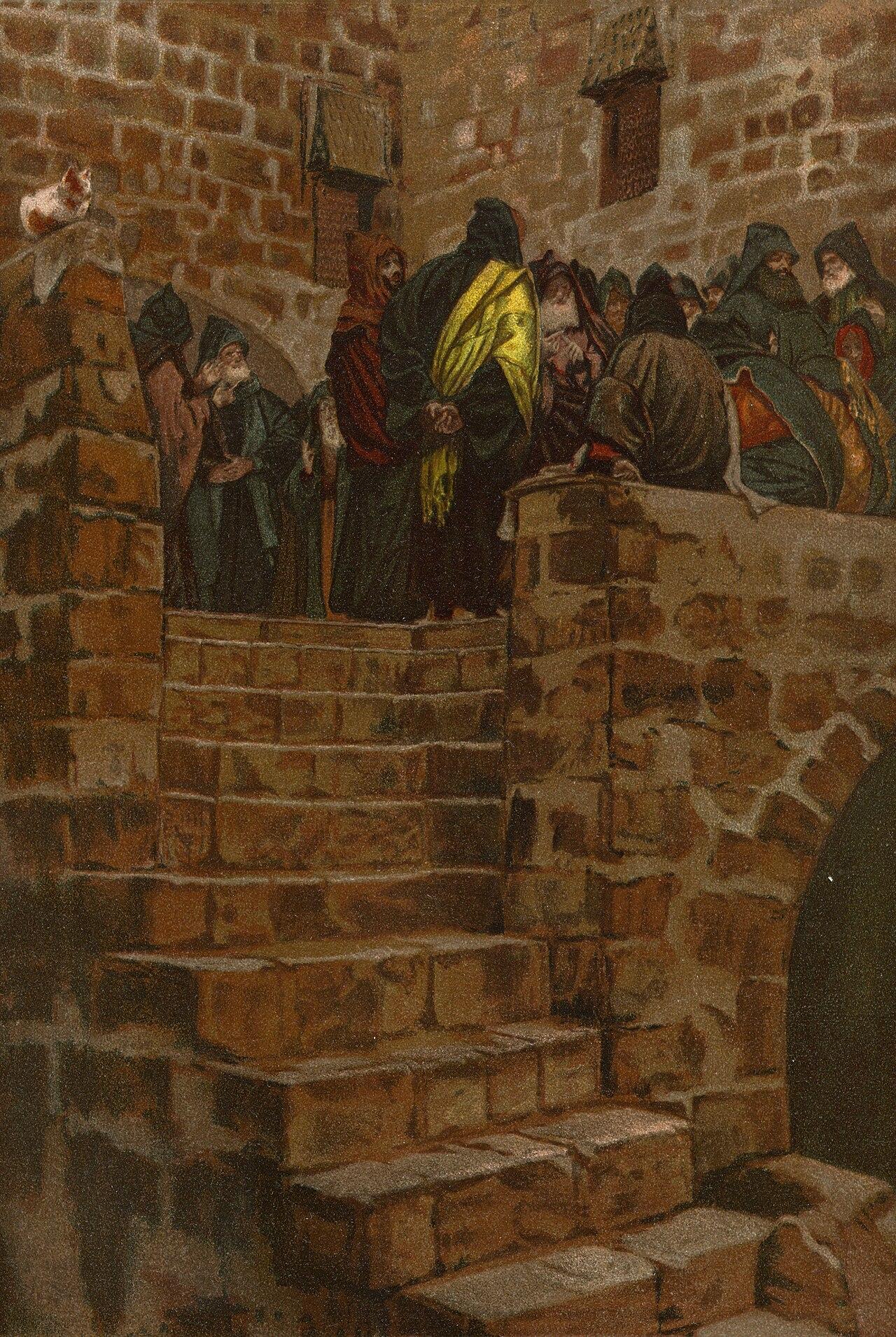
James Tissot, The Evil Counsel of Caiaphas. Public domain.
John 11:45 to 57 · Passage · Featured Study
Caiaphas's Prophecy
After Lazarus was raised, the high priest gave the council a counsel that John calls a prophecy.
Origen and Augustine both saw Rome later do what the council feared.
You do not realize that it is better for you that one man die for the people than that the whole nation perish.”
You do not realize that it is better for you that one man die for the people than that the whole nation perish.”
- The passage
- John 11:45 to 57
- Book
- John
- Hold in memory
- John 11:51, John 10:16
Summary
The chief priests and Pharisees met after Jesus raised Lazarus, afraid that Rome would take their place and nation. Caiaphas answered them, and his answer settled what the council would do.
- John hears in the high priest's counsel a death for the nation and for God's scattered children.
- Jesus withdrew to a town called Ephraim near the wilderness.
- Readers since Origen give three accounts of how such a man could prophesy.
The Council After Lazarus
The raising of Lazarus brought many to faith and brought the chief priests and Pharisees together in fear.
Many who saw Lazarus raised believed in Jesus, and some went and told the Pharisees (John 11:45 to 46). The Sanhedrin was the ruling council of the Jews in Jerusalem.
Then the chief priests and Pharisees convened the Sanhedrin and said, “What are we to do? This man is performing many signs. If we let Him go on like this, everyone will believe in Him, and then the Romans will come and take away both our place and our nation.”The council admits the signs in the same breath as its fear of Rome.
What Caiaphas Said and What John Heard
John's comment in John 11:51 to 52 turns a plan of the council into a prophecy.
John reads the counsel as a prophecy that reaches past the council's aims.
| Point | The counsel as the council heard it | The counsel as John reads it |
|---|---|---|
| The speaker | The high priest, speaking for himself | The high priest, speaking by his office |
| The death | One man put to death in place of many | Jesus dying for the nation |
| Who is spared | The nation, kept safe from Rome | The nation, and God's children beyond it |
| The end in view | The council's place kept | The scattered gathered into one |
The Plot That Followed
The council turned the counsel into a decision, and Jesus left Jerusalem for a time.
So from that day on they plotted to kill Him. As a result, Jesus no longer went about publicly among the Jews, but He withdrew to a town called Ephraim in an area near the wilderness. And He stayed there with the disciples.Jamieson, Fausset and Brown read the withdrawal as Jesus refusing to die before His time.
As the Passover drew near, the chief priests and Pharisees ordered anyone who knew where Jesus was to report it (John 11:57). Gregory the Great held that faith grew from the very death His persecutors meant to end it.
The Scattered Children of God
Readers name the scattered children of John 11:52 in two ways.
Augustine read them as the other sheep of John 10:16, those God had predestined to be brought in. Albert Barnes named them all whom God would call among Jews and Gentiles.
Cyril of Alexandria read them as all people, called children of God because He is the Father of all by creation.
High Priest That Year
John calls Caiaphas the high priest that year three times.
Adam Clarke noted that the Law of Moses gave the high priesthood for life, while in Caiaphas's day the Romans and Herod set up and put down high priests as they pleased. Clarke reported from Josephus that his name was Joseph and that he held the office eight or nine years.
John Chrysostom held that the office had become a thing bought for a year. Yet the Spirit, he wrote, was still present in it until the leaders lifted their hands against Christ.
How Could Caiaphas Prophesy?
Three readings, each with its holders and an objection from another reader.
The Spirit spoke through the office and left the man unchangedAugustine of Hippo, Tractates on John 49; John Chrysostom, Homilies on John 65
Augustine taught that even bad men may foretell things to come by the spirit of prophecy, and that John ascribes the gift to the high priest's office. Chrysostom wrote that grace used the high priest's mouth and never touched his heart, as with Balaam and Pharaoh.
The objection: Origen asked whether the Holy Spirit would speak through a man whose words then moved the council to kill Jesus.
Caiaphas meant only politics, and God fulfilled his words another wayAlbert Barnes, Notes on the New Testament, on John 11:50 to 51; Jamieson, Fausset and Brown, Commentary Critical and Explanatory (1871), on John 11:51
Barnes held that Caiaphas meant only that killing Jesus would keep the people safe from Rome. God fulfilled the words of a wicked man, Barnes wrote, in a way the man did not intend. Jamieson, Fausset and Brown wrote that Caiaphas meant nothing more than ridding the nation of the man who disturbed its peace.
The objection: Wesley held that Caiaphas spoke by the spirit of prophecy and not by his own spirit only.
A true prophecy, turned by the council to a wrong endOrigen of Alexandria, Commentary on the Gospel of John 28
Origen held that the prophecy was true, and that the council read it in a wrong sense, as a call to kill Jesus. The spirit that spoke the prophecy, he wrote, need not be the spirit that moved the plot.
The objection: Chrysostom held that the grace of the office was still present in Caiaphas and spoke through his mouth.
One Man for the People
In Jerusalem Jesus spoke of the same gathering in His own words.
And I, when I am lifted up from the earth, will draw everyone to Myself.”Jesus names His death as the means of the gathering John saw in the high priest's words.
Sources
Scripture is the Berean Standard Bible.
- Augustine of Hippo, Tractates on John 49, in Thomas Aquinas, Catena Aurea.
- Origen of Alexandria, Commentary on the Gospel of John, Book 28 (third century)
- John Chrysostom, Homilies on the Gospel of John, Homily 65 (fourth century)
- Cyril of Alexandria, Commentary on the Gospel of John, Book 7 (fifth century)
- Gregory the Great, Morals on the Book of Job, Book 6, in Thomas Aquinas, Catena Aurea.
- John Wesley, Explanatory Notes upon the New Testament (1755), on John 11:50.
- Adam Clarke, Commentary on the Bible (1832), on John 11:49 and John 11:52.
- Albert Barnes, Notes on the New Testament (1832 to 1869), on John 11:50 to 52.
- Jamieson, Fausset and Brown, Commentary Critical and Explanatory on the Whole Bible (1871), on John 11:51 and John 11:53.
Keep Studying
People and groups7
Places1