
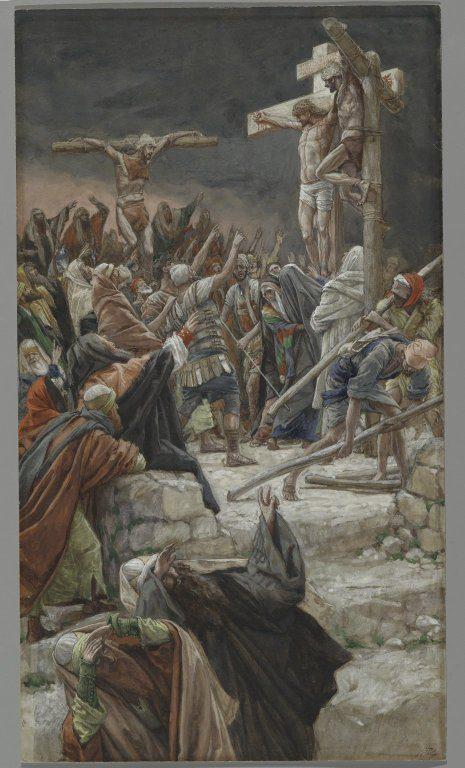
James Tissot, The Pardon of the Good Thief, 1886 to 1894. Public domain.
Luke 23:39 to 43 · Subject · Featured Study
The Criminal on the Cross and Paradise
Luke 23:39 to 43 records a promise of paradise made from the cross to a dying criminal.
John Wesley noted that even the apostles had not yet grasped the kingdom as clearly as this dying man.
And Jesus said to him, “Truly I tell you, today you will be with Me in Paradise.”
And Jesus said to him, “Truly I tell you, today you will be with Me in Paradise.”
- Books
- Luke, Matthew, Mark, 2 Corinthians, Revelation
- Hold in memory
- Luke 23:42
Summary
Two criminals were crucified with Jesus. Luke alone tells what one of them asked and what Jesus said.
- Ambrose of Milan said the second man may have mocked Jesus first and then been changed.
- Adam Clarke called him the first who believed in the intercession of Christ.
- Albert Barnes traced the word paradise to an old Eastern word for a king's park.
Two Men Beside the Cross
Jesus was crucified at the place called The Skull, with a criminal on His right and another on His left.
One of the criminals who hung there heaped abuse on Him. “Are You not the Christ?” he said. “Save Yourself and us!” But the other one rebuked him, saying, “Do you not even fear God, since you are under the same judgment? We are punished justly, for we are receiving what our actions deserve. But this man has done nothing wrong.”The first man repeats the mockery of the rulers and soldiers, and the second answers him from the same judgment.
Then he said, “Jesus, remember me when You come into Your kingdom!”The man asks for a place in a kingdom while its King is dying beside him.
John Gill noted that Jesus answered the man at once, and that He said not one word to the man who railed at Him.
What Three Gospels Say of the Two Men
The three accounts agree on the crosses and differ on the words spoken from them.
Each Gospel calls the two men by its own word and says what they did.
| Gospel | Its word for the two men | What the men crucified with Him did |
|---|---|---|
| Matthew | Robbers | The two robbers berated Him with the passers-by and the priests. |
| Mark | Robbers | Those crucified with Him berated Him beside the chief priests and scribes. |
| Luke | Criminals | One heaped abuse on Him, and the other rebuked him and asked to be remembered. |
What the Man Asked
Albert Barnes judged the crime of the two men, and the request shows the faith of one.
Albert Barnes took the two men for highwaymen, robbers of the roads, who deserved the death they were given.
John Wesley noted that the man owned Jesus as a king who could help the dead after His own death.
Paradise in Scripture and the Jewish Writers
Paul uses the same word in 2 Corinthians, and so does the letter to Ephesus in Revelation.
was caught up to Paradise. The things he heard were too sacred for words, things that man is not permitted to tell.Paul names paradise as a place a man in Christ was caught up to, beyond telling.
He who has an ear, let him hear what the Spirit says to the churches. To the one who overcomes, I will grant the right to eat from the tree of life in the Paradise of God.The tree of life of Genesis 2 stands in the paradise of God promised to the overcomer.
Adam Clarke reported that the Jewish writers counted four paradises, as they counted seven heavens. He wrote that among Christian writers the word usually means the place of the blessed or the state of departed spirits.
How the Accounts Agree
Ambrose of Milan asked in the fourth century how both men could mock and one rebuke the other.
John Wesley gave two answers in one note. Matthew and Mark may use the plural for one man, as good authors sometimes do, or both men reviled Jesus until one of them was turned by grace.
Theophylact of Ohrid took the second answer. He held that both men reviled Jesus at first, and that one later saw His goodness from the words Jesus spoke.
The Greek Words of the Promise
Three Greek words carry the exchange: the criminals, the day and the place.
κακοῦργος kakourgos, criminal
4 uses in the canon
A wrongdoer, Luke's word for the two men led out with Jesus.
σήμερον sēmeron, today
41 uses in the canon
On this day, the word whose place in the sentence readers dispute.
παράδεισος paradeisos, paradise
3 uses in the canon
A park or garden, used in the Greek Old Testament for the garden of Eden.
The First to Enter
Jerome set the man beside the sword that had guarded Eden since Adam.
Jerome (died 420)
“That flaming, flashing sword was keeping Paradise safe. No one could open the gates that Christ closed. The thief was the first to enter with Christ. His great faith received the greatest of rewards. His faith in the kingdom did not depend on seeing Christ. He did not see him in his radiant glory or behold him looking down from heaven. He did not see the angels serving him. To put it plainly, he certainly did not see Christ walking about in freedom, but on a gibbet, drinking vinegar and crowned with thorns.”
Jerome · On Lazarus and Dives · on Luke 23:43Patristic
Augustine, in a sermon, gave Jesus words to the man: His divinity had never left paradise, though He was about to go down among the dead.
Where the Word Today Belongs
Barnes joins today to the promise, and Bullinger joins it to the words before it.
With Christ in paradise that dayJohn Wesley, Explanatory Notes upon the New Testament (1755), on Luke 23:43; Albert Barnes, Notes, on Luke 23:43
John Wesley defined paradise as the place where the souls of the righteous remain from death till the resurrection. He read the promise as going beyond the request, since Jesus would have the man with Him that very day.
Barnes held that the man looked to a later coming of the Messiah, and that Jesus promised him an answer at his death.
The objection, from Bullinger: the reading depends on punctuation, which rests on human authority alone.
Today joined to I tell youE. W. Bullinger, The Companion Bible, Appendix 173
Bullinger joined today to the words before it, by a Hebrew way of speaking that sets this day beside the act of saying. He held that the Greek has no word for that before today, so the context must decide where it belongs.
The objection, from Adam Clarke: he called the comma after today a most feeble and worthless criticism.
A Kingdom Asked of a Dying King
Luke sets the man's request after the prayer of Jesus for the men who crucified Him (Luke 23:34).
Sources
Scripture is the Berean Standard Bible.
- Strong's lexicon entries g2557, g4594 and g3857, with their counts of uses.
- John Wesley, Explanatory Notes upon the New Testament (1755), on Luke 23:39, Luke 23:42 and Luke 23:43.
- Ambrose of Milan, on Luke 23:39 to 43, in Thomas Aquinas, Catena Aurea.
- Theophylact of Ohrid, Commentary on Luke (1107), on Luke 23:39 to 42.
- Albert Barnes, Notes, Explanatory and Practical (1832 to 1869), on Luke 23:41, Luke 23:43 and 2 Corinthians 12:4.
- Adam Clarke, Commentary on the Bible (1832), on Luke 23:42, Luke 23:43 and 2 Corinthians 12:4.
- E. W. Bullinger, The Companion Bible, Appendix 173, To-day (Luke 23:43)
- John Gill, Exposition of the New Testament (1746 to 1748), on Luke 23:43.
- Jerome, On Lazarus and Dives.
- Augustine of Hippo, Sermon 285.2.
Keep Studying
People and groups1
Symbols2
Go further8