
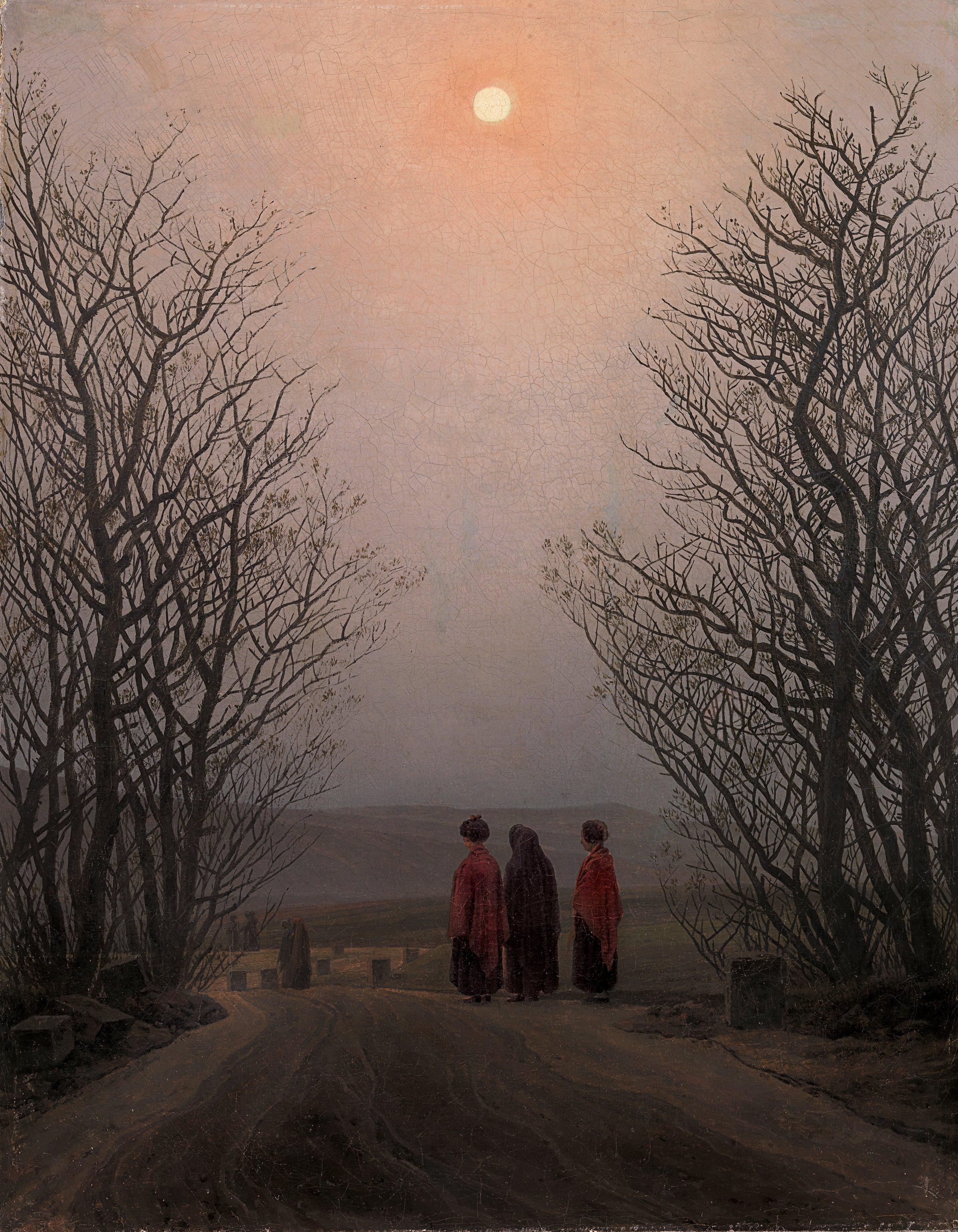
Caspar David Friedrich, Easter Morning, 1828 to 1835. Public domain.
1 Corinthians 15:3 to 4 and 1 Corinthians 5:7 · Subject · Featured Study
Easter
Easter is the feast at which Christians keep the resurrection of Jesus each year, on a spring Sunday near the Jewish Passover.
In 2027 the Western churches keep Easter on 28 March, and the Orthodox on 2 May.
But Christ has indeed been raised from the dead, the firstfruits of those who have fallen asleep.
But Christ has indeed been raised from the dead, the firstfruits of those who have fallen asleep.
- Books
- 1 Corinthians, Mark, Leviticus
- Hold in memory
- 1 Corinthians 15:20, 1 Corinthians 5:7
Summary
Easter takes its date from the Passover, and the Romance languages take its name from it too.
- It falls in spring because He died at the Passover and rose on the Sunday after it.
- The English name has a history of its own, which Bede records.
- Its date moves each year, and the Eastern churches often keep it on a later Sunday.
What Easter Is
In 1909 the Catholic Encyclopedia named Easter the principal feast of the church's year.
Frederick Holweck, who wrote that article, also calls it the oldest feast of the church. He says it keeps both the slaying of the Lamb of God and the resurrection.
For what I received I passed on to you as of first importance: that Christ died for our sins according to the Scriptures, that He was buried, that He was raised on the third day according to the Scriptures,Paul hands on to Corinth the message the feast keeps.
And if Christ has not been raised, our preaching is worthless, and so is your faith.Paul rests the whole faith on the rising.
Lewis sets the rising apart from every event before it.
“The New Testament writers speak as if Christ’s achievement in rising from the dead was the first event of its kind in the whole history of the universe.”
C.S. Lewis · Miracles (Geoffrey Bles, 1947), ch. XVI, Miracles of the New Creation · on 1 Corinthians 15:20High-Church Anglican
When Easter Falls
The date moves from year to year, as the Passover's did.
Holweck explains why Easter has no fixed date. He writes that the 15th of Nisan moved from date to date on the Julian calendar.
At Rome, he writes, the Sunday after the 14th of Nisan became the yearly feast.
The next five years, set side by side.
| Year | Western Easter | Orthodox Pascha | Same Sunday |
|---|---|---|---|
| 2027 | 28 March | 2 May | no |
| 2028 | 16 April | 16 April | yes |
| 2029 | 1 April | 8 April | no |
| 2030 | 21 April | 28 April | no |
| 2031 | 13 April | 13 April | yes |
Why Easter Falls Near the Passover
Mark sets the Last Supper on the day the Passover lamb was killed.
On the first day of the Feast of Unleavened Bread, when the Passover lamb was to be sacrificed, Jesus’ disciples asked Him, “Where do You want us to prepare for You to eat the Passover?”Mark ties the Last Supper to the Passover meal itself.
Very early on the first day of the week, just after sunrise, they went to the tomb.The women went out on the morning every Easter keeps.
Jamieson, Fausset and Brown, in their Commentary of 1871, note that the day after the Passover Sabbath was the day of the firstfruits. They add that it was the same day on which Christ rose.
“Speak to the Israelites and say, ‘When you enter the land that I am giving you and you reap its harvest, you are to bring to the priest a sheaf of the firstfruits of your harvest. And he shall wave the sheaf before the LORD so that it may be accepted on your behalf; the priest is to wave it on the day after the Sabbath.Paul's word firstfruits in 1 Corinthians 15:20 points back to this sheaf.
The same commentators think Paul wrote this letter about the time of the Passover.
Get rid of the old leaven, that you may be a new unleavened batch, as you really are. For Christ, our Passover lamb, has been sacrificed.Paul calls Christ the Lamb of the feast.
John Wesley comments on this verse in his Explanatory Notes upon the New Testament. He reads the Jewish Passover as only a type of Christ, slain for His people.
Leviticus 23:10 to 11, 1 Corinthians 5:7
Where the Name Easter Comes From
The church's own name for the feast is the Greek word for Passover.
פֶּסַח pesach
49 uses in the canon
The Passover: the festival, or the lamb offered at it.
πάσχα pascha
29 uses in the canon
The Passover: the meal, the day, the festival or its sacrifices.
The Catholic Encyclopedia gives pascha as the Aramaic form of the Hebrew pesach.
The Romance languages kept that word: Latin has Pascha, Italian Pasqua, Spanish Pascua and French Pâques.
English took another word, the Anglo-Saxon eâster, and German has Ostern.
Bede, in The Reckoning of Time, written in 725, ties the English name to Estre, a goddess.
The Catholic Encyclopedia adds that this goddess is otherwise unknown.
He arrested him and put him in prison, handing him over to be guarded by four squads of four soldiers each. Herod intended to bring him out to the people after the Passover.The King James Version gives Easter here for pascha, and the Berean text gives Passover.
He Has Risen
The feast repeats each spring the news the women heard on the first morning.
But he said to them, “Do not be alarmed. You are looking for Jesus the Nazarene, who was crucified. He has risen! He is not here! See the place where they put Him.The angel gives the women the first Easter message at the tomb.
Sources
Scripture is the Berean Standard Bible.
- King James Version, Acts 12:4.
- STEP Bible TBESH and TBESG lexicons, Tyndale House, CC BY 4.0.
- Frederick Holweck, Easter, The Catholic Encyclopedia, volume 5, New York, Robert Appleton Company, 1909.
- Bede, De temporum ratione (The Reckoning of Time), written 725, chapter 15 (the Catholic Encyclopedia cites it as I, v)
- Farmers' Almanac, When Is Easter 2027?, the table Upcoming Easter Dates Through 2032.
- C. S. Lewis, Miracles, Geoffrey Bles, 1947, chapter XVI, Miracles of the New Creation.
- Robert Jamieson, A. R. Fausset and David Brown, Commentary Critical and Explanatory on the Whole Bible (1871), on 1 Corinthians 15:20.
- John Wesley, Explanatory Notes upon the New Testament (1755), on 1 Corinthians 5:7.
Keep Studying
People and groups2
Doctrines7
Subjects4