
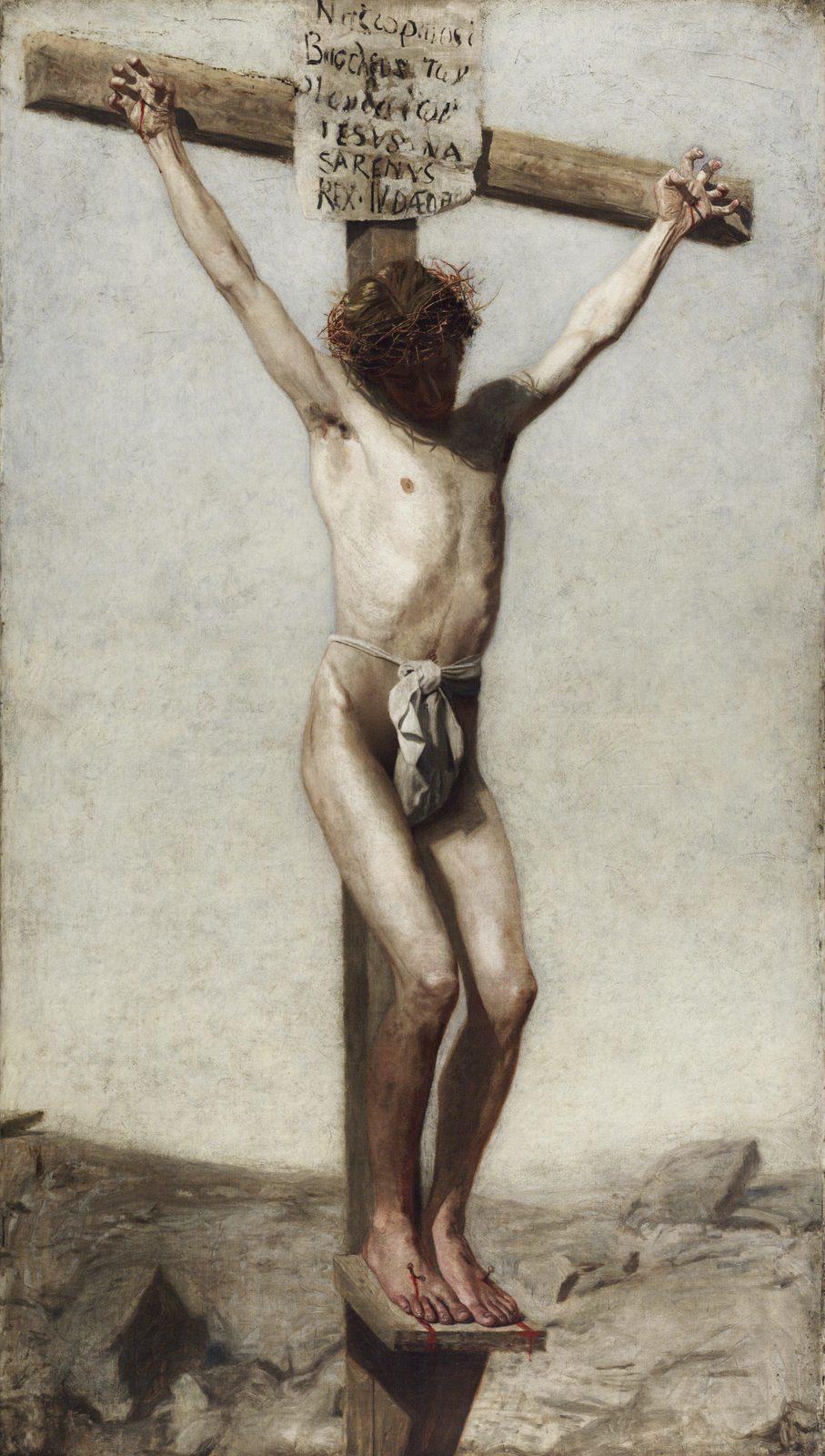
Thomas Eakins, The Crucifixion, 1880. Public domain.
Matthew 27:32 · Symbol · Featured Study
The Cross
In Matthew, Jesus calls His disciples to take up their cross ten chapters before He says that He will be crucified.
The cross in Matthew begins as a call on the road and ends with an empty tomb.
Then Jesus told His disciples, “If anyone wants to come after Me, he must deny himself and take up his cross and follow Me.
Then Jesus told His disciples, “If anyone wants to come after Me, he must deny himself and take up his cross and follow Me.
- The word
- σταυρός (stauros), G4716
- First appears
- Matthew 10:38 “…does not take up his cross and follow…”
Summary
The cross was the beam on which Rome put condemned men to death. In Matthew, Jesus speaks of it first as a call to His followers and then dies on one at Golgotha.
- Sixteen verses of Matthew hold the Greek words for the cross or for crucifying.
- Simon of Cyrene was forced to carry the cross of Jesus on the way out of the city.
- The law of Moses lies behind Paul's word that Christ became a curse.
- Readers since the third century have differed on what taking up the cross asks of a disciple.
Take Up His Cross
The first cross in Matthew is the one Jesus tells His disciples to carry.
and anyone who does not take up his cross and follow Me is not worthy of Me.This is the first verse of Matthew that holds the word for the cross.
Jesus said this to the Twelve as He sent them out (Matthew 10:5).
Jesus gives the call again in Matthew 16:24, three verses after He first foretells His death (Matthew 16:21).
Adam Clarke and Albert Barnes read the saying against the custom that a condemned man carried his own cross to the place of execution.
The Cross in Matthew
Jesus speaks five of the sixteen verses, and the other eleven tell of His trial, His death and His rising.
From the call of the Twelve to the empty tomb, the word passes from the warnings of Jesus to the shout of the crowd and the word of the angel.
- Jesus, sending out the TwelveA disciple takes up his cross.Matthew 10:38
- Jesus, after Peter's rebukeA disciple denies himself and takes up his cross.Matthew 16:24
- Jesus, going up to JerusalemThe Gentiles will crucify the Son of Man.Matthew 20:19
- Jesus, to the scribes and PhariseesThey will crucify some of those He sends.Matthew 23:34
- Jesus, two days before the PassoverHe will be handed over to be crucified.Matthew 26:2
- The crowd before PilateCrucify Him!Matthew 27:22
- The crowd, louderCrucify Him!Matthew 27:23
- PilateHe hands Jesus over to be crucified.Matthew 27:26
- The soldiersThey lead Him away to crucify Him.Matthew 27:31
- Simon of CyreneHe is forced to carry the cross.Matthew 27:32
- The soldiers at GolgothaThey crucify Him and cast lots.Matthew 27:35
- Two robbersThey are crucified with Him.Matthew 27:38
- Those passing byCome down from the cross.Matthew 27:40
- The chief priests, scribes and eldersLet Him come down now from the cross.Matthew 27:42
- The robbers crucified with HimThey berate Him.Matthew 27:44
- The angel at the tombThe women seek Jesus, who was crucified.Matthew 28:5
Each verse of Matthew that holds stauros, stauroō or systauroō, in the order of the Gospel.
The crowd, louder, Pilate, The soldiers, Simon of Cyrene, The soldiers at Golgotha, Two robbers, Those passing by, The chief priests, scribes and elders and 2 more
The Cross Carried to Golgotha
Another man carried the cross Jesus had told His disciples to take up.
Along the way they found a man from Cyrene, named Simon, and they forced him to carry the cross of Jesus.Matthew names Simon and his city.
Jerome set this beside John 19:17. He held that Jesus carried His cross as He went out of the praetorium, and that the soldiers met Simon after that.
Mark adds that Simon was the father of Alexander and Rufus, and that he was coming in from the country (Mark 15:21).
Hung on a Tree
In the law of Moses, the preaching of Peter and the letter to the Galatians, the place of the curse is called a tree.
Christ redeemed us from the curse of the law by becoming a curse for us. For it is written: “Cursed is everyone who is hung on a tree.”Paul quotes Deuteronomy 21:23 here.
Peter told the council that they had killed Jesus by hanging Him on a tree (Acts 5:30). He later wrote that Jesus bore our sins in His body on the tree (1 Peter 2:24).
“In order to redeem us from the curse of the law, Christ became a curse for us. This was demonstrated visibly when He hung on the cross.”
Derek Prince · Redeemed from the Curse (devotional) · on Galatians 3:13Pentecostal-Charismatic
Justin Martyr, in his Dialogue with Trypho, wrote that a curse lies in the law against those who are crucified, yet no curse lies on the Christ of God. In the same passage he wrote that the Father willed His Christ to take upon Him the curses of all.
The Words Behind the Cross
Three Greek words for the cross and crucifying, a Greek word for the tree, and the Hebrew verb for hanging.
σταυρός stauros
27 uses in the canon
A stake set upright, and specially a cross for execution, the word of Matthew 10:38 and Matthew 27:32.
σταυρόω stauroō
46 uses in the canon
To crucify, the word the crowd shouts before Pilate.
συσταυρόω systauroō
To crucify with, used of the robbers beside Jesus.
ξύλον xylon
20 uses in the canon
Wood or a tree, the word Paul and Peter use for the cross.
תָּלָה talah
To hang, the verb of the law on a man hung on a tree.
Come Down from the Cross
The mockers at Golgotha made coming down from the cross the test of His claim.
“He saved others, but He cannot save Himself. He is the King of Israel! Let Him come down now from the cross, and we will believe in Him.The religious leaders join the passers-by of Matthew 27:40.
Jerome answered the promise with a question. He asked which was harder, to come down alive from the cross or to rise from the grave, and he noted that the same men did not believe when Jesus rose.
Gregory the Great wrote that it was a greater thing to rise from the tomb than to come down from the cross.
The Voices
Four teachers on the cross, from the second century to the twentieth.
Ignatius of Antioch (died 108)
Second Epistle of Ignatius to the Ephesians (Syriac)
The cross is salvation to the believer
“My spirit bows in adoration to the cross, which is a stumbling-block to those who do not believe, but is to you for salvation and eternal life.”
on 1 Corinthians 1:18Patristic
Origen of Alexandria (died 253)
COMMENTARY ON MATTHEW 126
The cross is ours to carry too
“‘As they went out, they came upon a man of Cyrene, Simon by name; they compelled this man to carry the cross’ of Christ. It was fitting not only for the Savior to take up his cross but also for us to carry it, doing compulsory service for our salvation. Furthermore, we did not benefit by taking up his cross then as much as we benefit by it now, since he takes it upon himself and carries it.”
on Matthew 27:32Patristic
Isaac Watts (1674 to 1748)
Hymns and Spiritual Songs, London printing of 1818, book 3, hymn 7, stanza 5
Love that demands my all
“Were the whole realm of nature mine, That were a present far too small; Love so amazing, so divine, Demands my soul, my life, my all.”
Independent
J.I. Packer (1926 to 2020)
What Did the Cross Achieve? The Logic of Penal Substitution
The curse passes away
“The curse is the divine condemnation of sin which leads to death. To this curse we lay exposed; but Christ on his cross identified himself with the doom impending on sinners that, through his act, the curse passes away and we go free.”
on Galatians 3:13Reformed Anglican
What Does Taking Up the Cross Ask?
Four readings of the call, from Tertullian to John Wesley.
Readiness for a violent and shameful deathJohn Chrysostom, Homily 35 on Matthew; Tertullian, A Treatise on the Soul; Adam Clarke, Commentary on the Bible, on Matthew 10:38
Chrysostom wrote that Jesus told His hearers to stand against death, and against a death both violent and shameful. Tertullian read the call as the call to martyrdom, the cross borne after the Master.
Clarke wrote that a man who is not ready to suffer death for Christ does not deserve to be called His disciple.
The objection: in Luke the cross is taken up every day (Luke 9:23).
A cross carried every dayJerome, Commentary on Matthew, on Matthew 10:38; John Wesley, Explanatory Notes upon the New Testament, on Luke 9:23
Then Jesus said to all of them, “If anyone wants to come after Me, he must deny himself and take up his cross daily and follow Me.Jerome took the word daily from this verse.
Jerome cited Luke's word daily and wrote that the cross must always be carried. Wesley wrote that a day is lost on which no cross is taken up.
The objection: Matthew 10 sets the saying among warnings of flogging and death (Matthew 10:17 and 21).
Crucified to the worldJerome, Commentary on Matthew, on Matthew 16:24; Hilary of Poitiers, in Thomas Aquinas, Catena Aurea, on Matthew 10:38
I have been crucified with Christ, and I no longer live, but Christ lives in me. The life I live in the body, I live by faith in the Son of God, who loved me and gave Himself up for me.Jerome joined the call to Paul's words of being crucified with Christ.
Jerome wrote that the man who puts off the old self takes up his cross and is crucified to the world. Hilary wrote that in this cross we suffer with Christ, die with Him, are buried and rise again with Him.
The objection: the reading draws its sense from Paul's letters, and the saying in Matthew pictures a condemned man's walk.
Abstinence and compassionGregory the Great, Forty Gospel Homilies, Homily 37
Gregory wrote that the Lord's cross is carried in two ways. One is to keep the flesh under by abstinence, and the other is to make a neighbour's need one's own.
He warned that a man who does either for a passing end carries the cross without going after the Lord.
The objection: the saying names no practice, and the pairing of the two is Gregory's own.
Jesus, Who Was Crucified
The last verse of Matthew to name the cross is spoken by the angel at the empty tomb.
But the angel said to the women, “Do not be afraid, for I know that you are looking for Jesus, who was crucified.The angel names Jesus by His crucifixion and then says He has risen.
He then told the women to come and see the place where He lay (Matthew 28:6).
Paul later called the message of the cross the power of God to those who are being saved (1 Corinthians 1:18). He would boast in nothing except the cross of the Lord Jesus Christ (Galatians 6:14).
Sources
Scripture is the Berean Standard Bible.
- Adam Clarke, Commentary on the Bible (1832), on Matthew 10:38.
- Albert Barnes, Notes, Explanatory and Practical, on Matthew 10:38.
- Jerome, Commentary on Matthew (on 10:38, 16:24, 27:32 and 27:42), and the same notes in Thomas Aquinas, Catena Aurea.
- Gregory the Great, Forty Gospel Homilies, Homilies 21 and 37.
- John Chrysostom, Homilies on the Gospel of Matthew, Homily 35, on Matthew 10:38.
- Tertullian, A Treatise on the Soul, on Matthew 16:24.
- Hilary of Poitiers, in Thomas Aquinas, Catena Aurea, on Matthew 10:38.
- John Wesley, Explanatory Notes upon the New Testament (1755), on Luke 9:23.
- Justin Martyr, Dialogue with Trypho, chapters 94 and 95, on Galatians 3:13.
- Derek Prince, Redeemed from the Curse.
- Origen, Commentary on Matthew 126, on Matthew 27:32.
- Ignatius of Antioch, Second Epistle to the Ephesians (Syriac), on 1 Corinthians 1:18.
- Isaac Watts, Hymns and Spiritual Songs, book 3, hymn 7, stanza 5.
- J. I. Packer, What Did the Cross Achieve? The Logic of Penal Substitution (1974), on Galatians 3:13.
Keep Studying
Read it6
People and groups3
Doctrines5