
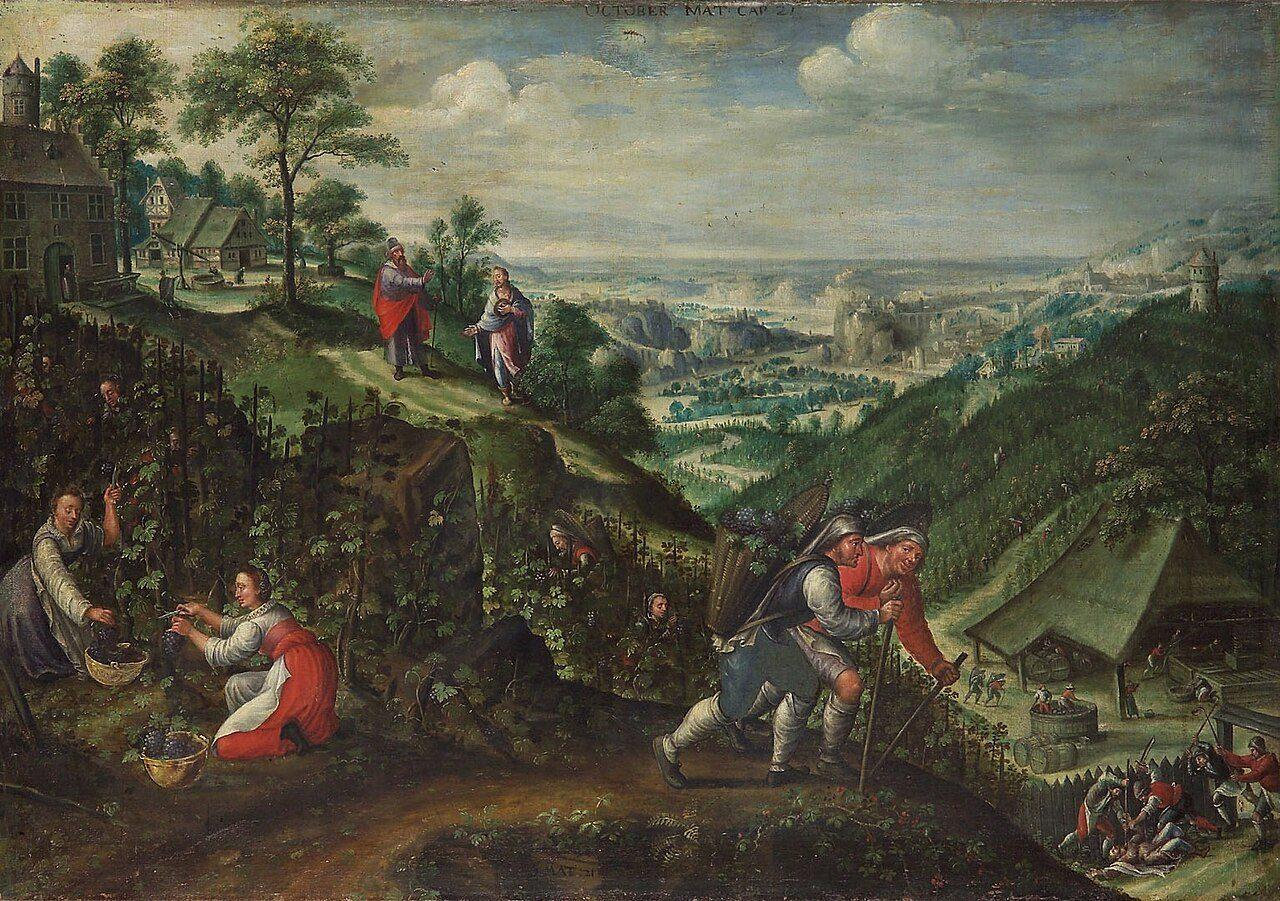
Marten van Valckenborch, Parable of the Wicked Husbandmen, 1580 to 1590. Public domain.
Mark 12:1 to 12 · Passage · Featured Study
The Parable of the Tenants
Jesus told the temple leaders a story of tenants who beat the owner's servants and killed his son.
What then will the owner of the vineyard do? He will come and kill those tenants, and will give the vineyard to others.
- The passage
- Mark 12:1 to 12
- Book
- Mark
- Hold in memory
- Mark 12:10, Isaiah 5:7
The chief priests saw themselves in the killers and sought to seize Him.
Summary
The parable of the tenants is a story Jesus told in the temple in His last week, in Mark 12:1 to 12. A man planted a vineyard and rented it to tenants. They beat and killed the servants he sent for his share, and at last they killed his beloved son. Jesus ended with a psalm about a rejected stone.
- The vineyard's wall, vat and tower come from Isaiah's song of the vineyard, where the vineyard is Israel.
- Peter later quoted the parable's closing psalm to the council in Jerusalem (Acts 4:11).
- Readers differ over why the owner says that the tenants will respect his son.
What the Parable Means
Jesus told the parable to the chief priests, scribes and elders who had asked by what authority He acted.
The leaders had just asked Jesus who gave Him authority to clear the temple (Mark 11:27 to 28). He answered with a story of a vineyard owner whose tenants refused him his fruit and killed his son.
At this, the leaders sought to arrest Jesus, for they knew that He had spoken this parable against them. But fearing the crowd, they left Him and went away.Mark's own comment on the parable tells the reader at whom it was aimed.
J. C. Ryle called it a historical parable, the story of God's dealings with His people for fifteen hundred years told under the figure of a vineyard.
Three Tellings of One Parable
Matthew, Mark and Luke tell the parable with the same son and the same stone, and they differ on the servants and the answer.
All three Gospels send servants, then the son, and end on the rejected stone.
| Point | Mark 12 | Matthew 21 | Luke 20 |
|---|---|---|---|
| The servants | three one at a time, then many others | a first group, then a larger one | one, a second, a third |
| The son | one beloved son, sent last | his son, sent last | my beloved son |
| Who gives the verdict | Jesus | the leaders | Jesus, and the people answer |
| The stone | the psalm, two verses | the psalm, two verses, and a saying on the stone | the psalm, one verse, and a saying on the stone |
In Luke the people answer with a cry that such a thing never happen (Luke 20:16).
“He will bring those wretches to a wretched end,” they replied, “and will rent out the vineyard to other tenants who will give him his share of the fruit at harvest time.”The hearers' own answer becomes the judgment Jesus turns on them two verses later.
The Servants and the Son
Each messenger met worse treatment, and the last one sent was the heir.
Pseudo-Jerome matched the parable to Israel's history.
“The servants who were sent were the prophets, the fruit of the vineyard is obedience; some of the prophets were beaten, others wounded, others slain. Wherefore it goes on, And they caught him, and beat him, and sent him away empty.”
Pseudo-Jerome · Catena Aurea by Aquinas · on Mark 12:2 to 5Patristic
Finally, having one beloved son, he sent him to them. ‘They will respect my son,’ he said.The owner's hope rests on who this messenger is, his own heir.
The tenants knew the son as the heir and killed him for the inheritance (Mark 12:7 to 8). Adam Clarke read their words as an admission in their consciences that He was the Messiah, the heir of all things.
The Vineyard Given to Others
The new tenants are named in two ways, as the Gentiles or as the apostles.
Therefore I tell you that the kingdom of God will be taken away from you and given to a people who will produce its fruit.The saying names the kingdom as the thing the vineyard stood for.
Matthew Henry saw the owner's word fulfilled when the Gentiles were taken in and the gospel bore fruit in all the world.
Adam Clarke named the new tenants as the apostles and evangelists. Under their ministry, he wrote, multitudes were brought to God before Jerusalem was destroyed.
Isaiah's Vineyard Behind the Story
Jesus built His story on a song His hearers already knew.
Jesus opened with a man who planted a vineyard, put a wall around it, dug a wine vat and built a watchtower (Mark 12:1).
He dug it up and cleared the stones and planted the finest vines. He built a watchtower in the middle and dug out a winepress as well. He waited for the vineyard to yield good grapes, but the fruit it produced was sour!Isaiah's song is God's complaint against His vineyard, and the parable carries it on.
For the vineyard of the LORD of Hosts is the house of Israel, and the men of Judah are the plant of His delight. He looked for justice, but saw bloodshed; for righteousness, but heard a cry of distress.The song's last line explains its picture, the way the hearers of Jesus knew it.
In Isaiah the vineyard itself fails to give good grapes. In the parable the vineyard bears its fruit, and the tenants keep it from the owner.
The Rejected Stone
A stone the builders threw away becomes the stone that holds the building together.
The stone the builders rejected has become the cornerstone. This is from the LORD, and it is marvelous in our eyes.With the psalm Jesus turns the story's end from the son's death to his vindication.
The crowds had cried Hosanna from the same psalm a few days before (Mark 11:9 and Psalm 118:26). Adam Clarke noted that the Jewish commentators Solomon Jarchi and Abarbanel read the stone as the Messiah. He judged that the psalm was first spoken of David, whom the rulers rejected and the Lord then chose.
They Will Respect My Son?
The owner's hope for his son looks foolish, and readers from the fourth century on explain it three ways.
God foreknew it, and the words state His dueAmbrose of Milan, Exposition of the Christian Faith, Book 5
Ambrose held that God can be neither in doubt nor deceived. He read Matthew and Mark as declaring that respect will be shown to the son, though Luke sounds as if the outcome were in doubt.
The objection: Luke's wording sets a question and a perhaps in the owner's mouth (Luke 20:13).
Spoken as a doubt, to leave the tenants freeBede, in Thomas Aquinas, Catena Aurea, on Mark 12:6
Bede held that the owner's words were not spoken in ignorance. God is said to doubt, in his reading, so that freedom of will may be left to man.
The objection: a hope spoken only to leave room for the hearers asks the reader to take the owner's words as less than he meant.
Spoken in ironyPseudo-Jerome, in Thomas Aquinas, Catena Aurea, on Mark 12:6
“The well-beloved son and the last is the Only-begotten; and in that He says, They will reverence my son, He speaks in irony.”
Pseudo-Jerome · Catena Aurea by Aquinas · on Mark 12:6Patristic
The objection: nothing in the telling marks the owner's words as irony, and Luke gives them as the owner's own question to himself (Luke 20:13).
The Heir Cast Out
Within days the leaders the parable named handed Jesus over to be crucified outside the city.
The tenants threw the son out of the vineyard, and Jesus was led out to be crucified at Golgotha (Mark 15:20 to 22). The letter to the Hebrews says where that place stood.
And so Jesus also suffered outside the city gate, to sanctify the people by His own blood.Hebrews makes the place outside the gate a pattern for believers in the next verse.
Sources
Scripture is the Berean Standard Bible.
- J. C. Ryle, Expository Thoughts on the Gospels: Mark (1857), on Mark 12:1 to 12.
- Pseudo-Jerome (date not known), on Mark 12, in Thomas Aquinas, Catena Aurea (1264)
- Adam Clarke, Commentary on the Bible (1832), on Mark 12:7, Mark 12:9 and Matthew 21:42.
- Ambrose of Milan, Exposition of the Christian Faith, Book 5 (fourth century), on Mark 12:6.
- Bede (735), on Mark 12:6, in Thomas Aquinas, Catena Aurea (1264)
- Matthew Henry, Commentary on the Whole Bible (1710), on Mark 12:9.
Keep Studying
Read it6
Studies5
People and groups2
Go further4
Places1
Doctrines1