
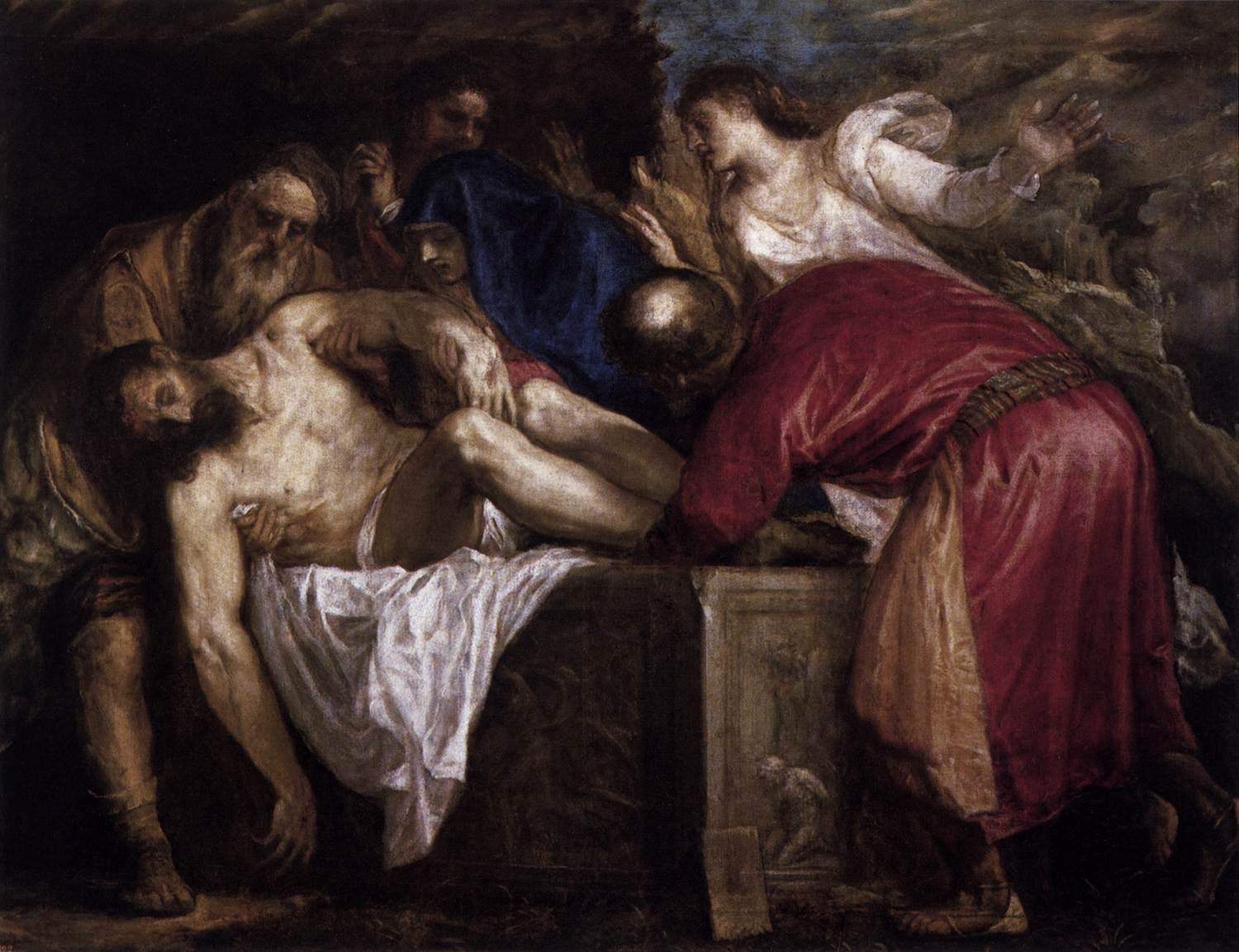
Titian, The Burial of Christ, 1559. Public domain.
Isaiah 53 · Passage · Featured Study
The Rich Man's Tomb of Isaiah 53:9
Isaiah 53:9 places the servant's grave among wicked men and beside a rich man, and the old copies and translations word that line in different ways.
He was assigned a grave with the wicked, and with a rich man in His death, although He had done no violence, nor was any deceit in His mouth.
- The passage
- Isaiah 53:9, 1 Peter 2:22
- Books
- Isaiah, 1 Peter
- Hold in memory
- Isaiah 53:9
The Hebrew says the servant was with a rich man in His deaths, in the plural.
Summary
The verse tells where the servant was buried, and Peter applies its last line to Jesus.
- The Qumran scroll of Isaiah writes a word that one scholar reads as a tomb.
- The old Greek and Aramaic translations turn the line into a word about the wicked and the rich given up.
- Readers divide over whether the rich man points to the tomb of Joseph of Arimathea.
The Verse in the Song
The verse closes the part of the song that follows the servant from His silence to His grave.
By oppression and judgment He was taken away, and who can recount His descendants? For He was cut off from the land of the living; He was stricken for the transgression of My people.His life is taken by an unjust sentence before the grave is named.
The Suffering Servant page sets out the whole song and reads Isaiah 53:7 to 9 as one stanza.
The Verse in the Old Witnesses
Four witnesses give the line, the Hebrew in two English forms.
The witnesses differ over who gives the grave and to whom.
| Witness | Its words for the grave line | What it shows |
|---|---|---|
| The Hebrew text, in the Berean | a grave with the wicked ... a rich man in His death | The wicked are many and the rich man is one |
| The Hebrew, word by word | and someone assigned ... with a rich person ... in His deaths | The verb names no one |
| The Great Isaiah Scroll | A word that Peter J. Gentry, writing in 2022, reads as a funerary mound or tomb | Gentry says the scroll is the sole witness to this form |
| The Septuagint, in Brenton's English | And I will give the wicked for his burial, and the rich for his death | God speaks and gives the wicked and the rich |
| The Targum, in the London translation of 1871 | he shall deliver the wicked into hell, and the riches of treasures which they got by violence unto the death of Abaddon | The wicked and ill-gotten riches are given up to judgment |
The Qumran copy was found by the Dead Sea. The Septuagint is the old Greek translation of the Scriptures of Israel, and the Aramaic is a rendering of the Prophets read in the synagogue.
Someone Assigned the Grave
The Hebrew verb is singular and names no one, so commentators ask who gave the grave.
The Cambridge Bible calls the subject indefinite, so that the verb works like a passive: his grave was made. The Pulpit Commentary and Ellicott read it the same way, one or they assigned Him a grave.
Albert Barnes lists three ways to read it. Someone in general gave the grave, or the LORD's people did, or God did. He takes the first. Keil and Delitzsch rule out the LORD as the subject, because the next verse sets the LORD apart as the one who willed to crush Him.
Yet it was the LORD’s will to crush Him and to cause Him to suffer; and when His soul is made a guilt offering, He will see His offspring, He will prolong His days, and the good pleasure of the LORD will prosper in His hand.This is the verse Keil and Delitzsch cite for their reading.
In His Deaths
The commentators read the plural noun in four ways.
Keil and Delitzsch read the plural as heightening a violent death, whose pain is like dying again and again. Matthew Poole reads it of the many kinds of death the servant underwent. The Cambridge Bible would read the singular, with the Septuagint.
Adam Clarke follows Lowth and reads a different word, high places, meaning a mound of earth over a grave. He reports it written out in full in sixteen manuscripts and the two oldest printed editions. Albert Barnes answers that the reading is opposed to all the ancient versions.
The Innocent Servant
The second half of the verse names the servant innocent, and the New Testament quotes it.
“He committed no sin, and no deceit was found in His mouth.”Peter uses the line to show Christ's people how to suffer.
When they heaped abuse on Him, He did not retaliate; when He suffered, He made no threats, but entrusted Himself to Him who judges justly.Peter sets the servant's silence beside Christ's silence before His accusers.
The Pulpit Commentary notes that the joining word can mean because or although, and the Berean has although. Peter writes that He committed no sin, where Brenton's Septuagint says he practised no iniquity.
Where Readers Divide
Two commentaries read the rich man in opposite ways.
The Pulpit Commentary finds in the words a singularly exact fulfilment in the burial of Jesus. Ellicott reads the rich as the wrongfully rich, set beside the wicked in the same verse.
After the Grave
After the anguish of His soul, He will see the light of life and be satisfied. By His knowledge My righteous Servant will justify many, and He will bear their iniquities.The verse after the grave gives the servant life beyond it.
Sources
Scripture is the Berean Standard Bible.
- Brenton Septuagint Translation, Esaias 53:9.
- Targum Jonathan on Isaiah 53:9, the London Chaldee Paraphrase of 1871, public domain.
- Peter J. Gentry, Part 3: The Servant's Burial according to the Scriptures, Text and Canon Institute, 2022.
- The Cambridge Bible for Schools and Colleges; the Pulpit Commentary; Ellicott; Keil and Delitzsch; Matthew Poole; Albert Barnes; Adam Clarke; each on Isaiah 53:9.
Keep Studying
Subjects1
People and groups3
Go further1