MANNAFEST

History · 1 Kings

Glory and Fracture

1 Kings is the Bible’s great cautionary glory-story. The God who fills Solomon’s temple with unapproachable light also watches the kingdom he built tear in two within one generation — because wisdom without a whole heart cannot save a throne, and only a greater Son of David, heard in the still small voice, ever will. Ten chapters climb; one chapter falls; eleven more never fully recover.

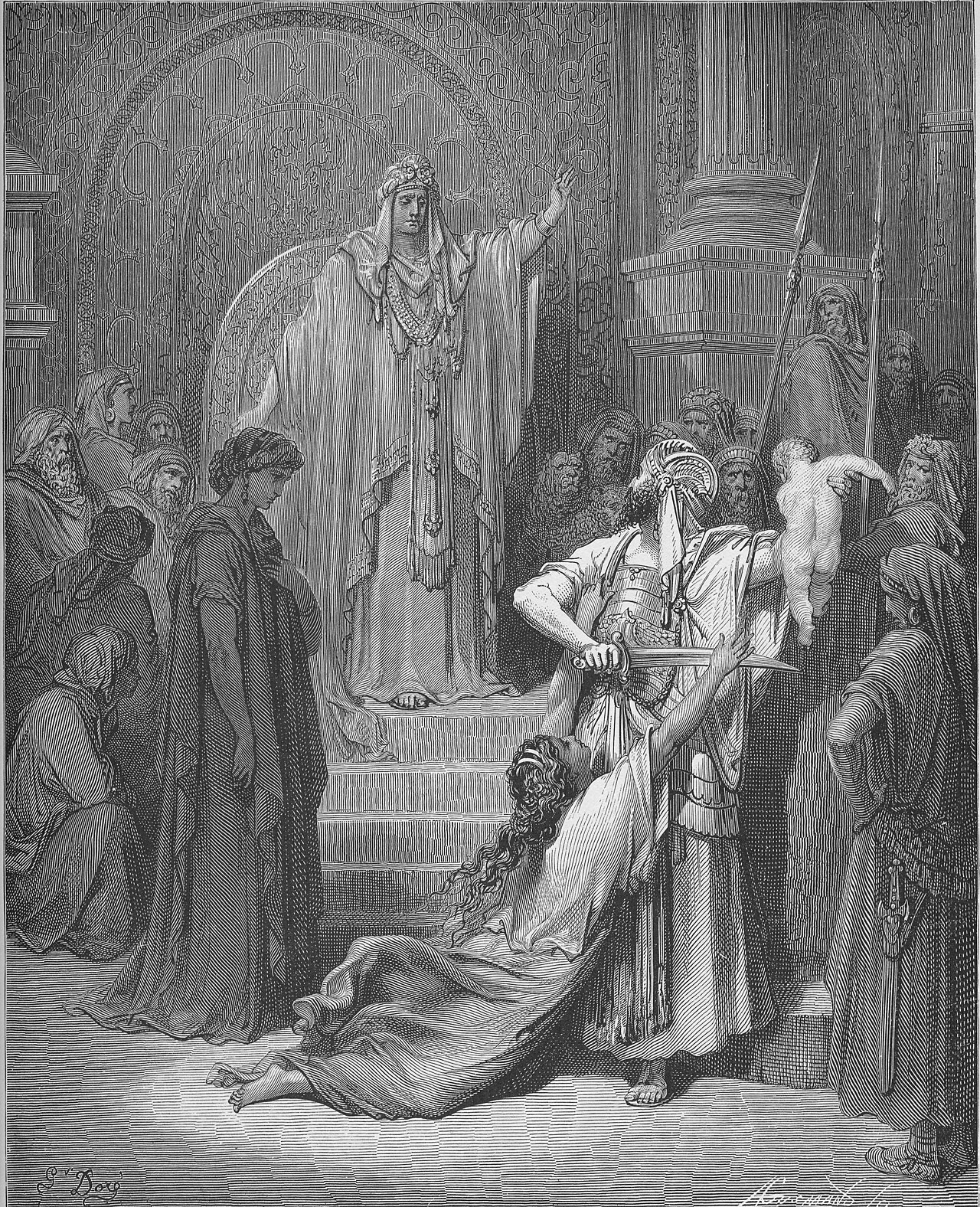
The Judgment of Solomon — Gustave Doré
The sword and the living child — the wisdom of God in him, to do judgment — Gustave Doré, Doré’s English Bible (1866), public domain · 1 Kings 3:24-28

The Arc

the book's own claimed shape — a chiasm of fortune, every chapter a door

1 Kings tells one continuous story in two movements: ten chapters of ascending glory, then a single chapter of apostasy that the rest of the book never recovers from. The profile below is MannaFest’s schematic reading of that shape — not a quantitative measurement, but the book’s own argument, chapter by chapter.

David's Throne, SecuredAn Understanding HeartThe House for the NameAs High as the Book Ever ClimbsThe PivotWhips and Scorpions“In the Way of His Father”The Prophet Who Rules the King
  1. David's Throne, Secured1 Kings 1:1–2:46

    David old and failing; Adonijah's coup attempt; Nathan and Bathsheba move fast. Solomon is crowned and clears the field — Adonijah, Joab, Shimei — before a single line of policy is written.

  2. An Understanding Heart1 Kings 3:1–4:34

    At Gibeon Solomon asks not for riches or long life but wisdom to judge God's people (3:9). The verdict on the two harlots proves the gift is real; his fame and administration reach the encomium of 4:29–34.

  3. The House for the Name1 Kings 5:1–8:66

    Seven years (6:38) to build the temple, from Hiram's Tyrian cedar and Phoenician craft, its furnishings detailed room by room. Solomon's own house takes thirteen (7:1) — the text states both numbers and lets the contrast speak for itself.

  4. As High as the Book Ever Climbs1 Kings 8:1–10:29

    The ark comes in; the cloud fills the house so the priests cannot stand to minister (8:10–11). God appears a second time and restates the promise — conditioned (9:1–9). The Queen of Sheba travels from the ends of the earth to marvel. Worldly glory at its absolute peak.

  5. The Pivot1 Kings 11:1–43

    700 wives, 300 concubines, and wives who “turned away his heart after other gods” (11:4). One chapter undoes ten. The book's central irony: the wisest king who ever lived cannot keep his own heart whole before God.

  6. Whips and Scorpions1 Kings 12:1–13:34

    Rehoboam's folly at Shechem splits the house of David in two. Jeroboam sets up golden calves at Bethel and Dan in Aaron's own words (12:28 // Exod 32:4) — the north's founding sin is the oldest sin, reasserted.

  7. “In the Way of His Father”1 Kings 14:1–16:34; 20:1–43; 22:41–53

    A fixed regnal formula carries a dozen kings past in a few verses each, judged by one standard. Judah keeps David's line and its high places; Israel spirals through five houses in two generations until Omri founds Samaria and Ahab out-sins them all.

  8. The Prophet Who Rules the King1 Kings 17:1–19:21; 21:1–29

    The narrative slows to its most vivid register: the Tishbite fed by ravens, the widow's oil, fire down on Carmel — and then wind, earthquake, fire, and, at last, a still small voice (19:12).

The Elijah cycle (17–19, 21) is not a separate era on the political timeline — it is woven through the alternating-kings section, standing out on purpose. The prophetic word cuts across the throne’s decline rather than running alongside it.

“But will God indeed dwell on the earth? Can we imagine that a Being infinitely high, and holy, and happy, will stoop so low as to let it be said of him that he dwells upon the earth and blesses the worms of the earth with his presence--the earth, that is corrupt, and overspread with sin--cursed, and reserved to fire?”

Matthew Henry, Commentary on the Whole Bible (1710), on 1 Kings 8:27 — public domain

The Argument

the whole book in three sentences
Attribution
Anonymous compiler; Jewish tradition names Jeremiah
Span
970s–850s BC narrated · final form compiled in or after the exile
Genre
Theological history — royal covenant-lawsuit
Shape
22 chapters · one continuous book with 2 Kings
  1. 1

    Solomon inherits David's throne, asks for wisdom rather than wealth, and builds the temple where the glory of the LORD comes to dwell among Israel exactly as it dwelt in the tabernacle — the high point of the whole historical corpus.

  2. 2

    But Solomon's foreign wives turn his heart after other gods, and the kingdom he built is torn in two under his son, splitting into a Davidic south and a calf-worshipping north that never has a single good king.

  3. 3

    The book's second half alternates the two kings' short, mostly-failing reigns against the towering figure of Elijah, YHWH's covenant prosecutor, who wins total public victory at Carmel and then meets God not in wind or fire but in a still small voice.

Christ in 1 Kings

four lines run from this book to Him
Solomon, exceeded — “a greater than Solomon”4:24–25; 10:1–13 → Matt 12:42; Luke 11:31; 1 Cor 1:24, 30

Solomon reigns in peace over a kingdom at rest and draws one queen from the ends of the earth to marvel and depart. Jesus names him the standard he exceeds, in the very discourse that quotes Isaiah's gentle Servant who “will not cry, nor lift up his voice” — MannaFest reads that as an echo of the still-small-voice pattern of ch. 19. Christ is not merely wiser than Solomon; He is “the wisdom of God,” drawing the nations to Himself permanently.

Open the study →
The glory-filled house → the Word tabernacled8:10–11, 27 → John 1:14; John 2:19–21

The cloud that fills Solomon's temple is the direct escalation of the tabernacle's completion (Exod 40:34–35) — tent becomes house. John pointedly answers it: the Word “dwelt among us, and we beheld his glory,” with a verb (eskēnōsen) that means pitched his tent — tabernacled — and Jesus names His own body the true temple. Solomon's prayer that God's eyes stay open toward this house anticipates a greater high-priestly intercession — not toward a building, but as a Person.

The everlasting kingdom, tested and preserved9:4–5 → 2 Sam 7:12–16 → Luke 1:32–33

God restates the Davidic throne's perpetuity as conditioned on obedience — the very promise this book shows crumbling under Solomon's own sons. The honest record of that collapse throws the reader back onto the unconditional core of the Davidic covenant, resolved in Jesus, Son of David, whose kingdom — unlike Solomon's — cannot be divided or lost.

Elijah, the forerunner-type — fulfilled in John the BaptistMal 4:5–6 → Matt 17:11–13; Luke 1:17; Luke 9:30–31; Jas 5:17–18

Jesus applies Malachi's promised return of “Elijah the prophet” to John the Baptist. Elijah himself stands with Moses at the Transfiguration, speaking of Christ's coming “exodus” — law and prophecy together attesting Him. James cites Elijah's Carmel-adjacent prayer life — “a man of like passions with us” — as the pattern for every believer's praying.

Open the study →

Themes

six load-bearing lines through the book
01

Wisdom as covenant discernment, not cleverness

1 Kings 3:9, 16–28; 4:29–34; 11:1–8

Solomon asks for an understanding heart to judge God's people rightly, not personal advancement. Its failure to anchor his own heart (11:1–8) is the book's central irony: knowledge of God's ways is not loyalty to God.

02

The temple as the dwelling-place of glory

1 Kings 8:10–11, 27

The cloud fills the house so the priests cannot stand to minister — the direct escalation of Exodus 40. Solomon's own prayer immediately relativizes the building: the temple is a sign of presence, never a container of it.

03

Covenant conditionality held with the unconditional promise

1 Kings 9:1–9; cf. 2 Sam 7:12–16

God's second appearance restates temple and throne as conditioned on obedience, echoing Deuteronomy 28 — while the underlying Davidic covenant's ultimate perpetuity was unconditional. 1 Kings shows the conditional layer executing while the promise survives underneath.

04

Idolatry as covenant adultery, syncretism the recurring sin

1 Kings 11:1–8; 12:28–33; 16:31–33

Solomon's foreign-wife apostasy, Jeroboam's calves, and Ahab's Baal institutionalization form an escalating sequence — private compromise, then state-sponsored syncretism, then full apostasy.

05

The prophetic word as the true throne over the throne

1 Kings 11:29–39; 18:17–18; 22:8, 14

Ahijah announces the division before it happens; Elijah confronts Ahab to his face; Micaiah alone tells the truth against 400 flattering prophets. Kings rule Israel — prophets rule the kings, in the name of the true King.

06

Revival, exhaustion, and the gentleness of God's voice

1 Kings 18:38; 19:4, 12

Carmel's fire-from-heaven triumph gives way immediately to Elijah's despair under the juniper tree, and God's answer is not another display of power but food, sleep, and — after wind, earthquake, and fire pass — a still small voice.

Original Language

the vocabulary that carries the book's argument

The paradox at the mountain — 19:12

qol demamah daqqah— traditionally “a still small voice,” more literally “a sound of a thin, gentle silence”: qol (“sound, voice”) + demamah (“calm, whisper”) + daq (“thin, fine”). A “sound” of “silence” is itself the theological point — the phrase's precise vocalization is still being confirmed for this workbench.

“Faith comes by hearing the word of God; miracles do but make way for it. Then God spoke to his people with terror; but in the gospel of Christ, which was to be introduced by the spirit and power of Elias, he would speak by a still small voice, the dread of which should not make us afraid; see Heb. xii.”

Matthew Henry, Commentary on the Whole Bible (1710), on 1 Kings 19:12 — public domain

The Approved Voices on 1 Kings

the roster applied — the specific work named, so you can go to it
Chuck Misslercite-only ≤50w

Learn the Bible in 24 Hours

Marcus Brown's formative teacher; the integrated-design lens reads the temple's doubled dimensions against the tabernacle, and the 480-years datum of 6:1, as intentional numeric architecture. Carried as emphasis, with the soundness gate held on any ELS-adjacent claim.

R. C. Sproulcite-only ≤50w

The Holiness of God (1985)

“If we lose our awe of God, we lose our dependence upon Him.” The Isaiah-6 “trauma of holiness” framework is the direct Reformed-register parallel to 8:10–11's glory-cloud and to the terror-then-tenderness shape of 19:11–13.

A. W. Tozercite-only ≤50w

The Knowledge of the Holy (1961) · The Pursuit of God (1948)

A magnificent building means nothing without the cloud — religious activity without God's manifest presence is evangelicalism's defining failure, applied to Solomon's dedication and its later emptied glory.

John Pipercite-only ≤50w

the Christian-Hedonist corpus

God-centered worship oriented to His supremacy and glory — a more cognitive-theological register than the manifest-presence voices, but directly applicable to the temple-dedication scenes.

Bill Johnson · Mahesh Chavda · Vlad Savchukcite-only ≤50w

the manifest-presence / “hosting the presence” corpus

The charismatic-register counter-voice-in-harmony to Sproul and Tozer on the temple-glory scenes: manifest presence as the believer's primary disposition.

Roberts Liardoncite-only ≤50w

the documented revival-pattern teaching

Prayer, repentance, preaching, Spirit-manifestation, social impact, eventual fade — a pattern that maps unusually well onto Carmel followed immediately by Jezebel's threat and Elijah's collapse (18:38–19:4).

Jane Hamoncite-only ≤50w

the prophetic-validation teaching corpus

Scripture-conformity, character-conformity, fruit-conformity, confirming counsel — a lens for reading Micaiah's lone true word against 400 false prophets (22:6–28).

Lee Strobelcite-only ≤50w

the apologetics case-for corpus

The natural apologetic voice for the united-monarchy archaeology debate and the Tel Dan Stele's “House of David” attestation.

Matthew Henrypublic domain

Commentary on the Whole Bible, on 1 Kings

The standard devotional-expository PD commentary; strong on the moral reading of Solomon's request for wisdom as a model prayer, and of Elijah's ministry.

Jamieson, Fausset & Brown (JFB)public domain

Commentary Critical and Explanatory on the Whole Bible

Concise critical-devotional notes, PD; reads Solomon's own words in 8:27 — “the heaven of heavens cannot contain thee” — as guarding Israel against a superstitious view of the building itself.

Keil & Delitzsch (K&D)public domain

Biblical Commentary on the Old Testament: The Books of the Kings

The standard PD critical-conservative philological commentary; the strongest source for the Hebrew and historical detail behind the 480-years datum of 6:1.

John Wesleypublic domain

Explanatory Notes Upon the Old Testament

Brief PD notes in Arminian-Wesleyan register; reads Solomon's “not perfect” heart (11:4) as a warning about gradual, cumulative compromise rather than sudden apostasy.

One honest absence, worth naming so nobody goes looking: Calvin's surviving Old Testament commentary corpus does not include 1–2 Kings — his Institutes discussion of idolatry (Bk. I, ch. 11) is legitimate background but not a verse-by-verse source here. Marcus Brown's own commentary leads above all; within a tier, all voices are equal.

Contested Points

presented at full strength, then MannaFest's flag

The united-monarchy historicity debate

The traditional reading

David and Solomon reigned over a modest, substantial kingdom c. 1010–931 BC, consistent with the text and defensible archaeologically — Kitchen, Mazar's “modified conventional” chronology, and the Tel Dan Stele's “House of David” inscription as extrabiblical attestation of the dynasty.

The low-chronology critique

Israel Finkelstein's school redates key 10th-century strata downward into the 9th century, arguing the monumental gates at Megiddo, Hazor, and Gezer may belong to Omri's dynasty a century later — implying a far smaller, more tribal “united monarchy” than the text's picture of imperial wealth.

MannaFest flag — Present both positions plainly; this is a live, unresolved archaeological argument, not a settled matter. The site does not overclaim material confirmation for details the text itself presents as extraordinary and singular.

1 Kings 6:1's 480 years and the date of the Exodus

The early-date reading

The figure is read as a literal historical total, placing the Exodus c. 1446 BC.

The late-date reading

480 read as a schematic twelve generations of forty years, matched to the store-city “Raamses” (Exod 1:11), pointing to a 13th-century Pharaoh and an Exodus c. 1260/1250 BC.

MannaFest flag — Both are held by conservative scholars; MannaFest presents the arithmetic and both readings openly rather than adjudicating.

How a wise man falls — Solomon's apostasy

The compartmentalization reading

Solomon's wisdom operated in governance and natural observation but was never rooted in a fully surrendered heart — Deut 17:17's explicit warning against a king multiplying wives is violated in plain sight, showing wisdom and covenant loyalty as distinct, separable gifts.

The developmental reading

Some readers hold the fall was gradual accommodation-by-treaty-marriage — standard ANE diplomatic practice — that metastasized over decades rather than a single decisive rejection.

MannaFest flag — Present both readings; Marcus Brown's own commentary on Solomon's fall leads.

The Cast

four linked pages, and the fuller cast the story needs

Also in the story, awaiting their own pages: Bathsheba · Adonijah · Joab and Abiathar (purged) · Zadok and Benaiah (installed) · Hiram, king of Tyre · the Queen of Sheba · Rehoboam · Jeroboam I · Ahijah the Shilonite · Asa and Jehoshaphat · Omri · Ahab and Jezebel · Obadiah (Ahab's God-fearing steward) · the widow of Zarephath · Naboth of Jezreel · Micaiah ben Imlah · Ben-hadad of Syria.

Places

Also in the story, awaiting their own pages: Gibeon (Solomon's dream) · Tyre and Sidon · Ophir · Sheba · Shechem (the division assembly) · Bethel and Dan (the calf shrines) · Zarephath · Horeb / Sinai · Jezreel · Ramoth-gilead.

Keep studying

— more from Israel's Story

Artwork: Peter Paul Rubens, The Judgement of Solomon — public domain. Drafted from MannaFest's research brief on 1 Kings — public-domain commentators (Henry, JFB, Keil & Delitzsch, Wesley) paraphrased, with ledger-confirmed verbatim excerpts, and the founder's approved-voices roster, cite-only for moderns. Scripture ASV. Every cited work — the sources registry →