

1 Kings 17–19 · Featured Study
Elijah on Carmel: the Still Small Voice
One chapter break holds the whole pattern: total public victory, then private collapse, then the gentlest possible re-commissioning. Elijah calls down fire before all Israel and hears them cry “The LORD, He is God”, and within hours he is under a juniper tree asking to die. God’s answer is not another display of power but food, sleep, and, after wind, earthquake, and fire have each passed and each failed to carry Him, a still small voice.
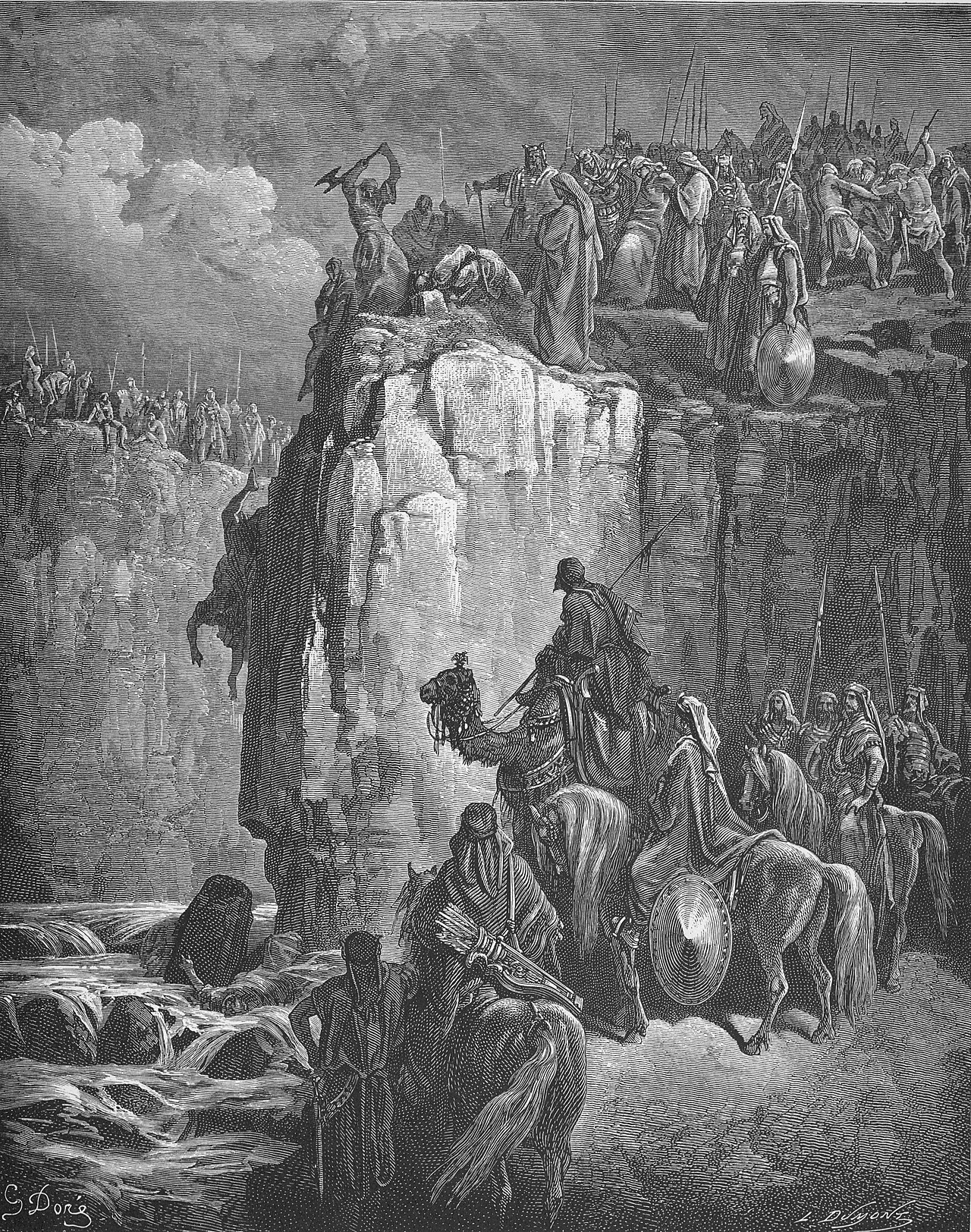
Gustave Doré, The Prophets of Baal Are Slaughtered (1866) — Public domain, via Wikimedia Commons
Summary
The page walks 1 Kings 17 through 19 as one connected sequence, then slows down at Horeb to look closely at the three things that pass before the still small voice arrives.
- The five-stage sequence from Cherith's provision to Carmel's fire to Horeb's voice
- The triple negation at Horeb: wind, earthquake, and fire each pass, and none carry the LORD
- Revival's cost: total public victory followed within hours by private collapse
- The Hebrew behind "a still small voice," qol demamah daqqah
- Elijah as the forerunner Malachi promised, present again at the Transfiguration
The Sequence
provision, contest, collapse, voice, in that order
- 1Cherith and Zarephath1 Kings 17:1–24
Elijah shuts the heavens by his word, is fed by ravens at the brook Cherith, then sent to a Gentile widow in Sidonian territory: her oil and meal do not fail, and her dead son is raised. Provision precedes the public contest; God proves faithful in hiding before He proves Himself in the open.
- 2The challenge1 Kings 18:1–19
Three years into the drought, Elijah confronts Ahab: "I have not troubled Israel, but you and your father's house have" (18:18). Obadiah, Ahab's God-fearing steward who has hidden a hundred prophets in caves, is sent to summon the king to Carmel.
- 3The contest1 Kings 18:20–40
"How long will you waver between two opinions? If the LORD is God, follow Him. But if Baal is God, follow him" (18:21). 450 prophets of Baal cry and cut themselves from morning till evening — no voice, no answer. Elijah rebuilds the LORD's altar, drenches it in water three times, and prays one sentence. Fire falls and consumes everything, including the water in the trench. The people fall on their faces: "The LORD, He is God!"
- 4Collapse1 Kings 18:41–19:8
Elijah prays down rain after three years of drought — then, hearing Jezebel's death threat, runs for his life into the wilderness and asks to die under a juniper tree. God's first answer is not rebuke but food, sleep, and food again, "or the journey will be too much for you" (19:7).
- 5Horeb: the still small voice1 Kings 19:9–18
At the same mountain where the law was given in thunder and fire (Exod 19:16–19), wind, earthquake, and fire each pass, and each time, "the LORD was not in" it. Then a still small voice, and the question repeated: "What are you doing here, Elijah?" God does not rebuke the despair; He recommissions him, and tells him he is not alone: seven thousand have not bowed to Baal.
The Triple Negation
19:11–12: reversing what this same mountain once meant
Horeb is Sinai. This is the same mountain where the law came down in thunder, fire, and a quaking so violent the people trembled (Exod 19:16–19). Elijah’s theophany deliberately reverses that expectation: three great displays arrive, and three times the text explicitly denies that the LORD was in them.
Great and strong, rending mountains and breaking rocks: "the LORD was not in the wind."
Follows the wind: "the LORD was not in the earthquake."
Follows the earthquake, the very sign that answered at Carmel just chapters earlier: "the LORD was not in the fire."
qol demamah daqqah — after the fire, a sound of a thin, gentle silence. Elijah wraps his face and goes out to stand at the entrance.
Revival's Cost
18:38 to 19:4 — the pattern the roster keeps returning to
Fire falls, the nation confesses, the drought breaks, and the very next thing Elijah does is run for his life and ask to die. This is not a contradiction the text is embarrassed by; it is the pattern several of the roster’s revival voices name explicitly: public triumph followed by private cost. God’s first response is not correction but rest and food, “because the journey is too great for thee” (19:7), and only after that, the mountain, and the voice.
James cites this same ministry as the pattern for every believer’s praying: “Elijah was a man of like passions with us, and he prayed fervently... and he prayed again” (Jas 5:17–18), Scripture’s own commentary on the Carmel-to-Horeb sequence.
“Nay, which kept him by his sacrifice when the fire of God fell upon it? He that stood undaunted in the midst of the terrors both of heaven and earth trembles at the impotent menaces of a proud passionate woman. Great faith is not always alike strong.”
Matthew Henry, Commentary on the Whole Bible (1710), on 1 Kings 19:3 — public domain
The Keynote Words
the vocabulary of the mountain
The component parsing of qol demamah daqqah(19:12) is still being confirmed for this workbench — the paradox of a “sound” of “silence” is the theological point either way.
Elijah, the Forerunner
Malachi's promise, fulfilled
Malachi closes the Old Testament promising “Elijah the prophet” before the great and terrible day of the LORD (Mal 4:5–6). Jesus applies it to John the Baptist (Matt 17:11–13), and Elijah himself stands with Moses at the Transfiguration, speaking with Christ about His coming “exodus” (Luke 9:30–31), the man who heard the still small voice on the mountain, present at the moment the Voice speaks from the cloud again: “This is my beloved Son.”
Keep studying
By subject
Courage11 pages
On this page
Studies1
People1
Places1
Doctrines1
Go further1