
1 Kings 3:9
in 1 Kings 3Therefore give Your servant an understanding heart to judge Your people and to discern between good and evil. For who is able to govern this great people of Yours?”
BSB
The same verse in ASV and KJV ▾
ASV
Give thy servant therefore an understanding heart to judge thy people, that I may discern between good and evil; for who is able to judge this thy great people?
KJV
Give therefore thy servant an understanding heart to judge thy people, that I may discern between good and bad: for who is able to judge this thy so great a people?
⋯
This verse in 1 Kings 3
Commentary
10 notes on this verseThe same is seen also in the example of Solomon who asked, not for gold and silver, but for an understanding heart: and so it was given to him. Hence James: "If any of you is wanting in wisdom, let him ask it of God, …
This site's exposition
thy people which thou hast chosen
on 1 Kings 3:8-9
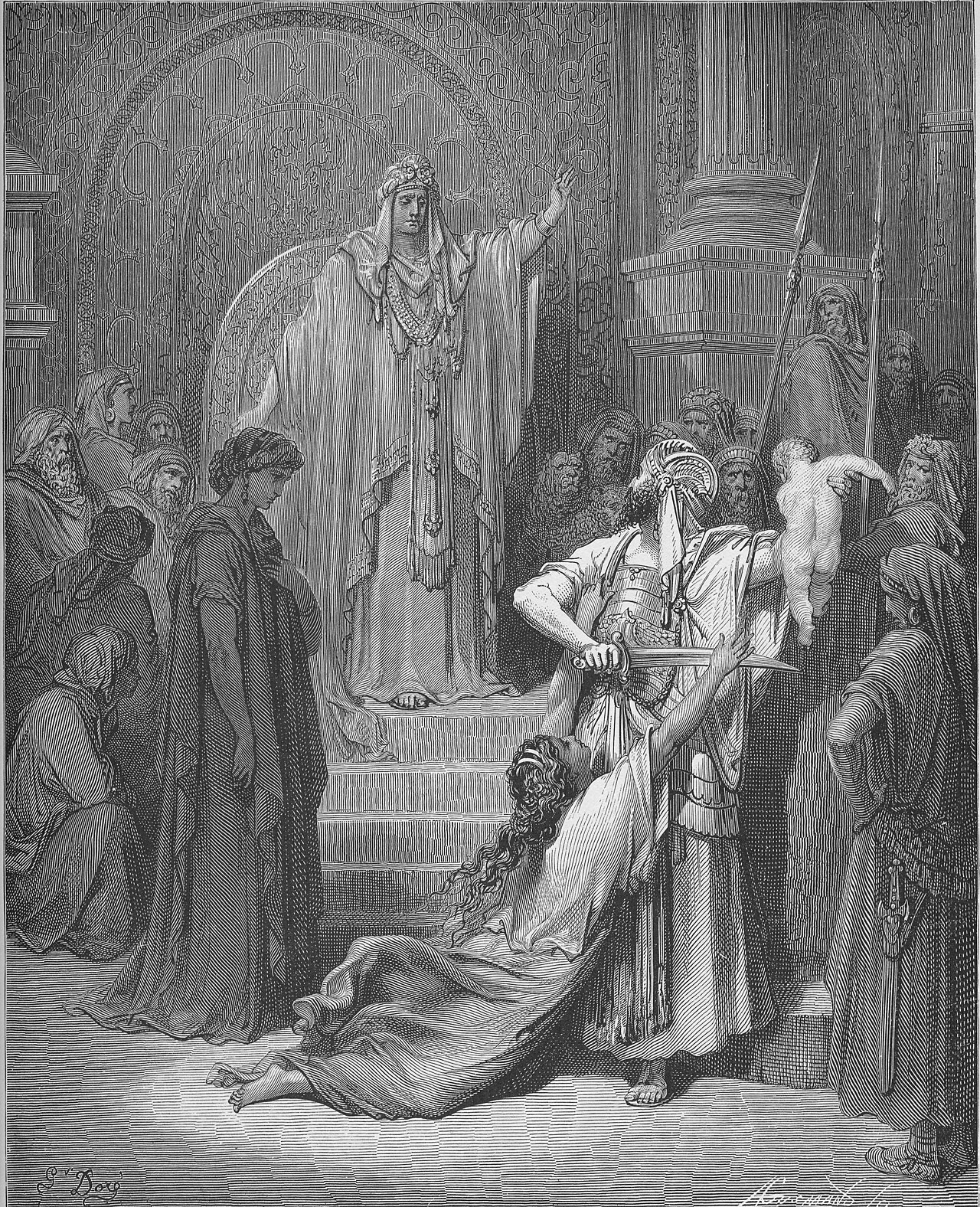
Solomon calls Israel a great people that cannot be numbered nor counted, echoing the promise made to Abraham of a seed too many to count, and grounds his request in the size of the task rather than his own ambition. What he asks is an understanding heart to judge, literally a hearing heart in the Hebrew, fit to discern between good and bad. That phrase, discern between good and bad, reaches forward to the very case the chapter closes with, two claims that sound alike until a hearing heart tells them apart.
This site's exposition
an understanding heart to judge Your people
Albert Barnes notes that hearing and deciding cases was a chief duty of an Eastern king, and Israel's rulers were called judges for that reason. Adam Clarke calls the request the science of government. Bonaventure joins it to the counsel of James to ask God for wisdom.
The record, by era
The Medieval Church1 voice
Do not be foolish in the request you make to God, otherwise you will insult God through your ignorance. Act wisely in prayer so that you may become worthy of glorious things. Ask for things that are honorable from him who will not hold back …
The Puritans and the Awakening4 voices
An understanding heart - Whereby I may both clearly discern, and faithfully perform all the parts of my duty: for both these are spoken of in scripture, as the effects of a good understanding; and he that lives in the neglect of his duties, or the practice of wickedness, is called a fool, and one void of understanding.
That is the best knowledge which will be serviceable to us in doing our duty; and such that knowledge is which enables us to discern between good and bad, right and wrong, sin and duty, truth and falsehood, so as not to be imposed upon by false colours in judging either of others' actions or of our own. The favourable answer God gave to his request. It was a pleasing prayer (
quarantine:debris (2026-07-29) — unbalanced-parens
Give therefore thy servant an understanding heart, to judge thy people,....
Absalom, who was a wise man, trembles at the undertaking and suspects his own fitness for it. The more knowing and considerate men are the better acquainted they are with their own weakness and the more jealous of themselves.
2 more voices on this verse
The Nineteenth Century2 voices
A commentator
Albert Barnes1798–1870
Notes, Explanatory and Practical, on the Old and New Testaments (1832-1869)
One of the chief functions of the Oriental monarch is always to hear and decide causes. Hence, supreme magistrates were naturally called “judges.” (See the introduction to the Book of Judges.) In the minds of the Jews the “judge” and the “prince” were always closely associated, the direct cognisance of causes being constantly taken by their chief civil governors. (See Exo 2:14; Exo 18:16, Exo 18:22; 1Sa 8:20; 2Sa 15:2-6.) Good and bad - i. e. “right and wrong,” “justice and injustice.”
Give - an understanding heart to judge thy people - He did not ask wisdom in general, but the true science of government. This wisdom he sought, and this wisdom he obtained.
The words behind it
19 Hebrew wordsEvery Hebrew word of this verse in the order it stands, with what it means and the door to its own study. The last column counts the times a word stands in the whole Bible: the rarer the word, the more the places it appears belong together.
| Hebrew | Sound | Meaning | Word study | In the Bible |
|---|---|---|---|---|
| וְנָתַתָּ֨ | venatata | and you will give | H5414 → | 2011 times |
| לְעַבְדְּךָ֜ | leavdekha | to servant your | H5650 → | 799 times |
| לֵ֤ב | lev | a heart | H3820 → | 595 times |
| שֹׁמֵ֙עַ֙ | shomea' | [which] listens | H8085 → | 1159 times |
| לִשְׁפֹּ֣ט | lishpot | to judge | H8199 → | 202 times |
| אֶֽת־ | ʾet- | <obj.> | H853 → | 10935 times |
| עַמְּךָ֔ | ʾamekha | people your | H5971 → | 1873 times |
| לְהָבִ֖ין | lehavin | to distinguish | H995 → | 170 times |
| בֵּֽין־ | bein- | between | H996 → | 407 times |
| ט֣וֹב | tov | good | H2896 → | 538 times |
| לְרָ֑ע | lera' | and evil | H7451 → | 662 times |
| כִּ֣י | ki | for | H3588 → | 4482 times |
| מִ֤י | mi | who? | H4310 → | 423 times |
| יוּכַל֙ | yukhal | is he able | H3201 → | 194 times |
| לִשְׁפֹּ֔ט | lishpot | to judge | H8199 → | 202 times |
| אֶת־ | ʾet- | <obj.> | H853 → | 10935 times |
| עַמְּךָ֥ | ʾamekha | people your | H5971 → | 1873 times |
| הַכָּבֵ֖ד | hakaved | <the> massive | H3515 → | 41 times |
| הַזֶּֽה׃ | hazeh | <the> this | H2088 → | 1180 times |
וְנָתַתָּ֨and you will give
venatataH5414 →2011 times
לְעַבְדְּךָ֜to servant your
leavdekhaH5650 →799 times
לֵ֤בa heart
levH3820 →595 times
שֹׁמֵ֙עַ֙[which] listens
shomea'H8085 →1159 times
לִשְׁפֹּ֣טto judge
lishpotH8199 →202 times
אֶֽת־<obj.>
ʾet-H853 →10935 times
עַמְּךָ֔people your
ʾamekhaH5971 →1873 times
לְהָבִ֖יןto distinguish
lehavinH995 →170 times
בֵּֽין־between
bein-H996 →407 times
ט֣וֹבgood
tovH2896 →538 times
לְרָ֑עand evil
lera'H7451 →662 times
כִּ֣יfor
kiH3588 →4482 times
מִ֤יwho?
miH4310 →423 times
יוּכַל֙is he able
yukhalH3201 →194 times
לִשְׁפֹּ֔טto judge
lishpotH8199 →202 times
אֶת־<obj.>
ʾet-H853 →10935 times
עַמְּךָ֥people your
ʾamekhaH5971 →1873 times
הַכָּבֵ֖ד<the> massive
hakavedH3515 →41 times
הַזֶּֽה׃<the> this
hazehH2088 →1180 times
A shaded row is a word that stands 400 times or fewer in the Bible.
The walk
8 stopsEach card is a verse this one points to, and under it the verses that one points to in turn. Where several paths arrive at the same place, that place is listed first: the text keeps returning to it.
Through
James 1:5Now if any of you lacks wisdom, he should ask God, who gives generously to all without finding fault, and it will be given to him.
it leads to
- Proverbs 2:3–6
if you truly call out to insight and lift your voice to understanding,
- John 15:7
If you remain in Me and My words remain in you, ask whatever you wish, and it will be done for you.
- Jeremiah 29:12–13
Then you will call upon Me and come and pray to Me, and I will listen to you.
- Proverbs 3:5–7
Trust in the LORD with all your heart, and lean not on your own understanding;
- 1 John 5:14–15
And this is the confidence that we have before Him: If we ask anything according to His will, He hears us.
- Proverbs 2:3–6
Through
John 5:30I can do nothing by Myself; I judge only as I hear. And My judgment is just, because I do not seek My own will, but the will of Him who sent Me.
it leads to
Through
Hebrews 5:14But solid food is for the mature, who by constant use have trained their senses to distinguish good from evil.
it leads to
- 1 Corinthians 2:14–15
The natural man does not accept the things that come from the Spirit of God. For they are foolishness to him, and he cannot understand them, because they are spiritually discerned.
- 1 Corinthians 2:14–15
Where this verse is studied
By subject
Wisdom35 verses
On this page
About 1 Kings
This page draws on 9 works. Open the list of works
This page draws on Adam Clarke, Commentary on the Bible; Albert Barnes, Notes, Explanatory and Practical, on the Old and New Testaments (1832-1869); Bonaventure, Collations on the Hexaemeron, Collation 2; Isaac of Nineveh, DISCOURSE 3; John Gill, Exposition of the Old Testament; John Gill, Exposition of the Old Testament (1748-1763); John Wesley, Explanatory Notes upon the Old Testament; Keil, The Books of the Kings and Matthew Henry, Commentary on the Whole Bible.