
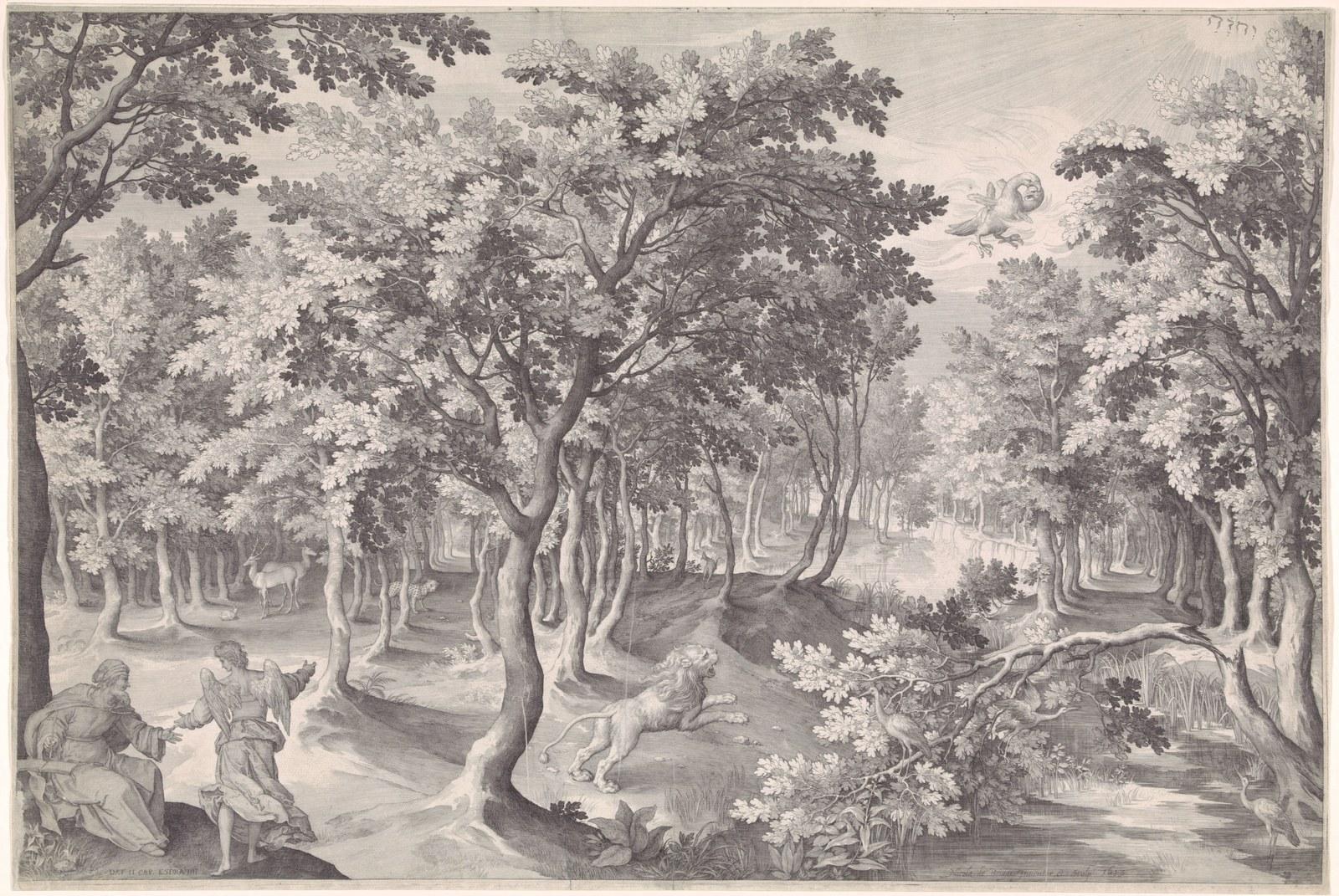
Nicolaes de Bruyn, The Fifth Vision of Ezra, 1613. CC0.
2 Esdras 1 to 16 · Book · Apocrypha, a study resource beside the canon
2 Esdras
A book of the Apocrypha in sixteen chapters, written in the name of Ezra after Rome destroyed Jerusalem.
In my vision in the night I continued to watch, and I saw One like the Son of Man coming with the clouds of heaven. He approached the Ancient of Days and was led into His presence.
- Date
- about AD 120, by Box's reckoning (probable)
- Occasion
- Grief after Rome destroyed Jerusalem in AD 70, told as Ezra's grief in Babylon after the first fall.
- Edition
- 2 Esdras in the King James Version Apocrypha, 1769 text (eBible.org); the Berean Standard Bible for the canon
Box, the book's editor of 1913, called 2 Esdras 12:11 "a particularly clear and interesting case of the way in which apocalyptic prediction was reinterpreted and reapplied."
Summary
2 Esdras is a Jewish book of visions about the fall of Jerusalem, with Christian chapters added later. The churches of the West print it outside their canons, and the Ethiopian Church holds its chapters 3 to 14 as canonical. The site reads it beside the Bible as a study resource and rests no doctrine on it.
- Its first verse traces Ezra's line through Saraias, Azarias and Helchias.
- No Hebrew or Greek copy of chapters 3 to 14 survives.
- The eagle of 2 Esdras 11 has twelve wings and three heads.
The Book of 2 Esdras
The book's long middle part opens on Ezra's grief, and its names differ from one Bible to the next.
2 Esdras opens its long middle part with Ezra in Babylon: "In the thirtieth year after the ruin of the city I was in Babylon, and lay troubled upon my bed" (2 Esdras 3:1). The angel Uriel answers him, and the dialogue runs on into visions.
English Bibles call the book 2 Esdras, the Vulgate's appendix calls it 4 Esdras, and the Slavonic Bible calls it 3 Esdras. Box's edition calls chapters 3 to 14 IV Ezra, and modern critical editions call chapters 1 and 2 5 Ezra and chapters 15 and 16 6 Ezra.
The site holds the sixty-six books of the Bible as Scripture.
The Seven Visions
Box divides chapters 3 to 14 into seven visions, from Ezra's questions to the books he dictates.
The seven visions move from three dialogues with the angel to four visions: a woman, an eagle, a man from the sea and the books.
- The first2 Esdras 3:1 to 5:19: the first dialogue with Uriel
- The second2 Esdras 5:20 to 6:34: the second dialogue
- The third2 Esdras 6:35 to 9:25: the third dialogue
- The fourth2 Esdras 9:26 to 10:59: the mourning woman
- The fifth2 Esdras 11:1 to 12:35: the eagle from the sea
- The sixth2 Esdras 13:1 to 58: the man from the sea
- The seventh2 Esdras 14: the books written again
A sequence of the seven visions in Box's divisions, each with its chapters in the King James numbering; Box begins the fifth at verse 60 of chapter 10 in his own numbering.
Where the Book Came From
Box dates the book after the fall of Jerusalem to Rome and traces it through its versions.
G. H. Box introduced 4 Ezra in R. H. Charles's Apocrypha and Pseudepigrapha of the Old Testament in 1913. He read the book's thirtieth year as primarily 556 BC, after Nebuchadnezzar's destruction of Jerusalem. He also read it as a pointer to "the thirtieth year after the destruction of Jerusalem by Titus in A.D. 70, i.e. A.D. 100". He dated the finished book to "about the year A. D. 120".
Box held that the book was written in Hebrew and put into Greek. He held that the versions, "with the possible exception of the Armenian", stand on "a lost Greek version". It survives in Latin, Syriac, Ethiopic, two Arabic versions and Armenian. Chapters 1 and 2 and 15 and 16 stand in the Latin alone. Box called them Christian chapters, written in Greek and added in the third century.
The Latin text then known lacked about seventy verses between 2 Esdras 7:35 and 36. In 1875 R. L. Bensly found the missing Latin text in a ninth-century manuscript at Amiens. The King James text was made before that find, and its chapter 7 ends at verse 70.
Who Receives the Book
Councils, churches and printed Bibles have each settled where the book stands.
Six witnesses, from the fathers to the Ethiopian Church, and what each does with the book.
| Who | What they do with the book | The source |
|---|---|---|
| Ambrose and other fathers | quote it often | The Catholic Encyclopedia, Esdras, 1909 |
| The Council of Trent, 1546 | names two books of Esdras, Ezra and Nehemiah, and leaves this one out | The decree of session 4 |
| The Church of England, Article VI, 1571 | names The Fourth Book of Esdras among the books read for example of life | The Articles of Religion |
| The Latin Vulgate | prints it in an appendix after the books of its canon | The Catholic Encyclopedia, Esdras, 1909 |
| The King James Version | prints it second among the Apocrypha, after 1 Esdras | The 1769 Oxford text at Wikisource |
| The Ethiopian Orthodox Church | holds chapters 3 to 14 as canonical and calls the book Izra Sutuel | Wikipedia, 2 Esdras |
The Catholic Encyclopedia records that 2 Esdras 2 "has furnished the verse Requiem æternam to the Office of the Dead". In the King James text the words stand at 2 Esdras 2:34 and 35: "he shall give you everlasting rest", and "the everlasting light shall shine upon you for evermore".
The book stands outside the Hebrew Bible, and Article VI, following Jerome, reads such books "for example of life" and not to establish any doctrine.
The Verse That Names Jesus
One verse of chapter 7 reads differently in the Latin and in the eastern versions.
The King James text follows the Latin at 2 Esdras 7:28: "For my son Jesus shall be revealed with those that be with him". The next verse reads, "After these years shall my son Christ die".
Box translated the verse "my Son the Messiah". His note sets the Latin "filius meus Jesus" beside the Ethiopic "my Messiah" and the Armenian "the Messiah of God".
The Voices
A father of the church set the book among the apocryphal writings.
Jerome (died 420)
Jerome put Ezra and Nehemiah into Latin as one book. In his preface he warned that "nor ought anyone take delight in the dreams found in the apocryphal third and fourth books".
Books to Read Next
Three works give the book, its versions and its readers in the church.
2 Esdras, King James Version Apocrypha
The King James translators · 1611
It gives the whole book in the King James English.
Read it free at eBible.orgThe Apocrypha and Pseudepigrapha of the Old Testament, vol. II
R. H. Charles, ed.; IV Ezra by G. H. Box · 1913
Box sets out the book's date, versions and visions, and translates it with the missing verses restored.
Read it free at archive.orgEsdras, in The Catholic Encyclopedia
The Catholic Encyclopedia · 1909
Its section on the fourth book gives the Vulgate's appendix, the fathers and the liturgy.
Read it free at New AdventThe Kingdom That Outlasts the Eagle
Daniel 7 gives the kingdom that outlasts every empire.
The angel tells Ezra that the eagle from the sea "is the kingdom which was seen in the vision" of Daniel (2 Esdras 12:11). Daniel's own vision ends on the kingdom given to the one like a son of man.
And He was given dominion, glory, and kingship, that the people of every nation and language should serve Him. His dominion is an everlasting dominion that will not pass away, and His kingdom is one that will never be destroyed.Sources
Scripture is the Berean Standard Bible.
- 2 Esdras, King James Version Apocrypha, 1769 text (eBible.org USFX edition), public domain.
- G. H. Box, IV Ezra, in R. H. Charles (ed.), The Apocrypha and Pseudepigrapha of the Old Testament, vol. II, Oxford, 1913; public domain.
- Jerome, Preface to Ezra, tr. Mark DelCogliano.
- The Catholic Encyclopedia, Esdras, 1909; public domain.
- The Council of Trent, session 4, 8 April 1546, tr. J. Waterworth, 1848.
- The Church of England, Articles of Religion, 1571, Article VI, in the Book of Common Prayer of 1863.
- Wikipedia, 2 Esdras.
- Wikisource, Bible (King James), the 1769 Oxford text.
Keep Studying
People and groups1
Symbols1
Doctrines1